
1. Background
Cardiovascular diseases (CVDs) are among the most common and leading causes of death worldwide. According to the World Health Organization (WHO), CVDs were responsible for 17.3 million deaths in 2008, equivalent to 30% of all global deaths, and this figure is expected to reach 23.6 million by 2030 (1). According to statistics from the Ministry of Health and Medical Education of Iran, CVDs account for 46% of all deaths and have a prevalence of 19.4% in the general population. Cardiovascular diseases not only lack definitive cures but also substantially affect patients’ psychological status, behaviors, and lifestyles (2). Psychological symptoms may exacerbate cardiovascular symptoms and increase the likelihood of heart attacks (2). Psychological variables associated with CVDs include depression (3-6), anxiety (6, 7), and anger (8).
Depression in patients with CVD can worsen cardiac function, increase physical limitations, and reduce treatment satisfaction and quality of life (9). Depression is characterized by sadness, diminished motivation and interest in life, negative thoughts, and physical symptoms (10). According to Taylor and Riso et al. (5, 11), depression may play a significant role in the onset and adverse prognosis of cardiovascular diseases. Compared with the general population, the prevalence of depression in patients with CVD is almost three times higher (12, 13). Clinically, major depression is experienced by 40% to 65% of patients after myocardial infarction (12). These patients may also experience anxiety due to uncertainty about therapeutic processes, lifestyle changes, hospitalization, and required lifestyle restrictions.
Anxiety is one of the most prevalent and important psychological reactions to cardiovascular diseases (14) because it can intensify physiological and psychological activity, including heart rate, respiratory rate, and blood pressure. Anxiety is an aversive feeling of uneasiness and pressure in various life situations and may inhibit or undermine engagement in therapeutic procedures, thereby worsening the consequences of cardiovascular disease (15). The prevalence of anxiety among patients with CVD has been reported to range from 20% to 55% (16, 17).
Studies have also shown that anger and resentment are important psychological precipitants in the pathogenesis of cardiovascular disease. Personality traits associated with high hostility and frequent episodes of anger are associated with an increased risk of cardiovascular disease and adverse outcomes after a cardiac event (18, 19). This association may involve chronic activation of the sympathetic nervous system, increased inflammation, and effects on health behaviors such as nonadherence to treatment (20). When individuals approach negative emotions with a compassionate attitude rather than suppressing them or expressing anger destructively, they may manage these emotions more adaptively. Self-compassion training has been associated with significant reductions in anger and hostility (21, 22).
Given the important role of psychological factors in the course and prognosis of cardiovascular diseases (23), effective psychological interventions that target multiple symptoms simultaneously are needed.
One therapeutic approach relevant to the variables in this study is mindfulness-based compassion (24). According to Kabat-Zinn, mindfulness involves remaining in the present moment with acceptance and awareness (25). Compassion shares several features with mindfulness, including empathy, acceptance, and nonjudgment (26). Mindfulness-based treatments have shown positive effects on mental health-related variables (27, 28), and compassion has been considered a skill for promoting health when combined with mindfulness (29). By fostering a compassion-based relationship rather than blame, condemnation, or self-criticism, compassion-focused therapy can help clients. Previous studies indicate that compassion training can improve mental health (30), self-control (31), and emotion regulation while reducing dysfunctional attitudes.
Compassion therapy is a relatively new approach that has been examined in a limited number of studies. Combining compassion with mindfulness may provide broader and more diverse techniques for improving mental health in counseling and clinical settings. Although the theoretical foundations of the two approaches differ, they share basic principles. The main focus of this therapy is to use the compassionate mind for self-assistance and to promote gentleness, safety, and relief through compassion toward oneself and others.
2. Objectives
This study aimed to determine the effectiveness of a mindful self-compassion intervention in reducing depression, anxiety, and anger in patients with CVDs.
3. Methods
3.1. Study Design and Setting
This clinical trial included a control group and an experimental group, with pretest, mid-test (at the end of the fourth session/fourth week), post-test, and 2-month follow-up assessments. The mid-test was included in the repeated-measures design to assess the trend in symptom reduction over time and to improve the precision of the time-by-group interaction effect, thereby distinguishing early treatment responses from post-treatment outcomes. The study population comprised patients diagnosed with cardiovascular diseases who sought professional care at Imam Ali Cardiovascular Hospital and Imam Reza Hospital in Kermanshah from October to December 2020.
The absence of psychotic and personality disorders was verified through a two-step process. First, the patients' documented medical and psychiatric histories at Imam Ali and Imam Reza hospitals were reviewed. Second, a baseline clinical screening interview was conducted by a master's-level clinical psychologist to determine suitability for the group-based intervention.
3.2. Participants and Sampling
Fourteen patients were allocated to each group according to the inclusion criteria using purposive sampling, consistent with the study by Neff and Germer (32). The inclusion criteria were: 1) a diagnosis of cardiovascular disease by a specialist; 2) a history of hospitalization due to the disease; 3) at least 5 years of school education; 4) no other medical conditions, such as asthma or kidney disease; 5) no psychotic disorders; 6) no personality disorders; and 7) written informed consent to participate in the program.
The exclusion criteria were: 1) relapse and rehospitalization during the study; 2) absence from more than 2 sessions; 3) unwillingness to continue participation; and 4) chronic medical conditions, such as asthma or kidney disease, which were excluded to control for confounding psychological distress.
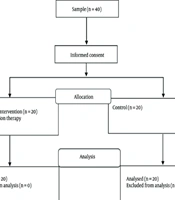
The planned sample size was 14 participants per group (28 participants in total), based on previous comparable pilot studies in cardiovascular settings that demonstrated the efficacy of mindfulness interventions in similarly small cohorts (33). This sample size was considered appropriate given the intensive nature of the 8-session mindful self-compassion program and the clinical constraints of recruiting cardiac patients during the specified period. Patients were randomly assigned to the experimental and control groups. Two participants in each group dropped out and were excluded; therefore, data from 24 participants were analyzed. In (Figure 1), the sampling process of the current research is presented.
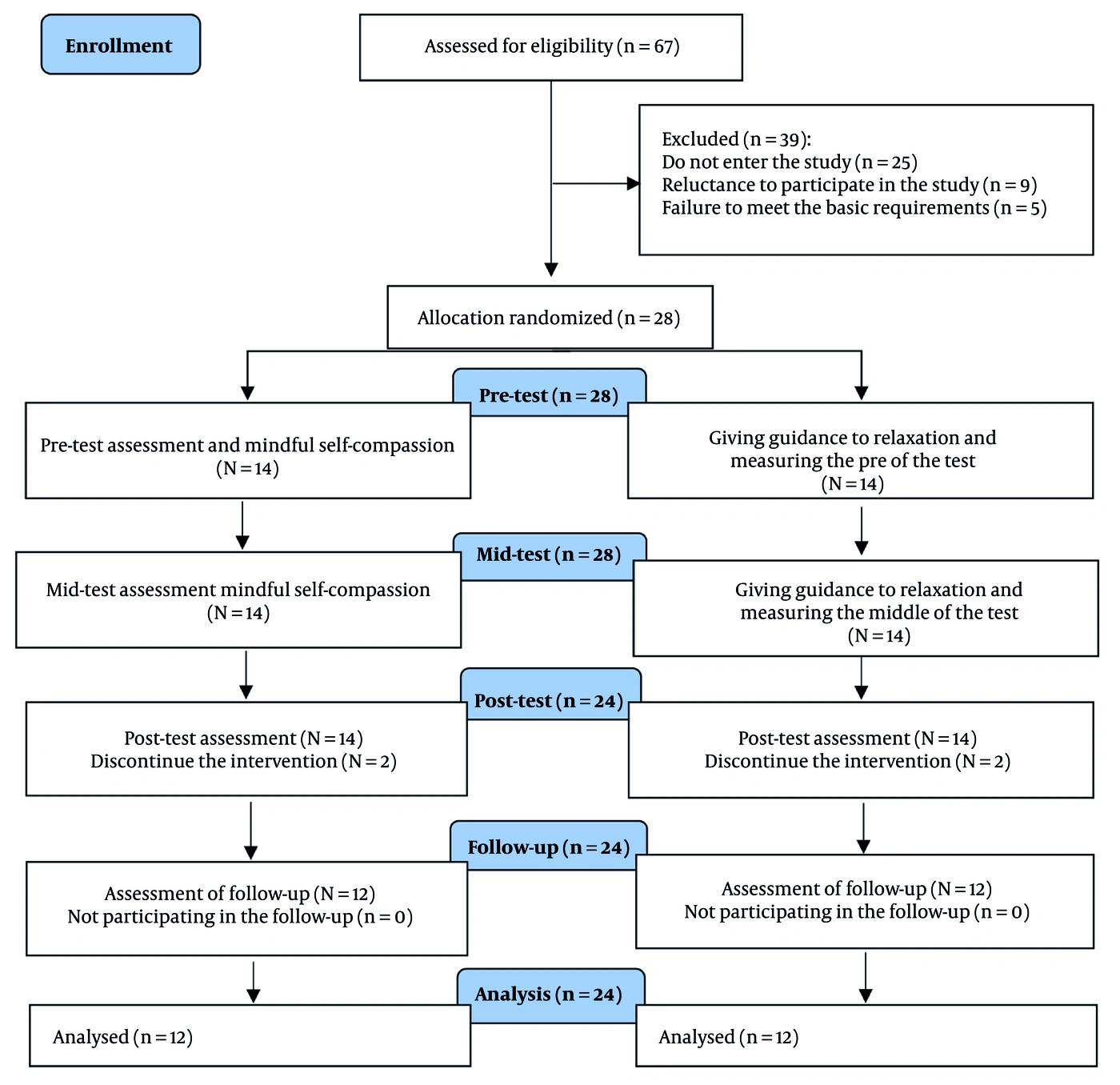
Figure 1.
The sampling process of the current research is presented.
3.3. Intervention
The mindful self-compassion sessions were conducted weekly for 90 minutes. Although the core theoretical framework of the original protocol was retained, clinical examples and discussions were culturally and medically adapted to address psychological challenges specific to patients with CVD, such as fear of recurrence and physical limitations. The control group received relaxation compact discs and handbooks. Participants completed the demographic information form and questionnaires assessing depression, anxiety, and anger at the assessment stages (Table 1).
Table 1.
Operational Summary of the Mindful Self-Compassion Intervention Sessions
| Sessions | Objectives | Specific techniques | Homework assignments |
|---|---|---|---|
| Session 1: Discovering mindful self-compassion | Defining self-compassion and its role in health | "How do I treat a friend?" exercise; introduction to the physiology of self-criticism | Practice the self-compassion break once daily |
| Session 2: Practicing mindfulness | Reducing resistance to physical and emotional pain | Affectionate breathing and body scan adapted for cardiac comfort | Practice affectionate breathing for 15 minutes daily |
| Session 3: Practicing loving-kindness | Using language to cultivate internal warmth | Developing personal compassionate phrases focused on recovery | Repeat phrases during stressful medical checkups |
| Session 4: Finding a compassionate voice | Shifting from self-criticism to self-encouragement | Writing a compassionate letter to oneself about the challenges of living with CVD | Identify the inner critic during dietary or lifestyle lapses |
| Session 5: Living deeply | Aligning values with daily life despite illness | Identifying core values and practicing compassionate listening | Perform one value-based action for heart health with kindness |
| Session 6: Meeting difficult emotions | Handling anxiety and anger using the Soften-Soothe-Allow technique | Labeling emotions and softening physical heart-related tension | Practice Soften-Soothe-Allow when feeling anger or anxiety |
| Session 7: Challenging relationships | Managing interpersonal stress and caregiver dynamics | Giving and receiving compassion exercise (breathing in for self and out for others) | Practice compassion for others during difficult social interactions |
| Session 8: Embracing your life | Cultivating gratitude and resilience | Appreciating the body, exercise, and gratitude journaling | Maintain a daily self-appreciation and gratitude journal |
3.4. Measures
3.4.1. Demographic Information Form
The researcher-developed demographic information form collected data on gender, marital status, education, age, type and duration of disease, professional help-seeking from a psychiatrist or psychologist, cigarette smoking, and history of other substance use.
3.4.2. Patient Health Questionnaire-9
The Patient Health Questionnaire-9 (PHQ-9), developed by Kroenke et al. (34), is a 9-item measure based on DSM criteria. Its sensitivity and specificity have both been reported as 0.88 at a cutoff point of ≥ 10. Items are scored on a 4-point Likert scale ranging from 0 (not at all) to 3 (nearly every day). Depression severity is scored from 0 to 27 and is classified into the following ranges: 0 - 4, 5 - 9, 10 - 14, 15 - 19, and 20 - 27 (34). Ahmadi et al. reported a cutoff point of ≥ 8, with sensitivity and specificity of 0.80 and 0.81, respectively (35). Dadfar et al. reported a Cronbach α of 0.88 and a 1-week test-retest reliability of 0.79 for the PHQ-9 in Iranian psychiatric outpatients (36).
3.4.3. Beck Anxiety Inventory
The Beck Anxiety Inventory (BAI), developed by Beck et al. (37), assesses anxiety symptoms using 21 items. Each item is scored on a 4-point Likert scale from 0 to 3, with higher scores indicating greater anxiety. Beck et al. reported a Cronbach α of 0.92 and a 1-week test-retest reliability of 0.75. Item correlations ranged from 0.30 to 0.76 (37).
3.4.4. Siegel's Multidimensional Anger Inventory
Siegel's Multidimensional Anger Inventory (MAI) is a 30-item questionnaire developed by Siegel in 1986 to measure anger. It assesses anger arousal, anger-eliciting situations, hostile outlook, anger-in, and anger-out. The psychometric properties of the questionnaire have been confirmed in a foreign sample (38). For the Persian sample, Cronbach α values for the subscales and total score ranged from 0.75 to 0.91 in student samples (180 boys and 202 girls) and the general population (218 men and 198 women). Test-retest correlations among 76 participants from the student sample and 83 from the general-population sample, assessed twice at intervals of 2 to 4 weeks, were r = 0.67 and 0.65 for anger arousal, r = 0.77 and 0.81 for anger-eliciting situations, r = 0.69 and 0.70 for hostile outlook, r = 0.79 and 0.83 for anger-out, r = 0.78 and 0.74 for anger-in, and r = 0.74 and 0.75 for total anger score. These values indicate satisfactory test-retest reliability. The convergent and divergent validity of the MAI has also been confirmed.
3.5. Statistical Analysis
SPSS version 25 was used for data analysis. Means, standard deviations, frequencies, and percentages were used for descriptive analyses. Chi-square and Fisher exact tests were used to assess homogeneity between the groups for demographic variables. Independent t tests were used to compare the groups on study variables at each assessment stage. After the required assumptions were examined, repeated-measures analysis of variance was used to test the study hypotheses.
3.6. Ethical Considerations
All procedures were conducted in accordance with the ethical standards of the responsible institutional and national committees on human experimentation and with the Declaration of Helsinki of 1975, as revised in 2000.
4. Results
4.1. Participant Characteristics
The study included 24 patients with CVD, divided into 2 groups of 12 participants each. The mean ages of participants in the experimental and control groups were 51 ± 7.93 and 55.75 ± 6.65 years, respectively. Table 2 presents the demographic characteristics of the experimental and control groups.
Table 2.
Demographic Characteristics of the Experimental and Control Groups (N = 24)
| Variables | Experimental Group | Control Group | Statistic | P-Value | ||
|---|---|---|---|---|---|---|
| Frequency | Percentage | Frequency | Percentage | |||
| Gender | 0.168 | 0.682 a | ||||
| Male | 7 | 58.3 | 6 | 50 | ||
| Female | 5 | 41.7 | 6 | 50 | ||
| Marital status | 0.599 | 0.998 b | ||||
| Single | 2 | 16.7 | 1 | 8.3 | ||
| Married | 8 | 66.7 | 9 | 75 | ||
| Separated | 2 | 16.7 | 2 | 16.7 | ||
| Education | 1.699 | 0.828 b | ||||
| Secondary school diploma | 4 | 33.3 | 6 | 50 | ||
| High school/college diploma | 6 | 50 | 5 | 41.7 | ||
| BA | 1 | 8.3 | 1 | 8.3 | ||
| MA | 1 | 8.3 | 0 | 0 | ||
| Duration of illness (y) | 1.178 | 0.883 b | ||||
| < 1 | 1 | 8.3 | 2 | 16.7 | ||
| 1 - 5 | 4 | 33.3 | 5 | 41.7 | ||
| 6 - 10 | 5 | 41.7 | 3 | 25 | ||
| > 10 | 2 | 16.7 | 2 | 16.7 | ||
| Seeking professional help (psychologist/psychiatrist) | 0.253 | 0.615 a | ||||
| Yes | 3 | 25 | 2 | 16.7 | ||
| No | 9 | 75 | 10 | 83.3 | ||
| Cigarette smoking | 0.178 | 0.673 a | ||||
| Yes | 5 | 41.7 | 4 | 33.3 | ||
| No | 7 | 58.3 | 8 | 66.7 | ||
| History of substance use | 0.253 | 0.615 a | ||||
| Yes | 2 | 16.7 | 3 | 25 | ||
| No | 10 | 83.3 | 9 | 75 | ||
a P values are statistically significant (P < 0.05).
b P values are statistically significant (P < 0.01).
There were no significant differences between the control and experimental groups in demographic variables (P > 0.05). Table 3 presents the means, standard deviations, and independent t-test results for the study variables across assessment stages.
Table 3.
Study Variables by Assessment Stage in the Experimental and Control Groups (N = 24)
| Variables and Stages | Experimental | Control | t | P-Value | 95% CI lower | 95% CI upper | ||
|---|---|---|---|---|---|---|---|---|
| Mean | SD | Mean | SD | |||||
| Depression | ||||||||
| Pretest | 13.92 | 3.75 | 11.50 | 5.60 | 1.24 | 0.227 | -1.62 | 6.45 |
| Mid-test | 6.42 | 2.47 | 9.25 | 4.63 | -1.87 | 0.075 | -5.98 | 0.31 |
| Post-test | 2.50 | 1 | 7.92 | 2.07 | -8.18 | < 0.01 a | -6.79 | -4.04 |
| Follow-up | 2.08 | 0.99 | 9.17 | 1.80 | -11.92 | < 0.01 a | -8.31 | -5.85 |
| Anxiety | ||||||||
| Pretest | 50.67 | 9.53 | 46.50 | 12.66 | 0.91 | 0.372 | -5.32 | 13.69 |
| Mid-test | 34.42 | 5.58 | 44.42 | 8.59 | -3.38 | 0.01 a | -16.13 | -3.81 |
| Post-test | 29.50 | 2.07 | 43.42 | 3.29 | -12.56 | < 0.01 a | -16.41 | -11.73 |
| Follow-up | 28.33 | 2.31 | 50.25 | 3.55 | -18.11 | < 0.01 a | -24.70 | -19.63 |
| Anger | ||||||||
| Pretest | 33.108 | 11.11 | 08.109 | 54.12 | 0.72 | 0.478 | -4.68 | 9.68 |
| Mid-test | 67.90 | 74.14 | 58.103 | 55.9 | -2.68 | < 0.01 a | -14.05 | -1.78 |
| Post-test | 42.81 | 69.6 | 92.99 | 83.6 | -4.43 | < 0.01 a | -19.70 | -7.13 |
| Follow-up | 33.80 | 88.7 | 83.98 | 99.6 | -9.74 | < 0.01 a | -20.32 | -13.18 |
a P values are statistically significant (P < 0.001).
The groups did not differ significantly in depression, anxiety, or anger at pretest (P > 0.05). Because repeated-measures analysis of variance was used to test the study hypotheses, the required assumptions were examined. Table 4 presents the results of Mauchly's test of sphericity.
Table 4.
Mauchly's Test of Sphericity for the Study Variables (N = 24)
| Variables | Within-Group Effect | Mauchly | X2 | df | P-Value | Greenhouse-Geisser | Huynh-Feldt | Lower bound |
|---|---|---|---|---|---|---|---|---|
| Depression | Time | 0.315 | 23.911 | 5 | 0.001 | 0.612 | 0.696 | 0.333 |
| Anxiety | Time | 0.258 | 28.043 | 5 | 0.001 | 0.559 | 0.628 | 0.333 |
| Anger | Time | 0.533 | 12.020 | 5 | 0.023 | 0.754 | 0.883 | 0.333 |
Mauchly's sphericity assumption was not met for depression, anxiety, or anger because the P values were < 0.05. Greenhouse-Geisser, Huynh-Feldt, and lower-bound corrections were considered; the Greenhouse-Geisser results are reported here. Table 5 presents the within-group effects for the study variables.
Table 5.
Within-Group Effects for the Study Variables (N = 24)
| Variables and Sources | Test | SS | df | MS | F | P-Value | η2 | Power |
|---|---|---|---|---|---|---|---|---|
| Depression | ||||||||
| Time | Greenhouse-Geisser | 852.781 | 1.837 | 464.191 | 41.977 | < 0.001 | 0.656 | 1 |
| Time × Group | Greenhouse-Geisser | 310.031 | 1.837 | 168.758 | 15.261 | < 0.001 | 0.411 | 0.998 |
| Anxiety | ||||||||
| Time | Greenhouse-Geisser | 1977.53 | 1.677 | 1178.91 | 16.36 | < 0.001 | 0.43 | 0.998 |
| Time × Group | Greenhouse-Geisser | 2185.86 | 1.677 | 1303.11 | 18.08 | < 0.001 | 0.45 | 0.999 |
| Anger | ||||||||
| Time | Greenhouse-Geisser | 5551.208 | 2.263 | 2453.440 | 22.520 | < 0.001 | 0.506 | 1 |
| Time × Group | Greenhouse-Geisser | 1260.750 | 2.263 | 557.207 | 5.115 | < 0.007 | 0.189 | 0.833 |
As shown in Table 5, the effect of time was significant for depression, anxiety, and anger, indicating that symptom intensity changed significantly over time (P < 0.001). The time-by-group interaction was also significant for depression, anxiety, and anger, indicating that the mindful self-compassion program had a significant effect over time (P < 0.001). Table 6 presents the between-group effects.
Table 6.
Between-Group Effects for the Study Variables (N = 24)
| Variables | Source | SS | df | MS | F | P-Value | η2 | Power |
|---|---|---|---|---|---|---|---|---|
| Depression | Group | 250.26 | 1 | 250.26 | 11.95 | 0.002 | 0.352 | 0.912 |
| Anxiety | Group | 2656.51 | 1 | 2656.51 | 36.09 | < 0.001 | 0.621 | 1 |
| Anger | Group | 3850.667 | 1 | 3850.667 | 23.728 | < 0.001 | 0.519 | 0.996 |
As shown in Table 6, the experimental and control groups differed significantly in depression, anxiety, and anger (P < 0.005). According to Table 3, the mean depression, anxiety, and anger scores in the experimental group decreased significantly over time. Therefore, the mindful self-compassion intervention significantly reduced depression, anxiety, and anger in participants.
5. Discussion
The present study evaluated the effectiveness of a mindful self-compassion program for psychological symptoms in patients with cardiovascular diseases. The program significantly reduced depressive symptoms in patients with CVD. These findings are consistent with those of Scott-Sheldon et al. (39), Zeidan et al. (40), Neff and Germer (32), and Delui et al. (41). Mindfulness training may increase awareness of thoughts and feelings and foster a nonjudgmental approach, helping patients distance themselves from distressing thoughts and develop a more compassionate attitude toward themselves and others (42). Self-kindness and a sense of connectedness may also support mindfulness. When individuals reduce self-judgment and self-blame and develop self-acceptance, the negative impact of emotional experiences may diminish, facilitating a more balanced awareness of thoughts and emotions (17).
The mindful self-compassion program also significantly reduced anxiety in patients with CVD. These findings are consistent with studies by Compare et al. (43), Roemer and Orsillo (44), and Scott-Sheldon et al. (39). According to Kabat-Zinn's theory, mindfulness can facilitate engagement with all aspects of life, including painful experiences, allowing individuals to respond with awareness rather than automatic anxiety-based responses (45). Mindfulness involves behavioral, cognitive, and metacognitive strategies for directing attention, which may reduce worry, broaden perspective, and facilitate more adaptive thoughts and emotions. Compassion can also reduce negative feelings toward the self. Through acceptance, individuals can acknowledge their limitations rather than hide or ignore them. Self-compassion may help reduce maladaptive thinking and encourage new ways of addressing problems (29). Mindful self-compassion treatment helps clients develop kindness, acceptance, and care toward difficult subjective experiences. Lower levels of self-compassion are associated with greater psychological symptom severity (46).
Mindful self-compassion also significantly reduced anger in patients with CVD. Few studies have evaluated the effect of mindful self-compassion on anger specifically in cardiovascular populations; therefore, studies of related populations were used to interpret the present findings. The results are consistent with findings reported by Gilbert and Procter (47), Perestelo-Perez et al. (48), Singh et al. (49), Amutio et al. (50), and Neff (46). Anger is a negative emotional state characterized by physiological arousal, blame-related thoughts, and a tendency toward aggression. It is an important risk factor in patients with cardiovascular disease because it may exacerbate disease through physiological mechanisms, such as increased blood pressure and heart rate, and behavioral mechanisms, such as nonadherence to treatment (51). According to the frustration-aggression hypothesis, encountering an obstacle such as a diagnosis of chronic illness can trigger anger (52). Thus, anger in response to illness may be understandable in these patients, although persistent anger can lead to additional psychological and physical complications.
According to Neff's theory (53), self-compassion promotes a kind and nonjudgmental attitude toward oneself and an understanding that suffering and failure are inevitable parts of the shared human experience. Self-compassion is also associated with coping strategies and emotion regulation. Emotion-focused coping strategies that involve awareness, understanding, and perception of emotions are associated with positive psychological adaptation. Rather than simply replacing negative feelings with positive ones, self-compassion may generate positive emotions that help balance negative emotions (54). Individuals with higher levels of self-compassion may also be able to face the distress of others without becoming distressed themselves (32).
Mindful self-compassion has been described as increasing oxytocin, which is associated with the parasympathetic nervous system. Safety is not merely the absence of threat or reduced activity; it may reflect a specific soothing system that produces feelings of well-being and satisfaction. Accordingly, mindful self-compassion educational and therapeutic programs may play an important role in parasympathetic nervous system activity. To further explain this proposed physiological mechanism, practicing self-kindness may activate an affiliative system that is evolutionarily linked to caregiving and care-receiving behaviors. Engaging in mindful self-compassion may encourage a transition from a threat-focused state to a soothing state characterized by activation of the parasympathetic nervous system, specifically the ventral vagal complex. This physiological shift is associated with the release of oxytocin, a neuropeptide involved in emotional regulation and social bonding. In patients with cardiovascular diseases, this activation may serve as a biological buffer against the cardiotoxic effects of chronic stress and anger, thereby reducing cardiovascular stability (55).
5.1. Study Limitations
An important limitation of this study was the absence of clinical cutoff scores for depression, anxiety, and anger in the inclusion criteria. Consequently, some participants may have entered the study with subclinical or low levels of psychological symptoms, potentially attenuating the observed intervention effects by reducing statistical power and increasing the likelihood of a ceiling effect. This limitation also restricts the generalizability of the findings to cardiovascular patients with clinically significant psychological distress. The use of lengthy self-report questionnaires may have introduced response bias and participant fatigue. Data collection during the COVID-19 pandemic and associated hygiene restrictions may also have influenced participants' psychological states and engagement with the intervention. In addition, impatience and low tolerance for lengthy procedures among patients with cardiovascular disease, potentially associated with type A personality characteristics, may have affected adherence and responsiveness. Despite these limitations, the findings suggest that implementing mindful self-compassion programs in cardiovascular health settings may be beneficial for reducing depression, anxiety, and rumination while enhancing self-compassion. Future studies should apply baseline symptom thresholds, such as established PHQ-9 or BAI cutoff scores, assess personality pathology in this population, and compare mindful self-compassion with other evidence-based psychotherapeutic interventions.
5.2. Conclusions
The results indicate that mindful self-compassion can significantly reduce depression, anxiety, and anger in patients with cardiovascular diseases. Cardiovascular health centers may consider implementing this program to reduce these psychological symptoms in this patient population.