
1. Background
Internet addiction (IA), also described as problematic internet use or IA disorder, is a behavioral addiction characterized by excessive or inadequately controlled thoughts, urges, or behaviors related to internet use that result in marked distress or impairment in daily functioning (1-4). IA is commonly associated with diminished control over internet use and may lead to substantial psychological, social, and academic difficulties (5). The increasing global prevalence of IA underscores the importance of its identification and management, particularly among adolescents, who are at a sensitive developmental stage during which underdeveloped emotion regulation abilities may increase the risk of persistent psychological consequences (6). Evidence further emphasizes the need to better understand IA because of its association with co-occurring mental health problems, including depression and anxiety, which may reduce quality of life and interfere with personal development (7, 8).
Recent epidemiological data indicate that the global prevalence of IA among adolescents and youth varies widely, ranging from 7.9% to 40.3%, with higher rates observed in regions with extensive digital access (9). In Asian countries, the prevalence of IA is notably elevated at 7.1% overall, representing the highest rate globally according to a meta-analysis across 31 nations (10). Among adolescents and youth in Asia, estimates range from 8% to 26%, with variation influenced by factors such as socioeconomic status, parental monitoring, and psychological traits, including anxiety and depression (10).
In Iran, post-COVID-19 estimates indicate a prevalence of problematic internet use of 31% (17% to 45%) among adolescents, reflecting a sharp increase attributed to greater online reliance during quarantines (11). Consistent with this, a cross-sectional study of Iranian high school students reported that 25% were at risk of IA, while a meta-analysis among Iranian university students (predominantly young adults) found a pooled prevalence of 31.51% (3, 12). IA profoundly affects adolescents’ academic performance, quality of life, interpersonal relationships, and mental health, including increased risks of depression and anxiety (13-15).
Excessive internet engagement is associated with reduced academic efficiency, increased school burnout, and lower academic achievement, as it diverts attention from academic tasks and impairs cognitive self-control (6, 8). Quality of life is also significantly diminished, with symptoms such as sleep loss and social withdrawal contributing to poorer overall well-being; for example, among college students with a 27.9% prevalence of IA, those affected scored lower on quality of life measures (6). Moreover, IA shows moderate positive correlations with depression, anxiety, stress, and suicidal behavior, and negative associations with self-esteem and psychological well-being; among Egyptian students, strong correlations were found between IA and these mental health problems, potentially exacerbating academic and relational difficulties (7, 8). Among Iranian adolescents, similar patterns link IA to adverse lifestyle factors and mental health declines (3).
Emotion regulation refers to the mechanisms through which individuals shape the emotions they experience, the timing of these emotions, and the ways in which they perceive and express them, encompassing both adaptive and maladaptive cognitive strategies (16). Adaptive strategies, including cognitive reappraisal and acceptance, involve interpreting emotional experiences more positively or acknowledging emotions without judgment, thereby supporting psychological flexibility and resilience. By contrast, maladaptive strategies, such as rumination and suppression, are characterized by persistent negative thinking or the inhibition of emotional expression, which may intensify distress and disrupt functioning (17, 18). In the context of IA, maladaptive emotion regulation strategies have been positively associated with increased IA tendencies, as individuals may turn to excessive online activities to escape or numb unresolved emotional distress, whereas adaptive strategies are linked to lower IA risk by promoting healthier coping mechanisms (19). For example, among adolescents, greater reliance on maladaptive strategies correlates with higher IA severity, highlighting how ineffective emotion management can drive compensatory internet use as a form of avoidance.
Traumatic childhood experiences (TCEs), such as maltreatment or adverse events, disrupt the development of effective emotion regulation, often leading to a predominance of maladaptive strategies that mediate pathways to behavioral addictions such as IA (20). According to theoretical frameworks such as the Interaction of Person-Affect-Cognition-Execution (I-PACE) model, early traumatic experiences are linked to increased emotional dysregulation. This dysregulation may, in turn, contribute to greater dependence on internet use as a coping strategy to reduce distress. Maladaptive strategies, such as rumination, may strengthen this association, whereas adaptive strategies, such as acceptance, may attenuate it (21). Empirical evidence supports this mediated relationship; for example, childhood maltreatment is statistically associated with IA through serial indirect pathways of maladaptive cognitive emotion regulation and depression, with indirect effects accounting for significant variance in IA outcomes among adolescents (22, 23).
Although studies have consistently shown that early trauma disrupts emotion regulation development, leading to increased reliance on maladaptive cognitive emotion regulation strategies (CERSs) that heighten vulnerability to IA, fewer investigations have examined adaptive strategies (e.g., reappraisal, acceptance, positive refocusing) as protective mediators, and findings often indicate limited or inconsistent protective effects (24). For example, some research reports no significant association between certain facets of emotion dysregulation (e.g., lack of emotional clarity) and IA in non-clinical adolescent samples, suggesting that contextual moderators such as gender or socioeconomic factors may influence these pathways (25, 26). Contradictory findings have also been reported regarding gender differences: although maladaptive emotion regulation often predicts higher IA severity in males, findings in females are mixed, with some studies reporting weaker associations, greater reliance on suppression, or potential buffering by social factors, underscoring the need for gender-specific models (27, 28).
Moreover, longitudinal data are scarce, limiting causal inference, and Iran-specific research remains limited, often focusing on prevalence rather than mechanistic pathways involving trauma and emotion regulation, despite elevated post-pandemic IA rates among Iranian youth (3, 11).
To address these limitations, the present study examined whether adaptive and maladaptive cognitive emotion regulation strategies were statistically associated with the link between traumatic childhood experiences and IA tendency among female high school students in Iran, a group that remains underrepresented in mechanism-focused research (3, 12, 29). Drawing on the I-PACE framework, this study tested parallel mediation models to clarify inconsistent findings in the literature and generate evidence to inform the development of more precisely targeted interventions (21). It was proposed that early TCEs would be positively associated with both maladaptive CERSs and IA tendencies, but negatively associated with adaptive CERSs. It was further hypothesized that maladaptive cognitive emotion regulation strategies would be associated with higher IA tendency, whereas adaptive strategies would be associated with lower IA tendency.
2. Objectives
This study investigated the associations among TCEs, adaptive and maladaptive CERSs, and IA tendencies in Iranian female adolescents using a cross-sectional SEM approach.
3. Methods
3.1. Study Design and Setting
This study employed a cross-sectional correlational design to examine associations among childhood traumatic experiences, adaptive and maladaptive cognitive emotion regulation strategies, and the tendency toward IA in female adolescents. To test the theory-informed structural pathways, partial least squares structural equation modeling (PLS-SEM) was used to estimate direct and statistical indirect associations among the study constructs. Given the cross-sectional nature of the data, all findings are interpreted as non-causal statistical associations.
3.2. Participants and Sampling
Participants were female high school students in Qom, Iran, and data were collected between April and September 2025. In accordance with the STROBE guidelines for reporting observational studies, a multistage cluster sampling procedure was implemented. Initially, two educational districts (Districts 3 and 4) were selected. Subsequently, several public high schools within these districts were approached, and eligible students in grades 10 through 12 were invited to participate. A total of 400 students were approached. Of these, 372 provided written informed consent and returned completed questionnaires. Following eligibility screening and data-quality checks, 22 cases were excluded (due to more than 10% missing data or a self-reported history of severe psychiatric hospitalization in the past year). The final analytic sample therefore comprised 350 students.
The mean age of the participants was 15.4 years (SD = 1.01). Regarding grade level, 118 students (33.7%) were enrolled in the 10th grade, 121 students (34.6%) in the 11th grade, and 111 students (31.7%) in the 12th grade.
Students were eligible for inclusion if they met the following criteria: (a) female students currently enrolled in grades 10 - 12 at a public high school within educational districts 3 and 4 of Qom; (b) being within the typical age range for secondary education (approximately 14 - 18 years); (c) having sufficient proficiency in Persian to comprehend and complete the study measures; and (d) provision of written informed consent. Exclusion criteria were predefined as follows: (a) inability to provide written informed consent; (b) a self-reported history of severe psychiatric disorders requiring hospitalization within the preceding year; and (c) technical exclusion due to incomplete questionnaires (defined as missing more than 10% of responses) or patterns of unreliable responding.
To ensure adequate statistical power for structural equation modeling, the target sample size was set at 350 participants. This sample size aligns with established recommendations for PLS-SEM (30), which suggest a minimum of approximately 200 observations or a ratio of 10 - 20 cases per estimated parameter to achieve stable and reliable model estimates. Accordingly, the final analytic sample (N = 350) was considered sufficient to provide adequate power to detect theory-informed statistical indirect associations using bootstrapping procedures, while accommodating the potential non-normality often observed in adolescent behavioral data.
3.3. Data Collection and Instruments
Data were collected using validated Persian versions of three self-report questionnaires assessing early traumatic experiences, CERSs, and IA tendencies. All scales were administered in a paper-and-pencil format.
3.3.1. Childhood Trauma Questionnaire
Early traumatic experiences were measured using the Persian adaptation of the Childhood Trauma Questionnaire (CTQ) (31). This 28-item instrument assesses five forms of childhood maltreatment, including emotional abuse, physical abuse, sexual abuse, emotional neglect, and physical neglect. Responses are scored on a 5-point Likert scale ranging from 1 (never true) to 5 (very often true), with higher overall scores indicating greater exposure to traumatic experiences. In Iranian populations, the Persian version has shown satisfactory reliability, with Cronbach’s α values between 0.60 and 0.86 for its subscales, along with supporting evidence for convergent validity (32). In the present study, Cronbach’s α for the total scale was 0.93.
3.3.2. Cognitive Emotion Regulation Questionnaire
Cognitive emotion regulation strategies were assessed using the Persian version of the Cognitive Emotion Regulation Questionnaire (CERQ) (33). This 36-item self-report instrument evaluates nine cognitive coping strategies used in response to negative or stressful life events. It comprises five adaptive strategies (acceptance, positive refocusing, refocus on planning, positive reappraisal, and putting into perspective) and four maladaptive strategies (self-blame, rumination, catastrophizing, and other-blame). Items are scored on a 5-point Likert scale ranging from 1 ((almost) never) to 5 ((almost) always). Each subscale yields a score between 4 and 20, with higher scores indicating more frequent use of the corresponding strategy. The full 36-item Persian version demonstrated satisfactory psychometric properties, including Cronbach’s α coefficients ranging from 0.76 to 0.92 across subscales, acceptable test-retest reliability, and adequate construct and criterion validity. In the current study, reliability was excellent, with Cronbach’s α values of 0.89 for adaptive strategies and 0.91 for maladaptive strategies, consistent with prior Iranian studies reporting overall reliability values above 0.85 (34).
3.3.3. Internet Addiction Test
In this study, the term internet addiction (IA) is used as the primary term to refer to problematic and excessive internet use measured by Young’s Internet Addiction Test. Internet addiction tendencies were assessed using the Persian version of Young's IAT (35), a 20-item scale evaluating problematic internet use (e.g., loss of control, preoccupation, withdrawal, negative impacts). Each item is scored on a 5-point Likert-type scale ranging from 0 (not applicable) to 5 (always), producing a total score between 0 and 100. Higher total scores reflect greater symptom severity. Score interpretation follows established cutoffs: 0 - 30 indicates normal use, 31 - 49 mild symptoms, 50 - 79 moderate symptoms, and 80 - 100 severe symptoms. The Persian version has demonstrated strong internal consistency (Cronbach’s α = 0.917) and acceptable construct validity among Iranian student samples (36). In the present study, the Cronbach’s α coefficient was 0.92.
3.4. Statistical Analysis
Data were analyzed in two stages using SPSS version 24 and SmartPLS version 3.3.7. In the first stage, descriptive statistics (means, standard deviations, and frequencies) were computed in SPSS. Preliminary screening procedures were conducted to evaluate distributional characteristics and potential multicollinearity. Bivariate associations among the study variables were examined using Pearson correlation coefficients. Cases with more than 10% missing responses were excluded during data screening; therefore, no missing data remained in the final analytic sample. In the second stage, the hypothesized model was tested using PLS-SEM in SmartPLS. In accordance with the recommended two-step approach, the measurement model was evaluated before the assessment of the structural model. Indicator loadings, Cronbach’s alpha, and composite reliability (CR) were examined to assess internal consistency reliability. Convergent validity was evaluated using the average variance extracted (AVE), with values greater than 0.50 indicating adequate convergence. Discriminant validity was assessed using the heterotrait–monotrait ratio (HTMT), with values below 0.85 indicating satisfactory discriminant validity. The structural model was subsequently evaluated by estimating standardized path coefficients (β) and their statistical significance using a bootstrapping procedure with 5,000 resamples. The explanatory power of endogenous constructs was assessed using the coefficient of determination (R2), and effect sizes were examined using f2. Predictive relevance was evaluated using the blindfolding procedure (Q2). Multicollinearity among predictor constructs was assessed using variance inflation factors (VIF), with values below 5 indicating the absence of problematic multicollinearity. Overall model fit was examined using the standardized root mean square residual (SRMR). The hypothesized indirect associations between TCEs and the tendency toward IA through adaptive and maladaptive cognitive emotion regulation strategies were tested using bootstrapped bias-corrected and accelerated (BCa) confidence intervals. The significance of both direct and indirect effects was assessed using the nonparametric bootstrapping procedure implemented in SmartPLS (v.3.3.7). A total of 5,000 bootstrap resamples were generated using BCa 95% confidence intervals with two-tailed significance testing (α = .05). Statistical significance was determined when the bootstrap confidence interval did not include zero.
Given the cross-sectional nature of the data, the temporal ordering specified in the mediation model was theoretically informed rather than empirically established. Consistent with the theoretical and empirical literature, childhood trauma was conceptualized as a distal antecedent, cognitive emotion regulation strategies as proximal psychological processes, and IA tendencies as the outcome variable. Given the cross-sectional design, the structural paths represent theory-guided statistical associations rather than causal mechanisms.
3.5. Ethical Considerations
The study protocol was approved by the Research Ethics Committees of Islamic Azad University, Central Tehran Branch (Ethics Code: IR.IAU.CTB.REC.1404.092). After obtaining permission from the Education Department and the principals of the selected schools, eligible students were informed about the objectives and procedures of the study. Written informed consent was obtained from all participants. Questionnaires were administered collectively in classroom settings to minimize disruption to regular school activities. Participants were assured that their responses would remain anonymous and confidential and would be used solely for research purposes. Participation was voluntary, no financial or non-financial incentives were provided, and participants could withdraw from the study at any time without penalty.
4. Results
A total of 400 students were approached to participate. Of these, 372 provided written informed consent and completed the study questionnaires (response rate = 93%). After eligibility screening and data-quality assessment, 22 questionnaires were excluded because of incomplete responses (greater than 10% missing data) or a self-reported history of severe psychiatric hospitalization within the preceding year. The final analytic sample therefore comprised 350 students.
The study sample consisted of 350 female high school students in the 10th, 11th, and 12th grades. Among them, 118 students (33.7%) were enrolled in the 10th grade, 121 students (34.6%) in the 11th grade, and 111 students (31.7%) in the 12th grade. The mean age of the participants was 15.4 years (SD = 1.01), indicating limited age variation within the adolescent sample.
As reported in Table 1, one-way analysis of variance (ANOVA) indicated that grade level was not associated with significant differences in TCEs (F (2, 347) = 1.72, P > 0.05), maladaptive CERQ (F (2, 347) = 1.14, P > 0.05), adaptive CERQ (F (2, 347) = 2.43, P > 0.05), or IA tendency (F (2, 347) = 1.56, P > 0.05). These results suggest that the main study variables were similarly distributed across educational grade levels (Figure 1).
Table 1.
Demographic Characteristics and Comparison of Study Variables a
| Variables and Grades | Total | CTQ-SF | P-Value | M. CERQ | P-Value | A. CERQ | P-Value | IAT | P-Value |
|---|---|---|---|---|---|---|---|---|---|
| Grade Level | 0.18 | 0.32 | 0.09 | 0.21 | |||||
| 10th | 118 (33.7) | 61.2 ± 21.4 | 50.1 ± 14.6 | 71.3 ± 12.9 | 43.9 ± 15.2 | ||||
| 11th | 121 (34.6) | 64.5 ± 22.0 | 51.8 ± 15.1 | 69.4 ± 13.5 | 46.8 ± 16.4 | ||||
| 12th | 111 (31.7) | 66.3 ± 22.8 | 52.9 ± 15.4 | 66.9 ± 13.7 | 48.7 ± 16.9 |
a Values are expressed as mean ± SD or No. (%). All P values were obtained using one-way analysis of variance (ANOVA). Abbreviations: CTQ-SF, Childhood Trauma Questionnaire–Short Form; M. CERQ and A. CERQ, maladaptive and adaptive Cognitive Emotion Regulation Questionnaire; IAT, Internet Addiction Test.
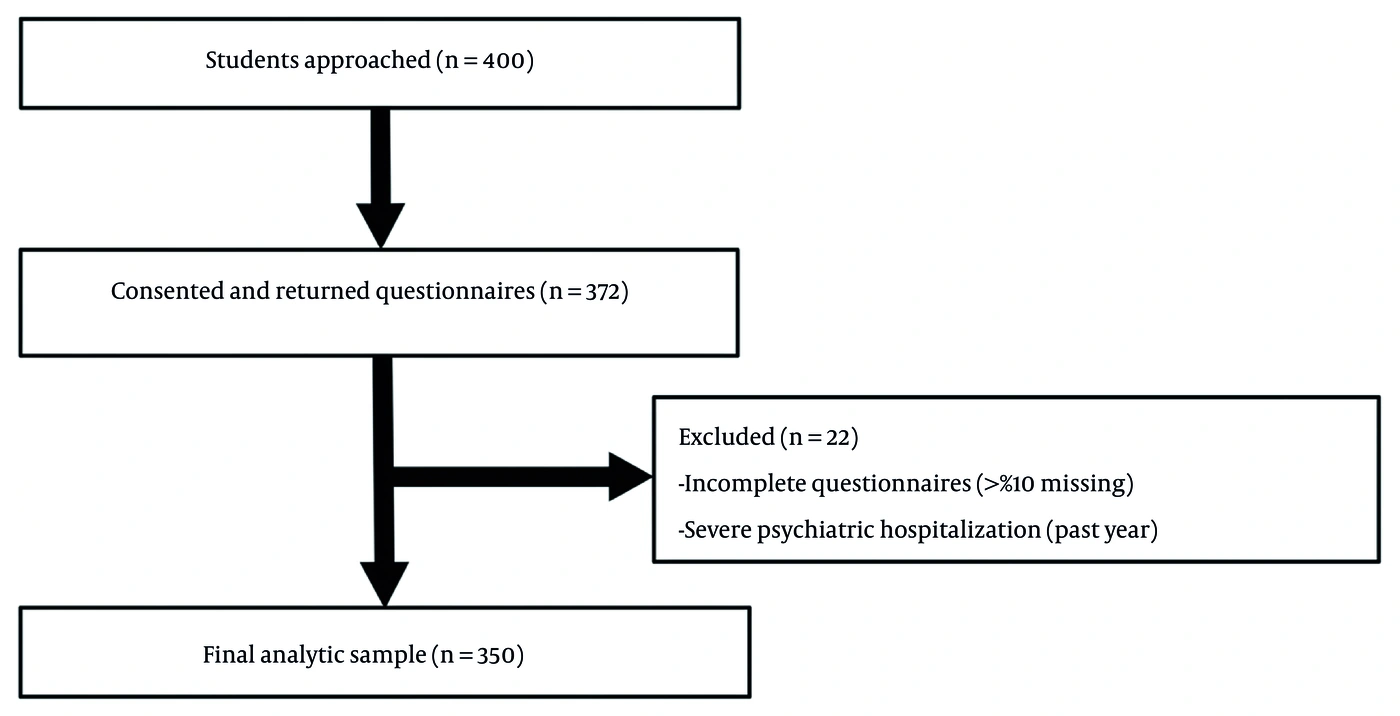
Figure 1.
Flow diagram of participant recruitment and inclusion
Table 2 summarizes the descriptive statistics, reliability coefficients, and bivariate associations among the principal study variables. Specifically, it presents the means, standard deviations, Cronbach’s alpha coefficients, and Pearson correlation coefficients. Reliability analyses indicated acceptable internal consistency across all instruments, with Cronbach’s alpha values ranging from 0.89 to 0.93.
Table 2.
Descriptive Statistics, Reliability Coefficients, and Correlations Among the Study Variables (N = 350) a
| Variables | Cronbach’s α | Mean ± SD | 2 | 3 | 4 |
|---|---|---|---|---|---|
| TCEs | 0.93 | 63.80 ± 22.10 | 0.48 b | −0.41 b | 0.32 b |
| Maladaptive Emotion Regulation | 0.91 | 51.60 ± 15.05 | 1 | −0.36 b | 0.49 b |
| Adaptive Emotion Regulation | 0.89 | 69.20 ± 13.40 | 1 | −0.38 b | |
| IA | 0.92 | 46.30 ± 16.25 | 1 |
a Abbreviations: TCEs, Early traumatic childhood experiences; IA, Internet Addiction
b P < 0.01 was considered statistically significant.
Pearson correlation coefficients indicated that TCEs were significantly and positively related to maladaptive CERQ (r = 0.48, P < 0.01) and IA tendency (r = 0.32, P < 0.01). Conversely, a significant inverse relationship was observed between TCEs and adaptive CERQ (r = −0.41, P < 0.01). Maladaptive CERQ was also positively and significantly related to IA tendency (r = 0.49, P < 0.01). In contrast, adaptive CERQ scores were negatively and significantly correlated with IA tendency (r = −0.38, P < 0.01).
Regarding descriptive statistics, participants reported moderate levels of TCEs (M = 63.80, SD = 22.10), maladaptive CERQ (M = 51.60, SD = 15.05), and IA tendency (M = 46.30, SD = 16.25). Adaptive CERQ showed comparatively higher mean levels (M = 69.20, SD = 13.40).
Because no significant grade-level differences were observed for any of the principal study variables, educational grade was not included in the subsequent statistical indirect-effects analysis.
The structural model was tested to evaluate theory-guided statistical indirect associations among the study variables. Table 3 reports the model evaluation indices for the proposed mediation framework. Overall, the results indicated that the model corresponded adequately with the observed data. The AVE estimates were above the recommended minimum value of 0.50, and the CR coefficients were greater than 0.70, supporting satisfactory convergent validity and construct reliability. VIF values were within acceptable ranges, suggesting no multicollinearity. In addition, the SRMR and normed fit index (NFI) supported satisfactory model fit, and the Stone–Geisser Q2 values indicated strong predictive relevance for the endogenous variables.
Table 3.
Measurement and Structural Model Evaluation Indices
| Index (Acceptable Value) | Obtained Value |
|---|---|
| Average variance extracted (AVE > 0.50) | 0.61 - 0.79 |
| Composite Reliability index (CR > 0.70) | 0.88 - 0.94 |
| VIF (< 5 acceptable) | 1.92 - 3.18 |
| SRMR (< 0.08) | 0.046 |
| NFI (> 0.90) | 0.92 |
| Stone–Geisser Q2 index (0.15 - 0.35: strong) | 0.21 - 0.34 |
As shown in Figure 2, the proposed parallel mediation model was analyzed to examine the statistical indirect associations linking TCEs to IA tendency through maladaptive and adaptive CERQ strategies. Table 4 presents the estimated coefficients for the direct and indirect pathways, along with the corresponding 95% bias-corrected and accelerated bootstrap confidence intervals (BCa CIs).
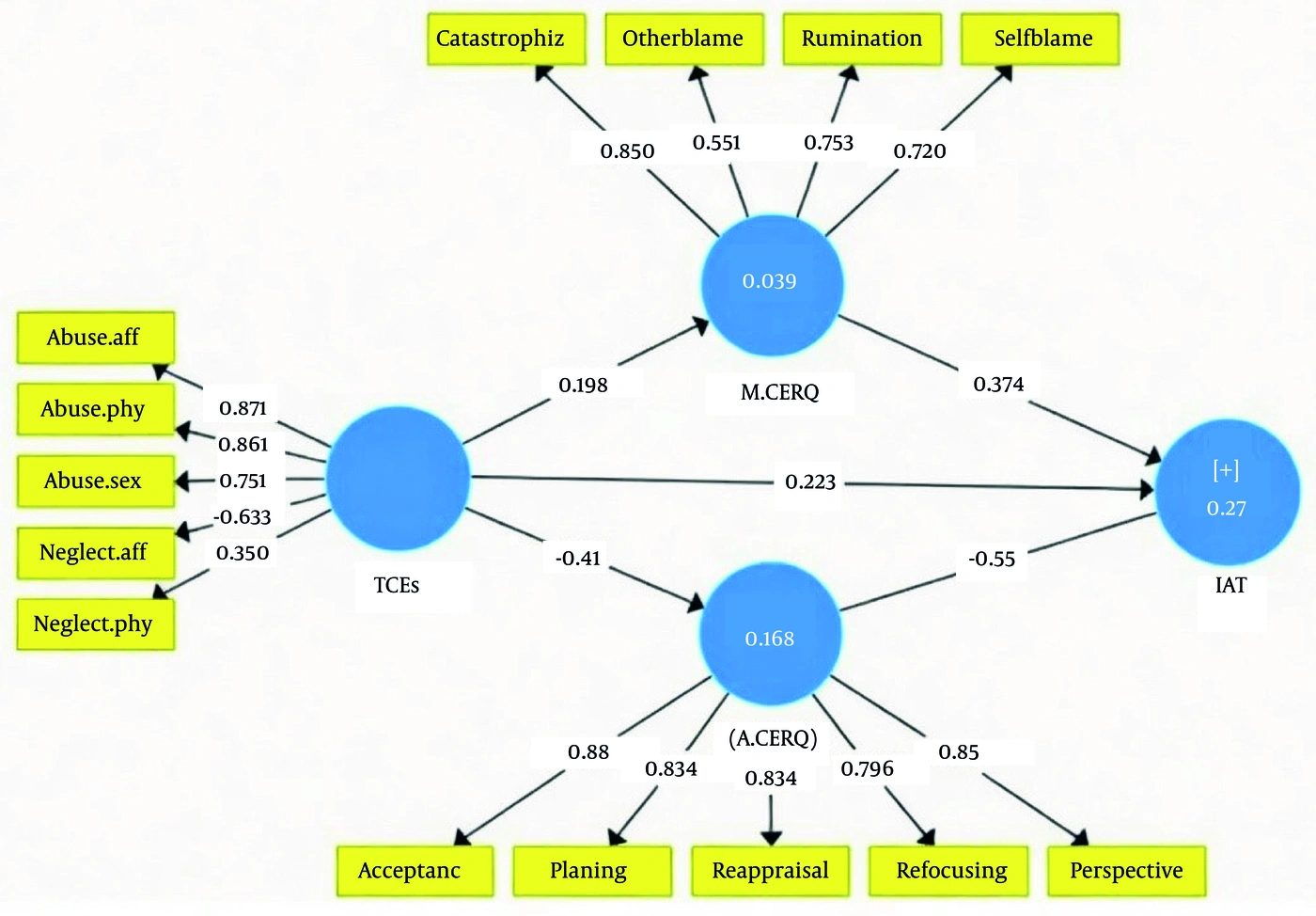
Figure 2.
Structural model showing direct and statistical indirect associations among TCEs, maladaptive and adaptive CERSs, and IAT.
Table 4.
Path Coefficients and Statistical Indirect Effects in the Structural Model a
| Structural Path | β | t | P-Value | 95% BCa CI |
|---|---|---|---|---|
| Direct Effects | ||||
| TCEs → IA | 0.22 | 4.05 | < 0.001 | [0.11, 0.32] |
| TCEs → Maladaptive CERQs | 0.20 | 4.11 | < 0.001 | [0.11, 0.29] |
| TCEs → Adaptive CERQs | −0.41 | 7.85 | < 0.001 | [−0.51, −0.31] |
| Maladaptive CERQs → IA | 0.37 | 6.12 | < 0.001 | [0.25, 0.49] |
| Adaptive CERQs → IA | −0.55 | 8.54 | < 0.001 | [−0.67, −0.42] |
| Indirect Effects | ||||
| TCEs → Maladaptive CERQs → IA | 0.07 | 3.94 | < 0.001 | [0.04, 0.11] |
| TCEs → Adaptive CERQs → IA | 0.23 | 6.68 | < 0.001 | [0.16, 0.31] b |
| Overall Indirect Effect | 0.30 | 7.79 | < 0.001 | [0.21, 0.39] |
| Total Effect (Direct + Indirect) | 0.52 | 9.88 | < 0.001 | [0.41, 0.63] |
a Abbreviations: CERSs, Cognitive emotion regulation strategies; IA, Internet Addiction; TCEs, Early traumatic childhood experiences. 95% BCa CI = 95% bias-corrected and accelerated confidence interval.
b Indicates the specific indirect pathway of interest (TCEs → Adaptive CERQs → IA) that demonstrated a significant positive indirect effect despite the inverse relationship between the constructs.
The measurement model demonstrated satisfactory psychometric properties. All standardized indicator loadings exceeded the recommended threshold of 0.70, ranging from 0.70 to 0.90 across the four latent constructs. Composite Reliability values ranged from 0.90 to 0.94, and AVE values ranged from 0.61 to 0.79, indicating satisfactory internal consistency and convergent validity. Table 5 summarizes the indicator loadings and measurement properties.
Table 5.
Indicator Loadings and Measurement Properties a
| Construct | Number of Indicators | Indicator Loadings (Range) | Cronbach's α | Composite Reliability (CR) | AVE |
|---|---|---|---|---|---|
| TCEs | 28 | 0.71 - 0.89 | 0.93 | 0.94 | 0.79 |
| Maladaptive CERQs | 20 | 0.72 - 0.87 | 0.91 | 0.92 | 0.68 |
| Adaptive CERQs | 16 | 0.70 - 0.86 | 0.89 | 0.90 | 0.61 |
| IA | 20 | 0.73 - 0.90 | 0.92 | 0.93 | 0.74 |
a Abbreviations: CERSs, Cognitive emotion regulation strategies; IA, Internet Addiction; TCEs, Early traumatic childhood experiences.
Discriminant validity was evaluated using the HTMT. As shown in Table 6, all HTMT values ranged from 0.46 to 0.66, well below the recommended threshold of 0.85. These findings provide further evidence that the latent constructs were empirically distinct.
Table 6.
Discriminant Validity (HTMT Matrix) a
| Constructs | CTQ | Maladaptive CERQs | Adaptive CERQs | IA |
|---|---|---|---|---|
| CTQ | — | |||
| Maladaptive CERQs | 0.63 | — | ||
| Adaptive CERQs | 0.49 | 0.58 | — | |
| IA | 0.46 | 0.66 | 0.54 | — |
a Abbreviations: CERSs, Cognitive emotion regulation strategies; IA, Internet Addiction; TCEs, Early traumatic childhood experiences.
Based on the structural model results, TCEs significantly predicted greater use of maladaptive CERQs (M.CERQ) (R2 = 0.039, β = 0.20, t = 4.11, P < 0.001, 95% BCa CI, [0.11, 0.29]). Conversely, CTQ was significantly associated with lower use of adaptive CERQs (A.CERQ) (R2 = 0.168, β = −0.41, t = 7.85, P < 0.001, 95% BCa CI, [−0.51, −0.31]).
The statistical indirect-effects analysis further demonstrated significant indirect effects of CTQ on IA through both M.CERQ (β = 0.07, t = 3.94, P < 0.001, 95% BCa CI, [0.04, 0.11]) and A.CERQ (β = 0.23, t = 6.68, P < 0.001, 95% BCa CI, [0.16, 0.31]). The overall indirect effect of CTQ on IAT was also statistically significant (β = 0.30, t = 7.79, P < 0.001, 95% BCa CI, [0.21, 0.39]).
Furthermore, TCEs retained a significant direct association with IA (β = 0.22, t = 4.05, P < 0.001, 95% BCa CI, [0.11, 0.32]). When both the direct and indirect pathways were considered simultaneously, the total effect of TCEs on IA remained statistically significant (R2 = 0.27, β = 0.52, t = 9.88, P < 0.001, 95% BCa CI, [0.41, 0.63]).
5. Discussion
The present study examined whether adaptive and maladaptive cognitive emotion regulation strategies were statistically associated with the link between TCEs and IA among Iranian female adolescents. The findings supported the hypothesized model, indicating that TCEs were associated with greater use of maladaptive strategies and higher IA, as well as with lower use of adaptive strategies. The results further suggested that both adaptive and maladaptive strategies statistically accounted for indirect associations between trauma and IA. Notably, TCEs remained directly and significantly associated with IA after the intermediate variables were included in the structural model.
These findings are consistent with prior research. For example, Gu et al. reported a direct association between childhood maltreatment and IA among Chinese adolescents, alongside significant indirect associations through emotion regulation pathways (24). Similarly, Guo et al. (37) observed that childhood maltreatment was related to IA through serial associations involving cognitive emotion regulation strategies and depression. Dong et al. (38) likewise documented a robust association between childhood trauma and adolescent IA beyond the indirect pathways examined.
With respect to maladaptive cognitive emotion regulation strategies (e.g., rumination, suppression, catastrophizing), the present findings indicate that these strategies were associated with higher levels of IA and statistically explained part of the association between trauma and IA. This pattern aligns with findings by Gu et al. (24) and Jin et al. (23), who reported that maladaptive regulation strategies were linked to problematic internet behaviors among adolescents exposed to maltreatment. Evidence from Deng et al. (39) and Jin et al. (23) similarly suggests that rumination, suppression-like avoidance, and related cognitive patterns are associated with problematic digital behaviors in trauma-exposed populations.
In contrast, adaptive cognitive emotion regulation strategies (e.g., reappraisal, acceptance, refocusing on planning) were associated with lower levels of IA and statistically accounted for part of the trauma–IA association. This finding is consistent with Guo et al. (37), who reported that adaptive strategies were indirectly linked to lower IA through emotional processes, although their magnitude was smaller than that of maladaptive strategies. Miu et al. (20) likewise found that adaptive regulation strategies were associated with reduced psychopathology in individuals reporting childhood adversity.
These findings may be interpreted within the I-PACE model. From this perspective, early adverse experiences are theorized to be linked to alterations in affective and cognitive functioning, which may, in turn, be associated with greater reliance on maladaptive regulation strategies and problematic internet use. Conversely, adaptive strategies such as cognitive reappraisal may be linked to greater cognitive flexibility and less reliance on escapist internet use (21). In the present sample of Iranian female adolescents, cultural and gender-related norms surrounding emotional expression and regulation may also shape these associations. Indeed, unresolved trauma may be associated with significant emotional distress, which may, in turn, be associated with greater reliance on maladaptive regulation to avoid recurrence of psychological pain, even at the cost of addictive behaviors (20). Such patterns may manifest as excessive internet use for social validation, self-blame for perceived failures, or rumination on past harms, further reinforcing the cycle of problematic use (21-23).
From an applied standpoint, the findings highlight the potential relevance of trauma-informed and emotion regulation–focused components within school-based mental health programs. Interventions aimed at reducing maladaptive cognitive regulation patterns and strengthening adaptive strategies may be associated with lower levels of problematic internet use. However, these findings should be interpreted with caution. Given the cross-sectional design, the observed indirect associations cannot be interpreted as evidence of causal mediation. Rather, the results reflect theory-consistent statistical associations among TCEs, cognitive emotion regulation strategies, and IA. Longitudinal or experimental studies are required to clarify the temporal ordering of these variables and to more rigorously test potential causal mechanisms and the effectiveness of clinical interventions.
5.1. Study Limitations
Despite its contributions, several limitations of the present study should be acknowledged. First, the cross-sectional design precludes causal inference and does not allow the temporal or developmental sequencing of TCEs, cognitive emotion regulation strategies, and the tendency toward IA to be established. Accordingly, the mediation model should be interpreted as reflecting theory-informed statistical indirect associations rather than causal pathways linking these variables. Longitudinal or prospective studies are needed to clarify developmental trajectories and to examine the directionality of these relationships over time.
The structural model was estimated without adjustment for potentially relevant demographic and behavioral covariates, such as socioeconomic status, parental characteristics, daily internet-use duration, and type of internet activity, because these variables were not collected as part of the study protocol. Consequently, residual confounding cannot be completely excluded, and future studies should examine whether the observed statistical indirect effects remain robust after controlling for these factors.
Second, the use of multistage cluster sampling from public high schools in Qom may limit the generalizability of the findings to adolescents in other regions of Iran or in different sociocultural contexts. Moreover, because the sample consisted exclusively of female adolescents, the results cannot be readily generalized to male students or mixed-gender populations, particularly given prior evidence indicating gender differences in emotion regulation and problematic internet use.
Third, all variables were assessed using self-report questionnaires, which may introduce bias, including social desirability and retrospective recall bias, particularly when reporting TCEs. Future research would benefit from incorporating multi-informant designs or complementary assessment approaches, such as caregiver reports, behavioral indicators, or structured clinical interviews. Fourth, several potentially relevant covariates were not included in the present analysis. Variables such as age, grade level, socioeconomic status, and patterns of internet use (e.g., duration and type of online activity) may influence adolescents’ tendency toward IA. The absence of these factors may have affected the estimation of structural associations, and future studies should incorporate such variables to obtain more precise and robust estimates. Fifth, the broader cultural context may have shaped the observed associations. Emotion socialization processes within Iranian society, including gender-related norms surrounding emotional expression and regulation, may influence adolescents’ preferences for particular cognitive emotion regulation strategies. Therefore, the findings should be interpreted within their sociocultural context, and cross-cultural replication studies are warranted. Finally, IA was assessed as a global construct without differentiating among specific forms of problematic internet-related behaviors, such as online gaming, social media use, or excessive smartphone use. Because these behaviors may involve distinct psychological mechanisms, future research should examine problematic internet use across more specific domains. Despite these limitations, the study also has several strengths. These include a relatively large sample size (N = 350) suitable for PLS-SEM analysis, the use of validated Persian-language instruments with satisfactory internal consistency, and the simultaneous examination of both adaptive and maladaptive cognitive emotion regulation strategies as potential mediating mechanisms in an understudied population. Future research employing longitudinal designs, culturally informed approaches, and more comprehensive methodological frameworks will help to further clarify and extend these findings.
5.2. Conclusions
This study indicates that TCEs are statistically associated with IA among Iranian female adolescents through distinct cognitive emotion regulation patterns. Maladaptive strategies were associated with higher levels of IA, whereas adaptive strategies were associated with lower levels, statistically accounting for indirect associations between trauma and IA. These findings suggest that vulnerability to problematic internet use among trauma-exposed adolescents may be linked not only to trauma exposure itself but also to patterns of cognitive emotion regulation. Accordingly, preventive and clinical efforts that address maladaptive cognitive regulation and promote adaptive strategies such as cognitive reappraisal and acceptance may be relevant in this context. From a public health perspective, integrating trauma-informed and emotion regulation–focused components into school-based mental health programs may represent a feasible and culturally sensitive approach; nevertheless, longitudinal and experimental research is needed to clarify directionality and potential causal mechanisms.