
1. Background
Breast cancer is the most common cancer among women worldwide, but it is one of the most treatable cancers as well. It is common and curable and a large number of patients are treated and have long lifetimes; so, they require support after diagnosis and during and after treatment (1). Regarding the nature of cancer, psychological and complementary therapies play an important role in the management of this disease (2).
Many female patients experience physical and psychological effects such as chronic pains, depression, and anxiety when they are aware of their breast cancer disease (3). Therapeutic procedures, especially surgery and chemotherapy, are associated with certain side effects, as well as physical damages such as removal of all or some parts of the breast that can exacerbate cancer psychological effects (4, 5). Patients usually become shocked when they hear the word of cancer and express psychological reactions such as fear, isolation, anger, irritability, and confusion. However, most studies suggest that depression and anxiety, and adjusting-related disorders are the most common psychological problems among patients with breast cancer (6). Given excessive burden of these disorders on shoulders patients with breast cancer, understanding the psychological effects of cancer and ways to deal with them is of salient importance.
Compassion-focused therapy (CFT) is the third wave of psychotherapy to treat psychological disorders, namely anxiety and depression (7). This therapy is a combination of social, developmental, and Buddhist psychologies and neuroscience. One of the basic tenets of this approach is to help people develop a sense of encouragement, safety, and tranquility through cultivation of compassion and heart-whole awareness of humanity suffering and efforts to alleviate those sufferings.
The empirical evidence for the effectiveness of CFT on whole range of mental problems is raising. In early studies on the use of CFT in a group of people with chronic mental problems in a daily hospital, Gilbert and Procter found that CFT significantly decreased shame, self-criticism, self-blame, depression, and anxiety among participants (8). For example, Beaumont et al. (9) compared the effectiveness of cognitive behavioral therapy (CBT) interventions with compassion-focused interventions among clients with traumatic experiences (9). Their findings showed more improvement among the people, who received compassion-focused therapy. Ashworth et al. (10) also found that compassion-focused therapy is helpful to reduce the shame and self-blame in patients with brain damage.
2. Objectives
Regarding the role of psychological indices on prevention and treatment of cancer and the need to improve psychological potentials in the cancer management process and considering the combination of depression and anxiety indices with breast cancer and the lack of a similar study in Iranian society, the present study was carried out with the aim of evaluating the effectiveness of CFT on depression and anxiety indices in women with breast cancer.
3. Methods
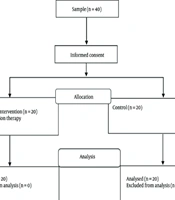
This study was a randomized controlled trial with pre- and post-tests and the data were collected from February 2016 to March 2017. One hundred women were referred to radiotherapy and oncology ward in Golestan Hospital in Ahvaz, southwest of Iran, were selected through respondent-driven sampling method (11, 12). The sample size was calculated to be 30 subjects (With assumption of Z = 1.645, d = 0.2, α = 0.05 and also power of test 1-β = 0.84 ).
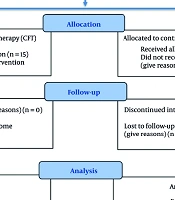
Accordingly, a primary total of 100 people completed Beck depression inventory (short form (BDI-13)) and Beck anxiety inventory (21 items). Finally, 30 people, who had high anxiety and depression scores, (two standard deviations) were selected and randomly (by Microsoft Excel) assigned to experimental (n = 15) and control (n = 15) groups.
Eligibility criteria for initial enrollment included: women aged 20 to 50 years old, willingness to take part in the study, diagnosed with breast cancer, under chemotherapy treatment, and over elementary school in education level. The treatment sessions were done twice a week and each session was 90 minutes and the entire treatment process was 8 weeks (16 sessions). The content of the sessions was planned based on Gilbert’s compassion protocol. The control group only received motivational enhancement therapy (MET). The intervention process was conducted by two clinical psychologists, who did not play a role in analyzing the data. All the data of this study were collected after agreement with the patient, and informed consent was received before the intervention and publication, and all stages of the study were based on the latest version of the Helsinki Declaration.
In order to collect the demographic data of the participants about age, education, and marital status, a researcher-made demographic checklist was used (13).
3.1. Structured Clinical Interview (SCID)
It is a clinical interview, which is used for diagnosis of Axis I Disorders based on DSM - IV. The diagnostic agreement of this tool in Persian was favorable for most general and specific diagnoses with reliability greater than 0 60. The Kappa coefficient for all of the current diagnoses and longevity diagnosis was obtained equal to 0.52 and 0.55, respectively (14).
3.2. Beck Depression Inventory (Form 13 Items)
It is an abbreviated version of 21-item questionnaire, which was presented in 1972 by Beck et al. It is a self-administered questionnaire and takes 5 minutes to complete. It contains the following items: sadness, pessimism, frustration, lack of pleasure, feelings of guilt, self-loathing, self-destruction, social withdrawal, indecisiveness, self-concept, labor trouble, fatigue, and appetite. Each item has 4 options with scores ranging from 0 to 3. The maximum score in this short questionnaire can be 39, equal to acute depression. According to Reynolds and Gould, this inventory has 0.83% internal consistency (15).
3.3. Beck Anxiety Inventory
It is a self-administered scale comprised of 21 questions that measures anxiety. The questionnaire is based on 21 signs of anxiety in a Likert scale (0, 1, 2, and 3 for each question) and higher scores show greater anxiety. Three questions are related to anxious mood, other 3 are related to specific phobias, and the rest measure automatic symptoms of hyperactivity and physical stress in anxiety. Beck and Clark reported that internal consistency of the questionnaire was 0.93 and test-retest reliability of the scale was 0.75 (16).
After selecting participants and putting them into case and control groups, Gilbert’s compassion-focused therapy was conducted among the cases. The therapy comprised of two sessions each week and every session lasted for 90 minutes.
4. Results
Prior to selecting the statistical test, the assumptions were examined. Regarding the normal distribution, which was evaluated by Kolmogorov Smirnov test (P > 0.05), the similarity of variance was evaluated by Leven test (P > 0.05), as well as regression slope homogeneity (P > 0.05), the use of parametric test was detected possible. Regarding the importance of pre-test control, a multivariate covariance analysis (MANCOVA) was used to examine the post-test changes. Also, the results of box’s M test showed a non-significance of covariance matrix (P = 0.602; F = 0.619). To analyze demographic data, the Chi-square test was used. Data were analyzed at the level of 0.05, using SPSS version 22. The demographic information of the participants is presented at the following.
Thirty patients (15 patients in each study group) were included into the final analysis. The mean age of the participants was 38 years (SD 7.62 years). The majority of the patients (66.67%) were highly educated and 76.67% were married. In terms of age distribution, education level, marital status, and anxiety levels, no significant difference was observed between the two groups before the intervention (P > 0.05). Distribution of anxiety and depression scores of the participants in two groups was presented in two stages of pre-test and post-test in Table 1 .
Table 1.
Distribution of Anxiety and Depression Scores Among the Participants
| Group | Valuea |
|---|---|
| Anxiety | |
| Experiment | |
| Pre-test | 19.07 ± 2.29 |
| Post-test | 16 ± 3.13 |
| Control | |
| Pre-test | 20.53 ± 4.11 |
| Post-test | 21.20 ± 3.14 |
| Depression | |
| Experiment | |
| Pre-test | 19.74 ± 4.51 |
| Post-test | 17.26 ± 4.72 |
| Control | |
| Pre-test | 19.11 ± 3.43 |
| Post-test | 18.53 ± 3.54 |
a Values are expressed as mean ± SD.
The results of multivariate covariance analysis for anxiety and depression are presented in Table 2.
Table 2.
Information on Credit Indices for Multivariate Covariance Test for Anxiety and Depression
| Effect | Value | F | Df | Significance Level |
|---|---|---|---|---|
| Anxiety | ||||
| Pilaei effect | 0.865 | 80.352 | 2 | 0.000 |
| Wilks’ Lambda | 0.135 | 80.352 | 2 | 0.000 |
| Healing effect | 6.428 | 80.352 | 2 | 0.000 |
| Roy’s largest root | 6.428 | 80.352 | 2 | 0.000 |
As the data in Table 2 show, the effectiveness of therapy on the two anxiety and depression indices is significant (P < 0.000).
5. Discussion
In the current study, compassion was considered a therapeutic approach and its effectiveness on depression and anxiety levels was examined among women, who were diagnosed with breast cancer. The results showed that compassion could be effective in reducing anxiety and depression level among those women.
Regarding the role of psychological indices on prevention and treatment of cancer and the need to improve psychological potentials in the cancer management process and considering the combination of depression and anxiety indices with breast cancer and the lack of a similar study in Iranian society, the present study was carried out with the aim of evaluating the effectiveness of CFT on depression and anxiety indices in women with breast cancer.
In line with our findings, the results of a study conducted by Pinto-Gouveia et al. (17) show that increasing of compassion is associated with the reduction of psychopathology in the form of reduction of stress and depression in patients with cancer, and compassion-focused intervention therapy with increasing psychological compatibility of cognitive psychology leads to the management of psychological consequences of cancer
The results of the study carried out by Leaviss and Uttley (18) in the form of a systematic review showed that compassion therapy is an effective intervention for a range of mood disorders. This study shows that this treatment is especially useful for patients with high self-criticism levels.
Also, the systematic results of the review by Kirby (19) showed that compassion therapy now has many benefits in a wide range of clinical interventions and can be helpful in reducing the pain and suffering of patients.
In this regard, the results of a research performed by Jazaieri et al. (20) in the form of a randomized clinical trial show that compassion therapy is associated with improvement in compassion for others, receiving compassion from others, and self-compassion.
In this regard, Shih et al. (21) examined the effectiveness of a compassion-based practice program on improving the skills of medical students. The results showed that the program of compassion-based practice has been associated with improved moral judgment.
Similar to the present study, it was found that self-compassion played an important role in reducing negative emotions that are associated with personality disorders (22). In a study on the effectiveness of mindfulness-based cognitive therapy (23), the researchers found that self-compassion was an important intermediary between mindfulness and healing. Also, in a study conducted among patients with chronic psychological problems, who were admitted to a hospital (8), it was found that CFT significantly reduced self-criticism, shame, humiliation, depression, and anxiety. Other studies have also found that CFT is significantly effective in treatment of personality disorders (24) and eating disorders (25). These all are in line with the findings of the present study.
Psychological training that compassion therapy provides can play an important role in enabling the patients to maintain compatibility with their cancer (26). During the training period about compassion, people learn how to cultivate self-directed kindness in their mind (27). Knowing mystery and trickery of the mind and its sensitivity to depression and anxiety, indeed, allows them to learn how to cope with depression and anxiety and heal them (28). Depression and anxiety in response to life's problems, especially cancer, are natural and inevitable and they learn to respond in a kind and receptive state of mind to their disease (29). Instead of answering in forms of suppression of experience, avoidance of social relationships or self-blame, which worsen the situation, patients learn to respond with awareness and compassion to their body-related inner painful experiences (25). Compassion-focused therapy is in fact generated from within, but directed towards self and others (30). This leads to improved well-being and dramatic changes in the struggle with depression and anxiety induced by cancer (31).
At physiological level, compassion-focused therapy allows people, to some extent, involve their parasympathetic nervous system and oxytocin system and courage (32). At behavioral level, compassion leads to psychological resilience and adaptive psychological functioning and removal of dominance of depression, anxiety, and threatening behaviors (33). At social level, compassion develops foundation for social and cooperative ties and a stronger attachment. It, therefore, helps to aim for positive behavior change free from probable shame (31). When there is no shame or its fear, regardless of breast cancer-induced bodily changes, like removal of breast, a reliable basis for courage, curiosity, sociability, and flexible response to the challenges can be developed (18). In fact, when patients are able to pay attention to themselves and others with deep compassion, with internal reserves of confidence, and with high willingness to take action, they better approach to others and flourish personally regardless of the diseases (16). A compassionate mind is indeed less dominated by negative cancer-related emotions and following behaviors are less driven by threats (28). The patient, then, can choose goals that lead to a meaningful life (34). Therefore, this approach is an appropriate intervention to help patients with breast cancer adjust the side effects and psychological complications of their disease. Currently, to the best of authors’ knowledge, there is no CFT related treatment protocol for patients with cancer, but considering positive findings of this study, such a matter seem necessary and can be a line of future research.
There were some limitations in our study merit attention. Some patients had difficulties in dealing with some questions of the questionnaires and it can cloud the findings in some ways, though negligibly. Researchers could not examine the effects across different age groups. This matter can be an interesting matter of research in future. The sample was small and any generalization should be done cautiously. Finally, due to lack of awareness of psychological services, some patients were not cooperative enough in our study. However, it is suggested that CFT deserves to be undertaken among different age groups with large sample sizes and in various oncology wards in future. This approach should be compared with other treatments, too, to better evaluate its strengths and weaknesses.
5.1. Conclusions
The findings of this study showed that 8 weeks of compassion therapy was associated with a significant reduction in depression and anxiety in women with breast cancer. These findings can be promising in the perspective of using psychological interventions as a complementary therapy in patients with cancer. Carrying out a clinical trial to evaluate the compassion therapy in male patients with cancer can be a good route for future studies.