
1. Background
Older adulthood is the later phase of the life course, marked by distinct physical, psychological, and social transitions. During this stage, individuals often face challenges that can influence overall health, including declines in physical capacity, the emergence of chronic conditions, and emotional experiences such as loneliness and depression (1, 2). These factors interact in ways that may adversely affect the psychological well-being of older adults (2). However, the concept of successful aging emphasizes that later life is not defined solely by decline. Instead, it can involve preserved cognitive functioning, active social engagement, and sustained life satisfaction (3). Successful aging is understood as a dynamic, multidimensional process through which older adults maintain meaningful levels of physical, cognitive, psychological, and social functioning despite age-related changes (4).
Earlier definitions of successful aging focused primarily on the absence of illness, disability, or functional impairment. Although important, these views overlooked the psychological, social, and existential aspects of aging (5). More contemporary views no longer define successful aging solely in terms of physical health but emphasize the preservation of quality of life across multiple domains. Accordingly, maintaining personal independence, actively participating in social activities, continuing meaningful roles, experiencing inner satisfaction, and having purpose and meaning in life have been identified as central pillars of this approach (6). This shift reflects a more comprehensive appreciation of the biopsychosocial nature of aging and acknowledges that individuals may experience a fulfilling and dignified later life even in the presence of certain health limitations (7). Within this framework, social well-being emerges as a key dimension that can directly and indirectly enhance psychological health in older adulthood (8).
Social well-being encompasses feelings of belonging, effective interpersonal engagement, social acceptance, and recognition of one’s role within the community (9). It reflects the extent to which individuals perceive themselves as valued, connected, and useful members of society. This dimension is closely tied to psychological health because supportive relationships, social connectedness, and active participation can strengthen psychological security and bolster resilience against mental health challenges (10). Its importance is especially evident in later life, when retirement, reduced social contact, loss of previous roles, and potential loneliness may occur. Under such circumstances, maintaining community ties and meaningful social involvement can help preserve self-esteem, provide a sense of purpose, and reduce isolation (11). Research consistently shows that higher social well-being among older adults is associated with lower levels of depression, anxiety, and inadequacy, as well as with positive affect and meaningful engagement (12). Psychological security also plays a central role in supporting mental health in older adulthood; trust and access to home care staff have been associated with older adults' sense of security (13). By reducing psychological tension and fostering inner calm, psychological security provides a foundation for successful aging.
Psychological security refers to a sense of inner stability and freedom from psychological or social threats that enables individuals to express themselves and their emotions, make decisions, and engage socially without fear of negative judgment (14). Overall, psychological security is essential for emotional stability and healthy relationships, whereas its absence may cause anxiety, social withdrawal, and reduced psychological well-being (15). As a core element of effective daily functioning, psychological security is vital across settings such as family, work, and education. When people feel psychologically secure, they can confidently demonstrate their abilities, make better decisions, and engage positively in social and personal responsibilities (16). For older adults, psychological security fosters feelings of calm, stability, and control, thereby improving mental well-being. This sense of safety enhances their ability to handle age-related challenges and promotes a meaningful and positive aging process (17). Consequently, psychological security serves as a mental foundation for optimal functioning, fostering social connections and maintaining mental health across life stages. It becomes crucial for successful aging in later years. Additionally, self-perception significantly influences how older adults view aging and assess their success in later life (18).
Self-perception is a multifaceted concept pertaining to an individual's awareness, assessment, and attitude toward their own traits, skills, emotions, thoughts, and behaviors (19). It reflects awareness of personal identity across cognitive, emotional, and social domains and is continually influenced and reshaped by social interactions, life experiences, feedback from the environment, and introspection (20). Self-perception is crucial to shaping behavioral decisions, establishing goals, and interpreting life experiences. Individuals with a negative self-view tend to perceive themselves and their abilities unfavorably, often resulting in self-judgment and reduced self-esteem—circumstances that greatly impair their capacity to handle daily challenges (21). In contrast, cultivating a positive self-perception fosters a sense of competence, mastery of life's situations, and enhanced psychological adaptability to biological and social changes. This is especially important in later years, when individuals confront increased health challenges, functional limitations, and higher mortality rates. In these circumstances, a positive self-perception can act as a protective factor against the psychological impacts associated with aging (22). An affirmative view of oneself allows older adults to develop a sense of meaning, purpose, and control in their lives, ultimately leading to greater satisfaction and hope. Research further corroborates that a positive self-perception in older age not only enhances quality of life but also contributes to successful aging (23).
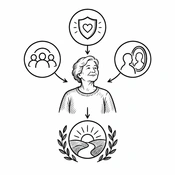
Older adults, particularly those facing the physical, psychological, and social difficulties associated with aging, are at increased risk of psychological vulnerability (24). In these situations, effective social support and a sense of community are vital for promoting social well-being. By strengthening interpersonal relationships, enhancing feelings of self-worth, and encouraging active social involvement, social well-being fosters a positive outlook during later life (25). Furthermore, psychological security, defined as a sense of stability, predictability, and emotional support in one's surroundings, can alleviate existential anxiety and promote mental peace, thereby contributing to a safe and fulfilling aging experience (26). Self-perception—how individuals view their identity, capabilities, and social roles as they age—also plays a significant role in fostering positive attitudes toward retained abilities, embracing age-related changes, and adapting to new social roles (27). Collectively, social well-being, psychological security, and self-perception can influence the overall outcome of successful aging, which includes mental health, life satisfaction, functional independence, and the maintenance of a sense of meaning in life.
Previous studies have indicated that each of these constructs plays a unique role in different aspects of successful aging. A positive correlation exists between social interactions and satisfaction with social support and various elements of successful aging (28). Older adults who maintain positive attitudes, independence, and an active social life, even in the face of physical disabilities, tend to view themselves as aging successfully (29). Additionally, life satisfaction and a positive outlook on the aging process have been identified as predictors of successful aging (30). However, prior studies have not examined these three psychosocial constructs together; instead, they have focused primarily on physical, economic, or cultural factors. This indicates a lack of a comprehensive model that considers the simultaneous impact of social well-being, psychological security, and self-perception on successful aging.
2. Objectives
This study aims to investigate whether social well-being, psychological security, and self-perception can predict successful aging among older adults.
3. Methods
3.1. Study Design
This cross-sectional study was conducted in accordance with the STROBE checklist for cross-sectional studies. According to the World Health Organization’s definition, individuals aged 60 years and older are considered older adults (31). The sampling method was nonrandom, voluntary, and convenience-based.
3.2. Setting
This study included older adults residing in urban areas of Tehran during the second quarter of 2025. To recruit participants, the researcher obtained the necessary administrative permissions and coordinated with elderly social centers, including health houses, retirement associations, cultural centers, and other welfare institutions across 5 different districts of Tehran. Recruitment was conducted through in-person announcements, written notices, and electronic notifications. Individuals who met the inclusion criteria and provided informed consent were enrolled in the study. During the final selection process, efforts were made to ensure demographic diversity in age, gender, marital status, and educational level, thereby increasing the relative generalizability of the findings to the urban elderly population.
3.3. Participants
Eligibility was limited to individuals aged 60 years and older, consistent with the World Health Organization’s definition of aging (31). Participants were required to reside continuously in the urban areas of Tehran at the time of data collection and to demonstrate sufficient cognitive ability to understand and complete the questionnaires independently or with minimal guidance from the researcher. Only individuals without severe psychiatric disorders, such as dementia, schizophrenia, or treatment-resistant major depressive disorder, as determined by self-report or preliminary researcher evaluation, were considered eligible. Participation was also contingent on willingness to take part in the study and provision of informed consent.
Participants were excluded if they withdrew at any stage of the research process, did not complete the questionnaires, or provided inconsistent responses that compromised data validity. Individuals who reported or were observed to have active psychological disorders that interfered with stable and informed participation in data collection were also excluded.
3.4. Ethical Considerations
This study was approved by the Research Ethics Committee of Tehran Islamic Azad University of Medical Sciences (IR.IAU.TMU.REC.1404.361). All participants provided written informed consent before the study began. Participant records and information were anonymized and de-identified before analysis.
3.5. Variables
In this study, social well-being consisted of five components: social integration, social coherence, social participation, social actualization, and social acceptance. Self-perception included two components: self-esteem and self-acceptance. Psychological security comprised four components: self-confidence, satisfaction, environmental adaptability, and esteem from others.
3.6. Data Sources and Measurement
Successful Aging Questionnaire. The Successful Aging Questionnaire is a 54-item instrument developed by Zanjari et al. (32) to assess successful aging. All items were rated on a five-point Likert scale (very high = 0 to very low = 4) and scored in the same direction. Scores range from 0 to 216, with lower scores indicating lower levels of successful aging and higher scores reflecting higher levels. Based on the instrument’s scoring guidelines, a score equal to or greater than 80 was considered indicative of successful aging for prevalence estimation. Reliability, assessed using Cronbach’s alpha, was reported to exceed 0.93 (32). In the present study, Cronbach’s alpha was calculated as 0.879 for the sample of 152 participants.
Social Well-Being Scale. The Social Well-Being Scale, developed by Keyes (33), is a 33-item questionnaire based on his theoretical model of social well-being. It is widely used in health psychology to measure social well-being. Items are scored on a five-point Likert scale ranging from “strongly disagree” (1) to “strongly agree” (2), yielding total scores between 33 and 165, with lower scores indicating lower levels of social well-being and higher scores reflecting higher levels. Keyes empirically validated the instrument, reporting Cronbach’s alpha coefficients ranging from 0.43 to 0.81 (33). In Iran, Heidari and Ghanaei (2008) standardized the questionnaire in a sample of 632 university students, reporting an alpha of 0.83 and confirming a five-factor structure with minor modifications (34). In the present study, Cronbach’s alpha was 0.884 overall, with subscale reliabilities of 0.821 for social integration, 0.807 for social coherence, 0.794 for social participation, 0.816 for social actualization, and 0.809 for social acceptance.
Psychological Security Questionnaire. The Psychological Security Questionnaire was developed by Maslow to measure individuals’ perceptions of psychological security. It consists of 18 items scored dichotomously (yes = 1, no = 0), with lower scores indicating lower levels of psychological security and higher scores reflecting higher levels. Maslow and colleagues (1952) reported an alpha coefficient of 0.66 for the original instrument (35). Wang et al. (36) later reported an alpha of 0.77 and item content validity indices above 0.70 (36). In Iran, Sharah (2022) confirmed content validity through expert review, with coefficients above 0.70, and reported reliability of 0.74 (37). In the present study, Cronbach’s alpha was 0.853 overall, with subscale reliabilities of 0.812 for self-confidence, 0.781 for satisfaction, 0.796 for environmental adaptability, and 0.775 for perceived social attitudes.
Self-Perception Questionnaire. The Self-Perception Questionnaire, designed by Shostrom (38), combines two scales—self-esteem and self-acceptance—extracted from the Personal Orientation Inventory. Together, the 40 items measure self-perception, with lower scores indicating lower levels of self-perception and higher scores reflecting higher levels (38). Scoring is based on a correction key. In Iran, coefficients of 0.79 for self-acceptance, 0.63 for self-esteem, and 0.73 for overall self-perception were reported. In the present study, Cronbach’s alpha was 0.867 overall, with subscale reliabilities of 0.809 for self-esteem and 0.832 for self-acceptance.
3.7. Bias
In this study, we established inclusion and exclusion criteria to control for confounding psychological factors and enhance sample homogeneity. These criteria aimed to reduce selection bias while ensuring demographic diversity. All participants were screened uniformly according to standardized eligibility thresholds to avoid subjective judgment. This methodological approach strengthened the internal validity of our findings and supported reliable analytical inferences.
3.8. Study Size
To estimate the sample size in this study, the formula proposed by Tabachnick and Fidell (2013) was applied. This formula is defined as n ≥ 50 + (8 × m), where n is the sample size, m is the number of predictor components, and 8 is a constant coefficient. The total number of predictor components in this study was calculated as 11. Based on the formula, the initial sample size was estimated as follows: n ≥ 50 + (8 × 11) = 138. Considering a 10% increase to compensate for potential attrition and to enhance the accuracy of statistical analyses, the final sample size was calculated as follows: 138 + (0.10 × 138) = 151.8, which was rounded to 152 participants. During data collection, we applied exclusion criteria based on established guidelines to identify careless or disengaged responses. These criteria included removing incomplete questionnaires, questionnaires with invariant response patterns (e.g., selecting the same option for all items), and questionnaires with irrelevant or nonsensical answers—common indicators of low-quality data (39, 40). A total of 193 responses were collected, with 78 participants from higher socioeconomic areas, 60 from moderate areas, and 55 from lower areas. Initially, 21 responses were eliminated for incomplete answers, followed by 12 responses with consistent patterns, indicating a lack of engagement. Additionally, 8 questionnaires were excluded due to irrelevant responses. This screening process reflects our commitment to maintaining high research standards.
3.9. Statistical Methods
The Kolmogorov–Smirnov test was used to assess data normality. After distributional assumptions were confirmed, Pearson correlation coefficients were calculated to examine relationships among variables. Two multiple linear regression models were used to predict successful aging. In both models, age, gender, marital status, and educational level were entered as potential confounding variables and statistically adjusted for. Model 1 examined the predictive effects of total social well-being, psychological security, and self-perception scores, whereas Model 2 included the individual subscales of these constructs. The assumptions of linearity, independence of errors (Durbin-Watson statistic), and absence of multicollinearity (tolerance and variance inflation factor) were evaluated before analysis. All analyses were conducted using SPSS version 27, with a significance level of α = 0.05.
4. Results
A total of 152 older adults participated in the study; 52% were women and 48% were men. Participants ranged in age from 60 to older than 81 years. According to the scoring guidelines for the Successful Aging Questionnaire, individuals who scored above 80 were classified as demonstrating successful aging. All participants scored above this threshold and were therefore classified as exhibiting successful aging. Descriptive statistics for all main variables and subscales are presented in Table 1. Mean scores were 101.19 for successful aging, 113.01 for social well-being, and 52.77 for self-perception. Psychological security had the lowest mean (M = 10.47). At the subscale level, social coherence (M = 24.15) and self-acceptance (M = 32.83) had the highest means, whereas satisfaction (M = 1.72) and social participation (M = 19.99) had the lowest.
Table 1.
Descriptive Statistics of Main Variables and Subscales
| Variables | N | Max | Min | Mean ± SD | Standardized Scores (0 - 100) |
|---|---|---|---|---|---|
| Successful aging | 152 | 123 | 81 | 101.19 ± 11.45 | 46.8 |
| Social well-being total | 152 | 129 | 99 | 113.01 ± 7.04 | 60.5 |
| Social well-being | |||||
| Social coherence | 152 | 29 | 20 | 24.15 ± 2.86 | 75.6 |
| Social integration | 152 | 26 | 18 | 22.17 ± 2.48 | 67.4 |
| Social participation | 152 | 24 | 17 | 19.99 ± 2.54 | 58.3 |
| Social actualization | 152 | 28 | 21 | 23.96 ± 2.45 | 74.8 |
| Social acceptance | 152 | 28 | 20 | 22.74 ± 2.65 | 69.8 |
| psychological security total | 152 | 15 | 7 | 10.47 ± 2.22 | 58.2 |
| psychological security | |||||
| Self-confidence | 152 | 6 | 3 | 4.06 ± 1.16 | 67.7 |
| Satisfaction | 152 | 3 | 1 | 1.72 ± 0.80 | 28.7 |
| Environmental adaptability | 152 | 4 | 2 | 2.72 ± 0.78 | 45.3 |
| Esteem from others | 152 | 3 | 1 | 1.97 ± 0.84 | 32.8 |
| Self-perception total | 152 | 70 | 43 | 52.77 ± 7.32 | 65.9 |
| Self-perception | |||||
| Self-esteem | 152 | 26 | 17 | 19.94 ± 2.88 | 49.9 |
| Self-acceptance | 152 | 44 | 26 | 32.83 ± 5.72 | 82.1 |
Before conducting regression analysis, demographic variables, including age, gender, marital status, and educational level, were examined as potential confounders. None demonstrated significant associations with successful aging (P > 0.05); therefore, these variables were not included as covariates in the final regression models.
The assumptions of regression analysis were assessed. Univariate normality, absence of multicollinearity, and independence of residuals were confirmed. Kolmogorov–Smirnov tests indicated nonnormality for all variables except successful aging (P < 0.05). Tolerance values exceeded 1.0, and variance inflation factor (VIF) values were below 10, indicating no multicollinearity. The Durbin–Watson statistic (1.5 - 2.5) confirmed the absence of autocorrelation.
Pearson correlations are presented in Table 2. Significant positive correlations were observed between successful aging and social well-being (r = 0.498, P = 0.001), psychological security (r = 0.506, P = 0.001), and self-perception (r = 0.507, P = 0.001). Among the subscales, social participation (r = 0.447, P = 0.001), social actualization (r = 0.477, P = 0.001), social acceptance (r = 0.423, P = 0.001), satisfaction (r = 0.434, P = 0.001), environmental adaptability (r = 0.435, P = 0.001), self-esteem (r = 0.439, P = 0.001), and self-acceptance (r = 0.429, P = 0.001) were significantly correlated with successful aging.
Table 2.
Pearson Correlation Test for Examining the Relationship Among Variables and Successful Aging
| Variables | R | Sig. |
|---|---|---|
| Social well-being total | 0.498 | 0.001 |
| Social well-being | ||
| Social coherence | 0.043 | 0.599 |
| social integration | -0.016 | 0.842 |
| Social participation | 0.447 | 0.001 |
| Social actualization | 0.477 | 0.001 |
| Social acceptance | 0.423 | 0.001 |
| Psychological security total | 0.506 | 0.001 |
| Psychological security | ||
| Self-confidence | 0.350 | 0.001 |
| Satisfaction | 0.434 | 0.001 |
| Environmental adaptability | 0.435 | 0.001 |
| Esteem from others | 0.034 | 0.681 |
| Self-perception total | 0.507 | 0.001 |
| Self-perception | ||
| Self-esteem | 0.439 | 0.001 |
| Self-acceptance | 0.429 | 0.001 |
4.1. Model 1: Total Scores Regression
Multiple linear regression was conducted using the total scores for social well-being, psychological security, and self-perception as predictors of successful aging, with adjustment for age, gender, marital status, and educational level. The model was statistically significant (F(7, 144) = 9.84, P < 0.001), explaining 38% of the variance in successful aging (adjusted R2 = 0.381) (Table 3).
Table 3.
Multiple Linear Regression Analysis of Total Scores Predicting Successful Aging
| Variables | B | SE | β | T | P | 95% CI |
|---|---|---|---|---|---|---|
| Social Well-Being | 0.311 | 0.298 | 0.071 | 1.044 | 0.298 | -0.27, 0.89 |
| Psychological Security | 1.214 | 0.402 | 0.312 | 3.017 | 0.003 | 0.42, 2.00 |
| Self-Perception | 0.944 | 0.351 | 0.289 | 2.689 | 0.008 | 0.25, 1.63 |
The psychological security total score was a significant predictor (B = 1.214, SE = 0.402, β = 0.312, t = 3.017, P = 0.003, 95% CI: 0.42 - 2.00). The self-perception total score was also significant (B = 0.944, SE = 0.351, β = 0.289, t = 2.689, P = 0.008, 95% CI: 0.25 - 1.63). The social well-being total score was nonsignificant (B = 0.311, SE = 0.298, β = 0.071, t = 1.044, P = 0.298, 95% CI: –0.27 - 0.89). All demographic covariates were nonsignificant (P > 0.05). The model summary is presented in Table 4.
Table 4.
Regression Summary and Autocorrelation of Model 1
| Criterion Variable | R | R2 | Adjusted R2 | Standard Error |
|---|---|---|---|---|
| Successful Aging | 0.642 | 0.412 | 0.381 | 6.783 |
4.2. Model 2: Subscale Regression
A second multiple linear regression was conducted using all subscale scores for social well-being, psychological security, and self-perception as predictors of successful aging, with adjustment for the same confounders (Table 5). The model was statistically significant (F = 11.06, P < 0.001), explaining 42% of the variance (adjusted R2 = 0.423) (Table 6). Three subscales were significant predictors:
Table 5.
Correlation and Regression Coefficients of Social Well-Being, Psychological Security, and Self-Perception on Successful Aging
| Variables | B | SD | Standard β | T | P value | 95% CI (Lower–Upper) |
|---|---|---|---|---|---|---|
| Constant | -6.721 | 5.156 | - | -1.303 | 0.195 | 2.56 - 22.47 |
| Social Well-Being | ||||||
| Social coherence | 0.114 | 0.256 | 0.028 | 0.444 | 0.658 | –0.57 - 1.00 |
| Social integration | -0.196 | 0.288 | -0.043 | -0.682 | 0.496 | –0.63 - 0.90 |
| Social participation | 0.616 | 0.339 | 0.136 | 1.818 | 0.071 | –0.51 - 0.84 |
| Social actualization | 0.882 | 0.351 | 0.189 | 2.515 | 0.013 | 0.19 - 1.54 |
| Social acceptance | 0.609 | 0.310 | 0.141 | 1.969 | 0.051 | –0.51 - 0.91 |
| Psychological Security | ||||||
| Self-confidence | 0.268 | 0.727 | 0.027 | 0.368 | 0.713 | –0.70 - 1.31 |
| Satisfaction | 1.469 | 1.099 | 0.103 | 1.337 | 0.183 | –0.69 - 1.14 |
| Environmental adaptability | 2.403 | 1.044 | 0.164 | 2.302 | 0.023 | 0.33 - 4.47 |
| Esteem from others | 0.514 | 0.856 | 0.038 | 0.601 | 0.549 | –0.66 - 1.28 |
| Self-Perception | ||||||
| Self-esteem | 0.621 | 0.288 | 0.156 | 2.159 | 0.033 | 0.05 - 1.19 |
| Self-acceptance | 0.266 | 0.144 | 0.133 | 1.846 | 0.067 | –0.44 - 0.73 |
Table 6.
Regression Summary and Autocorrelation of Model 2
| Criterion Variable | R | R2 | Adjusted R2 | Standard Error |
|---|---|---|---|---|
| Successful Aging | 0.682 | 0.465 | 0.423 | 8.698 |
• Social actualization (B = 0.882, SE = 0.351, β = 0.189, t = 2.515, P = 0.013, 95% CI: 0.19 - 1.54)
• Environmental adaptability (B = 2.403, SE = 1.044, β = 0.164, t = 2.302, P = 0.023, 95% CI: 0.33 - 4.47)
• Self-esteem (B = 0.621, SE = 0.288, β = 0.156, t = 2.159, P = 0.033, 95% CI: 0.05 - 1.19)
All other subscales and demographic covariates were nonsignificant (P > 0.05). The constant term was nonsignificant (P = 0.195).
Regression analysis identified three significant predictors of successful aging: social actualization, environmental adaptability, and self-esteem. The other predictors did not reach statistical significance (P > 0.05).
5. Discussion
The present study examined the relationships between social well-being, psychological security, self-perception, and successful aging among older adults in Tehran. The findings revealed significant positive correlations among all three constructs and their respective components, and regression analysis determined that these predictors could account for the variance in successful aging. In particular, social actualization, environmental adaptability, and self-esteem emerged as significant contributors, underscoring the central role of psychosocial dimensions in shaping the experience of aging.
5.1. Social Well-Being and Successful Aging
Social well-being and its components—social participation, social actualization, and social acceptance—were positively associated with successful aging. These findings are consistent with those of prior studies (18, 28, 29, 32, 41, 42). Successful aging is a multidimensional process that involves maintaining physical, cognitive, psychological, and social functioning in meaningful ways (4). Social participation provides opportunities to engage in group activities, reinforcing social identity and boosting self-esteem. Social actualization cultivates motivation, hope, and meaning by instilling the idea that older adults can contribute to societal advancement (43). Social acceptance reduces loneliness and isolation by affirming individuals’ value within society (10). Collectively, these factors highlight social well-being as essential psychological and social groundwork for successful aging.
5.2. Psychological Security and Successful Aging
Psychological security and its components—self-confidence, satisfaction, and environmental adaptability—were also positively related to successful aging. These findings align with those of previous research (32, 41, 44). Psychological security signifies inner calm, emotional stability, and freedom from psychological and social threats (14). Self-confidence enables older adults to approach the challenges of aging as opportunities rather than threats, thereby sustaining their independence (45). Satisfaction promotes contentment with life, decreases negative emotions, and strengthens meaning and purpose (15). Environmental adaptability allows older adults to adjust to inevitable biological and social changes, preserving social identity and reducing feelings of helplessness (16). These mechanisms demonstrate that psychological security is not a passive state but a dynamic process that enables older adults to experience aging as active, meaningful, and fulfilling.
5.3. Self-Perception and Successful Aging
Self-perception, encompassing self-esteem and self-acceptance, was significantly associated with successful aging. Previous studies have emphasized the role of ego integrity and positive perceptions of aging in predicting successful aging (30, 46). Self-perception reflects an individual’s appraisal of abilities, worth, and identity (19, 47). Self-esteem provides older adults with confidence in their remaining capacities, encouraging continued engagement in social and family roles and preserving independence (48). Self-acceptance reduces negative emotions by helping older adults perceive age-related changes as natural aspects of life, thereby fostering resilience and meaning (23). Together, these components strengthen psychological well-being, reduce isolation, and enhance participation, all of which are integral to successful aging (20).
5.4. Integrative Perspective
The findings of this study indicate that social actualization, environmental adaptability, and self-esteem were the strongest predictors of successful aging in this sample. The model explains variance in successful aging scores rather than longitudinal change in aging outcomes. To further clarify these relationships, two multiple regression analyses were conducted. In the first model, psychological security and self-perception emerged as significant predictors of successful aging, whereas social well-being did not contribute significantly when examined at the total-score level. This pattern suggests that emotional stability and positive self-evaluation may exert stronger direct effects on successful aging than broader social indicators, consistent with previous studies highlighting the central role of psychological resilience and self-concept in later life. The second model, which included all subscales, identified social actualization, environmental adaptability, and self-esteem as significant predictors. These results indicate that specific components of social and psychological functioning, rather than overall scores, may be more influential in shaping successful aging.
5.5. Limitations
This study has several limitations. It focuses on social well-being, psychological security, and self-perception, while neglecting other important factors affecting successful aging, such as physical health and economic resources. Furthermore, reliance on self-report questionnaires may introduce bias because participants might exaggerate or downplay their experiences. Additionally, voluntary convenience sampling may limit representativeness, as individuals who choose to participate often differ from nonvolunteers in motivation, health, or engagement. Consequently, the findings may not fully generalize to the broader older adult population. Finally, the cross-sectional design restricts causal inference. Although the model identifies significant associations between social well-being, psychological security, self-perception, and successful aging, the temporal direction of these relationships cannot be determined. Longitudinal or experimental designs would be required to establish causality.
5.6. Conclusions and Implications
This study contributes to the literature by simultaneously examining social well-being, psychological security, and self-perception within a predictive model of successful aging—an approach not previously reported. The findings emphasize that successful aging is a dynamic process shaped by psychosocial resources rather than merely the absence of disease. Although the observational design limits causal inference, the results may offer useful directions for preventive and promotive efforts in mental health and aging, particularly those aimed at enhancing social participation, fostering adaptability, and strengthening self-esteem. Policymakers and practitioners can cautiously draw on these insights when considering programs to support older adults, recognizing that these implications reflect associations observed in this sample rather than demonstrated causal effects.