
1. Background
Aging is a natural stage of human life in the continuum of social life that is very different from other stages of life (1). The elderly population is increasing worldwide, and it is expected to grow rapidly in Iran. Approximately 700 million people in the world are over 60 years, which is projected to reach more than one billion by 2020 (2). Iran, as a developing country, has experienced similar changes to its population, illness, and structure over the past decade. Like many other developing countries, Iran’s population is experiencing fundamental changes in its age structure due to constant fertility reduction and increased life expectancy (3, 4). According to the census, the population of the elderly increased from 7.22% in 2006 to 8.20% in 2011. Considering this increase and the importance of aging, meeting the needs, and solving the problems of the elderly can be considered a social need (5).
The global growth of the elderly is a major challenge to healthcare providers, as well as families and society. Aging is a sensitive period in human life, in which people are at increased risk of developing chronic illness, isolation, and lack of social protection, and their autonomy is threatened due to their physical and mental disabilities (6, 7). The elderly population of a community is considered a vulnerable group, and they face several age-specific problems (8). The mental health of the elderly is one of the most important mental health challenges in the world. Mental health problems are neglected by healthcare professionals and older people themselves, and the stigma surrounding mental illness makes people reluctant to seek help (9-12). Noorbala et al. (13), in a national study in 2006, reported that the prevalence of mental disorder was about 21% in the total population, ranging from 15% in men to 26% in women. Their study also showed that the prevalence of these diseases was higher in some socio-economic groups such as retired, unemployed, widowed, divorced, and married people than among other people (13). Over 20% of adults aged 60 or over suffer from a mental or neurological disorder (excluding headache disorders), and 6.6% of all disability (disability-adjusted life years, DALYs) among people over 60 years is attributed to mental and neurological disorders. These disorders in older people account for 17.4% of years lived with disability (YLDs). The most common mental disorder in this age group is depression. Moreover, anxiety disorders affect 3.8% of the older population, and substance use problems affect almost 1% of them. Around a quarter of deaths from self-harm occur among people aged 60 or above (14).
Mental health can affect physical health and other aspects of health. Considering the increase in the population of the elderly and its associated problems, examining the status of mental health and the prevalence of mental disorders in the elderly can be effective for proper planning and health interventions. Several studies have noted the status of mental health and related factors, such as marital status, health status, housing conditions, loneliness, employment status, and income (15, 16). There have been no such studies, however, about the relationship between these factors and mental health status in community-dwelling older adults in Qom Province, Iran. Therefore, it is not yet clearly known what factors cause mental health problems in them. We believe it is important to clarify these factors and provide proper health management for the prevention and care of the elderly.
2. Objectives
This study was conducted to measure the mental health of community-dwelling older adults and related factors in Qom City, Iran, in 2018.
3. Methods
This cross-sectional descriptive-analytical study was done in 2018. A cluster multi-stage sampling method was used for this study. The statistical population of this study was older adults (over 60 years) living in urban areas of Qom, Iran. The study was approved by the Regional Research Ethics Committee of Qom University of Medical Sciences (no.: IR.MUQ.VCR.REC.1397.160).
To determine the sample size, according to the data of a previous study (17), considering the standard deviation of 6.8 for the mental health status of the elderly and the confidence level of 95%, the sample size was estimated at 363 people. Considering the possibility of drop-out, a total of 400 people were enrolled. For sampling, 20 health community centers were selected randomly among 38 centers covered by the Qom University of Medical Sciences. The selected centers were equally located in four districts of the city. Finally, 20 people were selected from each center (n = 400 participants).
In order to comply with random sampling in the area covered by each health center, one home was considered in proportion to all five houses, and the questionnaire was completed.
If the house had no elderly, the next house was selected. The data collection was done during face-to-face interviews. The interviews were conducted with individuals over 60 years who were able to answer the questions. If necessary, the interviews were conducted in a combination form, in-person, or by phone call.
In this way, if the person was not present at home or did not have time for the interview, part of the interview (demographic profile) at the door was asked of him/her or other family members, and after receiving the person’s phone number, the rest of the questionnaire was asked and completed by phone by the person or his/her caregiver.
Before questionnaire completion, the purpose of the research was explained to participants, and they were assured that the questionnaire information would remain completely confidential.
To collect the demographic data, we used a demographic questionnaire containing 11 questions on economic and social variables, including age, sex, education, marital status, employment status, source of income, housing status, elderly caregivers, and insurance status.
The Kessler Psychological Distress scale (K6) and Psychological Well-Being questionnaire were used to assess the mental health status. The Kessler Psychological Distress scale (K6) was used to assess the anxiety and depression status of the elderly. The Kessler scale was adapted from the Australian Ministry of Health’s annual survey of “Annual Health Status survey, 2000”. The K6 test is a six-item questionnaire that asks questions on the level of anxiety and depression in the last four weeks concerning the feelings of anxiety, hopelessness, restlessness or fidget, depression, and the feeling that everything was futile and worthless. Answers were rated on a 5-point scale including “always”, “often”, “sometimes”, “rarely”, and “never”. The scores for the six questions were analyzed for each participant in the range of 6 to 30, followed by dividing the scores at three levels of “bad” (6 to 14), “moderate” (15 to 22), and “good” (23 to 30) (18). The validity and reliability of the questionnaire were evaluated and confirmed according to similar studies from Iran (19, 20). The reliability of this questionnaire was 0.87 based on Cronbach’s alpha.
To assess the psychological well-being, a five-item questionnaire was used that asked about the feeling of happiness and depression and the overall level of psychological well-being in the last four weeks. The feeling of well-being among the elderly was measured through questions about happiness, calm, peace, illness, loneliness, and depression in the last four weeks. Answers were scored at three levels in terms of positive emotions (happiness and relaxation) or negative emotions (illness, loneliness, and depression). Positive and negative emotions were scored on a scale of 3, “always”; 2, “sometimes”; and 1, “never”. The raw scores obtained from the five questions were in the range of 5 to 15 for each individual and they were divided into three levels of “good” (5 to 8), “moderate” (9 to 12), and “bad” (13 to 15) for psychological well-being (18). The validity and reliability of the questionnaire were evaluated and approved according to a similar study in Iran (19). The reliability of the standard psychological well-being scale based on Cronbach's alpha was 0.83. The mean, standard deviation, and frequency were used to describe the data and study variables. The t-test and ANOVA were used for data analysis. Moreover, multiple linear regression was used to analyze the relationship of individual independent variables and socioeconomic variables with mental health status. Data were analyzed by Stata 12 software. The significance level was considered less than 0.05.
4. Results
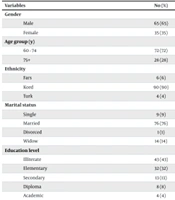
The mean age of the elderly was 72.13 (SD = 6.22), with 56.5% males. Most of the participants were widowed (50.50%). In terms of occupation, the highest percentage of them were retired (45.80%) and unemployed (26.50%). The source of income was pensioning for the majority of them (48%) and salary from the Imam Khomeini Relief Foundation for the minority of them (8%). Most of them had a private home (67.50%), and over 97.5% were covered by insurance. Considering diseases and disorders, 61.30% of them were ill, with the highest percentage related to cardiovascular problems (43%), followed by diabetes (23%) (Table 1).
Table 1.
Demographic Characteristics of Older Adultsa
| Variable | Values |
|---|---|
| Age | |
| 60 - 70 | 230 (57.5) |
| 71 - 80 | 148 (37.0) |
| ≤ 81 | 22 (5.5) |
| Gender | |
| Male | 226 (56.5) |
| Female | 174 (43.5) |
| Marital status | |
| Single | 16 (4.0) |
| Married | 166 (41.5) |
| Divorced | 16 (4.0) |
| Widowed | 202 (50.5) |
| Level of Education | |
| Less than a diploma | 307 (76.8) |
| Diploma | 84 (21.0) |
| Academic | 9 (2.3) |
| Employment status | |
| Employed | 59 (14.8) |
| Retired | 183 (45.8) |
| Disable | 52 (13.0) |
| Unemployed | 106 (26.5) |
| Illness | |
| Yes | 245 (61.3) |
| No | 155 (38.8) |
| Insurance | |
| Yes | 391 (97.8) |
| No | 9 (2.3) |
| Housing situation | |
| Personal | 270 (67.5) |
| Tenant | 99 (24.8) |
| Government-leased houses | 15 (3.8) |
| Relatives | 16 (4.0) |
| Source of Income | |
| Employed | 59 (14.8) |
| Retired | 192 (48.0) |
| Relatives | 72 (18.0) |
| Support organizations | 32 (8.0) |
| Caregiver | |
| Spouse | 152 (38.0) |
| Children | 174 (43.5) |
| Relatives | 29 (7.3) |
| Support organizations | 45 (11.3) |
aValues are expressed as No. (%).
Considering the mental health status, based on the K6, 55% of the elderly showed signs of low depression anxiety, 34% moderate, and 11% showed severe anxiety symptoms.
Regarding the status of well-being, 49.50% were in good condition (11.3 ± 3.3), 27.75% were in moderate condition (13.8 ± 2.9), and 22.75% were in poor condition (7.3 ± 2.6) (Table 2).
Table 2.
Mental Health Status of Older Adults According to K6 and Psychological Well-Being Indicesa
| Instrument | Scales | Values |
|---|---|---|
| K6 | Low | 220 (55.0) |
| Moderate | 136 (34.0) | |
| Severe | 44 (11.0) | |
| Psychological well-being | Complete | 91 (22.75) |
| Almost | 198 (49.5) | |
| Never | 111 (27.75) |
Abbreviation: K6, Kessler.
aValues are expressed as No. (%).
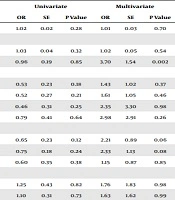
The results of multivariate analysis showed that if other variables were constant, one unit increase in age increased the chance of psychological distress by about 1.01 times, which was not statistically significant (P = 0.7). When other variables were constant, the female gender increased the chances of psychological distress by about 3.7 times, which was significant (P = 0.002). If other variables were constant, older adults who were supported by their relatives for income were about 4.5 times more likely to have severe psychological distress than those who had jobs, which was statistically significant (P = 0.008). Moreover, having a history of the disease increased the chance of mental distress by six times (P = 0.008). However, other variables were not significantly correlated with increased psychological distress. More details are shown in Table 3.
Table 3.
Significant Correlations Between Demographic Variables and Anxiety and Depression Status (K6)
| Anxiety and Depression Status (K6) | Univariate | Multivariate | ||||
|---|---|---|---|---|---|---|
| OR | SE | P Value | OR | SE | P Value | |
| Age | 1.02 | 0.02 | 0.28 | 1.01 | 0.03 | 0.70 |
| Gender | ||||||
| Male | 1.03 | 0.04 | 0.32 | 1.02 | 0.05 | 0.54 |
| Female | 0.96 | 0.19 | 0.85 | 3.70 | 1.54 | 0.002 |
| Marital status | ||||||
| Single | 0.53 | 0.23 | 0.18 | 1.43 | 1.02 | 0.37 |
| Married | 0.52 | 0.27 | 0.21 | 1.61 | 1.05 | 0.46 |
| Divorced | 0.46 | 0.31 | 0.25 | 2.35 | 3.30 | 0.98 |
| Widowed | 0.79 | 0.41 | 0.64 | 2.98 | 2.91 | 0.26 |
| Level of Education | ||||||
| Less than a diploma | 0.65 | 0.23 | 0.12 | 2.21 | 0.89 | 0.06 |
| Diploma | 0.75 | 0.18 | 0.24 | 2.33 | 1.13 | 0.08 |
| Academic | 0.60 | 0.35 | 0.38 | 1.15 | 0.87 | 0.85 |
| Employment status | ||||||
| Employed | 1.25 | 0.43 | 0.82 | 1.76 | 1.83 | 0.98 |
| Retired | 1.10 | 0.31 | 0.73 | 1.63 | 1.62 | 0.99 |
| Disable | 2 | 0.74 | 0.06 | 9.60 | 9.40 | 0.98 |
| Unemployed | 1.40 | 0.45 | 0.25 | 3.60 | 3.50 | 0.98 |
| Illness | ||||||
| Yes | 1.84 | 0.38 | 0.004 | 6 | 2.31 | 0.001 |
| Insurance | ||||||
| Yes | 0.14 | 0.09 | 0.001 | 0.40 | 0.60 | 0.54 |
| Housing situation | ||||||
| Personal | 0.47 | 0.12 | 0.43 | 0.32 | 0.14 | 0.21 |
| Tenant | 0.59 | 0.14 | 0.03 | 0.34 | 0.10 | 0.07 |
| Government-leased houses | 0.13 | 0.06 | 0.001 | 0.24 | 1.14 | 0.08 |
| Relatives | 0.04 | 0.02 | 0.001 | 0.45 | 1.23 | 0.62 |
| Source of Income | ||||||
| Employed | 1.23 | 0.23 | 0.84 | 3.23 | 6.45 | 0.78 |
| Retired | 1.01 | 0.28 | 0.97 | 5.40 | 7.70 | 0.98 |
| Relatives | 3.64 | 1.36 | 0.001 | 4.46 | 2.50 | 0.008 |
| Support organizations | 0.51 | 0.22 | 0.12 | 0.39 | 0.21 | 0.08 |
| Caregiver | ||||||
| Spouse | 1.43 | 0.34 | 0.03 | 1.32 | 0.67 | 0.45 |
| Children | 2.10 | 0.45 | 0.001 | 1.04 | 0.73 | 0.95 |
| Relatives | 0.50 | 0.20 | 0.08 | 1.50 | 1.16 | 0.60 |
| Support organizations | 3.90 | 1.60 | 0.001 | 1.45 | 1.40 | 0.70 |
In multivariate analysis, the results showed that if other variables were constant, one unit increase in age increased the chance of psychological well-being by 0.99 times, which was not statistically significant (P = 0.89). When other variables were constant, the female gender increased the chance of psychological well-being by about 1.5 times, which was statistically significant (P = 0.17). If other variables were constant, older adults who were unemployed had an 87% lower chance of psychological well-being, compared to employed elderly, which was statistically significant (P = 0.004). If other variables were constant, older adults who had no health insurance had about 84% less chance of psychological well-being than people covered by insurance, which was statistically significant (P = 0.04). No significant relationship was found between other variables and increasing psychological well-being. Further details are shown in Table 4.
Table 4.
Significant Correlation Between Demographic Variables and Psychological Well-Being
| Psychological Well-Being | Univariate | Multivariate | ||||
|---|---|---|---|---|---|---|
| OR | SE | P Value | OR | SE | P Value | |
| Age | 0.95 | 0.01 | 0.002 | 0.99 | 0.02 | 0.89 |
| Gender | ||||||
| Male | 1.03 | 0.04 | 0.32 | 1.02 | 0.05 | 0.54 |
| Female | 1.50 | 0.29 | 0.03 | 1.56 | 0.50 | 0.17 |
| Marital status | ||||||
| Single | 0.43 | 0.23 | 0.18 | 1.43 | 1.02 | 0.38 |
| Married | 0.55 | 0.27 | 0.23 | 1.27 | 0.77 | 0.69 |
| Divorced | 0.87 | 0.60 | 0.84 | 1.20 | 1.47 | 0.87 |
| Widowed | 0.40 | 0.20 | 0.06 | 1.02 | 0.86 | 0.98 |
| Level of Education | ||||||
| Less than a diploma | 0.64 | 0.14 | 0.21 | 2.18 | 1.11 | 0.06 |
| Diploma | 1.41 | 0.32 | 0.13 | 1.03 | 0.37 | 0.93 |
| Academic | 1.36 | 0.95 | 0.66 | 0.70 | 0.57 | 0.65 |
| Employment status | ||||||
| Employed | 1.04 | 0.24 | 0.64 | 1.46 | 1.4 | 0.74 |
| Retired | 0.41 | 0.12 | 0.003 | 0.30 | 0.42 | 0.39 |
| Disable | 0.29 | 0.11 | 0.001 | 0.42 | 0.36 | 0.32 |
| Unemployed | 0.06 | 0.02 | 0.001 | 0.13 | 0.09 | 0.004 |
| Illness | ||||||
| Yes | 0.88 | 0.17 | 0.50 | 0.72 | 1.85 | 0.21 |
| Insurance | ||||||
| Yes | 1.55 | 0.96 | 0.47 | 0.16 | 0.15 | 0.04 |
| Housing situation | ||||||
| Personal | 0.78 | 0.23 | 0.56 | 0.72 | 0.18 | 0.32 |
| Tenant | 0.93 | 0.20 | 0.74 | 0.83 | 0.23 | 0.50 |
| Government-leased houses | 2.40 | 1.20 | 0.06 | 2.24 | 0.16 | 0.25 |
| Relatives | 3 | 1.50 | 0.02 | 1.44 | 0.15 | 0.64 |
| Source of Income | ||||||
| Employed | 0.43 | 0.12 | 0.005 | 1.90 | 0.51 | 0.61 |
| Retired | 0.10 | 0.04 | 0.001 | 0.87 | 0.29 | 0.77 |
| Relatives | 0.08 | 0.04 | 0.001 | 0.61 | 0.96 | 0.34 |
| Support organizations | 0.51 | 0.22 | 0.12 | 0.39 | 0.21 | 0.08 |
| Caregiver | ||||||
| Spouse | 1.83 | 0.33 | 0.012 | 1.23 | 0.82 | 0.89 |
| Children | 0.72 | 0.15 | 0.12 | 1.32 | 0.68 | 0.59 |
| Relatives | 1.44 | 0.53 | 0.32 | 1.09 | 0.68 | 0.89 |
| Support organizations | 0.50 | 0.16 | 0.03 | 1.03 | 0.70 | 0.97 |
5. Discussion
Understanding the health status of the elderly can be effective in defining the applicable and infrastructural plans for this group. This study examined socioeconomic and health-related variables to learn more about the associations between these variables and to identify possible factors affecting the mental health of community-dwelling older adults.
The results of the regression analysis showed that age, sex, relatives as a supporting source of income, and history of chronic disease are associated with psychological distress. There was a significant relationship between the sex of the elderly and anxiety and depression. Some of the study results in Iran are in line with this finding (21, 22), while some studies did not report a statistically significant relationship (23), and some studies reported more anxiety in older women than in men.
It has also been reported that with increasing age, there is an almost equal prevalence of depression in both sexes (24). According to the self-report questionnaire, women in this study reported more psychological distress that may be due to their more attention and obsession with their health status, or because women in different situations in life are more vulnerable than men.
There was also a significant relationship between the marital status of the elderly and psychological distress. Single older adults had higher psychological distress. In two studies from Kerman and Shahroud, Iran, married elderlies were better off in terms of anxiety and depression (18, 25). Married people seem to have stronger support and better social relationships because of their spouses, which ultimately leads to more stable and better mental health.
The present study showed that the income status had a significant relationship with both psychological well-being and anxiety and depression. Elderly people with better economic status reported greater happiness, less anxiety, and less depression. In the study by Tajvar et al. (26), there was a positive relationship between living status (living alone or with family), age, marital status, education level, and economic status, and mental and physical health. It is necessary to have a good quality of life not only for covering the necessities of life but also as an important factor in community participation, as well as the enjoyment of hobbies and leisure activities.
The results showed a significant relationship between anxiety and depression and elderly caregivers. The highest rate of care for the elderly was achieved by their children (43.5%) and the least by relatives (7.30%). In line with the present study, the results of Heidari et al. (27) study showed that more than half of the elderly were cared for by their spouses and children, and a small proportion were supported by relatives and official organizations such as the Imam Khomeini Relief Foundation. In the study by Tajvar et al. (26), older adults living with family had a higher quality of life, and better health than older adults who lived alone and the health status of older people living with relatives was also poorer than that of older adults who lived alone, which was due to cultural and social diversity (26). Chalise et al. (28) also stated that spouses, children, siblings, and close friends could be the most important sources of social support for the elderly. The results of Negahban et al. (29) study showed that older people living with their spouses and children had more psychological support and more interactions and relationships, which increased the social capital of the elderly and increased their mental health.
Given that the elderly form a vulnerable group of society, and that changes in aging can affect the lives of the elderly and the community, appropriate planning is needed to promote a healthy lifestyle, create a supportive environment and develop supportive organizations, policies in this area should focus more on caring for them, promoting a healthy lifestyle, strengthening support organizations, and creating a supportive environment for vulnerable people.
5.1. Conclusions
The results showed that about half of the elderly in Qom had moderate anxiety and depression disorders, as well as moderate mental well-being, which indicates the moderate level of anxiety and mental disorders in the elderly in Qom. As the elderly population grows, the prevalence of their mental disabilities increases. This has raised concerns about the health and social care systems that are currently under pressure. Thus, health care systems need documented and reliable information to provide comprehensive care for the elderly. Moreover, according to the results of the study, increasing the financial independence of older people can have a positive impact on their mental health.