
1. Introduction
Population aging is a widespread global phenomenon (1). Aging is defined as a time-related disorder, indicating that over time, due to various factors, a person is exposed to damage that is not properly repaired (2). According to the World Health Organization, 727 million people aged 65 years and older will be living in 2025, and it is projected that by 2050, the number of elderly individuals will exceed 1.5 billion (3). The global population of people older than 60 years is expected to increase from 962 million in 2017 to 2.1 billion in 2050 (4). Consequently, population aging is an inevitable phenomenon in Iran’s future, necessitating the adoption of healthy aging policies.
Aging is a sensitive period of human life, and addressing the issues and needs of this stage is a social necessity. Given the specific needs of older adults, attention to health-promoting behaviors, which have often been neglected, is critically important (5). Although aging does not necessarily equate to declining health or increased disability (6), health problems among older adults, particularly mental health issues, become more pronounced alongside demographic shifts. Elderly individuals with limited or negative social relationships may develop thoughts that lead them to avoid contact with others, reinforcing negative self-perceptions. These stresses can trigger unpleasant emotions such as anxiety and depression, as well as major and minor physical illnesses (7). One of the key challenges many older adults face is communicating with new people and expanding their social circles (8). Thus, social isolation among older adults is a growing concern (9).
A substantial number of older adults are at risk of social isolation and social constraint due to broad changes in the social structure of societies. Evidence suggests that individuals with fewer social relationships are more likely to experience mental disorders, especially depression, suicidal behavior, alcoholism, addiction, reduced health and life expectancy, decreased quality of life and life satisfaction, increased disability, and a higher likelihood of hospitalization or admission to elderly care centers (10). These risks are particularly important for older adults given their specific physical, mental, and social conditions. Enhancing social capital among older adults may contribute to reducing healthcare expenditures (11). Moreover, given the relatively high prevalence of cardiovascular disease risk factors in older women and men, comprehensive planning is required to identify underlying causes and implement continuous education on lifestyle modifications, such as proper nutrition, exercise, and regular physical activity, as effective strategies to reduce cardiovascular burden (12). Studies indicate that cardiovascular risk factors, including obesity, hypertension, physical inactivity, and smoking, are significantly prevalent among older adults; therefore, screening, risk factor control, and health promotion efforts are strongly recommended (13).
Successful aging can be achieved by maintaining social participation and social status. To promote public health, it is essential to consider social capital, given its substantial impact on individuals’ lives (14). Maintaining communication with others is crucial for achieving successful aging, which comprises health, longevity, and happiness, and this goal is more attainable through increased social capital (15). Studies have demonstrated that attention to social determinants of health, including social capital and social participation, plays a significant role in promoting the health of older adults (16). Social capital is directly associated with reduced mortality, improved health, greater happiness, and poverty reduction (17).
Social capital is a relatively new and evolving concept in social research, yet it is deeply rooted in human social relations. It is defined as the funds of social life, including networks, norms, and social trust, that enable individuals to act collectively and effectively toward common goals (18). Social capital encompasses relationships, shared values, and trust among individuals and groups, facilitating collaboration and the achievement of collective objectives; it is inherently multidimensional (19). It primarily derives from relationships with family, neighbors, religious communities, and broader society, and it contributes to both mental well-being and physical health (20). Social capital constitutes a resource available to individuals through membership in specific groups or networks and is personally realized through social networks or structures. Robert Putnam, in his theory of social capital, argues that communication and social networks significantly influence individual and social outcomes, including health behaviors. Putnam conceptualizes social capital as comprising features of social organization, such as networks, norms, and trust, that enable coordination and cooperation for mutual benefit (21). The core components of social capital therefore include mutual trust, support, cooperation, and reciprocal relations among members of a society. Given the specific challenges of old age and the protective role of social capital, investigating this form of capital in later life is more necessary than ever.
As Iran is beginning to experience population aging, it is imperative to address health-related issues among older adults. Identifying the health status of older adults is the first step toward health promotion and the ultimate goal of successful aging. Given the undeniable importance of social capital in achieving life satisfaction, quality of life, public health, and successful aging, the need to examine this variable in the elderly population is increasingly evident. Moreover, given the scarcity of studies on this topic in Iran, particularly in Kermanshah, more extensive research in this area is warranted.
Studying social capital within a hospital setting is particularly important for several reasons. Hospitals serve as a critical interface at which elderly individuals, often with heightened health and social vulnerabilities, interact with the healthcare system. Social capital, encompassing trust, networks, and social support, can directly influence health-seeking behaviors, adherence to medical advice, and the ability to navigate complex healthcare processes (22). Furthermore, robust social capital is associated with better postdischarge outcomes, including reduced readmission rates, improved recovery from acute illnesses, and more effective management of chronic conditions common among older adults (23). For older adults, a hospital visit itself can represent a period of heightened need for social and instrumental support, making it a strategic context in which to assess social resources that may buffer against health declines. Therefore, investigating social capital in this setting allows for the identification of modifiable factors that can be integrated into holistic care plans, ultimately aiming to enhance both immediate healthcare experiences and long-term health trajectories in the aging population.
Therefore, this study was conducted to determine social capital among elderly individuals visiting Imam Ali Hospital in Kermanshah.
2. Methods
2.1. Study Design and Setting
This descriptive cross-sectional study was conducted at Imam Ali Hospital in Kermanshah, Iran.
2.2. Participants and Sampling
The sample comprised 100 elderly individuals aged 60 years or older who visited the hospital. Participants were recruited using convenience sampling. They were consecutively invited to enroll during the data collection period based on availability, fulfillment of the inclusion criteria, and willingness to participate until the target sample size was reached.
The target sample size was set at 100 participants. This number was determined based on practical considerations for a preliminary descriptive cross-sectional study, including the data collection timeframe and the expected patient flow at the study site, while aiming to provide a stable estimate of key descriptive statistics.
2.3. Measures
Data were collected using two instruments.
Demographic and Health Information Form: This researcher-developed form collected data on age, gender, marital status, education level, occupation, economic status, home ownership, history of chronic illness, physical exercise, use of mobility aids, and lifestyle factors.
Social Capital Scale: Social capital was measured using the 36-item Onyx and Bullen Social Capital Scale (Onyx & Bullen, 2000). In this study, the officially Persian-translated and validated version for the Iranian elderly population was administered (Eftekharian et al., 2016). This version has demonstrated good reliability, with a reported Cronbach alpha of 0.96 for the total scale in the validation study. The scale measures 8 dimensions: local community participation, social agency/proactivity, feelings of trust and safety, neighborhood connections, connections with family and friends, tolerance of diversity, work connections, and value of life. Items are rated on a 4-point Likert scale from 1 to 4. The total score ranges from 36 to 144, with higher scores indicating higher perceived social capital.
2.4. Data Collection Procedure
After obtaining the necessary permissions, the researcher approached potential participants at the hospital. The study objectives, procedures, voluntary nature of participation, and confidentiality of information were explained in detail. Informed verbal consent was obtained from all participants before administering the questionnaires. To ensure comprehension, particularly given the elderly population, the questionnaires were completed through face-to-face interviews conducted by the researcher.
2.5. Ethical Considerations
The study protocol was approved by the Ethics Committee of Kermanshah University of Medical Sciences (Ethics Code: IR.KUMS.REC.1398.033). All participants provided informed verbal consent. Participants were assured of the confidentiality of their data and their right to withdraw from the study at any time without any consequences for their medical care.
2.6. Data Analysis
Data were analyzed using SPSS software version 16. Descriptive statistics, including frequency, percentage, mean, and standard deviation, were used to summarize demographic characteristics and social capital scores. Inferential statistics, including independent t-tests, analysis of variance, or correlation tests, as appropriate, were used to examine relationships between variables. A P value of less than 0.05 was considered statistically significant.
The normality of continuous variables was assessed using the Shapiro-Wilk test. Based on this assessment, parametric tests, including Pearson correlation and the independent t-test, were used for normally distributed data, whereas nonparametric equivalents, including Spearman correlation and the Mann-Whitney U test, were applied when the normality assumption was violated.
3. Results
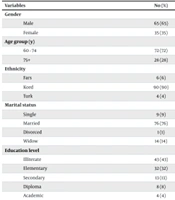
The aim of this study was to examine the relationship between social capital and the demographic characteristics of elderly individuals visiting Imam Ali Hospital. This section presents the findings based on the statistical analyses outlined in the Methods. The normality of continuous variables was assessed using the Shapiro-Wilk test, which guided the selection of parametric or nonparametric tests, as appropriate. The results are summarized in Tables 1-3.
Table 1.
Frequency and Percentage Distribution of Demographic Characteristics of Elderly Participants (N = 100) a
| Variables | No (%) |
|---|---|
| Gender | |
| Male | 65 (65) |
| Female | 35 (35) |
| Age group (y) | |
| 60 - 74 | 72 (72) |
| 75+ | 28 (28) |
| Ethnicity | |
| Fars | 6 (6) |
| Kord | 90 (90) |
| Turk | 4 (4) |
| Marital status | |
| Single | 9 (9) |
| Married | 76 (76) |
| Divorced | 1 (1) |
| Widow | 14 (14) |
| Education level | |
| Illiterate | 43 (43) |
| Elementary | 32 (32) |
| Secondary | 13 (13) |
| Diploma | 8 (8) |
| Academic | 4 (4) |
| Economic situation | |
| Low | 69 (69) |
| Medium | 27 (27) |
| High | 4 (4) |
| Residence type | |
| Personal home | 37 (37) |
| Rent | 53 (53) |
| Without paying money | 10 (10) |
| Employment status | |
| Employed | 2 (2) |
| Retired | 32 (32) |
| Unemployed | 17 (17) |
| Self-employed | 10 (10) |
| Employed after retirement | 19 (19) |
| Housewife | 20 (20) |
| Income source | |
| Occupational income | 16 (16) |
| Pension | 27 (27) |
| Spouse's pension | 13 (13) |
| Supporters organization | 3 (3) |
| Support from children/relatives | 25 (25) |
| Investment | 4 (4) |
| Without income | 12 (12) |
a Percentages may not total 100 because of rounding.
Data from 100 participants were analyzed, including 65 men and 35 women, with a mean age of 69.42 years (standard deviation: 6,243).
According to Table 1, participants were divided into 2 age groups: young elderly adults aged 60 - 74 years and elderly adults aged 75 years or older. The results are summarized below.
Table 2 presents the mean scores and standard deviations for the total Social Capital Scale and its subscales among the studied elderly participants.
Table 2.
Mean Scores and Standard Deviations of the Total Social Capital Scale and Its Subscales Among the Studied Elderly Participants (N = 100)
| Social Capital Scale/Subscale | Possible Score Range | Mean (SD) |
|---|---|---|
| Participation in local community | 7 - 28 | 13.11 (3.32) |
| Social agency/proactivity | 7 - 28 | 16.63 (3.47) |
| Feelings of trust and safety | 5 - 20 | 11.42 (2.54) |
| Neighborhood connections | 5 - 20 | 11.53 (2.77) |
| Connections with family/friends | 3 - 12 | 7.01 (1.65) |
| Value of life | 2 - 8 | 4.93 (1.23) |
| Work connections | 3 - 12 | 7.36 (2.11) |
| Tolerance of diversity | 2 - 8 | 4.35 (1.25) |
| Total social capital score | 36 - 144 | 81.77 (12.51) |
Table 3 shows the correlations between social capital and quantitative variables.
Table 3.
Correlation Between Social Capital and Quantitative Variables
| Variables | Correlation | P-Value |
|---|---|---|
| Age | -0.179 (Pearson) | 0.074 |
| Number of daughters | -0.163 (Spearman) | 0.104 |
| Number of sons | -0.138 (Spearman) | 0.171 |
| Total number of children | -0.201 (Spearman) | 0.045 |
4. Discussion
The findings of this study indicate a meaningful, albeit modest, inverse relationship between age and social capital among elderly individuals in Kermanshah, suggesting that social capital may diminish in later years. This trend aligns with life-course theories, which posit that aging may be accompanied by role losses, such as exiting the workforce or the death of spouses and peers, thereby shrinking social networks and opportunities for engagement (24). Furthermore, age-related declines in physical health and mobility may create practical barriers to maintaining social participation, a core component of social capital (25). These findings imply that interventions aimed at preserving social capital should particularly target the oldest-old and incorporate mobility-friendly and accessible formats of social engagement.
An important finding was that men in our sample reported higher levels of social participation and a stronger sense of life value than women. This discrepancy may be interpreted through the lens of prevailing sociocultural norms and gender roles in the Kurdish-majority context of Kermanshah. Traditional gender roles often grant men greater autonomy, mobility, and access to public social spaces, such as teahouses and public parks, thereby facilitating both formal and informal social participation (26). Conversely, older women’s social spheres tend to be more domestically oriented and kin-based, which may not be fully captured by scales measuring broader community participation. This gendered pattern is not unique to Iran; similar disparities have been reported in other traditional and transitioning societies. However, it underscores the need for gender-sensitive approaches to promoting social capital. Interventions must create accessible, safe, and culturally appropriate social opportunities for elderly women, recognizing that their existing forms of social contribution, often centered on family and caregiving, may represent undervalued forms of social capital.
Our study found a significant negative correlation between the total number of children and social capital, an intriguing result that merits contextual interpretation. In Western contexts, larger families are often associated with greater social support and expanded networks. However, in settings characterized by socioeconomic challenges, a larger number of adult children may paradoxically represent a source of financial and caregiving strain for elderly parents (27). Adult children facing economic precarity may themselves require support from aging parents, thereby depleting, rather than augmenting, the parents’ social and personal resources. This finding suggests that the quality and reciprocity of close relationships, rather than their sheer quantity, may be more critical to maintaining social capital in later life, particularly among populations facing economic hardship. Future research should examine qualitative dimensions of intergenerational relationships to better understand this counterintuitive finding.
When situated within the specific local context, our findings gain further nuance. The sample profile, characterized by a high proportion of individuals with low formal education and low self-reported economic status, reflects broader regional socioeconomic conditions in western Iran. In such environments, material constraints directly inhibit social participation through mechanisms such as transportation costs, expenses associated with social activities, and limited access to communication technologies (28). Economic insecurity also contributes to a diminished sense of control and perceived life value, both of which are key psychosocial dimensions of social capital. Therefore, efforts to enhance social capital among this population cannot be purely psychosocial or behavioral; they must be coupled with, or at minimum consider, strategies to address fundamental socioeconomic insecurity. Community-based interventions that reduce financial barriers to participation, such as subsidized transportation or free community programs, may be particularly impactful.
The central role of social capital in health is strongly supported by our findings and the wider body of literature. Consistent with previous research, our study confirms that stronger social capital is associated with better mental health outcomes, including lower rates of depression and higher quality of life among older adults (29). These health benefits likely operate through multiple mechanisms, including the provision of emotional support, reinforcement of healthy behaviors through social norms, facilitation of access to tangible resources and health information, and buffering of stress responses. Our results are consistent with studies conducted in other provinces of Iran and internationally, reinforcing the universality of the relationship between social capital and health (30-37). At the same time, our findings highlight the importance of local mediators, particularly gender roles and socioeconomic status, that shape how social capital is accumulated and mobilized. This suggests that while global frameworks for understanding social capital are valuable, they must be adapted to reflect the lived realities of specific aging populations.
4.1. Limitations
This study has several limitations. Owing to its cross-sectional design, causal relationships cannot be established. The single-center convenience sample of hospital visitors limits generalizability to the broader elderly population. The data relied on self-report, which may be subject to bias. In addition, the sample may lack diversity, and the modest sample size (N = 100) precluded more detailed subgroup analyses. Future longitudinal, multicenter studies with larger, randomly selected community samples are recommended.
4.2. Conclusion
This study highlights social capital as a key determinant of health and well-being among older adults in Kermanshah. The findings reinforce its role in promoting mental health and quality of life. To translate this evidence into practice, community-based programs tailored for older adults, particularly women, are recommended. Furthermore, integrating social capital assessments into routine geriatric care in healthcare settings could facilitate proactive social prescribing to community resources. Finally, creating age-friendly public spaces that encourage social interaction is a vital urban planning strategy. These measures may help leverage social connections as a powerful resource for healthy aging in similar sociocultural contexts.