


1. Background
Although spirituality received the attention of thinkers for a long time, careful attention to it and considering it as one of the dimensions of health dates back to recent years (1). Nowadays, spiritual well-being is accompanied by other dimensions of health such as physical, mental, and social health (2).
Students are considered as the most important class of society and face various issues in their personal and social lives, and considering significant and positive effects of spiritual well-being, promoting this aspect of health is of great importance. Farahani’s study on nursing students showed that 8.98% of freshman and all seniors had moderate spiritual well-being (3).
People sometimes construe spiritual well- being as religious practices. A lot of people achieve spirituality by religion. Since people are different, what may cause some people comfort and peace may be inefficient for others (4).
Pernod and Morse showed that people who considered themselves religious were more hopeful in comparison with the others (5). Spiritual well-being disorders can cause mental confusion, depression, and loss of the meaning of life (2). In their studies, many scientists found that spirituality has major effects on the mental health of people (6); religious beliefs and having faith in God, as the origin of truth and a superior and absolute power, can cause more tolerance to failures and can help physical and mental health, and ultimately raises hope for future .Hope is a symbol of mental dimensions and is related to physical and mental health and means the ability to believe in better feelings towards future (7).
But, hopelessness is completely the opposite; it is the main specification of depression. Hopelessness means dejection resulted from depression, which may appear as loss of hope for the future (8).
Numerous studies suggested that hope and spiritual well-being are meaningful components of one’s life. For example, the result of a study by McClain et al. showed that spiritual well-being has strong effects on the feeling of disappointment as the result of the end of life in patients with cancer (9).
According to Bandura, perceived inefficacy plays an important role in depression, anxiety, stress, hopelessness, and other emotional struts. In other words, self-efficacy refers to an individual’s judgments about his own abilities (10). Religious beliefs and spirituality, often as combat strategies, are related to psychological features of each individual. Studies showed that the two concepts of spirituality and believing in self-efficacy correlate with each other; therefore, self-efficacy and spiritual well- being are considered as strong motivations for individual’s development (11).
The study by Asghari et al. suggested that self-efficacy and spiritual well-being have a positive and significant correlation (12). The study by Cheung and Sun also showed that self-efficacy increase was related to improvement in mental health (13).
Due to the importance of spiritual well-being of students and considering that most studies just worked on evaluating the spiritual well-being of students, and the fact that hopelessness is studied less, the current study aimed at investigating the relationship between spiritual well-being, hopelessness, and self-efficacy in students.
2. Objectives
The present study was carried out in order to determine the relationship between spiritual health and hopelessness to Self-efficacy in students of Isfahan University of Medical Sciences.
3. Materials and Methods
The current descriptive-correlational study was conducted on 175 students of medicine, health, and modern technologies and medical sciences faculties of Isfahan University of Medical Sciences, Isfahan, Iran.
Subjects were selected randomly and the data were collected by a four-item self-administered questionnaire as follows:
1- Demographic characteristics (age, gender, educational level, marital status, parents` education)
2- The Ellison and Paloutzian spiritual well-being scale
3- Beck hopelessness scale
4- General self-efficacy questionnaire
The Ellison and Paloutzian spiritual well-being scale developed in 1982 (14) has 20 items scored based on a six-option Likert scale as “strongly disagree, disagree, relatively disagree, relatively agree, agree, strongly agree”. Ten items measure existential well-being. The total score of the scale is the sum of the two sub-groups ranging 20 to 120. Spiritual well-being is divided into three sub-groups called low (20 - 40), moderate (41 - 99), and high (100 - 200) well-being. Validity and reliability of this scale were confirmed and evaluated in Iran by Abbasi. Cronbach’s alpha coefficient of the scale was 82% and its reliability was also confirmed (3).
Beck hopelessness scale is one of the most applicable tools in psychiatry around the world developed in 1974 (15).
This test contains 20 sentences. The respondents should evaluate their attitudes toward the sentences and give them the answer true or false. The items 1, 3, 5, 6, 8, 10, 13, 15, and 19 should be answered no or false, as the correct choice. The scale total scores range 0 to 20. Higher scores indicate more hopelessness. The validity and reliability of the Persian version of the test were confirmed in Iran (16).
General self-efficacy scale was developed in 1979. It initially had 20 items with two separate sub-scales called general self-efficacy and social self-efficacy. In 1981, it was revised to a 10-item scale. It was translated into a lot of languages and its validity and reliability were also confirmed in Iran (17). This scale is also scored based on a four-option Likert scale as always, sometimes, seldom and always, and never. The maximum and minimum scores in this scale are 10 and 14, respectively. The higher scores indicate more self-efficacy.
To observe ethical principles, the questionnaires were completed anonymously. Also, consent forms were signed by the respondents. Some explanations were provided about the confidentiality and optionality of participating in the study. The collected data were transferred to the computer and analyzed with SPSS version 16.To classify well-being status, the mean score was considered as moderate, lower than mean as weak, and higher than mean as desirable.
To analyze the data in the current study, descriptive analysis, chi-square test and Pearson-Spearman correlation were used. The significant level was considered < 0.05.
4. Results
Totally, 175 students of three faculties of Isfahan University of Medical Sciences completed the questionnaire: 35 (20%) students from the faculty of medicine, 89 (50%) from the faculty of health, and 51 (30%) from the faculty of modern technologies of medical sciences. The mean age of the participants was 23.8 ± 0.29 years. Among the participants, 42.6% were male and the rest were female. About 70% of the students were single and the remaining were married. In terms of educational level, 47.7% were BSc students, 28.4% MSc, and the reminding were PhD students. In terms of paternal education, 9.7% were illiterate, 32.4% with no diploma, 48.3% diploma to B.A./BSc, and the remaining had M.A./MSc or higher degrees; considering maternal education, 15.3% were illiterate, 39.8 % with no diploma, 42.6% diploma to B.A./BSc and the remaining had M.A./MSc or higher degrees (P < 0.001).
Comparison between males and females showed that the mean score of hopelessness was significantly higher in males than females (P < 0.001).
Also, the mean score of spiritual well-being of the students was 97.5 and the mean score of hopelessness was 3.58.
Table 1 shows spiritual well-being, self-efficacy, and hopelessness status of the students. The information about how spiritual well-being, hopelessness, and self-efficacy were related to each other is displayed in Table 2 and Figure 1.
Table 1.Absolute and Relative Distribution Frequency of Self- efficacy, Spiritual Well-Being, and Hopelessness of the Students Under Study
| Status | No. (%) |
|---|---|
| Spiritual well-being | |
| High (100 - 120) | 89 (50.9) |
| Moderate (41 - 99) | 83 (47.2) |
| Low (20 - 40) | 4 (2.3) |
| Hopelessness | |
| High (> 14) | 41 (23.3) |
| Moderate (8 - 14) | 110 (62.5) |
| Low (< 8) | 25 (14.2) |
| Self-efficacy | |
| High (> 24) | 119 (67.6) |
| Moderate (16 - 24) | 55 (31.2) |
| Low (< 16) | 2 (1.2) |
Table 2.Correlation Coefficient Between Spiritual Well-Being and Self-Efficacy of the Students Under Study
| Criterion Variable | Pearson Correlation Coefficient R | Significance Level P | Number |
|---|---|---|---|
| Hopelessness | -0.63 | ≤ 0.001 | 175 |
| Self-efficacy | 0.41 | ≤ 0.001 | 175 |
| Hopelessness | -0.50 | ≤ 0.001 | 175 |
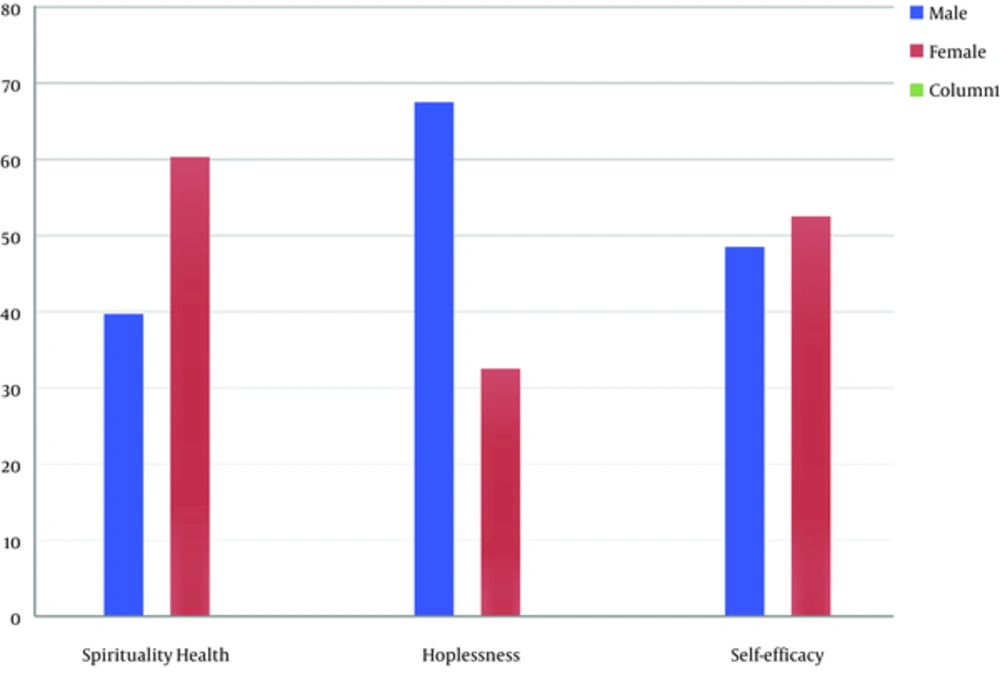
Figure 1.
The difference of spiritual health, hopelessness, and self-efficacy between males and females
5. Discussion
The finding of the study showed that spiritual well-being level of most of the students was high and moderate. This corresponds to those of Rahimi et al. (18) and Hsiao et al. (19). High level of spiritual well-being may be resulted from cultural and religious conditions of Iran’s society. In the current study, females’ mean score of spiritual well-being was more than that of males and this finding corresponds to that of the study by Saydshohadaiet al. (20).
Also, in the study by Kandaasmay et al. in India (21), females` spiritual well-being level was more desirable than that of males. It can be concluded that, in Islamic societies, religious beliefs in are stronger in females than in males.
Also, corresponding with the finding of the studies by Mesbah about the student of University of Tehran (22) and Dixon et al. (23), male students showed more significant hopelessness than female students and specifying this fact needs more studies. Further studies on the attitudes of the two genders toward future are recommended.
The result of the current study did not show a signification relationship between spiritual well-being and education and this corresponds to the results of the study by Highfield (24) and does not correspond to those of Saydshohadai et al. (20) and Rezai et al. (25).
These results showed a significant relationship between spiritual well-being and education in patients with cancer and this relationship was stronger in the patients with elementary education. The difference between these results may be attributed to the statistical population of the current study including healthy students studying at university that were not very different regarding the educational level.
Another result is the significant relationship between hopelessness and spiritual well-being. In the current study, the students with higher spiritual well-being level felt less hopeless and it corresponded to the results of the studies by Ghobari et al. (26) and Daaleman (27).
In other words, people with more spiritual well-being felt less hopeless according to the findings of the current study and comparing the results with those of the previous studies, it can be concluded that in most cases there was a significant and negative relationship between spirituality, hopelessness, and also depression indicating the intensity and strength of this relationship. Among social factors, it can be referred to important and preventive role of spiritual well-being against disorders of mental well-being.
According to the results of the current study, there was a significant and positive relationship between spiritual well-being and self-efficacy. Yarasi (28) found a significant and positive relationship between these two variables corresponding to the result of the current study.
The results of the current study corresponded to those of Asghasri et al. (12) and Duggleby et al. (29), which focused on the development of self-efficacy beliefs.
According to Bandura, when felling stress, those who see themselves efficient and capable to confront difficulties try more to overcome and cope with those difficulties, but those who see themselves inefficient and incapable give up easily and feel anxious, depressed, and hopeless (30). The findings of the current study showed a significant and revers relationship between hopelessness and self-efficacy.
This result corresponded to the results of Najafi et al. (31). Results of the current study showed that self-efficacy was a strong predictor for mental well-being. According to Bandura’s theory about self-efficacy, emotions, cognition, and one’s thoughts, it is not expected to obtain these results since when people face negative events, felling self-efficient helps them to control these situations and events and as a result they can control and protect themselves against their mental problems.
Among the limitations of the current study, investigating the students of only three faculties due to time limit can be mentioned. Participants’ tiredness, lower level of trust and responsibility to answer the questions were other limitations of the study.
5.1. Conclusions
According to the current study results, spiritual well-being plays an important role in predicting hopelessness and self-efficacy of students. Therefore, the authorities of educational system should consider it when they want to codify the educational system for students. In fact, promoting psychological well-being is considered as one of the basic foundations in education, which should be taught to students.



