


1. Background
According to the World Health Organization’s definition of health, mental well-being is one of the most important dimensions of being healthy, alongside social and physical well-being (1). Mental health is a key health indicator related to thoughts, feelings, and behaviors. In other words, being mentally healthy is a state in which a person can overcome the natural stresses of life, work effectively, and participate in social activities. It enables individuals to be compatible with themselves and others and cope with life’s challenges. Thus, mental health is essential for maintaining proper social, occupational, and academic performance and achieving success (2).
In recent years, there has been increasing literature focusing on spiritual health and its influence on mental health indicators. Spiritual health can be defined as the ability to communicate with others, find meaning and purpose in life, and establish a relationship with an exalted power (e.g., God) (3). Individuals with high spiritual health adapt to their issues and problems more easily, and strengthening spiritual health increases adaptability. Additionally, spiritual health fosters a new and positive attitude toward oneself, others, and the surrounding world (4).
Resilience, as a process, is the ability to adapt successfully to threatening conditions. It is considered a person's positive adaptation to adverse circumstances, including injuries and threats. However, resilience is not merely about stability in the face of damages or threatening situations. It is not a passive state but rather a dynamic and constructive behavior in the surrounding environment. Resilience serves as a protective factor, playing a critical role in an individual’s success and survival in unfavorable circumstances (5, 6).
From Newman’s perspective, mental resilience refers to the ability to adjust to difficulties. Within a disease stress model, individuals are believed to develop a disease or disorder only if they have the biological, psychological, or psychosocial predisposition to suffer from it and experience stress. However, many individuals with a predisposition to various diseases do not become ill. Effective resilience-based methods prevent people from being overwhelmed by stress (7). A person's successful coping with stressful factors and difficult life situations, along with physical health and psychological well-being, requires the additional ability of resilience (8).
Self-efficacy refers to a person's belief in their abilities to perform specific behaviors and can significantly influence their performance and well-being. Self-efficacy encompasses a person's trust and confidence in effectively performing self-care tasks, thereby enabling them to achieve more favorable outcomes from self-care efforts (9, 10).
Medical students are particularly prone to mental health problems due to the length of their studies, the necessity of their presence in hospitals, and their interactions with patients. A lack of complete mental health among students can lead to academic failure, reduced motivation, increased stress, and a considerable waste of intellectual potential in addressing such challenges (11, 12). The mental and spiritual health of students, especially medical students, is of particular importance, given their future roles in safeguarding the physical and mental health of others. According to recent studies, the prevalence of mental illnesses among students worldwide is gradually increasing (13).
Studying spiritual health, resilience, and Self-efficacy in universities is crucial because these factors directly affect students' academic progress. Student life presents several challenges, including unfamiliarity with the new academic environment, distance from family, lack of interest in the field of study, difficulties in adapting to peers in a shared living environment, socioeconomic problems, and inadequate welfare facilities. These issues can provoke psychological distress and discomfort, ultimately leading to academic failure (14, 15).
Given the importance of mental health in addressing the challenges faced by medical students, this study measured the levels of spiritual health, resilience, and Self-efficacy among a group of medical students at Shahid Beheshti University of Medical Sciences.
2. Objectives
Additionally, the research aims to examine the impact of spiritual health on resilience and Self-efficacy and to evaluate the associations between these three variables. See the conceptual framework (Figure 1).
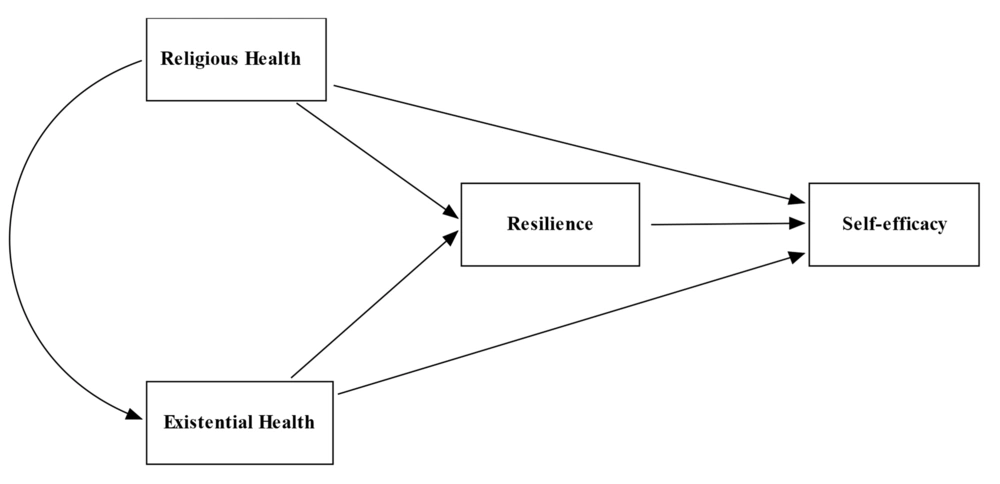
Figure 1.
A conceptual frame work showing the effect of spiritual health (consists of religious and existential health) on resilience and self-efficacy
3. Methods
3.1. Population and Sample
The statistical population of the current study included all medical students of Shahid Beheshti University of Medical Sciences who were studying medicine during the 2021 academic year. From this population, a sample of 300 students was selected using the simple random sampling method, consisting of 172 males and 128 females. Voluntary participation was considered an inclusion criterion, while incomplete questionnaires were considered an exclusion criterion.
In addition to questions about their demographic characteristics, participants were asked to complete three questionnaires to assess their spiritual health, resilience, and Self-efficacy. The demographic data of the participants are presented in Table 1.
Table 1.Demographic Characteristics of the Studied Subjects
| Demographic Characteristics and Subgroups | Frequency (%) |
|---|---|
| Age | |
| ≥ 20 | 72 (24.0) |
| 21 - 25 | 165 (55.0) |
| 26 - 30 | 63 (21.0) |
| Gender | |
| Male | 172 (57.3) |
| Female | 128 (42.7) |
| Marital status | |
| Single | 264 (88.0) |
| Married | 36 (12.0) |
| Educational level | |
| Extern | 83 (27.7) |
| Intern | 139 (46.3) |
| Basic science | 78 (26.0) |
| Economic status | |
| Low | 12 (4.0) |
| Middle | 194 (64.7) |
| High | 106 (35.3) |
| Very high | 217 (72.3) |
3.2. Measures
3.2.1. Spiritual Health
The Spiritual Well-Being Scale (SWB) was first designed by Ellison in 1983. He conceptualized spiritual well-being as having two components: Religious well-being (RWB) and existential well-being (EWB). Each subscale consists of ten items. Each item is rated on a 6-point Likert scale ranging from 1 (strongly disagree) to 6 (strongly agree). Scores in the current study range from 10 to 60 for each subscale. The total score for spiritual health is the sum of the scores from these two subgroups, ranging from 20 to 120.
The classification of scores is as follows: Low spiritual health (20 - 40), average spiritual health (41 - 99), and high spiritual health (100 - 120). Ellison reported the reliability of the SWB test as 0.93, with 0.96 for RWB and 0.86 for EWB. Additionally, Ellison established the scale's face validity and its theoretical correlation with other scales measuring spirituality (4).
The SWB scale was standardized in Iran by Seyedfatemi et al. in 2006, with validity assessed through qualitative content validity. The questionnaire’s reliability was reported with a Cronbach’s alpha of 0.82 (16).
3.2.2. Resilience
Resilience is measured using the Connor and Davidson Resilience Scale (CD-RISC). This questionnaire consists of 25 items and is designed to assess the level of resilience in individuals. Each item is rated on a 5-point Likert scale: 0 (not true at all), 1 (rarely true), 2 (sometimes true), 3 (often true), and 4 (true nearly all of the time) (17). The minimum possible resilience score on this scale is 0, and the maximum is 100.
Preliminary studies on the psychometric properties of this scale have confirmed its reliability and validity. Its internal consistency, test-retest reliability, and convergent and discriminant validity have been reported as adequate (18). Mohammadi standardized the scale in Iran, using exploratory factor analysis to establish validity and the Cronbach's alpha method to determine reliability. He reported a reliability coefficient of 0.89 for the Connor and Davidson Resilience Scale (19).
3.2.3. Self-efficacy
Sherer’s Self-efficacy Scale is used to measure Self-efficacy. This scale consists of 17 statements. The scoring is based on a 5-point scale: Completely disagree (1 point), disagree (2 points), intermediate (3 points), agree (4 points), and completely agree (5 points). The highest possible score is 85, and the lowest is 17. The scoring of questions 2, 4, 5, 7, 11, 12, 14, and 16 is reversed. A higher score on this scale (closer to 85) indicates greater Self-efficacy, and vice versa (20).
Woodruff and Cashman validated this scale and confirmed its reliability, reporting an internal consistency coefficient of 0.83 (21). In Asgharnejad et al.’s research, the Cronbach's alpha reliability coefficient was also reported as 0.83 (22).
In this study, the validity of the scale was assessed using factor analysis with principal components analysis and varimax rotation, applied to the 17 items of the questionnaire. Preliminary tests were conducted to evaluate the suitability of the sample for factor analysis, including the Kaiser-Meyer-Olkin (KMO) measure of sampling adequacy and Bartlett's test of sphericity. The KMO coefficient was 0.87, and Bartlett’s test result was 408.1553 (P < 0.001), indicating the appropriateness of the data for factor analysis. The factor analysis results revealed three factors with eigenvalues greater than one.
3.3. Statistical Analysis
To check the normal distribution of the data, skewness and kurtosis tests were used, with acceptable values in the interval (-2, 2). The data were statistically analyzed using descriptive statistical methods, including frequency, percentage, mean, and standard deviation. Additionally, Pearson's correlation coefficient and path analysis were applied. The analyses were performed using SPSS version 16 and EQS 6.4 software.
4. Results
4.1. Demographic Characteristics of the Studied Subjects
Table 1 presents the demographic characteristics of the studied subjects, including age, gender, marital status, educational level, economic status, and the number of family members.
A total of 300 medical students participated in this study, comprising Externs (27.7%), Interns (46.3%), and Basic Science students (26%). Of these participants, 57% were male, and 43% were female. Additionally, 88% of the studied subjects were single, while 12% were married. Regarding economic status, 2% of participants reported poor financial status, 62.5% had average financial status, 31.5% had good financial status, and 4% had excellent financial status (Table 1).
Table 2 presents the descriptive statistics, including the minimum, maximum, mean, and standard deviation of the variable’s spiritual health, resilience, and total Self-efficacy in the studied subjects. The mean values for spiritual health, resilience, and Self-efficacy were 73.02, 79.67, and 59.01, respectively.
Table 2.Descriptive Statistics of Spiritual Health, Resilience and Total Self-efficacy in the Studied Subjects
| Variables | Minimum - Maximum | Mean ± SD | Skewness | Kurtosis |
|---|---|---|---|---|
| Religious health | 10.00 - 59.00 | 39.90 ± 13.74 | -0.870 | 0.165 |
| Existential health | 9.00 - 54.00 | 29.57 ± 10.77 | 0.441 | -0.623 |
| Spiritual | 26.00 - 115.00 | 73.11 ± 23.45 | -0.115 | -0.637 |
| Resilience | 49.00 - 125.00 | 79.56 ± 17.92 | -0.033 | -0.348 |
| Self-efficacy | 33.00 - 85.00 | 59.07 ± 12.67 | -0.177 | -0.574 |
The skewness values indicate the symmetry of the data distribution, while the kurtosis values reflect whether the data are heavy-tailed or light-tailed relative to a normal distribution. These metrics provide insight into the distribution characteristics of the variables (Table 2).
The results of the Pearson correlation test indicate a direct and significant statistical correlation between resilience and Self-efficacy (r = 0.620), demonstrating that Self-efficacy increases significantly as resilience improves. Additionally, the analysis shows a direct and significant correlation between spiritual health and resilience (r = 0.615), suggesting that resilience increases significantly with an improvement in spiritual health (Table 3 and Figure 2).
Table 3.Examining the Correlation Between Spiritual Health, Existential Health, Resilience and Self-efficacy in the Studied Subjects
| Variables | Religious Health | Existential Health | Spiritual Health | Resilience |
|---|---|---|---|---|
| Existential Health | ||||
| Pearson Correlation | 0.587 | 1 | ||
| P-value | < 0.001 | |||
| Spiritual health | ||||
| Pearson Correlation | 0.918 | 0.858 | 1 | |
| P-value | < 0.001 | < 0.001 | ||
| Resilience | ||||
| Pearson Correlation | 0.530 | 0.527 | 0.615 | 1 |
| P-value | < 0.001 | < 0.001 | < 0.001 | |
| Self-efficacy | ||||
| Pearson Correlation | -0.040 | 0.235 | 0.111 | 0.620 |
| P-value | 0.494 | < 0.001 | 0.060 | < 0.001 |
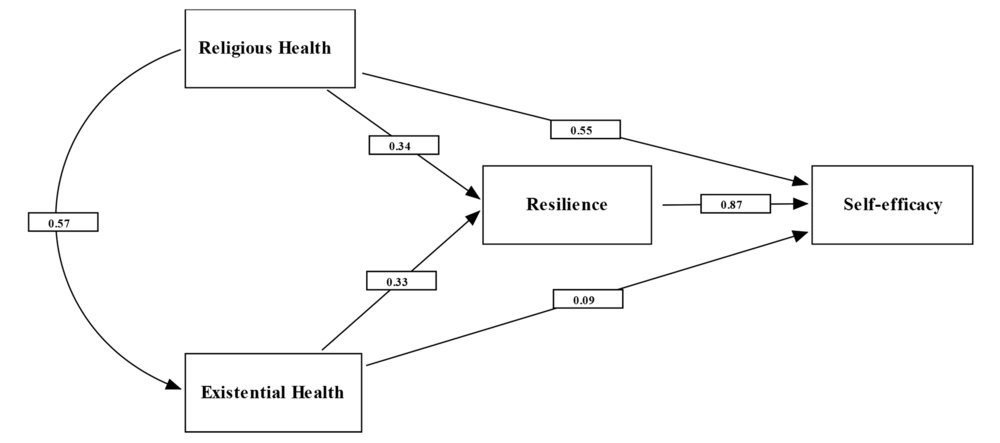
Figure 2.
First model of the effect of spiritual health (consists of religious and existential health) on resilience and self-efficacy
The results of the final model, as illustrated in Figure 3, indicate that all fit indices fall within an acceptable range, confirming that the current model has a good fit (Table 4).
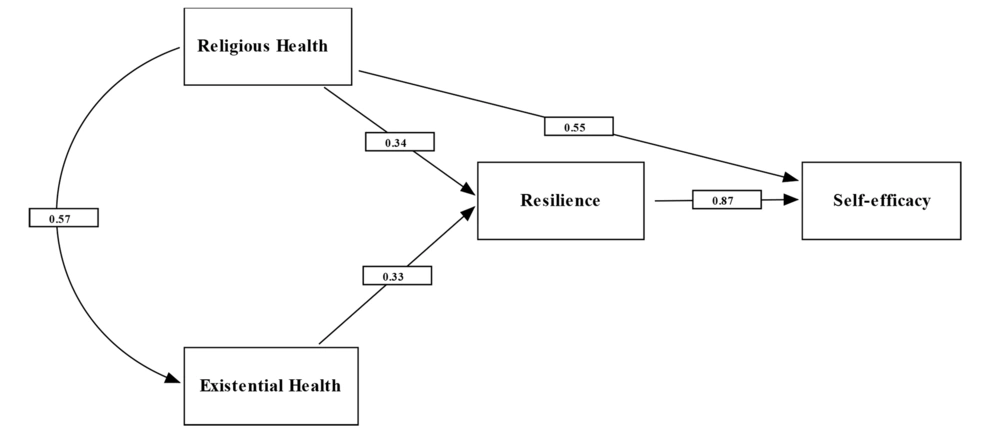
Figure 3.
Final model of the effect of spiritual health (consists of religious and existential health) on resilience and self-efficacy
Table 4.Goodness of Fit Statistics of the Research Model
| Fit Index | Amount | Acceptable Domain |
|---|---|---|
| CMIN/DF | 3.21 | 1 - 5 |
| GFI | 0.92 | > 0.90 |
| AGFI | 0.91 | > 0.90 |
| CFI | 0.94 | > 0.90 |
| IFI | 0.93 | > 0.90 |
| NFI | 0.91 | > 0.90 |
| RMR | 0.05 | < 0.08 |
| SRMR | 0.04 | < 0.08 |
| RMSEA | 0.07 | < 0.08 |
The direct and indirect effects of spiritual health (comprising religious and existential health) on resilience and Self-efficacy were calculated based on the correlations obtained in the path analysis, with the values shown in Table 5. As indicated in the table, religious health has a 55% positive and significant direct effect on Self-efficacy, while resilience exhibits an 87% positive and significant direct effect on Self-efficacy (Table 5 and Figure 3).
Table 5.Path Analysis of the Effect of Spiritual Health (Consists of Religious and Existential Health) on Resilience and Self-efficacy
a P < 0.001.
5. Discussion
The data analysis outcomes demonstrated that the mean spiritual health score was 73.02. Additionally, the mean total resilience score was 79.67, and the mean Self-efficacy score was 59.09. Asghari et al.'s study in 2014 reported an average spiritual health score of 82.29 and an average academic Self-efficacy score of 106.14, which were higher than those in the current study. These differences may be attributed to variations in sample size, university type, and conditions (23). The variable of Self-efficacy shows a direct and significant statistical correlation with resilience and its subscales, indicating that an increase in Self-efficacy is significantly associated with an increase in resilience and its subcomponents.
Spiritual health is a fundamental concept in coping with problems and stresses arising from various life conditions. As one of the dimensions of health, it contributes to the integration of other dimensions. Since Self-efficacy refers to a person's belief in their abilities and skills, it can be inferred that high spiritual health enables individuals to make accurate judgments about their skills and abilities with a positive self-view. This, in turn, fosters both high spiritual health and high Self-efficacy (3). Although no prior study has specifically examined the correlation between spiritual health and Self-efficacy, some research has demonstrated a positive relationship between spirituality and Self-efficacy. In 2007, Adegbola conducted a study investigating the correlation between spirituality, Self-efficacy, and quality of life in adults with diseases. The findings revealed a strong correlation between these variables, indicating that individuals with firm spiritual beliefs tend to exhibit higher Self-efficacy and quality of life (24).
The results indicated that among the dimensions of spiritual health, existential health had the highest predictive value for students' Self-efficacy. Existential health, as a psychosocial element, reflects a person's sense of identity, purpose, and belonging. While religious health focuses on guiding individuals toward God, existential health represents the external aspect of spiritual health, manifesting in social interactions and relationships. Thus, it can be concluded that receiving appropriate and supportive feedback from the environment enhances a person's belief in Self-efficacy. When individuals receive encouragement and social support, their Self-efficacy improves. In this context, a study by Li et al. found that increased social support for students reduced depressive symptoms, potentially promoting their physical and mental health (25).
Individuals who perceive potential threats as unmanageable often view many aspects of their environment as dangerous, magnify potential risks, and worry excessively about unlikely events. These thought patterns, stemming from low Self-efficacy, lead to anxiety and impaired performance. However, the higher a person's spiritual health, the higher their Self-efficacy, enabling them to cope more adaptively with stressful and threatening conditions.
The spiritual health variable also demonstrated a significant correlation with resilience, with increases in spiritual health significantly improving resilience and its subscales. This finding suggests that spiritual health, as a dimension of overall health, can create fundamental changes in individuals, enhancing their resilience. These results align with those of Friborg et al. (26), whose research on the mediating role of resilience in relation to fear and anxiety revealed a positive and significant association between resilience and various dimensions of health and life satisfaction.
Additionally, our findings are consistent with studies by Valentine and Feinauer (27), Pargament et al. (28), Werner (29), Park (30), Kalayjian and Shahinian (31), Hauser (32), Smith (33), and Coşkun et al. (34). These studies demonstrated that spiritual beliefs and finding personal meaning in distressing circumstances positively influence a person's resilience and coping abilities.
Our study indicates a positive and significant correlation between the existential health and resilience of students. This finding suggests that existential health, as an influential variable, can enhance resilience and make individuals more patient. This result aligns with the review by Kim et al. in 2005, which found a correlation between resilience and the meaningfulness of life. According to their study, increasing the meaningfulness of life not only helps individuals overcome inconsistencies but also improves their overall life satisfaction (35). Having a purpose plays a critical role in helping people navigate incompatible situations (36). Similarly, this finding is consistent with the study conducted by Hatami and Shekarchizadeh in 2022 (37). Both existential health and spiritual health variables significantly predict resilience. In other words, as existential and spiritual health improve, students' resilience is expected to increase.
According to the present research, one measure to enhance resilience is to consider the cultural patterns and societal context of individuals. Differences in resilience can be attributed to experiences in various domains, including access to material resources, interpersonal communication, sense of identity, cultural compliance, social justice, control and power, and solidarity. Individual characteristics such as communication skills, coping abilities, problem-solving skills, empathy, self-esteem, and other positive personal and environmental-social traits (both within and outside the family) also significantly impact resilience.
Spirituality, as one of the components of resilience according to Connor and Davidson, can enhance a person's resistance to life's stresses, acting as a shield (protective factor) on one hand and, on the other, as a factor of adaptability and compromise that can guide a person toward excellence and perfection (elevating factor). Both the defensive and transformational aspects of beliefs and spiritual values related to resilience are closely connected to the improvement of health indicators.
One measure that can be proposed in this field is the adoption of a spiritual approach in higher education curricula—in other words, emphasizing the importance of a spiritual curriculum.
According to the stated content, it is suggested that the elements of a spiritual curriculum be designed to promote the all-round development of the learner. Students should be viewed as individuals with diverse natural talents. For this purpose, the following suggestions are proposed for designing a spiritual curriculum in higher education:
- Determining the Goals of the Spiritual Curriculum: Establish goals based on the indicators of self-awareness, world-awareness, and God-awareness to address students' psychological, biological, and innate spiritual needs.
- Adopting a Relative and Comparative Perspective in Content Selection: Use a relative and comparative approach in selecting the content of the spiritual curriculum. This perspective involves comparing and analyzing the differences and similarities in the beliefs and opinions of various religions. Faith developed through this method is likely to be strong, internal, and resilient to external deterioration. Additionally, this approach, which encourages criticism and judgment about different religions, facilitates dialogue and interaction between cultures.
- Organizing the Learning Environment: Create a learning environment that fosters spirituality, critical thinking, teamwork, and active engagement in learning. A spiritual curriculum requires an environment that promotes flexibility, creativity, vitality, commitment, and reflection. The personalities of students and professors should be respected through targeted mental productivity. Such an environment should allow for new insights to be interpreted from various perspectives, with these interpretations leading to deeper understanding.
5.1. Conclusions
This study is among the first to examine the effect of spiritual health on medical students' Self-efficacy and resilience. Our findings indicate that Self-efficacy has a direct and significant statistical correlation with resilience and its subscales but shows no associative correlation with overall spiritual health. Spiritual health, however, has a significant correlation with resilience, and an increase in spiritual health enhances resilience and its subscales. While spiritual health can predict resilience, it cannot predict Self-efficacy. Given that individuals with high mental health exhibit higher levels of these variables, it can be concluded that supportive factors such as religion and spirituality can contribute to improving mental health components, including resilience.
5.2. Limitations
One of the limitations of the present research is the use of self-report methods for completing the questionnaires. Additionally, there are numerous factors that influence Self-efficacy, many of which were not measured in this study.


