Fulltext
Full-text is available in PDF format.
Journal of Nursing and Midwifery Sciences
The Official Journal of Mazandaran University of Medical Sciences
Authors
 2,*, Sina Sabourian-Jouybari1, Seyede Zeynab Mazloumi-Baghloui1
Background and Purpose: Spiritual well-being plays an important role in the mental and physical health, and is considered as a common strategy to cope with problems. Given the importance of promoting spiritual well-being in the nursing and midwifery students, we must first determine the level of this state in this population. Regarding this, the present study aimed to examine the spiritual wellbeing and its related factors in the nursing and midwifery students of Mazandaran University of Medical Sciences, Sari, Iran.
Methods: This descriptive analytical study was conducted on 183 nursing and midwifery students studying at the Mazandaran University of Medical Sciences in 2015. The sampling was performed using the systematic random sampling technique. The research instruments included a demographic form and the Spiritual Well-Being Scale developed by Palotzian and Ellison. The data were analyzed through the SPSS version 16 using the descriptive and analytical tests, including frequency, percentage, t-test, and Pearson correlation coefficient.
Results: According to the results of the present study, the mean spiritual well-being was 69.70±11.62. In addition, the means of religious and existential well-being were 35.77±6.80 and 34.04±6.19, respectively. The results demonstrated no significant correlation between the demographic variables and spiritual well-being in the participants (P>0.05). However, spiritual well-being had a significant relationship with the religious and existential well-being (P<0.001).
Conclusion: As the findings of the present study indicated, the majority of the nursing and midwifery students had a moderate level of spiritual well-being. Furthermore, religious well-being was found to be slightly higher than the existential well-being, which could be due to the cultural issues.
© 2017, Author(s). This open-access article is available under the Creative Commons Attribution 4.0 (CC BY 4.0) International License (https://creativecommons.org/licenses/by/4.0/), which allows for unrestricted use, distribution, and reproduction in any medium, provided that the original work is properly cited.
Asgari Ghoncheh K, Hashemnejad H, Hajibabaeei HR. The relationship between spiritual well-being and demographic characteristic of students of Qazvin University of Medical Sciences. J Inflamm Dis. 2024;22(3):e156093. doi:
Aghakhani N, Akbari M, Abbasi M, Naderi J, Cheraghi R, et al. Evaluation of the spiritual health of cancer patients and their nurses in Iran. J Nurs Midwifery Sci. 2016;3(3):e141226. doi: https://doi.org/10.18869/acadpub.jnms.3.3.34
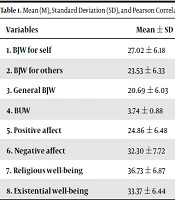
Zamani Amir F, Saberi H, Bashardoust S. A Predictive Model of Spiritual Well-being Based on Belief in a Just World Mediated by the Positive and Negative Affects in University Students. J Health Rep Technol. 2021;7(4):e118130. doi: https://doi.org/10.5812/ijhls.118130
Momeni K, Karami J, Shahbazi Rad A. The relationship between spirituality, resiliency and coping strategies with students' psychological well-being. J Kermanshah Univ Med Sci. 2013;16(8):e77274. doi:
Hasanshahi M, Amidi Mazaheri M, Baghbanian A. Relationship Between Spiritual Health, Hopelessness, and Self-Efficacy in Medical Sciences Students. Iran J Psychiatry Behav Sci. 2018;12(2):e2071. doi: https://doi.org/10.5812/ijpbs.2071
Last Update: 3 days ago
Last Update: 3 days ago
Last Update: 3 days ago
Last Update: 6 days ago
Last Update: 2 days ago
Last Update: 4 days ago