
1. Background
Mental and physical performances of human beings, whether asleep or awake, are affected by their diet (1). Diet is associated with the development of cognitive performance (2). Different diets provide precursors of chemical mediators and coenzymes necessary for human body and have a role in making neuronal membranes and myelin (3). On the other hand, the hypothalamus regulates sleep-wake cycle using acetylcholine and gamma amino butyric acid (4). However, these are not the only chemical mediators in this regard, and norepinephrine, serotonin, histamine, orexin, dopamine, and melatonin are some neurotransmitters that regulate and stabilize the sleep-wake cycle (5, 6). Additionally, adenosine, affecting the pre-optic area, sets off sleep (6, 7). While mediators associated with immunity, such as interleukin beta 1 and tumor necrotizing factor (TNF), facilitate non-REM sleep in physiological conditions (8). Sleepiness has been associated with reduced performance level and cognitive slips (9). It also undermines working memory, attention, concentration, and decision making (10). In this situation, reaction time, which is typically used as the objective means of assessment, increases. Certain types of food or soft drinks could affect these cognitive functions and sleepiness. Foods such as sea food containing antioxidants and omega 3 has displayed positive effects on cognitive performance (11, 12). Also, food containing flavonoids improve cognitive performance in 0 to 6 hours (13). Moreover, coffee also enhances reaction time and vigilance (14). Caffeine with a controlling effect on adenosine causes an increase in cAMP and consequently results in enhanced vigilance and a change in the timing of circadian rhythm (15).
Besides, dehydration leads to reduced cognitive performance that could be even more dominant if coupled with sleepiness (16). Consumption of drinks rich in sugar before sleep influences the sleep mechanism and causes repeated arousals (17). After consuming food rich in carbohydrates, the oxidation of carbohydrates, particularly during REM sleep, increases. On the other hand, sleep also affects food metabolism in its own term. As an example, carbohydrates decrease the duration of slow wave sleep (18). This is why eating and drinking during long work shifts has led to reduced reaction time and improved performance (19).
Consumption of probiotic diary products by those, who have a low mood, has been shown to improve their cognitive performance and mood (20, 21). Furthermore, a similar study on the elderly has also displayed a slight improvement in sleep quality, although the effect was not significant compared with the placebo effect and did not change the quality of life (22).
Obviously, Doogh is a dairy product that is traditionally consumed in Iran and some other countries. Industrial production of Doogh in Iran follows the Iranian national food standards; Doogh contains yogurt, water, edible sodium salt, and starter bacteria, such as Streptococcus thermophilus and Lactobacillus delbrueckii. Doogh is on the market both as carbonated and noncarbonated and might also receive heat through the production process or may be produced without heat; it can be homogeneous or heterogeneous (23). Yogurt is the second major ingredient of Doogh after water. Considering the activity of lactase, yogurt can be more beneficial for those with lactase deficiency and can be an alternative for milk for such individuals (24).
Despite the wide consumption of Doogh in some countries, especially Iran, to the best of the authors’ knowledge, the current study was among the very few studies on the effects of this drink on cognitive performance and vigilance-sleepiness. Therefore, the present research aimed at determining the effects of Doogh on reaction time, relevant errors, and sleepiness.
2. Objectives
The current study aimed at objectively evaluating the effect of Doogh (Yogurt drink) on attention, reaction time, and vigilance- sleepiness of healthy young adults.
3. Materials and Methods
This clinical trial was done by public invitation of participants. The participants entered the research project based on inclusion and exclusion criteria and subsequent formal consent. The participants were 20 to 40 years old, having a minimum education level of high school with sufficient computer skills.
3.1. Inclusion Criteria
The inclusion criteria were clear medical and psychiatric check results and health status, no case of taking sleep or psychiatric drugs and medication during the last month leading up to the research, and other drugs during the last 2 weeks before the research. Minimum education level of high school graduate, 7 to 8 hours of night sleep and wake up time before 7:30 am and no case of afternoon siesta during the last two weeks before the research, as confirmed by a sleep log, an Epworth Sleepiness Scale of lower than 8 and an under-20 score in General health questionnaire-28, no history of problems related to digesting Doogh, lack of pregnancy and no breast feeding, no weight loss/gain diet based on history, ability to have fixed morning work shift if employed, and a BMI between 19 - 27 kg/m2 were other inclusion criteria.
3.2. Exclusion Criteria
Participant's lack of willingness to cooperate in the study, any outbreak of a psychiatric problem, and any outbreak of a medical condition that might affect vigilance and sleep were the exclusion criteria.
The inclusion criteria were controlled before the interventions. For the female participants, the intervention was done in the first half of their menstrual cycle. Then, the participants received training in working with TOVA and they displayed their skills at least once. In order to control all of the disruptive factors, the first 4 groups (3 groups of 4 and 1 group of 5) were randomly formed, and also in every group, the intervention sequence, in terms of drink type and morning vs afternoon time, was randomly done based on various combinations of these two factors as presented in Table 1.
Table 1.
Order of Intervention for the Participants
| Participant Groups | Order of Intervention | |||
|---|---|---|---|---|
| 1 | 2 | 3 | 4 | |
| Group | MW | MD | ED | EW |
| Group | EW | ED | MD | MW |
| Group | MD | MW | EW | ED |
| Group | ED | EW | MW | MD |
For example, in group 1, the participants first received water in the morning, and afterwards, with a 3-day interval, received Doogh in the morning, Doogh in the afternoon, and water in the afternoon. In the other groups, the intervention followed the sequence presented in Table 1. It is noteworthy to mention that all of the assessments were done before each intervention and 2 hours immediately afterwards.
The intervention included 250 cc of low fat Doogh produced by Duka Dairy Products Co. and Senbi mineral water, a product of Jahansuz Mineral water Co. The participants received their drinks in the morning, sometimes between 9 and 9:30 am, and in the afternoon sometimes between 1 and 1:30 pm (four times totally). At each time, immediately before drinking and 1.5 to 2 hours after it, Test of Variable of Attention (TOVA) and Visual Analogue Scale (VAS) were run.
Test of variable of attention is a computer-based continuous performance test. The Psytask software was used to perform the TOVA (25). The right arrow of the keyboard was designated as the response key to the stimulus. The participants were asked to press the key as rapidly as they could, immediately after they saw the stimulating square at the top of the page (not at the bottom of the page). The test was contained for 640 trials (with equal 320 number for each Go and No Go) and display time was 100 milliseconds, with more NO GO at the beginning and more Go as approaching the end of the test. The TOVA is a kind of test that does not have language-dependent stimuli, thus can be used regardless of first language. Also, the reliability and validity of the TOVA have been confirmed by different methods (26). Finally, the changes in reaction time, omission error, and commitment error were extracted from TOVA.
The vigilance level prior to and after taking each drink was studied via the Visual analogue scale. Generally, VAS is a horizontal line of 100 mm across a sheet of paper. “Very Sleepy” (0) and “Very Vigilant” (100) are on both sides of the line. The participant is asked to locate his status on the line. The VAS score is the distance (in mm) between the point they have decided on and the right end of the line representing subjective sleepiness of the subjects at an equal or even a better level compared with stanford sleepiness scale (27, 28). The findings were analyzed using SPSS 22 and SAS 9.4 and paired T test and GEE at the 0.05 level.
4. Results
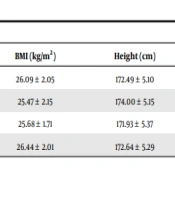
The study included 17 individuals, 10 females (average age of 29.0 ± 5.1 years and BMI of 23.9 ± 1.9 kg/m2) and 7 males (average age of 30.14 and standard deviation of 5.19 and BMI of 24.75 and standard deviation of 2.68). One of the subjects, having attended an intervening session, left the experiment due to unexpected change in his work shift that was replaced with another volunteer.
Tables 2 and 3 present the comparisons between variable means in different combinations of drink type, drink time (morning versus afternoon), and period (before and after) using paired t test and Table 4 presents the results of GEE modeling for analyzing the simultaneous effect of drink type, drink time (morning versus afternoon), and period (before and after) on the variables being researched. Before running all of the tests, the Kolmogorov-Smirnov test was applied to confirm the normality of all variables at 5%. Paired t test revealed that none of the variables had significant differences with others before intervening the 2 drink types (Table 2).
Table 2.
Comparison of the Means of Variables of the Two Drink Types Studied
| Time | Variables | Drink | Before | After | ||
|---|---|---|---|---|---|---|
| Mean ± SD | P Value | Mean ± SD | P Value | |||
| Morning | RT | Doogh | 303.9 ± 42.4 | 0.172 | 310.2 ± 43.3 | 0.84 |
| Water | 296.8 ± 42.9 | 300.1 ± 41.0 | ||||
| SD_RT | Doogh | 053.5 ± 15.6 | 0.221 | 055.7 ± 22.8 | 0.593 | |
| Water | 049.2 ± 14.7 | 052.8 ± 20.1 | ||||
| Omission | Doogh | 000.7 ± 01.1 | 0.112 | 000.5 ± 0.6 | 0.800 | |
| Water | 000.3 ± 00.4 | 000.5 ± 0.5 | ||||
| Commission | Doogh | 001.3 ± 01.4 | 0.104 | 000.9 ± 0.8 | 0.137 | |
| Water | 000.8 ± 00.9 | 000.6 ± 0.9 | ||||
| Sleepiness | Doogh | 0.93 ± 05.4 | 0.909 | 086.2 ± 5.2 | 0.111 | |
| Water | 093.4 ± 06.5 | 88.8 ± 6.9 | ||||
| Afternoon | RT | Doogh | 306.8 ± 54.8 | 0.109 | 327.4 ± 67.8 | 0.095a |
| Water | 286.2 ± 45.9 | 297.2 ± 56.9 | ||||
| SD | Doogh | 055.2 ± 22.2 | 0.751 | 074.5 ± 47.8 | 0.046b | |
| Water | 053.6 ± 18.3 | 050.8 ± 18.1 | ||||
| Omission | Doogh | 000.4 ± 003 | 0.695 | 001.0 ± 1.3 | 0.085a | |
| Water | 0004 ± 00.3 | 000.5 ± 0.6 | ||||
| Commission | Doogh | 000.6 ± 00.6 | 0.721 | 001.5 ± 1.9 | 0.123 | |
| Water | 000.5 ± 006 | 000.6 ± 0.9 | ||||
| Sleepiness | Doogh | 092.8 ± 05.4 | 0.248 | 081.8 ± 5.7 | 0.002b | |
| Water | 090.8 ± 05.3 | 087.8 ± 4.6 | ||||
Abbreviations: RT, reaction time; SD_RT, standard deviation of reaction time.
aSignificant in 0.10 level.
bSignificant in 0.05 level.
Table 3.
Comparison of Means of Variables Before and After the Intervention for Each Drink Type
| Drink | Variables | Time | Morning | Afternoon | Total | |||
|---|---|---|---|---|---|---|---|---|
| Mean ± SD | P Value | Mean ± SD | P Value | Mean ± SD | P Value | |||
| Doogh | RT | Before | 303.9 ± 42.4 | 0.190 | 306.8 ± 54.8 | 0.063a | 305.3 ± 48.3 | 0.024b |
| After | 310.2 ± 43.3 | 327.4 ± 67.8 | 318.8 ± 56.7 | |||||
| SD_RT | Before | 053.6 ± 15.6 | 0.497 | 055.2 ± 22.2 | 0.039b | 054.4 ± 18.9 | 0.030b | |
| After | 055.7 ± 22.8 | 074.5 ± 47.8 | 065.1 ± 38.08 | |||||
| Omission | Before | 000.7 ± 01.1 | 0.394 | 000.4 ± 00.3 | 0.044b | 000.6 ± 00.8 | 0.324 | |
| After | 000.5 ± 00.6 | 001.0 ± 01.3 | 000.8 ± 01.0 | |||||
| Commission | Before | 001.3 ± 01.4 | 0.164 | 000.6 ± 00.6 | 0.049b | 000.9 ± 01.1 | 0.289 | |
| After | 000.9 ± 00.8 | 0v1.5 ± 01.9 | 001.2 ± 01.5 | |||||
| Sleepiness | Before | 093.5 ± 05.4 | < 0.001b | 092.8 ± 05.4 | < 0.001b | 093.1 ± 05.3 | < 0.0001b | |
| After | 086.2 ± 05.2 | 081.8 ± 05.7 | 084.0 ± 05.8 | |||||
| Water | RT | Before | 296.8 ± 42.9 | 0.227 | 286.2 ± 45.9 | 0.314 | 291.5 ± 44.1 | 0.199 |
| After | 300.1 ± 41.0 | 297.2 ± 56.9 | 298.7 ± 48.9 | |||||
| SD_RT | Before | 049.3 ± 14.7 | 0.208 | 053.6 ± 18.3 | 0.457 | 051.4 ± 16.5 | 0.880 | |
| After | 052.8 ± 20.1 | 050.8 ± 18.1 | 051.8 ± 18.9 | |||||
| Omission | Before | 000.3 ± 00.4 | 0.337 | 000.4 ± 00.32 | 0.619 | 000.4 ± 00.4 | 0.303 | |
| After | 000.5 ± 00.5 | 000.5 ± 00.6 | 000.5 ± 00.6 | |||||
| Commission | Before | 000.7 ± 00.9 | 0.321 | 000.5 ± 00.6 | 0.577 | 0v0.7 ± 00.8 | 0.707 | |
| After | 000.6 ± 00.9 | 000.6 ± 00.9 | 000.6 ± 00.9 | |||||
| Sleepiness | Before | 093.4 ± 06.5 | 0.011b | 090.8 ± 05.3 | 0.026b | 092.1 ± 05.9 | 0.001b | |
| After | 088.8 ± 06.9 | 087.8 ± 04.6 | 088.3 ± 05.9 | |||||
Abbreviations: RT, reaction time; SD_RT, standard deviation of reaction time.
aSignificant in 0.10.
bSignificant in 0.05 level.
Table 4.
Generalized Estimation Equation Model Model Fitting Results for the Studied Variables
| Dependent Variable | Parameter | Estimation | SE | P Value |
|---|---|---|---|---|
| Model1: RT | Intercept | 255.1 | 13.9 | < 0.0001a |
| Drink | 029.3 | 09.7 | 00.003a | |
| Time | 0 - 7.1 | 07.3 | 00.331 | |
| Pre-postb | 053.9 | 08.6 | < 0.0001a | |
| Model2: SD_RT | Intercept | 030.9 | 09.7 | 00.002a |
| Drink | 004.7 | 05.6 | 00.395 | |
| Time | 001.8 | 05.0 | 00.726 | |
| Pre-post | 049.8 | 05.0 | < 0.0001a | |
| Model3: Omission Error | Intercept | 004.6 | 03.6 | 00.201 |
| Drink | 0 - 0.3 | 00.4 | 00.390 | |
| Time | 001.5 | 01.2 | 00.227 | |
| Pre-post | 0 - 9.2 | 07.8 | 00.242 | |
| Model4: Commission Error | Intercept | 0 - 0.7 | 01.0 | 00.459 |
| Drink | 000.3 | 00.2 | 00.039a | |
| Time | 0 - 0.6 | 00.2 | < 0.0001a | |
| Pre-post | 002.9 | 02.0 | 00.146 | |
| Model5: Sleepiness | Intercept | 097.2 | 00.9 | < 0.0001a |
| Drink | 0 - 4.7 | 01.1 | < 0.0001a | |
| Time | 0 - 0.8 | 01.4 | 00.5470 | |
| Pre-post | 0 - 5.6 | 00.7 | < 0.0001a |
Abbreviation: SE, standard error.
aSignificant in 0.05 level.
bPre-post: the difference between pretest and post test.
The standard deviation of changes of reaction time and also the degree of sleepiness in the afternoon time after the intervention were significant between the 2 groups at 0.05 level. Meaningful changes of reaction time were observed in the morning and afternoon assessments (P = 0.024). However, the changes after drinking Doogh were more considerable. A comparison of means after drinking the 2 types of drinks revealed more inclination towards sleepiness as a result of drinking Doogh compared with water (P = 0.02).
Through running the Paired t test, meaningful changes were displayed in reaction time, omission error, and sleepiness at the 0.05 level, and standard deviation from the mean of the participants and omission error at 0.1 level before and after drinking Doogh in the afternoon time. While in the morning, only the degree of sleepiness was meaningful (P = 0.011; Table 3). Although sleepiness occurred in the morning after drinking water (93.4 vs. 88.8), the degree of changes were higher for drinking Doogh (93.5 vs. 86.2 reduced points in VAS). On the other hand, as Tables 2 and 3 indicate, although sleepiness that was measured by VAS occurred for both drink types in the afternoon, there was a more significant reduction for the group taking Doogh (93.1 to 84.0) compared with the group taking water (92.1 to 88.3). The mean difference for commitment error before and after drinking Doogh in the afternoon was significantly meaningful at 0.049.
The results of Table 2 and 3 clarify the reasons for which some factors in Table 4 became meaningful. Table 4 includes the analysis of the effects of factors, such as drink type, timing (morning and afternoon), and period before (pre) and after (post), on response variables. For example, regarding generalized estimation equation (GEE) model analysis for RT, one can deduce that if the effect of other factors is supposed to be fixed, there is a significant difference between RT means for Doogh and water (P = 0.003). According to the results of Table 3, this difference is observed both in the morning and afternoon between Doogh and water (P = 0.025, P = 0.022). Also, if the effect of other factors are supposed to be fixed, there is a significant difference between pre and post RT means (P = 0.003); Table 3 suggests that this difference is caused by the difference related to pre- and post-Doogh consumption.
The GEE model for SD showed that only the period factor (before and after the intervention) had a significant effect on SD mean. It could be deduced that the difference is caused by drinking Doogh, as Table 2 shows that after the invention or post SD, mean difference was significant between Doogh and water in the afternoon time (P = 0.046). Also, the pre and post means of SD were significantly different in the afternoon for Doogh (P = 0.039). Generally, none of the factors had a significant effect on omission mean. More detailed analysis based on Table 2 and 3 suggests that the pre and post means of this variable for drink in the afternoon were significantly different (P = 0.044). Also, factors that had meaningful effect on omission mean included drink and timing (morning and afternoon). These significant factors were observed based on the results of Table 2 and 3 in the morning and afternoon for Doogh (P = 0.049). The effect of drink type and period factors on VAS mean was also significant and the significance was observed both for water (P = 0.026) and for Doogh (P < 0.001) (Table 3).
The GEE analysis showed that the effect of time variable (morning and afternoon) was significant only in the commission model (P < 0.001) i.e. regardless of the effect of other variables, the commission mean was lower in the morning compared with the afternoon time.
Figures 1 to 5 and Tables 2 to 4 helped check the assumption of the mutual effect of time and drink for models 2 to 5; such an effect was not significant in any of them. Also, a mutual effect of drink time and drink type was explored for Table 4 models and none of them were found to be significant. The variables’ trends are represented in the following figures.

Figure 1.
The Changes of Reaction Time Before and After the Intervention

Figure 2.
The Changes of Standard Deviation of Reaction Time Before and After the Intervention

Figure 3.
The Changes of Omission Error Before and After the Intervention

Figure 4.
The Changes of Commission Error Before and After the Intervention

Figure 5.
The Changes of Alertness Before and After the Intervention
5. Discussion
Vigilance reduction and sleepiness have negative effects on cognitive performance. These effects objectively occur due to an increase in reaction time and more omission or commission errors when a stimulus needs to be responded or a stimulus needs not to be responded.
Recording the reaction time is used for the simple analysis of mental performance. An increase in reaction time suggests a slow mental processing and reaction time, which is even more sensitive than the reaction type. The significance of increased reaction time lies in its role in incidents, such as traffic accidents (29). Accordingly, in research projects studying the effects of sleep deprivation on mental performance, reaction time is usually measured as a cognitive performance indicator (30-32).
The dispersion mean of reaction time before and after drinking Doogh increased significantly. The discrepancy was due to differences stemming from drinking Doogh in the afternoon. The significant increase in the number of commission and omission errors as a result of drinking Doogh was observed in the afternoon. However, reaction time, dispersion of reaction time, omission and commission errors in the morning and afternoon were constant, after water had been consumed.
Meanwhile, self-perceived vigilance level reported by the participants had decreased in both drink types and drink times. Although it had decreased more significantly in those, who had drunk Doogh compared with those who had drunk water in both the morning and afternoon.
The reaction time and commission and omission errors have been studied with regards to medical drugs and the results of the present study are similar to those of diphenhydramine (33). Like the above mentioned study, drinking Doogh led to significant changes in reaction time, commission error, omission error, and reaction time dispersion, especially in the afternoon. However, in the above mentioned research, the timing of tests during the day was not specified.
This effect could be attributed to the intensification of the range of Circadian rhythm and reduction in cognitive performance and increased sleepiness in the afternoon as a result of drinking Doogh. In Dinges and Basner’s study, reaction time dispersion had a greater importance than the time itself. The importance of the increase in the range of reaction dispersion in continuous performance test of participants, who had experienced sleep deprivation, has also been displayed (34). The findings of the present research also suggest an increase in reaction time dispersion. The cognitive effects that were represented as reaction time, omission error, and commission error in the present study were caused by Doogh.
5.1. Conclusions
Doogh slows down reaction time and causes instability during reaction time (increased deviation from reaction time means), increased number of omission and commission error, and sleepiness. These changes were more obvious in the afternoon and could suggest the homeostatic effect of sleep due to Doogh and the intensification of reduction of circadian vigilance in the afternoon. This could be taken into account for medical treatment and also the prevention of incidents in general, and traffic accidents, in particular.
5.2. Limitations
The study was done on young participants and in order to generalize the results to other age groups, more studies need to be performed. In this study, a keyboard was used for responding to the TOVA stimulus; future studies could be performed by applying instruments with higher time precision compared with a keyboard.