
1. Background
Attention to physical activity has expanded as a complement to a healthy life. Studies show that physically active people have a longer lifespan than inactive people (1). Physical activity can develop physiological capacity in humans and reduce the risks of inactivity (2). Achieving and maintaining physical fitness affects all aspects of life and in addition to strengthening health, is effective in increasing work and mental productivity (3). Also, maintaining a good level of physical fitness elements such as cardiovascular endurance, muscle strength and endurance, body composition and flexibility is effective in reducing the risk of heart disease, hypertension, diabetes, osteoporosis, obesity and mental disorders and depression (4).
Vitamin deficiency is one of the health problems. Studies show that approximately between 30 - 50% of the country’s adult population and 50% of the elderly population are at risk of vitamin D deficiency (5). In Iran, a study reported a prevalence of vitamin D deficiency in healthy adults of 61%, of which 10% suffered from severe vitamin D deficiency (5). In addition, evidence suggests that vitamin D deficiency increases the risk of autoimmune diseases and chronic diseases (6). Vitamin D deficiency leads to disorders such as defects in calcium and phosphorus metabolism. In cases of vitamin D deficiency, intestinal absorption of calcium decreases and hypocalcemia develops lead to an increase in PTH secretion (1). The results of some studies have also shown that vitamin D deficiency occurs with symptoms such as weakness and fatigue (6). A survey in the UK found that more than 50% of the adult population was deficient in vitamin D and 16% of the population had severe vitamin D deficiency in winter and spring (7). The results of some studies also showed that vitamin D deficiency is common in the Middle East despite adequate sunlight. The main causes of this phenomenon in middle east countries are different vitamin D receptor-specific polymorphisms, low daily calcium intake, obesity, elderly, certain medications and diseases, and the winter season (8). Screening for vitamin D deficiency can identify people with low levels of vitamin D, benefit them from treatment, and improve their health. Screening for vitamin D deficiency can identify people with low levels of vitamin D, and by treating this deficiency, the complications and subsequent problems caused by it can be well prevented and even cured (9). Another important function of vitamin D is appetite regulation. This issue has been well investigated in the study of 4600 women over 65 years of age and it has been shown that there is a significant relationship between weight gain due to more calories consumed and vitamin D deficiency in these women (10).
Screening for vitamin D deficiency and identifying people with low levels of vitamin D accelerates the initiation of treatment and prevents long-term vitamin D deficiency complications (9).
In addition to its role in calcium absorption, vitamin D is one of the most important regulators of appetite, so the results of a survey that there is a significant relationship between weight gain and vitamin D deficiency (10).
The prevalence rate of vitamin D deficiency in hard-working employees, especially hospital staff in Iran, is not well known. Also in past studies, a significant relationship between vitamin D deficiency and weakness and fatigue during work has been proven (6). Therefore, it is very important to check the physical condition and levels of important vitamins such as vitamin D of those working in hard jobs and investigate its relationship with job fatigue in order to the prevention of health problems of hard-working employees. Considering the effects of vitamin D deficiency on the performance of employees through physical and cognitive dysfunction, increased risk of skeletal-muscular damage, general weakness, decreased neuromuscular function and poor cardiovascular system function, vitamin D deficiency can lead to decreased job performance. Therefore, it is necessary to monitor vitamin D deficiency in workers in hard and sensitive jobs that deal with human life (4).
2. Objectives
The purpose of this study was to investigate the effect of eight weeks of aerobic exercise and vitamin D consumption on fatigue and job performance of employees of Imam Reza Hospital in Kermanshah.
3. Methods
The statistical population of this study was the staff of Imam Reza Hospital Complex in Kermanshah with an age range of 30 to 50 years who had the inclusion criteria (absence of acute and chronic diseases including asthma, diabetes, cardiovascular diseases, etc.; no history of surgery that prevented the implementation of tests; not smoking and using any kind of tobacco; lack of history of continuous sports activity in the past 6 month).
Among these 48 men and 48 women, a total of 96 employees of Imam Reza Hospital were randomly selected as subjects. Subjects were randomly divided into four groups of 24 people: (1) exercise group; (2) exercise group with vitamin D intake; (3) vitamin D intake group; and (4) non-exercise group without supplement (control group). Before and after the exercises, job fatigue questionnaires (11), employee performance evaluation questionnaire (12), appetite questionnaire (2), Walton quality of work life (QWL) questionnaire (13) were completed by the subjects. Subjects’ lipid profile including LDL cholesterol, HDL cholesterol, triglyceride was measured before and after exercise.
The training program was based on the recommendations of the American College of Sports Medicine for adults (14).
Subjects completed 8-week aerobic exercise training. The training program was 3 days a week. All training sessions began with 10 minutes of warm-up and stretching. In the first two weeks, the subjects performed the exercise for 25 - 30 minutes with an intensity of 60% HRmax. The third and fourth weeks of the program consisted of 35 - 40 minutes with an intensity of 65% HRmax. At the fifth and sixth weeks, the subjects practiced for 45 to 50 minutes with an intensity of 70% HRmax. The seventh and eighth weeks consisted of 50 to 60 minutes with an intensity of 75% HRmax. To control the intensity of exercise, the subjects’ heart rate was monitored using a polar heart rate monitor. Maximum heart rate was estimated from the equation:
Vitamin groups consume 50,000 units of oral vitamins D once a week in the form of capsules. The placebo was edible paraffin with the color and shape similar to vitamin D (10).
The study was performed in a double-blind manner. Forty-eight hours after the last training session and taking supplements, the patients went to the laboratory on an empty stomach and 5 cc of blood was taken from a brachial vein. The protocol and method of intervention in this research has been approved by the ethics committee of Razi University with the code of ethics IR.RAZI.REC.1398.011.
3.1. Statistical Method
Kolmogorov-Smirnov test was used to check the normality of data distribution and after ensuring the normality of data distribution. First we take delta and then one-way ANOVA test was used to examine group differences. LSD post hoc test and dependent t-test were used to evaluate the effect within the group. All statistical calculations were performed at a significant level of 0.05 using SPSS version 22.
4. Results
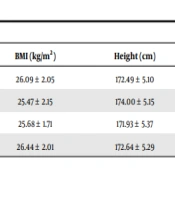
one way analysis of variance showed that the lipid profile of subjects including LDL cholesterol and triglyceride was not significantly different between the intervention groups (P > 0.005), although there were significant differences between the three experimental groups and the control group (P < 0.05 and F = 26.96), but this change in HDL cholesterol was not significant (P > 0.05). Also, the results of depended t-test showed a significant difference in serum levels of lipid profile in the groups of aerobic exercise, vitamin D intake and aerobic exercise + vitamin D intake before and after interventions (P < 0.05), but this difference was not significant in the control group (P < 0.05) (Table 1).
Table 1.
Descriptive Characteristics of the Subjects a
| Variables | BMI (kg/m2) | Height (cm) | Weight (kg) | Age (y) |
|---|---|---|---|---|
| Exercise+ vitamin D | 26.09 ± 2.05 | 172.49 ± 5.10 | 76.97 ± 12.56 | 42.08 ± 2.42 |
| Exercise | 25.47 ± 2.15 | 174.00 ± 5.15 | 77.12 ± 12.26 | 39.92 ± 2.68 |
| Vitamin D | 25.68 ± 1.71 | 171.93 ± 5.37 | 75.11 ± 11.58 | 43.77 ± 2.56 |
| Control | 26.44 ± 2.01 | 172.64 ± 5.29 | 78.21 ± 11.58 | 41.82 ± 1.42 |
a Values are expressed as mean ± SD.
The results of one-way analysis of variance showed that there was a significant difference between the three experimental groups with the control group in fatigue factors (F = 97.96 and P < 0.001), job performance (F = 147.68 and P < 0.001), appetite (F = 88.11 and P < 0.001) and quality of life (F = 184.03 and P < 0.000).
5. Discussion
The results of the present study indicate the positive and effective effect of aerobic exercise with vitamin D consumption on lipid profile among employees, which is consistent with the findings of Wang et al., Moy and Bulgiba and Noori et al. (15-17), but was not in line with the research of Havdahl et al. and Hashemipour et al. (18, 19). Sardar et al. after 8 weeks of aerobic exercise concluded that 8 weeks of regular physical activity has a significant effect on body fat percentage (20). Mathunjwa et al. in a study of obese women showed that 10 weeks of aerobic exercise was associated with improved risk of cardiac metabolic factors including body weight, triglycerides and LDL cholesterol and HDL cholesterol (21). In the present study, weight loss and body fat percentage due to aerobic exercise can be attributed to the adaptations of the cardiovascular, muscular and metabolic systems to exercise. Worstman et al. showed that there is an inverse relationship between obesity and vitamin D (22). The researchers found that vitamin D was stored in body fat mass after synthesis and entry into the bloodstream, followed by slow release from adipose tissue (22). Noori et al. showed that there is an inverse relationship between serum vitamin D concentration and the prevalence of metabolic syndrome (17). In this regard, some studies have reported that increasing the level of vitamin D in the blood through vitamin D supplementation improves the symptoms of metabolic syndrome (23).
Also, the results of this study regarding the significant effect of aerobic exercise and vitamin D consumption on fatigue were in line with the results of some studies such as Ahmadi Ahangar et al., Saremi et al. and Ghasemi et al. (1, 6, 24). Mollart et al. found in their research that midwives who devote more hours to exercise have less job fatigue (25). Gerber et al. investigated the effect of aerobic exercise in men with occupational fatigue and their results showed that exercise significantly reduces the symptoms of occupational fatigue (26). In explaining the results of our research, it can be that any factor that reduces the psychological stress of the person, also reduces his job fatigue. Exercise and physical activity affect the human psyche in two ways; one is the release of endorphins and the second is the reduction of levels of cortisol (a hormone released by the blood pressure in the bloodstream). Endorphins are natural painkillers that cause pleasant feelings. Exercise increases endorphin secretion levels. Some researchers have concluded that proper physical activity has a significant effect on increasing levels of serotonin (a hormone that improves mood). Therefore, exercise seems to help the body get more endorphins and serotonin (27). One of the limitations of this study is measuring fatigue, job performance and quality of life by a questionnaire. Given that the questionnaire may have errors in measuring variables, it is suggested that in a future studies, hormones affecting the mental state of individuals, such as cortisol, endorphins and serotonin be measured and the results be compared with this study.
The results of the present study on the significant effect of aerobic exercise and vitamin D consumption on job performance was in line with the findings of Seifpanahi Shabani and Parvandi, Ahmadi Ahangr et al., Saremi et al. (6, 24, 28). Also, aerobic exercise and vitamin D consumption on quality of life were in line with the results of Ahmadi Ahangar et al. and Ghasemi et al. (1, 6). In explaining the results of the research and aligning with the mentioned researches, it can be said that regular physical activity as a non-pharmacological intervention leads to many physiological and psychological benefits and can lead to the general health and quality of life of the individual. Commenting on the effect of physical activity on stress reduction, Schilling et al. pointed to the selective attention of the central nervous system and stated that when pleasant physical stimuli reach the brain through the sensory nerve pathways, unpleasant stimuli centrally or locally inhibited in other afferent pathways (29). Exercise and physical activity, by providing the possibility of emptying and consuming waste products and by placing the body in a state of response to stress, cause the excretion of waste products and pathogens and contribute to a person’s health (28). One of the most important benefits of physical activity is its social dimension. Participating in group exercises increases social interactions, and by attending sports activities, one becomes aware of one’s abilities and leads to improved self-esteem and self-confidence. On the other hand, studies have shown that sports activities are effective in eliminating negative thoughts and creating positive thoughts and ideas and can cause feelings of satisfaction. This issue was also evident in our study, so that after the intervention, the employees’ overall satisfaction with their living conditions improved (29).
The link between vitamin D deficiency and depression has also received widespread attention in recent years. The results of various studies have shown that calcitriol (the active form of vitamin D) plays an important role in regulating many neurotransmitters in the brain, including regulating and increasing the supply of dopamine and epinephrine in the brain through its effect on the enzyme are synthesizers of these catechoamines (30). In the present study, it was found that taking vitamin D supplements alone or in combination reduces stress and fatigue levels in people. These findings are consistent with the research of Focker et al., which indicates the effect of vitamin D on mental health (27). The results of research and studies on the effect of physical activity and vitamin D supplementation on stress and its various indicators such as anxiety, depression, excitement, lack of self-esteem, indicate that physical activity directly was associated with mental health. People who are highly physically active are less prone to stress and its complications, and feel more refreshed and healthier than inactive people. Physical exercise is one of the most effective ways to reduce depression, reduce anxiety, reduce fatigue and increase self-confidence and self-esteem, and thus improve mental state and quality of life (31).
The results show that exercise combined with vitamin D can improve physical and mental health. Therefore, it can be said that exercise combined with vitamin D can increase the capacity of employees in the face of stress in the workplace and ensure their general health. Managers are therefore advised to institutionalize sports activities and take vitamin D supplements and foods containing this type of vitamin in the organization.