Evaluation of the clearance characteristics of liposomes in the human nose by gamma-scintigraphy
Authors
Abstract
The nasal cavity possesses many advantages as a site for drug delivery, such as, ease of administration, applicability for long term treatments and a large surface area for absorption. One important limiting factor for nasal drug delivery is the limited time available for absorption within the nasal cavity due to mucociliary clearance. Several drug delivery systems including different kinds of microspheres and liposomes have been tried for encapsulation of drugs and increasing the residence time in nasal cavity. In this study the clearance rate of three kinds of liposomes: neutral [phosphatidylcholin (PC) and cholesterol (Chol)], cationic (PC, Chol and stearylamine) and fusogenic (PC, Chol, dioleoylphosphatidylethanolamine) was determined by gamma scintigraphy with lactose powder being used as negative control.
Liposomes were prepared by dehydration-rehydration method. 99mTc labeled liposomes were prepared using technetium pertechnetate in the presence of a potent reducing agent, stannus chloride. The labeling procedure was set in a manner that each 150 µl of liposome suspensions contained 2 MBq of radioactivity. Labeling efficiency was calculated by paper chromatography using acetone as mobile phase. Each delivery system containing 2 MBq of activity was sprayed into right nostril of four healthy volunteers and one-minute static views were repeated each half hour until 4 hours. Clearance rates were compared using two Regions of Interest (ROIs); the initial site of deposition of particles, and all of nasopharynx region. The clearance rate of each one of liposomes was calculated after applying the physical decay corrections.
The mean labeling efficiencies for neutral, cationic and fusogenic liposomes were calculated as 91%, 20% and 69%, respectively. The cleared percent of preparations from nasopharynx region after 4 hours was determined as follows: neutral liposomes 18±2.9%; fusogenic liposomes 53.5±1.2%; cationic liposomes 69.7±4.2%; lactose powder 74.5±4.9%. Neutral liposomes showed the lowest clearance rate compared to lactose powder (P<0.0001), followed by fusogenic liposomes (P<0.01) and cationic liposomes (P<0.05). The clearance profiles of formulations from deposition ROI and nasopharynx ROI were identical.
This study shows the neutral liposomes have the highest mucoadhesion properties and are suitable nasal delivery systems. Furthermore, this study proves that limiting step for the nasal clearance of nasally administered particulate systems is their dislocation from the initial site of deposition, and their following interactions with mucus layer in the rest of nasal passage does not significantly affect the clearance time.
Highlights
Copyright
© 2022, Author(s). This open-access article is available under the Creative Commons Attribution 4.0 (CC BY 4.0) International License (https://creativecommons.org/licenses/by/4.0/), which allows for unrestricted use, distribution, and reproduction in any medium, provided that the original work is properly cited.
Similar Articles
Nano Liposomes Labeled with 99mTc-HMPAO, a Novel Agent for Blood Pool Imaging
Sadri K, Momenypoor S, Dabbagh Kakhki VR, Sadeghi R, Aryana K, et al. Nano Liposomes Labeled with 99mTc-HMPAO, a Novel Agent for Blood Pool Imaging. Iran J Pharm Res. 2015;14(4):e125385. doi: https://doi.org/10.22037/ijpr.2015.1741
Formulation and Evaluation of Liposomes for Transdermal Delivery of Celecoxib
Moghimipour E, Salami A, Monjezi M. Formulation and Evaluation of Liposomes for Transdermal Delivery of Celecoxib. Jundishapur J Nat Pharm Prod. 2015;10(1):e17653. doi: https://doi.org/10.17795/jjnpp-17653
Freeze-dried Xanthan/Guar Gum Nasal Inserts for the Delivery of Metoclopramide Hydrochloride
Dehghan MH, Girase M. Freeze-dried Xanthan/Guar Gum Nasal Inserts for the Delivery of Metoclopramide Hydrochloride. Iran J Pharm Res. 2012;11(2):e125844. doi: https://doi.org/10.22037/ijpr.2012.1088
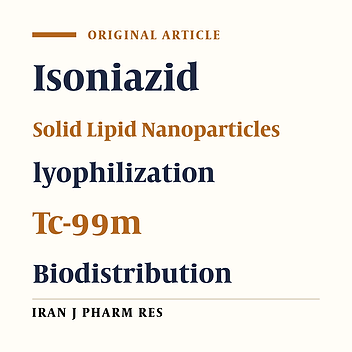
Biodistribution of Tc-99m Labeled Isoniazid Solid Lipid Nanoparticles in Wistar Rats
Ghazizadeh F, Ghaffari S, Mirshojaei SF, Mazidid M, Azarmi S. Biodistribution of Tc-99m Labeled Isoniazid Solid Lipid Nanoparticles in Wistar Rats. Iran J Pharm Res. 2018;17(4):e124860. doi: https://doi.org/10.22037/ijpr.2018.2301
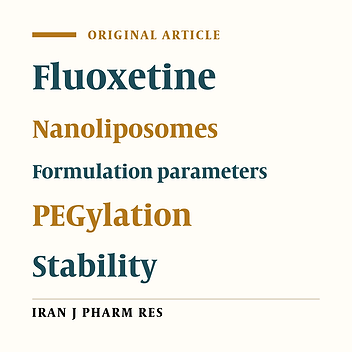
Preparation and Characterization of Stable Nanoliposomal Formulation of Fluoxetine as a Potential Adjuvant Therapy for Drug-Resistant Tumors
Haeri A, Alinaghian B, Daeihamed M, Dadashzadeh S. Preparation and Characterization of Stable Nanoliposomal Formulation of Fluoxetine as a Potential Adjuvant Therapy for Drug-Resistant Tumors. Iran J Pharm Res. 2014;13(Suppl):e125473. doi: https://doi.org/10.22037/ijpr.2014.1453
More by these authors
- Scopus by DOI: 12
Last Update: 3 weeks ago
- Scopus by Title: 12
Last Update: 3 weeks ago
- Scopus by Title (Ref): 1
Last Update: 3 weeks ago
- CrossRef: 0
Last Update: 1 hour ago
- OpenAlex: 8
Last Update: 12 hours ago
- OpenCitations: 0
Last Update: 4 days ago