Effectiveness of Fluconazole for Suppressive Maintenance Therapy in Patients with RVVC: a Randomized Placebo-Controlled Study
Authors
Abstract
Recurrent vulvovaginal candidiasis (RVVC) is seen in 5% of women with Candida vaginitis. Use of fluconazole as prophylactic treatment has been suggested for RVVC. The aim of the present study was to evaluate the efficacy of fluconazole suppressive therapy in RVVC patients, as a randomized, placebo-controlled, double-blind prophylactic study. Among the 330 women with acute symptomatic vulvovaginal candidiasis referred to Mirza-kouchak Khan gynecology hospital, 64 eligible subjects with RVVC were enrolled. Then, all of them were treated with fluconazole (150 mg orally every 3 days, for three doses). This was followed by microscopical and clinical examination. Next, patients were randomly divided into two groups. In the fluconazole group (n = 32), patients received fluconazole 150 mg, per week for 6 months and in the control group (n = 32) they received placebo. All the patients were revisited on a monthly basis and at the end of treatment, as well as 3 and 6 months after treatment. At the end of treatment, the frequency of positive culture in fluconazole group was significantly lower than the placebo group (25% vs. 62.5%, P = 0.05). Furthermore, the rate of clinical recurrence was significantly lower in the fluconazole group,with respect to the placebo group (18.8% vs. 50%, P = 0.017). However, following band 6 months after treatment, patients who received fluconazole maintenance therapy had a non-significant differences, compared to the placebo group, based on the rate of clinical recurrence or the frequency of positive cultures. Resistance to fluconazole (MIC ≥ 64) was comparable between groups. Despite the fact that fluconazole is well tolerated by the patients, suppressive treatment with fluconazole in RVVC patients had an insufficient effect on prevention from recurrence of clinical signs and the improvement of vaginal mycological status in long term (3-6 months after treatment).
Highlights
Copyright
© 2022, Author(s). This open-access article is available under the Creative Commons Attribution 4.0 (CC BY 4.0) International License (https://creativecommons.org/licenses/by/4.0/), which allows for unrestricted use, distribution, and reproduction in any medium, provided that the original work is properly cited.
Similar Articles
Vaginal azoles Versus oral Fluconazole in Treatment of Recurrent Vulvovaginal Candidiasis
Fardyazar Z, Habibzadeh S, Abdollahi Fard S, Tello M. Vaginal azoles Versus oral Fluconazole in Treatment of Recurrent Vulvovaginal Candidiasis. Arch Clin Infect Dis. 2007;2(1):. doi:
Treatment and recurrence of vaginal candidiasis after oral and intravaginal treatment
Khorsandi M, Modares Gilani M, Khosravi A. Treatment and recurrence of vaginal candidiasis after oral and intravaginal treatment. J Inflamm Dis. 2024;4(2):e154708. doi:
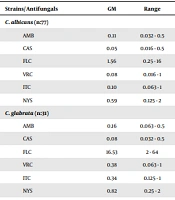
Azole Antifungal Resistance in Candida albicans and Candida glabrata Isolated from Vulvovaginal Candidiasis Patients
Deravi N, Fathi M, Tabatabaeifar SN, Pooransari P, Ahmadi B, et al. Azole Antifungal Resistance in Candida albicans and Candida glabrata Isolated from Vulvovaginal Candidiasis Patients. Arch Clin Infect Dis. 2021;16(2):e106360. doi: https://doi.org/10.5812/archcid.106360
Comparing Fluconazole and Clotrimazole in treatment of candida albicans vaginitis
Karimaan N, Shafaaii Z, Afraakhte M, Valaaii N, Ahmadi M. Comparing Fluconazole and Clotrimazole in treatment of candida albicans vaginitis. J Kermanshah Univ Med Sci. 2002;6(3):e81013. doi:
Isolation of Different Species of Candida in Patients With Vulvovaginal Candidiasis From Sari, Iran
Hedayati MT, Taheri Z, Galinimoghadam T, Aghili SR, Yazdani Cherati J, et al. Isolation of Different Species of Candida in Patients With Vulvovaginal Candidiasis From Sari, Iran. Jundishapur J Microbiol. 2015;8(4):e15992. doi: https://doi.org/10.5812/jjm.8(4)2015.15992
More by these authors
- Scopus by DOI: 0
Last Update: 3 weeks ago
- Scopus by Title: 16
Last Update: 3 weeks ago
- Scopus by Title (Ref): 0
Last Update: 3 weeks ago
- CrossRef: 0
Last Update: 6 days ago
- OpenAlex: 15
Last Update: 5 hours ago
- OpenCitations: 0
Last Update: 4 days ago