Diagnostic Evaluation of Neonatal Cholestasis: HIDA Scan and Alagille Criteria

Author(s):
Farzaneh MotamedFarzaneh Motamed1, Abbas KhaliliAbbas Khalili1, Payman SalamatiPayman Salamati2,*, Golnaz MoradiGolnaz Moradi3, Mehri Najafi SaniMehri Najafi Sani1, Ahmad KhodadadAhmad Khodadad1, Gholam Hossein FallahiGholam Hossein Fallahi1, Fatemeh FarahmandFatemeh Farahmand1, Maryam MonajjemzadehMaryam Monajjemzadeh4
1Department of Pediatric Gastroentrology, Children’s Hospital Medical Center, Tehran University of Medical Sciences, Tehran, Iran
2Advanced Diagnostic and Interventional Radiology Research Center (ADIR), Imam Khomeini Hospital, Tehran University of Medical Sciences, Tehran, Iran
3Department of Radiology, Imam Khomeini Hospital, Tehran University of Medical Sciences, Tehran, Iran
4Department of Pathology, Children’s Hospital Medical Center, Tehran University of Medical Sciences, Tehran, Iran

IJ Radiology:Vol. 11, issue 4; e6382
Published online:Oct 20, 2014
Article type:Letter
Received:May 16, 2012
Accepted:Jan 02, 2013
How to Cite:Motamed F, Khalili A, Salamati P, Moradi G, Najafi Sani M, et al. Diagnostic Evaluation of Neonatal Cholestasis: HIDA Scan and Alagille Criteria. I J Radiol. 2014;11(4):e6382. doi: https://doi.org/10.5812/iranjradiol.6382

Dear Editor,
Neonatal cholestasis (NC) is defined as prolonged elevation of serum levels of conjugated bilirubin beyond two weeks of life. The two most common causes of NC are biliary atresia (BA) and idiopathic neonatal hepatitis (INH). Early and accurate differentiation of these two entities is very important and determines the prognosis and curability of cholestasis. BA requires surgical intervention as soon as possible; whereas, INH needs medical management (1-3). There is no single non-invasive test that can definitely differentiate these two entities. The gold standard for the diagnosis of BA is intraoperative cholangiography. Liver biopsy is the investigation with high diagnostic usefulness in NC. Its diagnostic accuracy for NC has been more than 90% in several studies (1, 4-6). Alagille identified four clinical features that, although nonspecific, supported the correct diagnosis of intrahepatic or extrahepatic cholestasis in 82% of the cases. These clinical variables included stool color within 10 days of admission, age at onset of acholic stools, birth weight, and the features of hepatic involvement, specifically the presence of hepatomegaly and consistency of the liver in palpation (6).
We conducted a retrospective study between March 1996 and March 2007 to review medical records of infants with NC. Patients were all admitted in Children’s Hospital Medical Center affiliated to Tehran University of Medical Sciences, which is the major tertiary pediatric referral center in Iran. We reviewed medical records of 250 infants with NC. Infants were excluded if they did not have liver biopsy results, definite diagnosis or complete data on their medical records. Ultimately, 88 infants with BA confirmed by exploratory laparotomy or INH confirmed by liver biopsy were enrolled into the study. In this study, the gold standard tests were liver biopsy and exploratory laparotomy in INH and BA cases, respectively. The sensitivity, specificity and predictive values of HIDA scan and Alagille criteria were evaluated in comparison with liver biopsy and surgical findings. Chi-square test was used for comparison and P < 0.05 was taken as significant.
There were 88 infants with NC, including 49 (55.7%) boys and 39 (44.3%) girls. Of these, 63 (37 boys, 26 girls) were diagnosed to have INH and the remaining 25 (12 boys, 13 girls) had BA, according to liver biopsy (P = 0.361). Laparotomy confirmed liver biopsy results in all 25 cases of BA. It means that liver biopsy had 100% accuracy in diagnosing BA. Thirty-three patients had HIDA scan. Among the 23 cases with a positive scan for BA (Figure 1), 14 of them also had BA in liver biopsy (P = 0.031). Among 15 patients with a positive liver biopsy for INH, HIDA scan had shown INH in only two cases (P = 0.15).
Among 18 cases who had all four criteria of Alagille accommodated with INH, 14 (77.8%) cases had INH in liver biopsy (P = 0.0514). Of the five patients who had all four Alagille criteria accommodated with BA, in two (40%) cases, liver biopsy showed BA (P = 0.554). So the accuracy of Alagille criteria in our study is lower than what is reported in the pediatric GI textbooks. HIDA scan had a diagnostic accuracy of 60% and 11% for BA and INH, respectively.
In conclusion, there is not a single imaging test or clinical feature that has sufficient sensitivity and specificity to differentiate BA from INH, but according to our study hepatobiliary scintigraphy had a good sensitivity for diagnosing BA and the presence of acholic stools and hepatomegaly is significantly higher in infants with BA. So, scintigraphy and clinical features can help in the assessment of any infant with NC to arrive at a timely diagnosis for appropriate management. Since percutaneous liver biopsy is highly accurate in diagnosing BA, in developing countries such our country, using this modality is cost-effective, and it can preclude unnecessary surgical exploration.
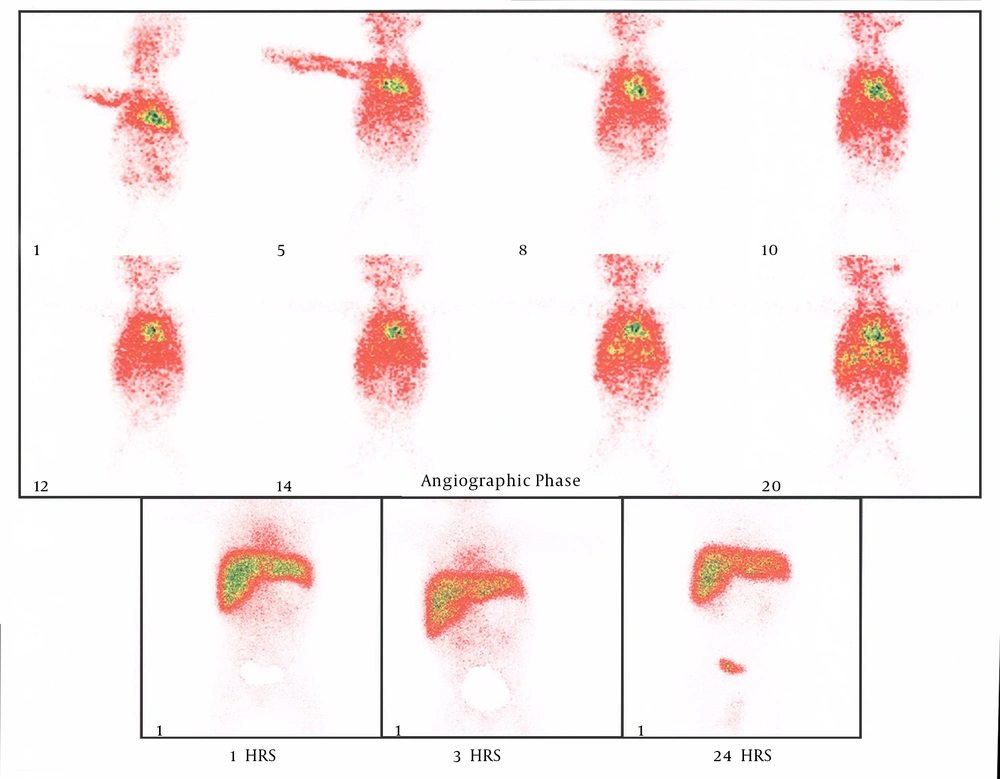
HIDA scan report of a patient with biliary atresia
Figure 1.

HIDA scan report of a patient with biliary atresia

References

  • 1.
    Poddar U, Thapa BR, Das A, Bhattacharya A, Rao KL, Singh K. Neonatal cholestasis: differentiation of biliary atresia from neonatal hepatitis in a developing country. Acta Paediatr. 2009;98(8):1260-4. [PubMed ID: 19469771]. https://doi.org/10.1111/j.1651-2227.2009.01338.x.
  • 2.
    Hartley JL, Davenport M, Kelly DA. Biliary atresia. Lancet. 2009;374(9702):1704-13. https://doi.org/10.1016/s0140-6736(09)60946-6.
  • 3.
    Bellomo-Brandao MA, Arnaut LT, Tommaso AM, Hessel G. Differential diagnosis of neonatal cholestasis: clinical and laboratory parameters. J Pediatr (Rio J). 2010;86(1):40-4. [PubMed ID: 20151096].
  • 4.
    Dehghani SM, Haghighat M, Imanieh MH, Geramizadeh B. Comparison of different diagnostic methods in infants with Cholestasis. World J Gastroenterol. 2006;12(36):5893-6. [PubMed ID: 17007060].
  • 5.
    McKiernan PJ. Neonatal cholestasis. Semin Neonatol. 2002;7(2):153-65. [PubMed ID: 12208100].
  • 6.
    Chan MY, Rusconi CP, Alexander JH, Tonkens RM, Harrington RA, Becker RC. A randomized, repeat-dose, pharmacodynamic and safety study of an antidote-controlled factor IXa inhibitor. J Thromb Haemost. 6(6). 2008. p. 789-96.

Similar Articles

25
Jul
2018
Frequency of Different Causes of Infant Cholestasis in a Tertiary Referral Center in South-East Iran

Frequency of Different Causes of Infant Cholestasis in a Tertiary Referral Center in South-East Iran

Touran Shahraki,
Ghasem Miri-Aliabad,
Mansour Shahraki

Shahraki T, Miri-Aliabad G, Shahraki M. Frequency of Different Causes of Infant Cholestasis in a Tertiary Referral Center in South-East Iran. Inn J Pediatr. 2018;28(5):e65409. doi: https://doi.org/10.5812/ijp.65409

1
Jan
2013

Paucity of Intrahepatic Bile Ducts in Neonates: the First Case Series from Iran

Mozhgan Zahmatkeshan,
Bita Geramizadeh,
Mahmood Haghighat,
Hajar Enteshari

Zahmatkeshan M, Geramizadeh B, Haghighat M, Enteshari H. Paucity of Intrahepatic Bile Ducts in Neonates: the First Case Series from Iran. Inn J Pediatr. 2013;23(1):. doi:

31
Mar
2010

A Woman with Recent Jaundice and Pruritus

Bita Behnava,
Seyed Moayed Alavian

Behnava B, Alavian S. A Woman with Recent Jaundice and Pruritus. Hepat Mon. 2010;10(1):. doi:

21
Jul
2013

Alpha 1 Antitrypsin Deficiency in Infants with Neonatal Cholestasis

Maryam Monajemzadeh,
Reza Shahsiah,
Mohammad Vasei,
Parin Tanzifi,
Nima Rezaei,
Mehri Najafi
,et al.

Monajemzadeh M, Shahsiah R, Vasei M, Tanzifi P, Rezaei N, et al. Alpha 1 Antitrypsin Deficiency in Infants with Neonatal Cholestasis. Inn J Pediatr. 2013;23(5):. doi:

10
May
2014

Approach to Liver Function Tests in Children

Mahmood Haghighat

Haghighat M. Approach to Liver Function Tests in Children. J Compr Ped. 2014;5(2):e17526. doi: https://doi.org/10.17795/compreped-17526


Crossmark
Crossmark
Checking
Share on
Cited by
Metrics

Ordering Reprints

Articles are published under the Creative Commons license stated on each article. No permission or royalty fee is required for uses permitted by that license. CCC handles optional bulk and customized reprint orders. Any quotation covers production and delivery services only, not copyright permission. > Request Reprints from CCC 

Search Relations

Author(s):

Related Articles