
Full Text
Full text is available in PDF
IJ Radiology
 Amir Hossein Saveh1,*,
  Ali Reza Zali1, Hamidreza Haghighatkhah2, Morteza Sanei Taheri2, Seyed Morteza Kazemi3, Mahmoud Chizari4, Kazuyoshi Gammada5
The salvage proximal femoral osteotomy is performed in mild to moderate forms of osteoarthritis when the articulating surfaces are normal and relieves the subjects pain. Because of the importance of angular mal-alignment of the femur bone at the hip junction, accurate pre-op planning based on patient specific anatomy is required to prevent any lower misalignment and joint problem.
In this study, a virtual CT-Based modeling technique was used to a 3D-Model of the patients pelvis and proximal femur. The registration stage using angio-fluoroscopy was performed to calculate the proximal femur kinematic and input it into a finite element model to achieve the stress distribution pattern of femoroacetabular joint.
To assess the biomechanics of the joint contact surface, it is necessary to have the stress distribution in the articulating surfaces of the hip joint. The decision about the salvage surgical approach and the appropriate plan for wedge excision will be made based on the biomechanical results at the joint. FE model also provides additional information on the stress profile of the contact surface when the joint moves from full extension to full flexion.
Use of a non-invasive 3D modeling method will remediate the surgical approach in pre-op stage. Here, the in-vivo modeling and assessment of the patient femuroacetabular contact is approved. It has been shown that the accuracy of the proposed model is comparable with the existing surgical pre-op planning.
© 2014, Author(s). This open-access article is available under the Creative Commons Attribution 4.0 (CC BY 4.0) International License (https://creativecommons.org/licenses/by/4.0/), which allows for unrestricted use, distribution, and reproduction in any medium, provided that the original work is properly cited.
Wu H, Latif M, Zhong Z, Yu B, Wu W, et al. Detection of Acetabular and Proximal Femoral Radiographic Abnormalities Showed by Hip Digital Tomosynthesis in Special Functional Position Compared with Conventional Radiography. I J Radiol. 2017;14(1):e13478. doi: https://doi.org/10.5812/iranjradiol.36009
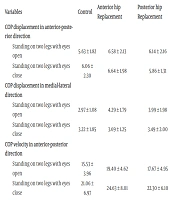
Eshaghi Namaghi MS, Daryabor A, Hejazi-Shirmard M, Qoreishy M, Jamebozorgi A. Comparison of Biomechanical, Clinical Indicators, and Quality of Life in People Undergoing Hip Replacement Surgery with Anterior and Posterior Approaches. Middle East J Rehabil Health Stud. 2025;12(1):e149066. doi: https://doi.org/10.5812/mejrh-149066
Ashtiani MN, Azghani M, Shakouri SK. Biomechanical Modeling of Hip Abduction Exercise Using Optimized Inverse Dynamics. Zahedan J Res Med Sci. 2019;21(1):e68977. doi: https://doi.org/10.5812/zjrms.68977
Seifi M, Dashtbozorg A, Mazarei S, Mohammadi SM, Aghaeiaghdam A. Evaluation of the Clinical and Radiological Findings of Open Reduction in Developmental Dysplasia of the Hip. J Compr Ped. 2025;16(3):e160289. doi: https://doi.org/10.5812/jcp-160289
Teke M, Goya C, Alemdar C, Hamidi C, Guli Cetincakmak M, et al. Radiological Assessment of Femoroacetabular Impingement Morphology Using Computed Tomography in an Asymptomatic Young Population. I J Radiol. 2017;14(1):e13456. doi: https://doi.org/10.5812/iranjradiol.22152

Checking
Last Update: 2 weeks ago
Last Update: 2 weeks ago
Last Update: 2 weeks ago
Last Update: 4 days ago
Ordering Reprints
Articles are published under the Creative Commons license stated on each article. No permission or royalty fee is required for uses permitted by that license. CCC handles optional bulk and customized reprint orders. Any quotation covers production and delivery services only, not copyright permission. > Request Reprints from CCC
Author(s):