Fulltext
The full text is available in PDF.
International Cardiovascular Research Journal
An annual journal in scientific affiliation with the Cardiovascular Research Center, Shiraz University of Medical Sciences
Image Credit:Int Cardiovasc Res J
Authors
Background: A significant proportion of patients who begin CR (cardiac rehabilitation) do not complete the program.
Objectives: The purpose of this study was to determine the predicting factors that interfere with adherence and completion of an outpatient CR program.
Patients and Methods: A cross-sectional survey was conducted with all 128 patients who entered the CR program at the Rajaie Cardiovascular Medical and Research Center in Tehran, IR Iran, from March 2009 to March 2010. The demographic variables included age, sex, education, employment status, insurance status, and return to work. These variables were compared in patients who completed and did not complete phase II CR. The reason for CR incompletion was asked in follow-up phone interviews.
Results: The most frequent clinical diagnosis among the patients enrolled in the CR program was coronary artery disease. 83.6% of patients who participated had a CABG or PCI procedure during the last year. CR participation increased when cardiac revascularization procedures were performed during the first hospitalization. 88 of the 128 patients dropped out, yielding a dropout rate of 68.7%, which was significantly (P < 0.01) higher than the same study in other countries. Sex and age did not predict the completion rate. As education increased, cardiac rehabilitation utilization and completion increased. Unemployed patients were less likely than employed patients to complete the program.
Conclusions: Our data indicate a low rate of CR completion, with lower rates among unemployed, uninsured, and less educated patients.
© 2011, Author(s). This open-access article is available under the Creative Commons Attribution 4.0 (CC BY 4.0) International License (https://creativecommons.org/licenses/by/4.0/), which allows for unrestricted use, distribution, and reproduction in any medium, provided that the original work is properly cited.
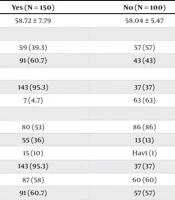
Salari A, Ebadollahian A, Parvaneh S, Fakhrmousavi A, Hasandokht T. Demographic and Social Factors Affecting Participation in Cardiac Rehabilitation: A Cross-Sectional Study. Int J Cardiovasc Pract. 2025;10(1):e158989. doi: https://doi.org/10.5812/intjcardiovascpract-158989
Soroush A, Heydarpour B, Saeidi M, Ezzati P, Komasi S. Waiting Time for Start of Outpatient Cardiac Rehabilitation: Correlations of Non Compliance to Systematic Referral After Coronary Artery Bypass Surgery. Jundishapur J Chronic Dis Care. 2016;6(2):e43402. doi: https://doi.org/10.5812/jjcdc.43402
Komasi S, Saeidi M. Aging is an Important Cause for a Lack of Understanding of the Main Risk Factor in Cardiac Rehabilitation Patients. Thrita J Neu. 2015;4(4):e32751. doi: https://doi.org/10.5812/thrita.32751
Ettefagh L, Mosahebi Mohammadi L, Naderi N, Azma K. Resting heart rate changes in patients referring to cardiac rehabilitation. Ann Mil Health Sci Res. 2013;11(3):e65135. doi:
Nalini M, Najafi F, Saeidi M, Gerami F, Rashidi A, et al. Changes in exercise capacity and modifiable risk factors after a comprehensive cardiac rehabilitation in patients with and without left ventricular systolic dysfunction. J Kermanshah Univ Med Sci. 2009;13(3):e79594. doi:
Last Update: 2 weeks ago
Last Update: 2 weeks ago
Last Update: 2 weeks ago
Last Update: 11 hours ago
Last Update: 14 hours ago
Last Update: 5 days ago
