
1. Background
Although cardiopulmonary resuscitation (CPR) is infrequently performed in pediatric emergencies, it is crucial that CPR is administered correctly and promptly for children requiring resuscitation. Cardiac arrest that necessitates resuscitation occurs in approximately 7 out of every 1,000 hospitalizations of children with cardiovascular disease, which is more than ten times the rate seen in children hospitalized without cardiovascular issues (1). Therefore, comprehensive training in CPR should be organized for all healthcare providers in pediatric emergency departments. The survival rates for children experiencing in-hospital cardiac arrest (IHCA) have nearly tripled over a ten-year span, increasing from 14.3% to 43.4% between 2000 and 2009 (2).
Studies have shown that nearly two-thirds of children who experience cardiac-respiratory arrest in the hospital achieve spontaneous return of circulation, and 20 to 40 percent of them are discharged from the hospital with favorable neurological outcomes (3). In contrast, children who experience cardiac-respiratory arrest outside the hospital have the worst outcomes; the survival rate until discharge for these children is usually less than 10%, and many of them suffer from severe neurological complications (4). Numerous diseases and clinical conditions, including cardiac arrest, respiratory failure, various types of shock, and trauma, can necessitate CPR in children. Early diagnosis and management of these conditions may help prevent the need for resuscitation.
Caregivers of children with heart disease face several challenges in hospital environments. Knowledge about high-risk pediatric cardiac patients plays a vital role in enhancing survival rates from cardiac arrest through effective resuscitation efforts and improving outcomes in post-resuscitation care (5). Certain characteristics affect the outcomes of CPR in patients who present to the emergency department with cardiac arrest. These factors include patient characteristics such as age and gender, the presence of certain underlying diseases, the cause of resuscitation, the initial rhythm recorded after cardiac arrest, response time, and the duration of CPR. In some studies, it has also been mentioned that the location of cardiac arrest (out-of-hospital/in-hospital), the type of hospital, and the country seem to have a significant impact on CPR outcomes (6-8).
2. Objectives
This study aimed to evaluate demographic characteristics, etiological factors, arrest characteristics (rhythm, location, shift), and their associations with survival outcomes [return of spontaneous circulation (ROSC), 24-hour survival, and survival to discharge] in pediatric patients who underwent CPR in a tertiary emergency department in Iran between April 2021 and March 2023.
3. Methods
3.1. Participant
In this retrospective cohort study, all patients under 18 years old who underwent CPR in the emergency department of the Children's Medical Center Hospital for any reason from April 2021 to March 2023 were retrospectively assessed.
3.2. Data Gathering
We conducted an evaluation of patient records utilizing the Sabara archiving software to extract pertinent variables. The initial sample comprised 164 patients. However, the records of 13 patients were either incomplete or unreadable within the archiving software, thereby precluding the extraction of essential information. Furthermore, two patients were over the age of 18, rendering them irrelevant to the scope of our study. Consequently, after excluding these cases, we finalized our analysis with a total of 149 cases. This study was conducted with the approval of the Ethics Committee of Tehran University of Medical Sciences; reference code: IR.TUMS.CHMC.REC.1400.218. Access to patient files was granted after obtaining permission from the research department of the hospital and in coordination with the archive’s unit.
3.3. Statistical Analyses
To assess the normality of the data, the Shapiro-Wilk test was employed. Continuous variables were expressed either as mean (± standard deviation) or median (IQR), depending on the data distribution. Categorical variables were presented as frequencies (%). We used the chi-Square test and Fisher's exact test to assess the association between predictor variables and outcomes. The statistical software Stata (Version 16, Stata Corp, College Station, Texas, USA) was used for data analysis. Statistical significance was defined as a P-value less than 0.05.
4. Results
This study assessed the characteristics of 149 patients (Table 1), with a median age of 18.0 months (IQR: 6.0 - 70.0). This retrospective cohort included 76 males (51.0%), and a significant portion of the patients (52, 34.9%) were admitted to the intensive care unit (ICU). A large majority (141, 94.6%) were intubated. Most patients experienced IHCA (118, 79.2%), with respiratory arrest being the most common cause (110, 73.8%). The predominant rhythm prior to chest compressions was asystole (51, 34.2%). Common symptoms included distress of breath (80, or 53.7%) and fever (53, 35.0%). Notable comorbidities included congenital heart defects (28, 19.0%) and cerebral palsy (20, 13.4%).
Table 1.
Characteristic of the Study Patients a
| Variables | Values (N = 149) |
|---|---|
| Age (mo) | 18.0 (6.0; 70.0) |
| Heart beat | 120.0 (75.0; 145.0) |
| Heart rate | 35.0 (22.0; 50.0) |
| Saturated | 90.0 (80.0; 95.0) |
| CPR duration (min) | 30.0 (15.0; 45.0) |
| Male sex | 76 (51.0) |
| ICU | 52 (34.9) |
| Intubation | 141 (94.6) |
| Shift | |
| Night | 56 (37.6) |
| Morning | 55 (36.9) |
| Evening | 38 (25.5) |
| Location of arrest | |
| IHCA | 118 (79.2) |
| OHCA | 31 (20.8) |
| Cause | |
| Respiratory arrest | 110 (73.8) |
| Cardiac arrest | 11 (7.4) |
| Cardiopulmonary arrest | 18 (12.1) |
| Status | 8 (5.4) |
| Decrease of GCS | 2 (1.3) |
| Rhythm prior to chest compressions | |
| Asystole | 51 (34.2) |
| NL sinus | 40 (26.8) |
| Nl sinus | 2 (1.3) |
| PEA | 12 (8.1) |
| PSVT | 1 (0.7) |
| Sinus bradycardia | 24 (16.1) |
| Sinus tachycardia | 12 (8.1) |
| VT | 7 (4.7) |
| Symptoms | |
| Distress of breath | 80 (53.7) |
| Fever | 53 (35.0) |
| LOC | 48 (32.0) |
| Apnea | 23 (15.4) |
| Cough | 23 (15.4) |
| Diarrhea | 18 (12.1) |
| Convulsion | 17 (11.4) |
| Comorbidity | |
| Congenital heart defect | 28 (19.0) |
| CP | 20 (13.4) |
| FTT | 15 (10.0) |
| NDD | 15 (10.1) |
| Metabolic | 10 (6.7) |
| Microcephaly | 8 (5.4) |
| Convulsion | 38 (25.5) |
Abbreviations: CPR, cardiopulmonary resuscitation; ICU, intensive care unit; IHCA, in-hospital cardiac arrest; OHCA, out-of-hospital cardiac arrest; PEA, pulseless electrical activity.
a Values are expressed as median (IQR) or No. (%).
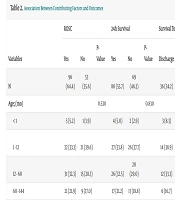
As shown in Table 2, 64.4% of patients achieved ROSC, 53.7% survived for 24 hours after the event, and 24.2% survived until discharge. The analysis of the association between contributing factors and outcomes in pediatric resuscitation efforts reveals several insights. Firstly, there is no association between age and outcomes. Also, sex does not appear to be a determining factor in any of the outcomes, as there were no statistically significant differences between males and females across ROSC, 24-hour survival, or survival to discharge. The reason for resuscitation is an important factor, with respiratory arrest being strongly associated with better outcomes at all stages, while cardiac and cardiopulmonary arrests show poorer prognoses (P < 0.001). The rhythm prior to chest compressions is also a significant predictor, with asystole and PEA being associated with lower chances of ROSC and survival (P < 0.001). Interestingly, the shift during which the arrest occurs does not significantly affect the outcomes. Lastly, the location of the arrest is a pivotal factor, with IHCA showing better outcomes compared to out-of-hospital cardiac arrests (OHCA).
Table 2.
Association Between Contributing Factors and Outcomes
| Variables | ROSC | 24h Survival | Survival To Discharge | ||||||
|---|---|---|---|---|---|---|---|---|---|
| Yes | No | P-Value | Yes | No | P-Value | Discharge | Death | P-Value | |
| N | 96 (64.4) | 53 (35.6) | 80 (53.7) | 69 (46.3) | 36 (24.2) | 113 (75.8) | |||
| Age; (mo) | 0.530 | 0.830 | 0.295 | ||||||
| < 1 | 5 (5.2) | 1 (1.9) | 4 (5.0) | 2 (2.9) | 3 (8.3) | 3 (2.7) | |||
| 1 - 12 | 32 (33.3) | 21 (39.6) | 27 (33.8) | 26 (37.7) | 14 (38.9) | 39 (34.5) | |||
| 12 - 60 | 31 (32.3) | 15 (28.3) | 26 (32.5) | 20 (29.0) | 12 (33.3) | 34 (30.1) | |||
| 60 - 144 | 21 (21.9) | 9 (17.0) | 17 (21.2) | 13 (18.8) | 6 (16.7) | 24 (21.2) | |||
| 144 - 216 | 7 (7.3) | 7 (13.2) | 6 (7.5) | 8 (11.6) | 1 (2.8) | 13 (11.5) | |||
| Sex | 0.723 | 0.695 | 0.807 | ||||||
| Female | 46 (47.9) | 27 (50.9) | 38 (47.5) | 35 (50.7) | 17 (47.2) | 56 (49.6) | |||
| Male | 50 (52.1) | 26 (49.1) | 42 (52.5) | 34 (49.3) | 19 (52.8) | 57 (50.4) | |||
| Reason to resuscitation | < 0.001 | < 0.001 | 0.002 | ||||||
| Respiratory arrest | 82 (85.4) | 28 (52.8) | 69 (86.2) | 41 (59.4) | 30 (83.3) | 80 (70.8) | |||
| Cardiac arrest | 2 (2.1) | 9 (17.0) | 0 (0.0) | 11 (15.9) | 0 (0.0) | 11 (9.7) | |||
| Cardiopulmonary arrest | 3 (3.1) | 15 (28.3) | 3 (3.8) | 15 (21.7) | 0 (0.0) | 18 (15.9) | |||
| Status | 7 (7.3) | 1 (1.9) | 7 (8.8) | 1 (1.4) | 5 (13.9) | 3 (2.7) | |||
| Low GCS | 2 (2.1) | 0 (0.0) | 1 (1.2) | 1 (1.4) | 1 (2.8) | 1 (0.9) | |||
| Rhythm prior to chest compressions | < 0.001 | < 0.001 | < 0.001 | ||||||
| Asystole | 11 (11.5) | 40 (75.5) | 6 (7.5) | 45 (65.2) | 1 (2.8) | 50 (44.2) | |||
| NL sinus | 39 (40.6) | 1 (1.9) | 35 (43.8) | 5 (7.2) | 19 (52.8) | 21 (18.6) | |||
| Nl sinus | 2 (2.1) | 0 (0.0) | 2 (2.5) | 0 (0.0) | 1 (2.8) | 1 (0.9) | |||
| PEA | 8 (8.3) | 4 (7.5) | 7 (8.8) | 5 (7.2) | 2 (5.6) | 10 (8.8) | |||
| PSVT | 1 (1.0) | 0 (0.0) | 1 (1.2) | 0 (0.0) | 1 (2.8) | 0 (0.0) | |||
| Sinus bradycardia | 19 (19.8) | 5 (9.4) | 17 (21.2) | 7 (10.1) | 9 (25.0) | 15 (13.3) | |||
| Sinus tachycardia | 12 (12.5) | 0 (0.0) | 10 (12.5) | 2 (2.9) | 3 (8.3) | 9 (8.0) | |||
| VT | 4 (4.2) | 3 (5.7) | 2 (2.5) | 5 (7.2) | 0 (0.0) | 7 (6.2) | |||
| Shift | 0.649 | 0.780 | 0.361 | ||||||
| Night | 35 (36.5) | 21 (39.6) | 32 (40.0) | 24 (34.8) | 10 (27.8) | 46 (40.7) | |||
| Morning | 38 (39.6) | 17 (32.1) | 29 (36.2) | 26 (37.7) | 16 (44.4) | 39 (34.5) | |||
| Evening | 23 (24.0) | 15 (28.3) | 19 (23.8) | 19 (27.5) | 10 (27.8) | 28 (24.8) | |||
| Location of arrest | < 0.001 | < 0.001 | 0.034 | ||||||
| IHCA | 87 (90.6) | 31 (58.5) | 73 (91.2) | 45 (65.2) | 33 (91.7) | 85 (75.2) | |||
| OHCA | 9 (9.4) | 22 (41.5) | 7 (8.8) | 24 (34.8) | 3 (8.3) | 28 (24.8) | |||
Abbreviations: ROSC, return of spontaneous circulation; PEA, pulseless electrical activity; PSVT, paroxysmal supraventricular tachycardia; VT, ventricular tachycardia; IHCA, in-hospital cardiac arrest; OHCA, out-of-hospital cardiac arrest.
5. Discussion
Among the 149 participants in our investigation, the prevalence of survival to hospital discharge was 24 percent. This prevalence is significantly low in comparison to other studies performed in Asia (36%) and low and middle-income countries (34%) (9). In our study, the age and gender of resuscitated patients had no significant association with resuscitation outcomes, while some other studies have associated better outcomes with younger age. In another study, age also had no effect on resuscitation outcomes (10, 11).
The occurrence of IHCA was associated with better outcomes in terms of successful resuscitation and survival to discharge, with 73.7% of IHCA patients achieving ROSC and 30% surviving to discharge. Similarly, in the study by Yurtseven et al. in 2019, IHCA patients had better outcomes; 80% of IHCA patients achieved ROSC, and 40% survived to discharge (11). The differences in resuscitation outcomes between the IHCA and OHCA groups can be attributed to immediate post-arrest care, including the presence of experienced medical staff at the bedside, availability of necessary equipment, and the early initiation of ALS in IHCA patients.
In previous studies, respiratory failure has been identified as the most common cause of resuscitation in children, and it has also been observed that respiratory arrest as a cause of resuscitation is associated with better outcomes in terms of successful resuscitation and survival to discharge. Possible reasons for this difference include maintained blood flow: In respiratory arrest, the heart often continues to beat, allowing blood flow to vital organs. In contrast, cardiac arrest abruptly stops circulation, leading to cerebral ischemia and organ damage.
Time to Intervention: Respiratory arrest is usually identified more rapidly, allowing for prompt assisted ventilation. However, in cardiac arrest, the time required to recognize the event and initiate resuscitation may be longer. Response to Resuscitation: Respiratory arrest typically responds better to assisted ventilation, whereas cardiac arrest requires a combination of CPR, vasopressor administration, and potentially defibrillation (11-13). In our study, respiratory failure was also the most common cause of resuscitation, accounting for 73.8%, and was associated with better resuscitation outcomes.
In our study, the most common initial rhythm during resuscitation was asystole, accounting for 34.2%, followed by normal sinus rhythm at 28.2%, and sinus bradycardia at 16.1%. The worst outcomes were associated with asystole, while the best outcomes were associated with sinus rhythms. In the study by Reis et al., the most common rhythm was asystole at 55%, which was associated with a lower survival rate to discharge, followed by sinus bradycardia at 33%, which was associated with better survival outcomes (12). In the study by Rathore et al., the most common rhythm was sinus bradycardia at 52.2%, followed by PEA at 24%, and asystole at 15.2%, with asystole being associated with reduced survival to discharge (13).
Although our study did not identify a statistically significant difference in survival rates across different shifts, existing literature suggests that shift timing can influence patient outcomes due to factors such as staff fatigue, reduced staffing levels, and diminished alertness during off-hours. Specifically, a meta-analysis by Lin et al. demonstrated that OHCAs occurring at night are associated with lower survival rates compared to daytime incidents, potentially due to decreased staffing and delayed response times during night shifts (14). Similarly, Ofoma et al. found that IHCAs during off-hours (nights and weekends) had poorer outcomes, attributing this to factors like reduced nurse-to-patient ratios and less experienced staff (15). Furthermore, a study focusing on ICU physicians found that night shifts led to higher levels of fatigue and reduced psychomotor vigilance, which could potentially impact patient care quality.
5.1. Conclusions
In this study, we did not collect data regarding the long-term follow-up of patients who survived. It is clear that one of the most important factors in resuscitation is the potential complications (cardiovascular, neurological, respiratory, etc.) after successful resuscitation. Another limitation is the retrospective design, which restricts causal inference and is dependent on the accuracy of documentation. In this study, we faced limitations and challenges that were explained in the relevant section. Conducting multicenter studies with larger sample sizes and more complete data can enhance our understanding of the factors influencing the resuscitation process in children and their impact on the final outcomes. The prevalence of survival to hospital discharge was significantly low in comparison to other studies. The survival measures were associated with the location of cardiorespiratory arrest, cause of resuscitation, shorter duration of resuscitation, and rhythm prior to chest compressions.
5.2. Limitations
The most important limitation of our study was the incompleteness of the files. The information recorded in the files was sometimes poorly written and illegible. The files of some patients were incompletely scanned, meaning that the history and orders pages were not fully scanned. The files of a small number of patients were not available at all, and we had to exclude these patients from the study. Despite the lack of significant differences in resuscitation outcomes across different work shifts, due to the higher mortality rates in evening and night shifts, these shifts require more attention.
5.3. Recommendations
It is recommended to implement changes such as shortening the duration of the night shift or increasing the number of personnel in the shift to reduce mortality. These findings underscore the importance of early intervention and specific clinical factors in improving pediatric resuscitation outcomes.