Cover image of the article: Spontaneous Left Main Coronary Artery Dissection Presenting with Acute Myocardial Infarction in an Elderly Male: A Clue from the Collateral Flow

Image Credit:Int Cardiovasc Res J

Spontaneous Left Main Coronary Artery Dissection Presenting with Acute Myocardial Infarction in an Elderly Male: A Clue from the Collateral Flow

Authors

Sung Woo ChoSung Woo Cho ORCID1, Byung Gyu Kim1, Jong Chun NahJong Chun Nah ORCID1,*
1Division of Cardiology, Department of Internal Medicine, Inje University College of Medicine, Seoul Paik Hospital, Seoul, Korea
*Corresponding Author: Division of Cardiology, Department of Internal Medicine, Inje University College of Medicine, Seoul Paik Hospital, Seoul, Korea, Tel: + 822-2270-0010, E-mail: drnah1970@hanmail.net Email: drnah1970@hanmail.net

International Cardiovascular Research Journal:Vol. 13, issue 2; 75-77
Published online:Jun 30, 2019
Article type:Case Report
Received:Jun 19, 2018
Accepted:Mar 11, 2019
How to Cite:Cho SW, Kim BG, Nah JC. Spontaneous Left Main Coronary Artery Dissection Presenting with Acute Myocardial Infarction in an Elderly Male: A Clue from the Collateral Flow. Int Cardiovasc Res J. 2019;13(2):e83466. doi:

Abstract

Spontaneous Coronary Artery Dissection (SCAD) is a rare cause of Acute Myocardial Infarction (AMI), which usually occurs in young or middle-aged healthy females. Here, we reported a 62-year-old male having SCAD in the Left Main Coronary Artery (LMCA) presenting with AMI. In this case, we could diagnose a spontaneous LMCA dissection with the help of contrast dye staining at the end of the collateral flow from the Right Coronary Artery (RCA). Even a small amount of contrast dye staining at the end of the collateral flow from the RCA provides an important clue for suspecting spontaneous LMCA dissection. Meticulous catheter manipulation should be required in such cases to prevent the extension of iatrogenic catheter-dissection during the procedure.

Highlights

Fulltext


The full text is available in PDF.
 
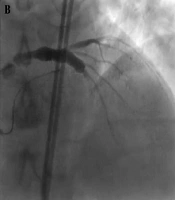
Video 1. Right Coronary Angiography Showing a Collateral Flow toward the Left Anterior Descending Artery and Contrast Dye Staining at the End of the Collateral Flow, Which Was Suspicious of Spontaneous Left Main Coronary Artery Dissection.
Video 2. Intravascular Ultrasound Showing a Soft Atherosclerotic Plaque at the Proximal Left Anterior Descending Artery and a Dissection Flap and False Lumen with Intramural Hematoma at the Left Main Coronary Artery.


References

  • 1.
    The references are available in PDF.

Copyright

© 2019, Author(s). This open-access article is available under the Creative Commons Attribution 4.0 (CC BY 4.0) International License (https://creativecommons.org/licenses/by/4.0/), which allows for unrestricted use, distribution, and reproduction in any medium, provided that the original work is properly cited.

Similar Articles

30
Jun
2010
Aortocoronary Dissection during Diagnostic Coronary Angiography: Treatment with Multiple Stenting of the Coronary Artery

Aortocoronary Dissection during Diagnostic Coronary Angiography: Treatment with Multiple Stenting of the Coronary Artery

A Ghaemian,
R Jalalian

Ghaemian A, Jalalian R. Aortocoronary Dissection during Diagnostic Coronary Angiography: Treatment with Multiple Stenting of the Coronary Artery. Int Cardiovasc Res J. 2010;4(2):e65021. doi:

25
Apr
2016
Anomalous Origin of the Right Coronary Artery from the Mid-Portion of the Left Anterior Descending Artery in a Patient with Single Left Coronary Artery: A Rare Coronary Artery Anomaly and Review of Literature

Anomalous Origin of the Right Coronary Artery from the Mid-Portion of the Left Anterior Descending Artery in a Patient with Single Left Coronary Artery: A Rare Coronary Artery Anomaly and Review of Literature

Mahmoud Beheshti Monfared,
Hamid Ghaderi,
Taraneh Faghihi Langroudi,
Seyedeh Adeleh Mirjafari,
Mahnoosh Foroughi,
Mohammad Forozeshfard
,et al.

Beheshti Monfared M, Ghaderi H, Faghihi Langroudi T, Mirjafari SA, Foroughi M, et al. Anomalous Origin of the Right Coronary Artery from the Mid-Portion of the Left Anterior Descending Artery in a Patient with Single Left Coronary Artery: A Rare Coronary Artery Anomaly and Review of Literature. I J Radiol. 2017;14(1):e13458. doi: https://doi.org/10.5812/iranjradiol.23484

1
Dec
2017
An Unusual Case of Spontaneous Left Main Coronary Dissection in A Young Pregnant Woman Treated with Percutaneous Intervention

An Unusual Case of Spontaneous Left Main Coronary Dissection in A Young Pregnant Woman Treated with Percutaneous Intervention

Jayme Ferro,
Giovanni Tortorella,
Massimo Pantaleoni,
Vincenzo Guiducci

Ferro J, Tortorella G, Pantaleoni M, Guiducci V. An Unusual Case of Spontaneous Left Main Coronary Dissection in A Young Pregnant Woman Treated with Percutaneous Intervention. Int Cardiovasc Res J. 2017;11(4):e61190. doi:

1
Sep
2018
Spontaneous Coronary Artery Dissection Treated with Intravascular Ultrasound Guided Percutaneous Coronary Intervention

Spontaneous Coronary Artery Dissection Treated with Intravascular Ultrasound Guided Percutaneous Coronary Intervention

Lucky Cuenza,
Kay Woon Ho

Cuenza L, Ho KW. Spontaneous Coronary Artery Dissection Treated with Intravascular Ultrasound Guided Percutaneous Coronary Intervention. Int Cardiovasc Res J. 2018;12(3):e64428. doi:

16
Dec
2025
Retrograde Revascularization of Left Main Coronary Chronic Total Occlusion: Distinct Roles of Conus Branch and Septal Collaterals: Two Case Report

Retrograde Revascularization of Left Main Coronary Chronic Total Occlusion: Distinct Roles of Conus Branch and Septal Collaterals: Two Case Report

Ata Firouzi,
Ali Sarreshtehdari,
Seyed Shahin Eftekhari,
Seyyed Mojtaba Hashemizadeh,
Ehsan Khalilipur,
Armin Elahifar
,et al.

Firouzi A, Sarreshtehdari A, Eftekhari SS, Hashemizadeh SM, Khalilipur E, et al. Retrograde Revascularization of Left Main Coronary Chronic Total Occlusion: Distinct Roles of Conus Branch and Septal Collaterals: Two Case Report. Int Cardiovasc Res J. 2025;19(1):e166985. doi: https://doi.org/10.69107/icrj-166985

More by these authors

Sung Woo ChoPubMedScholar
Byung Gyu KimPubMedScholar
Jong Chun NahPubMedScholar
Share
Cited by
Metrics