
1. Background
Based on the reports in 2014, the number of people affected by End-Stage Renal Disease (ESRD) in Iran was estimated at 28000 and this number is expected to reach 90,000 by 2021 (1). Not all patients are able to receive a kidney transplant and need other kidney replacement treatments, such as hemodialysis, to survive (2). Fatigue is a general and undeniable symptom in patients undergoing hemodialysis, which is present in 42 - 89% of patients (3) and has a negative effect on a person’s activities of daily living (ADL) (4). Despite progress in renal replacement therapy, fatigue remains one of the scariest symptoms for these patients (5), which can be due to anemia, decreased serum albumin, and sleep disturbance (6). The importance of fatigue in patients with kidney disease is more prominent where it has been seen that 94% of hemodialysis patients tend to undergo hemodialysis more frequently if their energy level increases (7).
Although the effect of fatigue on daily functioning in patients with chronic diseases is known (8), it is studied by researchers and addressed by care providers less frequently. However, fatigue can have a negative effect on the quality of life of patients undergoing hemodialysis and, if untreated, leads to increased dependence on others, weakness, decrease in physical and mental energy, social isolation and depression (8).
The first treatment for these disorders in patients undergoing hemodialysis is medication (9), but since these patients use many medications and most of them are excreted through the kidneys, adding another drug to the treatment process can worsen the patients’ problems, therefore, non-pharmacological methods are necessary for these patients (10). There are various methods to relieve the patient fatigue, the use of aromatherapy and massage therapy techniques have been investigated in many researches. Massage therapy reduces the number and duration of leg cramps in patients undergoing hemodialysis. It also improves sleep, emotional health and physical activities (11). Aromatherapy is one of the sub-branches of complementary medicine, which has been proven to have an effect on the mental and physical symptoms of various diseases (12) and reduces blood pressure and anxiety (13). Aromatherapy is also effective in treating the problems of patients undergoing hemodialysis such as fatigue and sleep disorder, pain (14), depression, anxiety, stress (15) and itching, and is regarded as a safe, cheap and affordable alternative to pharmaceutical methods. Geranium essential oil has a specific smell and is among the aromas that is widely used in aromatherapy (16). The accumulated molecules of this essential oil transmit a biological signal to the visual receptor cells in the limbic system and hypothalamus through a molecular mechanism, and reduces the activity of the sympathetic nervous system and stimulates the parasympathetic system by releasing neurotransmitters (17).
On the other hand, reflexology is one of the complementary and alternative therapies that has a long history and is currently considered one of the six complementary therapies in United States (18). It is a form of deep pressure therapy that is designed to improve neural pathways, coordinate and appropriate mental functioning, and promote relaxation responses. There are several theories on the reflexology effects, one of which is the stimulation of nerve receptors with an emphasis on the relationship between the central and peripheral nervous systems. Any pressure on certain hand and foot points can increase blood circulation and nerve impulses, release toxins and endorphins, improve performance and create a good feeling (19) and restore health and balance, increase blood flow, increase oxygenation in muscles and relieve fatigue (20).
Considering the fact that non-pharmacological treatment interventions are the responsibility of nurses and this type of treatment represents the art of the nursing profession, and also considering that researchers in the hemodialysis department are witnessing more fatigue in hemodialysis patients and so far a study with the aim of determining the effect of aromatherapy with geranium essential oil and foot reflexology on fatigue and daily life activities of hemodialysis patients has not been done, it seems necessary to conduct such a study.
2. Objectives
The purpose of the present study is to compare the effect of aromatherapy with geranium essential oil and foot reflexology on Fatigue and the daily activities of patients undergoing hemodialysis referred to the Hemodialysis Centers of Dezful University of Medical Sciences in 2019.
3. Methods
This is a randomized clinical trial that was conducted on hemodialysis patients referred to Dr. Ganjovian Dezful Hospital in 2019. The study population included 90 patients hospitalized in the hemodialysis department. The minimum sample size in each group was estimated 23 people using the formula:
type I error: α = 0.05, Zα = 1.96; test power: 1 - β = 0.80, Zβ = 0.84; the difference in the average score of expected fatigue severity in the control and case groups: ε = μ1 - μ2; proportion of samples in both case and control groups: k = 1; effect size: θ = effect size = |ε|/σ = 0.50 (21) in the two case and control groups, the effect size (22). In order to obtain more reliable results, 90 samples were selected in three groups (n= 30 people per group). Purposive sampling was carried out.
Inclusion criteria included age range of 18 to 60 years, patient with confirmed chronic renal failure, undergoing hemodialysis for at least three months, absence of wounds, fractures, burns and skin diseases, no use of sedatives in the last four hours, no use of other complementary medicine methods in the last three months, having a fatigue score of 5 or more (according to VAS-F), having a healthy sense of smell and not being allergic to geranium extract. Exclusion criteria also included being absent from two or more intervention sessions, increased disease severity and worsening of the patient’s condition, mental crises, respiratory disorders, unwillingness to continue participating in the intervention, patients with lower extremity edema, pregnancy, neuropathy, amputation. After obtaining the necessary permissions from the Research Vice-Chancellor of Dezful University of Medical Sciences and the head of Dr. Ganjovian Hospital in Dezful city and written consent from the patients, they were included based on the inclusion criteria. Also, sampling and data collection were performed in the mentioned hospitals.
Prior to the intervention, demographic information questionnaire, Piper Fatigue Scale (PFS) and Nottingham Extended Activities of Daily Living (NEADL) were completed by all the studied subjects. The patients of the control group were not given any advice to receive the intervention and were only asked to answer the questions of the questionnaire.
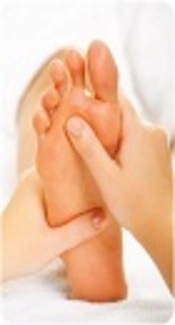
Geranium extract was used in the aromatherapy intervention group. First, 10 drops of pure geranium were poured by the researcher on an eye pad during the first hour of hemodialysis. The researcher then attached the soaked cotton to the neck of the patients and asked them to normally to breathe. The intervention group received foot reflexology for about 20 minutes (23, 24) for each person by a trained researcher. The intervention continued during all three hemodialysis sessions for five consecutive weeks. Most patients undergoing hemodialysis received the intervention three times a week, which resulted in 15 massage sessions. The sole massage was performed. The sole consists of three reflex points (solar plexus, pituitary gland and kidney). The pituitary reflex point is located in the center of the pads of the toes, solar plexus is also located on the soles of both feet just below the pads of the middle toe, and the kidney point is located inside the edge of the big pad at the base of the toe. Reflexology treatment was performed on each of these points for three minutes, which will last 10 minutes on each foot. Foot reflexology massage was performed by a trained researcher three times a week for five weeks and each session lasted 20 minutes. The intervention was carried out for men and women by a trained male researcher and a trained female assistant, respectively. All interventions were performed one hour after the dialysis session.
3.1. Measures
The data collection instrument included a four-part questionnaire that included demographic information questionnaire, VAFS, PFS and NEADL.
3.1.1. Demographic Questionnaire
The first part of the questionnaire related to the demographic information of the patient that included questions on age, gender, education level, marital status, employment status and cause of the disease.
3.1.2. Visual Analogue Fatigue Scale
The second part included VAFS that was used to screen the eligible samples. This is a standard scale and has been used many times in previous studies. The validity and reliability of this scale has been confirmed in a study by Tseng et al. (22). The test-retest reliability of the above scale was assessed in the present research (0.76), which is within the acceptable range. Patients with fatigue severity score of ten and above were included in the study. Scores zero, one-three, four-six, and seven-ten indicated no, low, moderate and severe fatigue, respectively (25).
3.1.3. Piper Fatigue Scale
The third part of the questionnaire includes PFS, which has been used in many international studies. Its reliability also was assessed in studies by Cho and Tsay (26) and Piper et al. (27). Cronbach’s alpha coefficient in Cho and Tsay’s research is equal to 91%, which is acceptable (27), The test-retest reliability of the above instrument was assessed in the present research (0.90). This questionnaire consists of 27 items and investigates four dimensions of mental fatigue including behavioral (six items), emotional (five items), sensory (five items) and cognitive dimensions (six items). The total score of 22 items of the above scale was calculated in the present study. Also, five additional items, that is items number 1 and 24 - 27 are not used when calculating the score of the subscales and the overall score of the fatigue scale and are used in the evaluation of descriptive data. Each item is assigned a score ranging from zero to ten. Scores zero, one-three, four-six, and seven-ten show no fatigue, mild, moderate, and severe fatigue, respectively (28). This scale was given to all patients twice, that is, at baseline and five weeks after the intervention, to determine the fatigue severity score (27).
3.1.4. Nottingham Extended Activities of Daily Living
The fourth questionnaire included NAEDL. It is one of the standard and valid questionnaires in this field, which consists of 22 questions in four areas (mobility, kitchen, household and leisure activities). The possible score range is 0 and 22. In scoring of the Nottingham, the questions are scored based on a four-point Likert scale ranging from: At all (zero), asking for help (zero) score, I myself but with difficulty (one), I myself (one) in the form of section one (mobility: Items one - six, section two (kitchen activities: Items 7 - 11), section three (home activities: Items 12 - 16), section four (leisure activities: Items 17 - 22). The reliability of this questionnaire was obtained 0.82 (29). After being translated, the questionnaire was checked by the content validity method and its validity was confirmed by the faculty members. Its reliability was also calculated using the test-retest method (0.88).
3.2. Statistical Analysis
Data analysis was carried out using SPSS version 16 software. P-value < 0.05 was considered as the significance level. We used the analysis of variance (ANOVA) to assess the difference in the mean score of fatigue and daily activity between the groups before and after the intervention. LSD was used for comparing the mean score of fatigue and daily activity in between groups. t test was used to assess the difference in the mean score of fatigue and daily activity in the paired groups.
3.3. Ethical Considerations
The present study was approved by the Ethics Committee of Dezful University of Medical Sciences (IR.DUMS.REC.1398.033).
4. Results
The present study was carried out on 90 patients undergoing hemodialysis including 45 men and 45 women. A total of 41.1% of the participants had a bachelor’s degree, 71.1% were married, and 50% of them were hypertensive (Table 1).
Table 1.
Frequency and Frequency Percentage of Sample’s Demographic Characteristics a
| Variables | Reflexology | Aromatherapy | Control | P Value |
|---|---|---|---|---|
| Age (y) | 51.37 ± 15.68 | 50.96 ± 17.00 | 55.63 ± 11.18 | 0.446 |
| Gender | 0.964 | |||
| Male | 14 (51.90) | 13 (50.0) | 13 (48.1) | |
| Female | 13 (48.1) | 13 (50.0) | 14 (51.9) | |
| Education | 0.895 | |||
| Illiterate | 7 (25.9) | 5 (19.2) | 4 (14.8) | |
| Primary | 7 (25.9) | 4 (15.4) | 7 (25.9) | |
| Middle | 2 (7.4) | 6 (23.1) | 4 (14.8) | |
| Graduate | 11 (40.7) | 11 (42.3) | 12 (44.4) | |
| Marital status | 0.277 | |||
| Single | 3 (11.1) | 6 (23.1) | 6 (22.2) | |
| Married | 23 (85.2) | 20 (76.9) | 18 (66.7) | |
| Widow | 1 (3.7) | 0 (0.0) | 3 (11.1) | |
| Job | 0.725 | |||
| Office worker | 5 (18.5) | 8 (30.8) | 9 (33.3) | |
| Unemployed | 8 (29.6) | 5 (19.2) | 8 (29.6) | |
| Self-employment | 11 (40.7) | 10 (38.5) | 9 (33.3) | |
| Retired | 3 (11.1) | 3 (11.5) | 1 (3.7) | |
| Past history | 0.708 | |||
| Diabetes | 6 (22.2) | 6 (23.1) | 5 (18.5) | |
| Hypertension | 11 (40.7) | 13 (50.0) | 16 (59.3) | |
| Glomerulonephritis | 2 (7.4) | 1 (3.8) | 4 (14.8) | |
| Diabetes and Hypertension | 5 (18.5) | 6 (23.1) | 0 (0.0) | |
| Other | 3 (11.1) | 0 (0.0) | 2 (7.4) |
a Values are expressed as mean ± SD or No. (%).
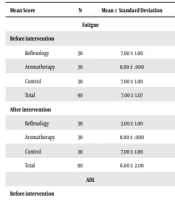
The mean and standard deviation of the fatigue score before the intervention and five weeks after the intervention in reflexology, aromatherapy and control groups are presented. The results showed that the mean fatigue score decreased and the mean ADL score increased after the intervention in the reflexology group. There was no change in the mean fatigue and ADL scores in the geranium and control groups after the intervention (Table 2).
Table 2.
Average Score of Fatigue and Daily Activity in Three Reflexology, Aromatherapy and Control Groups Before and After the Intervention
| Mean Score | N | Mean ± Standard Deviation |
|---|---|---|
| Fatigue | ||
| Before intervention | ||
| Reflexology | 30 | 7.00 ± 1.00 |
| Aromatherapy | 30 | 8.00 ± .000 |
| Control | 30 | 7.00 ± 1.00 |
| Total | 90 | 7.00 ± 1.07 |
| After intervention | ||
| Reflexology | 30 | 3.00 ± 1.00 |
| Aromatherapy | 30 | 8.00 ± .000 |
| Control | 30 | 7.00 ± 1.00 |
| Total | 90 | 6.00 ± 2.00 |
| ADL | ||
| Before intervention | ||
| Reflexology | 30 | 7.00 ± 2.06 |
| Aromatherapy | 30 | 6.00 ± 1.00 |
| Control | 30 | 6.00 ± 2.00 |
| Total | 90 | 6.00 ± 2.00 |
| After intervention | ||
| Reflexology | 30 | 18.00 ± 2.00 |
| Aromatherapy | 30 | 6.00 ± 1.00 |
| Control | 30 | 6.00 ± 2.00 |
| Total | 90 | 10.00 ± 6.00 |
Abbreviation: ADL, activities of daily living.
The difference in the mean fatigue and ADL scores between the reflexology, aromatherapy and control groups before the intervention and five weeks after the intervention was measured using the ANOVA test. The results showed a significant difference between the three groups in the post-intervention phase (P < 0.0001) (Table 3).
Table 3.
Analysis of Variance Test in Reflexology, Aromatherapy and Control Groups Before and After the Intervention
| Mean Score | ANOVA | ||||
|---|---|---|---|---|---|
| Sum of Squares | df | Mean Square | F | P | |
| Fatigue | |||||
| Before intervention | |||||
| Between groups | 5.00 | 2 | 2.00 | 2.00 | 0.093 |
| Within groups | 97.00 | 87 | 1.00 | ||
| Total | 102.00 | 89 | |||
| After intervention | |||||
| Between groups | 431.00 | 2 | 215.00 | 144.00 | 0.000 |
| Within groups | 130.00 | 87 | 1.00 | ||
| Total | 561.00 | 89 | |||
| ADL | |||||
| Before intervention | |||||
| Between groups | 36.00 | 2 | 18.05 | 3.00 | 0.026 |
| Within groups | 411.00 | 87 | 4.00 | ||
| Total | 447.00 | 89 | |||
| After intervention | |||||
| Between groups | 3067.00 | 2 | 1533.00 | 292.00 | 0.000 |
| Within groups | 456.00 | 87 | 5.00 | ||
| Total | 3523.00 | 89 | |||
Abbreviations: ANOVA, analysis of variance; ADL, activities of daily living.
The results of the LSD post hoc test showed significant changes in the mean fatigue scores after the intervention in the foot reflexology group compared to the aromatherapy and control groups, and it can be stated that the mean fatigue severity score in the foot reflexology group showed a significant decrease after the intervention compared to aromatherapy and control groups (P-value < 0.001) (Table 4).
Table 4.
Least Significant Difference Test in Reflexology, Aromatherapy and Control Groups After the Intervention
| Dependent Variables | (I) Group | (J) Group | Multiple Comparisons | |||
|---|---|---|---|---|---|---|
| LSD | ||||||
| Mean Difference (I - J) ± Standard Error | P Value | 95% Confidence Interval | ||||
| Lower Bound | Upper Bound | |||||
| Mean score of fatigue before intervention | Reflexology | Aromatherapy | 0.00 a ± 0.00 | 0.04 | -1.09 | -0.01 |
| Control | -0.07 ± 0.00 | 0.00 | 0.00 | 0.00 | ||
| Aromatherapy | Reflexology | 0.00 a ± 0.00 | 0.04 | 0.011 | 1.09 | |
| Control | 0.00 ± 0.00 | 0.08 | -0.05 | 1.02 | ||
| Control | Reflexology | 0.07 ± 0.00 | 0.00 | 0.00 | 0.00 | |
| Aromatherapy | 0.00 ± 0.00 | 0.08 | -1.02 | 0.05 | ||
| Mean score of fatigue after intervention | Reflexology | Aromatherapy | -4.00 a ± 0.00 | 0.00 | -5.00 | -4.00 |
| Control | -4.00 a ± 0.00 | 0.00 | -4.00 | -3.00 | ||
| Aromatherapy | Reflexology | 4.00 a ± 0.00 | 0.00 | 4.00 | 5.00 | |
| Control | 0.00 ± 0.00 | 0.08 | -0.07 | 1.00 | ||
| Control | Reflexology | 4.00 a ± 0.00 | 0.00 | 3.00 | 4.00 | |
| Aromatherapy | 0.00 ± 0.00 | 0.08 | -1.00 | 0.07 | ||
| Mean score of ADL before intervention | Reflexology | Aromatherapy | 1.00 a ± 0.00 | 0.01 | 0.00 | 2.00 |
| Control | 1.00 a ± 0.00 | 0.02 | 0.00 | 2.00 | ||
| Aromatherapy | Reflexology | -1.00 a ± 0.00 | 0.01 | -2.00 | 0.00 | |
| Control | -0.08 ± 0.00 | 0.00 | -1.00 | 1.03 | ||
| Control | Reflexology | -1.00 a ± 0.00 | 0.02 | -2.00 | 0.00 | |
| Aromatherapy | 0.08 ± 0.00 | 0.00 | -1.03 | 1.00 | ||
| Mean score of ADL after intervention | Reflexology | Aromatherapy | 12.00 a ± 0.00 | 0.00 | 11.00 | 13.00 |
| Control | 12.00 a ± 0.00 | 0.00 | 11.00 | 13.0 | ||
| Aromatherapy | Reflexology | -12.00 a ± 0.00 | 0.00 | -13.00 | -11.00 | |
| Control | 0.00 ± 0.00 | 0.00 | -1.00 | 1.00 | ||
| Control | Reflexology | -12.00 a ± 0.00 | 0.00 | -13.00 | -11.00 | |
| Aromatherapy | 0.00 ± 0.00 | 0.00 | -1.00 | 1.00 | ||
Abbreviations: LSD, least significant difference; ADL, activities of daily living.
a The mean difference is significant at the 0.05 level.
The results of the LSD post hoc test showed significant changes in the mean ADL scores after the intervention in the foot reflexology group compared to the aromatherapy and control groups, it can be stated that the mean ADL score in the foot reflexology group showed a significant increase compared to aromatherapy and control groups after the intervention (P-value < 0.001) (Table 4).
Also, the paired t-test showed significant changes in the mean fatigue and ADL scores in the reflexology group in the post-intervention phase compared to the pre-intervention phase (P-value < 0.001); however, there were no significant changes in the mean fatigue and ADL scores after the intervention (P-value > 0.05) (Table 5).
Table 5.
Paired t Test in Reflexology, Aromatherapy and Control Groups Before and After the Intervention
| Group | Description | Paired Differences | t | df | P Value | |||
|---|---|---|---|---|---|---|---|---|
| Mean ± Standard Deviation | Standard Error Mean | 95% Confidence Interval of the Difference | ||||||
| Lower | Upper | |||||||
| Reflexology | ||||||||
| Pair 1 | Score of fatigue before intervention - Score of fatigue after intervention | 4.28 | 1.45 ± 0.26 | 3.74 | 4.83 | 16.14 | 29 | 0.00 |
| Pair 2 | Score of ADL before intervention - Score of ADL after intervention | -11.00 ± 2.90 | 0.52 | -12.08 | -9.91 | -20.77 | 29 | 0.00 |
| Aromatherapy | ||||||||
| Pair 1 | Score of fatigue before intervention - Score of fatigue after intervention | -0.053 | 0.366 ± 0.06 | -0.190 | 0.08 | -0.80 | 29 | 0.42 |
| Pair 2 | Score of ADL before intervention - Score of ADL after intervention | 0.083 ± 0.26 | 0.04 | -0.015 | 0.18 | 1.72 | 29 | 0.09 |
| Control | ||||||||
| Pair 1 | Score of fatigue before intervention - Score of fatigue after intervention | 0.012 | 0.04 ± 0.00 | -0.002 | 0.02 | 1.68 | 29 | 0.10 |
| Pair 2 | Score of ADL before intervention - Score of ADL after intervention | 0.00 ± 0.26 | 0.04 | -0.098 | 0.09 | 0.00 | 29 | 1.00 |
5. Discussion
According to literature review, massage therapy and then aromatherapy, among the types of complementary medicine, are the most frequently used intervention to control fatigue in patients undergoing hemodialysis. The aim of the present study was to compare the effect of geranium essential oil aromatherapy and foot reflexology and the fatigue and ADLs of patients undergoing hemodialysis.
The results showed that the mean fatigue score decreased and the mean ADL score increased after the intervention in the reflexology group. Results of a 20-year study of the effects of reflexology on the physiological state, physical condition, vital signs, lipids and blood, showed reflexology can be useful in maintaining health (28). Unal and Balci Akpinar showed in their study that foot and back reflexology reduces fatigue and improves sleep quality of patients undergoing hemodialysis, which is consistent with the results of the present study (30). Other studies have shown that foot reflexology can reduce foot fatigue in patients with lymphoma (31), kidney transplant (32), breast cancer (33), multiple sclerosis (34) and coronary angiography (35). Compared to the area of massage therapy, foot massage is more effective in reducing pain than hand massage (36), which is consistent with the results of the present study. Also, another study studies have proven the effect of foot reflexology on ADL and fatigue scores of patients with stroke and rheumatoid arthritis (37).
The results showed that no change in the mean fatigue and ADL scores in the geranium groups and control after the intervention. Aromatherapy is as a cheap, quick and effective treatment to reduce the hemodialysis complications (38). Lavender essential oil aromatherapy can also be effective in improving fatigue symptoms in patients undergoing hemodialysis (2, 39, 40) which is no different from orange essential oil aromatherapy (41), which is against the findings of this study. Risyda et al. showed in their study that aromatherapy increases comfort, reduces fatigue, reduces pain caused by fistula insertion, improves sleep quality, reduces uremic itching, reduces anxiety and depression in patients hemodialysis (42). Also, another study showed that aromatherapy reduces fatigue in inflammatory bowel patients (43) and women with hypothyroidism (44). Although the results of studies introduced aromatherapy as an adjunctive treatment, and it had a positive effect on overcoming symptoms without having an adverse effect on patients undergoing hemodialysis, but such a result was not found in the present study.
The results of the present study showed that Significant reduction in the mean fatigue scores after the intervention in the foot reflexology group compared to the aromatherapy and control groups. The reflexology intervention started to decrease mean pain and fatigue scores earlier than aromatherapy massage in whit rheumatoid arthriti (45), which is consistent with the present study. But results of a study comparing massage therapy and lavender essential oil aromatherapy on the fatigue severity in patients with knee osteoarthritis showed that aromatherapy has been more effective on mental fatigue than massage therapy (46), which is against the results of the present study.
The results of the present study showed that Significant increase in the mean ADL scores after the intervention in the foot reflexology group compared to the aromatherapy and control groups. The aromatherapy excreted its effect on ADL mainly in the form of massage therapy, so that lavender essential oil massage was able to improve ADLs of patients with knee osteoarthritis (47), but the aromatherapy intervention used in the present study, could not be effective in reducing the symptoms of patients undergoing hemodialysis.
5.1. Conclusions
The results of the present study showed a significant decrease in the mean fatigue scores and a significant increase in the mean ADL scores in the foot reflexology group compared to the two aromatherapy and control groups. In other words, foot reflexology can better reduce fatigue symptoms and increase ADLs in patients undergoing hemodialysis, complementary medicine interventions must not only increase the burden of care but also reduce the symptoms of the disease and, thus, improve the patient’s quality of life. Therefore, it is recommended to use the foot reflexology method as an effective nursing intervention to reduce the symptoms of chronic kidney failure patients undergoing hemodialysis and improve their quality of life. Foot reflexology is an effective treatment and also a safe, cheap and cost-effective alternative to pharmaceutical methods that can be easily taught to nurses in different departments of medical centers. It is suggested to compare other complementary medicine techniques on fatigue and other common symptoms such as muscle pains and sleep quality in hemodialysis patients.
5.2. Limitations
One of the limitations of the current study was the patient death, and also some patients were sensitive to sole reflexology, therefore, they were excluded from the study and replaced by other patients.