
1. Background
Today, acute poisoning of chemical etiology is a significant socio-economic and medical problem (1-3). In all countries, the total number of acute poisoning cases has increased despite existing systems to control the circulation of toxic agents (4, 5). Acute poisoning is a leading factor among non-communicable diseases (NCDs) that affect the demographic situation due to the high morbidity and premature mortality of the working-age population (6-9). In Russia, injuries, poisonings, and other consequences of external causes rank second in the structure of mortality among the working-age population (10, 11). The mortality rate from these causes increased by 13.2% from 2019 to 2022, rising from 110.7 to 125.3 deaths per 100,000 population. Poisoning was the second-leading external cause (6.1 - 8.0%) (12). The total economic damage from premature mortality of working-age individuals due to external causes, including acute poisoning, amounts to more than 5 trillion rubles per year (13). Across all ages, there were 53.9 - 71.3 poison exposures reported per 100,000 population (10).
The leading causes of acute poisoning are alcohol and narcotic drugs (14-17). This issue is especially relevant for the working population, leading to social maladjustment (18, 19). In Russia, almost 446,000 cases of acute alcohol poisoning were identified between 2013 and 2022, with a case fatality rate of 26.8% (20). In St. Petersburg, the rate of alcohol poisoning was 3.3 times higher than in the Russian Federation (21.2 cases per 100,000 population). In Russia, the average rate of drug poisoning was 12.4 cases per 100,000 population, while in St. Petersburg, this level was 7.1 times higher (88.5 cases per 100,000 population) (21). Heroin consumption was the cause of every tenth poisoning, with a case fatality rate of 33.1% (22).
The negative impact of acute poisoning on public health is significant. Therefore, analyzing the medical and social profiles of toxicological patients is necessary for the development, justification, and implementation of effective preventive measures to reduce the influence of toxic factors as a cause of preventable morbidity and mortality (23).
2. Objectives
The present study aimed to analyze the medical and social characteristics of toxicological patients.
3. Methods
The study was conducted on 100 patients with acute poisoning who were treated at the Specialized Toxicology Centre in Saint Petersburg. Data were collected by copying information from medical records and conducting a survey among the patients. Data analysis, including the calculation of the extensity index, was performed using MS Excel.
4. Results
The study of the medical and social characteristics of toxicological patients revealed the following: The proportion of men in the study group was significantly higher than that of women (62.0% and 38.0%, respectively).
The breakdown of patients by age showed a prevalence of individuals aged 20 - 40 years (62.0%), with 28.0% aged 41 - 60 years. The proportions of patients under 20 years of age and those over 60 years were similar (5.0% each). There were no significant age differences between men and women. Descriptive statistics and group differences are shown in Table 1.
Table 1.
Distribution of Toxicological Patients of Different Genders by Age (%)
| Gender | Age | Total | |||
|---|---|---|---|---|---|
| Under 20 | 20 - 40 | 41 - 60 | Over 60 | ||
| Male | 4.8 | 66.2 | 25.8 | 3.2 | 100.0 |
| Female | 5.3 | 55.3 | 7.8 | 7.8 | 100.0 |
| Both genders | 5.0 | 62.0 | 5.0 | 5.0 | 100.0 |
The mean age of the sample was 37.4 years. The mean ages of females and males were 38.5 and 36.6 years, respectively.
Only 38.0% of patients lived in two-parent families. This category included patients who were married and those living with both parents (father and mother). The majority of participants (62.0%) lived in single-parent families.
By marital status, the largest proportion of patients were divorced (36.0%). Almost one-third of the survey participants (32.0%) had never married. Only one-quarter of patients (25.0%) were married, and the proportion of widowed patients was 7.0%.
Only one in three patients had higher education (31.0%). More than half of the poisoned patients received technical and vocational education and training (54.0%), while 15.0% of patients had only general secondary education.
The largest proportion (55.0%) of participants were unemployed. Almost a third of the patients, including those of retirement age (28.0%), indicated they had a job. The proportion of non-working pensioners was 11.0%, and 6.0% of patients were students.
More than half of the patients (56.0%) did not engage in sports or other forms of physical activity at home; 20.0% of patients exercised but not regularly. Only about one-quarter of patients (24.0%) exercised regularly at home.
About 43.0% of patients were smokers, while 57.0% did not smoke.
More than one-third of patients (37.0%) reported drinking alcohol more than once a week, which is a warning sign of developing alcoholism. Additionally, 21.0% of toxicological patients drank alcohol no more than once a week, and 42.0% drank no more than once a month.
Exactly half of the patients (50.0%) associated drinking alcohol with relaxation and pleasure. Less than one-quarter (22.0%) of patients believed that alcohol could amplify feelings of psychological depression. Meanwhile, 18.0% of patients drank alcohol to avoid feeling lonely. At the same time, 2.0% of patients used alcohol or drugs to fit in with a group and not seem like a "black sheep," while only 8.0% denied using alcohol or drugs.
The analysis of patient distribution by diagnosis showed that a large proportion (44.0%) were poisoned by drugs, 26.0% by medications, 17.0% by ethanol, 11.0% by psychotropic drugs, and 2.0% by technical liquids and inhalation poisoning.
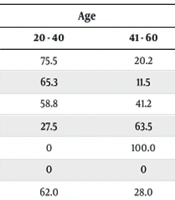
Table 2 demonstrates the difference between the diagnosis of acute poisoning and the age group of patients. Among those poisoned by narcotic substances, medications, and ethanol, a large proportion were from the active working population aged 20 - 40 years (75.5%, 65.3%, and 58.8%, respectively). Poisoning with psychotropic drugs was observed in 63.5% of patients aged 41 - 60 years, in more than a quarter of cases (27.5%) in those aged 20 - 40 years, and in 9.0% of cases in those under 20 years old. All patients with industrial fluid poisoning were aged 41-60 years. Inhalation poisoning occurred only among young patients under 20 years of age.
Table 2.
Distribution of Toxicological Patients of Diagnosis of Acute Poisoning by Age (%)
| Diagnosis (Poisoning) | Age | Total | |||
|---|---|---|---|---|---|
| Under 20 | 20 - 40 | 41 - 60 | Over 60 | ||
| Narcotics drug | 4.3 | 75.5 | 20.2 | 0 | 100.0 |
| Medication | 3.8 | 65.3 | 11.5 | 19.4 | 100.0 |
| Ethanol | 0 | 58.8 | 41.2 | 0 | 100.0 |
| Psychotropic drugs | 9.0 | 27.5 | 63.5 | 0 | 100.0 |
| Industrial fluid | 0 | 0 | 100.0 | 0 | 100.0 |
| Inhalation | 100.0 | 0 | 0 | 0 | 100.0 |
| All diagnosis | 5.0 | 62.0 | 28.0 | 5.0 | 100.0 |
In the study group of patients, the most common cause of poisoning was drug overdose (44.0%). Poisoning resulted from self-medication in 26.0% of patients, from a desire to achieve intoxication in 21.0%, from a suicide attempt in 8.0%, and from criminal poisoning in 1.0% of patients.
The highest proportion of poisoning caused by drug overdose was among individuals aged 20 to 40 years (75.5%). This age group also predominated among patients whose poisoning occurred as a result of intoxication or a suicide attempt (76.1% and 75.0%, respectively). Among patients whose poisoning resulted from self-medication, the proportion of individuals aged 41 - 60 years was higher (69.2%). All patients with criminal poisoning were also in this age group. The differences between the cause of acute poisoning and the age of patients are shown in Table 3.
Table 3.
Distribution of Acute Poisoning by age Groups and Cause (%)
| Cause of Poisoning | Age | Total | |||
|---|---|---|---|---|---|
| Under 20 | 20 - 40 | 41 - 60 | Over 60 | ||
| Drug overdose | 4.3 | 75.5 | 20.2 | 0 | 100.0 |
| Self-medication | 0 | 0 | 69.2 | 30.8 | 100.0 |
| To achieve intoxication | 23.9 | 76.1 | 0 | 0 | 100.0 |
| Suicide attempt | 12.5 | 75.0 | 0 | 12.5 | 100.0 |
| Criminal poisoning | 0 | 0 | 100.0 | 0 | 100.0 |
| All causes | 5.0 | 62.0 | 28.0 | 5.0 | 100.0 |
The study analyzed the presence of blood-borne viral infections among the patients. Nearly one-third of the patients (33.0%) had a viral infection: 18.0% had hepatitis C, 10.0% had HIV infection, and 5.0% had hepatitis B.
Additionally, 7.0% of all toxicological patients had pneumonia, which was observed due to aspiration at the prehospital stage, and 3.0% had sepsis.
5. Discussion
The study of the medical and social profile of patients with acute poisoning treated at the Toxicology Centre in Saint Petersburg showed that men prevailed in the analyzed group (62.0%). A large proportion of patients (62.0%) were in the working-age group of 20 - 40 years, while more than half (55.0%) of the participants were unemployed. More than two-thirds of the patients were divorced or had never married.
The most common causes of poisoning were drug overdose (44.0%), self-medication (26.0%), and intoxication (21.0%). A significant proportion of patients (33.0%) had a concomitant viral infection.
Based on the research findings, the social characteristics of patients were associated with stability and change in alcohol consumption. The main reason for drinking alcohol was the desire to relax, and over one-third (37.0%) drank alcohol more than once a week. Additionally, more than 50.0% of patients did not engage in sports or other forms of physical activity. These characteristics indicate that patients have a low level of concern for their health and well-being. Moreover, these social risk factors may contribute to an escalation of drug use.
The analysis of the medical and social characteristics of toxicological patients indicates the need for measures in public hygiene education to build social competence and cultivate a negative attitude towards harmful factors affecting health.
The study also revealed that a significant proportion of toxicological patients were divorced or never married. Therefore, the culture of family relationships should be improved at all levels of education, and a responsible attitude towards one’s present and future family should be fostered.