


1. Background
Disasters can occur at anytime and anywhere in the world in various forms and lead to widespread injury and death (1). In recent decades, the number of disasters has increased, leading to many deaths, injuries, illnesses, and disabilities (2). Despite enormous scientific, economic, and social advances, humans today have not yet been able to properly and completely control such events (3). Reports from the Center for Epidemiology Research on Accidents and Disasters indicated 396 natural disasters in 2019 (4). In 2021, this number increased to 432 incidents, and the economic losses amounted to $252 billion, which is nearly $100 billion more than the average of the last two decades. Among these, Asia accounted for about 40% of these incidents, 49% of the deaths, and 66% of the people affected by the incidents in 2021 (5). Asia accounted for about 40% of these incidents, 49% of deaths, and 66% of people affected by incidents in 2021 (4). In recent decades, in addition to local floods, storms, and mild earthquakes, natural disasters have claimed an average of 2,689 lives annually over the past three decades and caused $737,058,000 in economic damage to Iran (6). Natural disasters, especially earthquakes, have long been considered the most destructive factors that harm humans, society, and habitats. Data show that natural disasters such as earthquakes have increased in recent years. Therefore, the need for proper planning for pre-disaster equipment is more important than ever (7). Given that natural disasters affect the health, well-being, and welfare of society, providing appropriate health services is the main factor in survival and reducing mortality and morbidity of individuals in the stages after such events. The most effective way to respond to the needs created is preparedness, which the World Health Organization has raised as its long-standing concern and, by introducing it as part of the sustainable development process in societies, emphasizes the importance of the activities required to achieve preparedness (6). In order to respond appropriately to accidents and disasters, hospitals must have a plan that should manage threats and identify risks resulting from hazard and vulnerability analysis using a comprehensive plan, while reducing possible impacts, and provide an appropriate response.
2. Objectives
3. Methods
3.1. Study Method
This descriptive-cross-sectional study was conducted in four selected military hospitals in Tehran in 1401 - 1402. This study aimed to investigate the performance of selected military hospitals in Tehran during natural disasters and accidents, so that in the event of accidents such as floods, earthquakes, etc., they would be prepared to respond to the accident, prevent casualties, and provide appropriate services to the affected individuals.
Hospital readiness evaluation tool for facing natural disasters and accidents: Hospitals were assessed with a 250-question instrument that was scored based on available documentation, with some items being scored on a Likert scale from 0 to 4 with very poor, poor, average, good, very good, and some items being scored between 0 and 2 with no, somewhat, and yes. The assessors attended the hospital's quality improvement office and other departments and reviewed the documentation and reports of the actions taken to complete the instrument's metrics (Table 1).
Table 1.How to Score Hospital Readiness
| How to Score Hospital Readiness with the Tool | Very Weak | Weak | Average | Good | Very Good |
|---|---|---|---|---|---|
| Hospital functional readiness level | |||||
| Hospital readiness percentage | 0 - 20 | 21 - 40 | 41 - 60 | 61 - 80 | 81 - 100 |
| Score obtained by the selected hospital | 0 - 180 | 181 - 360 | 361 - 540 | 541 - 720 | 721 - 900 |
The dimensions of the tool were evaluated in 17 dimensions, including the areas of (1) command and control (17 questions), (2) risk assessment (9 questions), (3) early warning system (9 questions), (4) capacity building (20 questions), (5) continuity of vital services (18 questions), (6) hospital incident command system (28 questions), 7) Safety (14 questions), 8) Communications (10 questions), (9) triage (10 questions), (10) hospital evacuation plan (10 questions), (11) bodies and deceased (5 questions), (12) support and logistics management (36 questions), (13) human resources (16 questions), (14) hospital epidemiological surveillance system monitoring (26 questions), (15) disaster recovery (12 questions), (16) Cultural considerations (8 questions), and (17) security (12 questions) (10). Descriptive statistics indicators were used in data analysis. The score was calculated after summing the obtained scores based on the number 900. From the total scores, if the score of the medical center was between 0 - 180, the hospital in question was considered very poor; between 181 - 360, poor; between 361 - 540, average; between 541 - 720, good; and between 721 - 900, very good (11).
4. Results
During the survey conducted on hospital A, in the area of safety, it has a very good level of preparedness (81%), and in triage, it has a poor level of preparedness (33.7%), while in other areas, the level of preparedness is in the good and average range. The total score obtained in the risk assessment was 617 with a readiness percentage of 68.55%, which means that the overall level of preparedness of hospital A is good. Hospital B has a good level of preparedness in the area of command and control (77.33%), a poor level of preparedness in disaster recovery and continuity of vital services (37.5%), and in other areas the level of preparedness is in the average range. The score obtained in the risk assessment was 500 with a readiness percentage of 55.55%, which makes the overall level of preparedness of hospital B average. In the study of hospital C, it has a very good level of preparedness in the area of cultural considerations, a very poor level of preparedness in disaster recovery, and in other areas the level of preparedness is in the medium to poor range. The score obtained in the risk assessment was 359 with a readiness percentage of 39.88%, which means that the overall level of preparedness of hospital C is poor. During the survey conducted on hospital D, it has a good level of preparedness in the area of risk assessment, but a very poor level of preparedness in capacity increase, support and logistics, and triage, and in other areas, the level of preparedness is in the medium and weak range. The score obtained in the risk assessment is 340 with a readiness percentage of 37.77%, which means that overall the level of preparedness of hospital D is assessed as poor (Tables 2 and 3, Figure 1).
Table 2.Scoring of Different Departments of the Selected Hospital
| Variables | Question | Hospital A | Hospital B | Hospital C | Hospital D |
|---|---|---|---|---|---|
| Overall score of the tool in the field | 28 | 21 | 20 | 23 | 18 |
| Total preparation score | 900 | 617 | 500 | 359 | 340 |
| Percentage of readiness | 100 | 68.55 | 55.55 | 39.88 | 37.77 |
| Hospital readiness | Very good | Good | Medium | Weak | Weak |
Table 3.Level of Readiness of Different Departments of the Selected Hospital
| Checklist Variables | Command and Control Area | Risk Assessment | Early Warning System | Capacity Increase | Continuity of Vital Services | Incident Command | Safety | Security | Communications |
|---|---|---|---|---|---|---|---|---|---|
| Maximum tool score | 45 | 8 | 18 | 76 | 80 | 119 | 37 | 44 | 40 |
| Hospital A | |||||||||
| Hospital score | 35 | 6 | 14 | 50 | 52 | 80 | 30 | 20 | 30 |
| Score in percentage | 77.77 | 75 | 77.77 | 65.78 | 65.78 | 65 | 81.8 | 45.45 | 75 |
| Level of preparation | Good | Good | Good | Good | Good | Good | Very good | Medium | Good |
| Hospital B | |||||||||
| Hospital score | 33 | 5 | 12 | 52 | 30 | 70 | 25 | 25 | 25 |
| Score in percentage | 73.33 | 62.5 | 66.66 | 68.42 | 37.5 | 58.82 | 67.56 | 56.81 | 62.5 |
| Level of preparation | Good | Good | Good | Good | Weak | Medium | Good | Medium | Good |
| Hospital C | |||||||||
| Hospital score | 29 | 4 | 9 | 19 | 24 | 52 | 19 | 33 | 14 |
| Score in percentage | 64.44 | 50 | 50 | 25 | 30 | 43.69 | 51.35 | 75 | 35 |
| Level of preparation | Good | Medium | Medium | Weak | Weak | Medium | Medium | Good | Weak |
| Hospital D | |||||||||
| Hospital score | 28 | 6 | 8 | 8 | 17 | 50 | 23 | 27 | 18 |
| Score in percentage | 62.22 | 75 | 57.14 | 10.52 | 21.25 | 42.1 | 62.16 | 61.36 | 45 |
| Level of preparation | Good | Good | Medium | Very weak | Weak | Medium | Good | Good | Medium |
| Maximum tool score | 30 | 36 | 16 | 135 | 47 | 98 | 44 | 28 | 900 |
| Score obtained | 22 | 24 | 11 | 98 | 31 | 68 | 25 | 21 | 617 |
| Score in percentage | 33.73 | 66.66 | 68.75 | 59.72 | 65.95 | 69.38 | 56.81 | 75 | 68.55% |
| Level of preparation | Weak | Good | Good | Good | Good | Good | Medium | Good | Good |
| Hospital B | |||||||||
| Score obtained | 15 | 20 | 8 | 80 | 22 | 60 | 15 | 20 | 500 |
| Score in percentage | 50 | 55.55 | 50 | 25.59 | 46.8 | 61.22 | 34.9 | 42.71 | 55.55% |
| Level of preparation | Medium | Medium | Medium | Medium | Medium | Good | Weak | Good | Medium |
| Hospital C | |||||||||
| Score obtained | 9 | 14 | 5 | 61 | 23 | 47 | 7 | 23 | 359 |
| Score in percentage | 3 | 38.88 | 31.25 | 18.45 | 48.93 | 47.95 | 15.9 | 14.82 | 39.88% |
| Level of preparation | Weak | Weak | Weak | Medium | Medium | Medium | Very weak | Very good | Weak |
| Hospital D | |||||||||
| Score obtained | 3 | 13 | 2 | 53 | 22 | 27 | 18 | 18 | 340 |
| Score in percentage | 10 | 36.11 | 12.5 | 25.39 | 46.8 | 27.55 | 40.9 | 28.64 | 37.77% |
| Level of preparation | Very weak | Weak | Weak | Weak | Medium | Weak | Weak | Good | Weak |
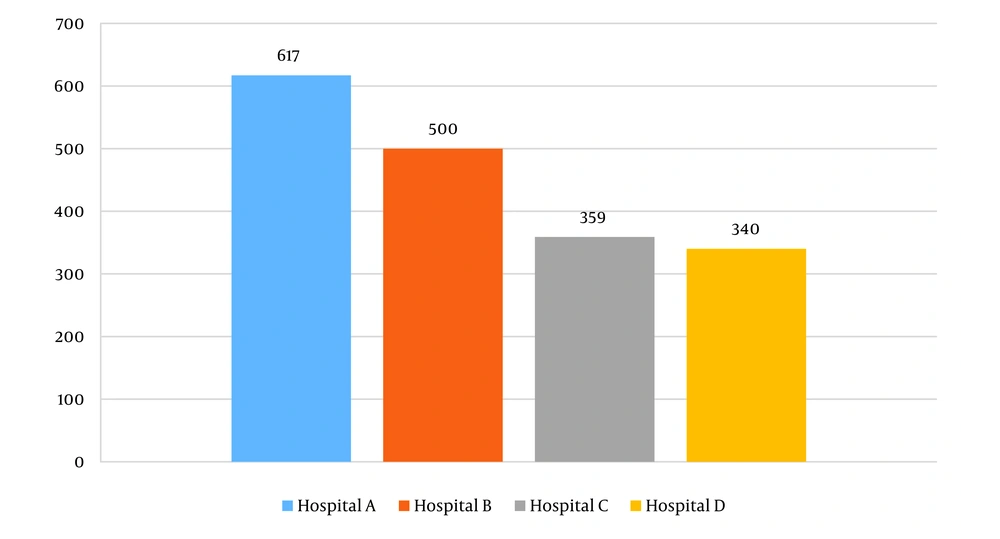
Figure 1.
Comparison of the readiness of selected military hospitals
5. Discussion
This study aimed to comprehensively assess the preparedness of four selected military hospitals in Tehran in the face of natural disasters. The findings of the present study showed that among the hospitals studied, only one hospital (hospital A) was rated at the “good” level (68.55%), while two hospitals (C and D) were rated at the “poor” level (below 40%), and one hospital (B) was rated at the “average” level (55.55%). This significant heterogeneity in the level of preparedness indicates the existence of a significant operational gap in the crisis management system of the capital’s military hospitals and highlights the need for targeted planning and allocation of special resources to improve preparedness (12). The significant weakness in the areas of triage and post-disaster recovery, which was evident in all hospitals studied, is one of the most concerning findings of this study. Poor performance in these two areas can have a detrimental impact on the overall effectiveness of the crisis response. This shortcoming is likely due to multiple factors, including the lack of unified and standardized protocols, a lack of operational training and periodic simulations, a lack of a systems approach to disaster management, and a shortage of specialized equipment (13). Numerous international studies have also emphasized the critical importance of these two areas. The World Health Organization (WHO) has emphasized in its guidance the need to establish dynamic triage systems, ongoing Advanced Trauma Life Support (ATLS) training, and long-term recovery plans as essential pillars of hospital preparedness (14). Research by Alqahtani et al. also shows that continuous training and implementation of simulated maneuvers, especially in the area of triage, can significantly increase the accuracy and speed of personnel response in crisis situations and reduce triage errors that can lead to preventable casualties (15). Li et al.'s study also emphasizes the importance of planning for long-term recovery, showing that hospitals with disaster recovery plans return to normal faster and provide more sustainable services (16). In contrast, relatively favorable performance in areas such as safety and cultural considerations (especially in hospital A) suggests that investment in physical infrastructure, compliance with building standards, and attention to the cultural and religious context of the community can partially compensate for weaknesses in other areas. This finding is consistent with the results of the study by Ghanizadeh et al., who reported that military hospitals generally perform better in some non-clinical indicators such as structural safety, physical security, and facility protection, due to stricter protocols (17). In one study, also emphasized the importance of cultural considerations in providing health services in a crisis and showed that paying attention to the cultural beliefs and values of the affected community can increase the acceptance of services and the effectiveness of interventions (18). Several organizational and contextual factors can explain the differences in preparedness levels between the hospitals studied. Factors such as hospital size and volume, number of beds, staff-to-patient ratio, access to specialized and trained human resources, the amount of budget allocated to crisis management programs, and the level of support from senior management are among these key variables (19). Bazyar et al.'s study, in an extensive meta-analysis of the preparedness status of Iranian hospitals, concluded that larger, educational, and university hospitals have a higher level of preparedness, mainly due to access to greater financial and human resources, trained specialist staff, and an organizational culture supportive of research and development (20). Furthermore, Kerola et al. showed that experience of previous exposure to disasters (such as the COVID-19 pandemic or past earthquakes) can act as a powerful organizational learning factor and significantly increase a hospital's capacity, resilience, and flexibility in response to future crises (21). Hsu et al.'s research also emphasizes the need to invest in training and human resource empowerment as the key to improving preparedness (22). One of the important findings, which was evident in three out of four hospitals, was the inadequate level of preparedness in the area of corpse and deceased management. This weakness in the context of mass casualty disasters can not only lead to health crises, but also have severe psychosocial consequences for survivors, service providers, and the community, and can delay the grieving process and psychological recovery. The study by Rahmati-Najarkolaei et al. also emphasized the need to develop transparent and standardized interdepartmental protocols, provide the necessary equipment (such as mobile morgues, special clothing and gowns, and identification systems), and train personnel in this area (23). The study also emphasizes close collaboration with other organizations such as forensic medicine, the Red Crescent, and municipalities to effectively manage this crisis. Research by Morgan et al. also shows that improper handling of bodies can exacerbate psychological distress in survivors, confirming the importance of a sensitive and respectful approach in this regard (24). Compared to previous studies, the findings of this study show overlaps as well as contradictions. For example, the overall level of preparedness reported in the studies of Ezati et al. in Kermanshah (25) and Parsaei et al. in Mazandaran (26) is consistent with the performance of hospital A, while studies such as Daneshmandi et al. in Tehran (27) and Amiri et al. (28) that reported a moderate level of preparedness are consistent with the findings of hospital B. This variation in results could be due to differences in measurement tools, methodology, time of study, specific geographic-organizational context of each region, and the level of investment and prioritization of crisis management in different time periods. For example, hospitals in earthquake-prone areas such as Kermanshah may have more investment and preparedness compared to some hospitals in the capital due to direct experience of disasters, which indicates the need for situation-specific studies.
Based on the findings of this study and international evidence, it appears that the following multifaceted strategies can play a decisive role in improving the level of preparedness of military hospitals:
Training and Empowerment of Human Resources: Conducting documented, periodic, and competency-based training courses for all personnel, especially in sensitive and high-risk areas such as advanced triage, crisis management, psychosocial support, and corpse management. Using innovative training methods such as high-fidelity simulation, virtual reality, and comprehensive annual exercises (29).
5.1. Review and Standardization of Protocols
Review, update, and integrate crisis management protocols based on international standards (such as WHO and INSARAG standards) and tailored to the specific hazards of the region (30).
Allocate resources and strengthen infrastructure: Allocate specific and sustainable funding to strengthen high-risk areas (such as triage, body recovery and management), provide and maintain essential crisis response equipment (such as field tents, mobile communication systems, mobile cold storage and triage kits), and structural retrofit (31).
5.2. Establishing Continuous Assessment and Improvement System
Integrating modern quality management and continuous improvement frameworks such as FOCUS-PDCA, Six Sigma, or Plan-Do-Check-Act (PDCA) into the crisis management cycle. These frameworks can help hospitals systematically identify weaknesses, prioritize improvement actions, implement changes, and monitor results on an ongoing basis (32).
5.3. Strengthening Inter-Sectoral and Community-Based Collaboration
Developing and strengthening close collaboration with other organizations involved in crisis management (such as emergency services, Red Crescent, fire departments, law enforcement, and non-governmental organizations) through joint exercises and developing clear communication protocols. Also, involving the local community and training them to participate in the initial response can be very effective (33).
Systematic and continuous implementation of these recommendations can not only improve the preparedness of military hospitals in the face of accidents and disasters, but also increase the resilience of the health system at a macro level and lead to a reduction in human and financial losses in times of crisis.
5.4. Conclusions
It should be noted that similar foreign and domestic research on the subject of research in military medical centers is limited, which is the reason for the lack of review or publication of the results. Therefore, this research was compared with similar research in other military and public hospitals. Of course, it should be noted that during accidents and disasters, there is no discrepancy in the provision of services in military or civilian medical centers (34). Hospital A has the highest level of preparedness and is consistent with other studies in many areas. Hospitals B, C, and D performed worse. Overall, the results indicate that there is a need for improvement in areas such as triage, disaster recovery, and corpse management in these hospitals. Previous studies have also shown that the lack of specialized personnel, staff stress, and lack of facilities are among the most important obstacles to increasing hospital preparedness against disasters. To improve preparedness, more detailed training and planning measures are needed at the hospital management level. To improve the preparedness of military hospitals in the face of accidents and disasters, it is recommended that regular training courses be held for all personnel, especially in sensitive areas such as triage, crisis management, and disaster recovery. Also, to improve infrastructure and facilities, hospitals should provide adequate disaster management equipment, such as early warning systems and corpse management equipment, and ensuring the proper functioning of communication systems and safety systems should be a priority. In order to increase triage and corpse management capabilities, it is necessary to establish specialized triage and corpse management teams to improve the speed and accuracy of disaster response. Also, hospital safe evacuation plans should be reviewed and practiced. The use of new crisis management approaches, such as the use of quality improvement models such as FOCUS-PDCA, can be effective for continuous improvement of hospital management and performance processes during crises. These models help analyze and eliminate weaknesses in hospitals. In the field of improving human resource management, it is of great importance to determine alternative forces and create plans for human resource management during crises, especially in situations of shortage of personnel. Also, programs to support employees' families can reduce the stress caused by working in crises. Implementing these suggestions can help improve hospitals' preparedness to deal with accidents and disasters and reduce human and financial losses during crises.
