
1. How Should a Scientist be Remembered?
Publications, citations, discoveries, appointments, and awards document achievement, but they provide only a partial account of a scientific life. They describe what a researcher produced more readily than what that researcher enabled: the confidence afforded to an early-career investigator, the connections from which a research program emerged, or the work undertaken when neither recognition nor reward was expected.
The life of Professor Reza Fekrazad, who died of cancer in July 2026, invites this broader measure (1).
A periodontist, educator, and internationally recognized figure in laser medicine and photobiomodulation, Professor Fekrazad held prominent roles in Iranian and international scientific organizations and served on the Editorial Board of the Journal of Archives in Military Medicine. These appointments establish his scientific standing; however, they do not, by themselves, explain his influence. That influence is evident in a field that gained greater scientific capacity during his career, in the networks he helped build, and in the opportunities that became available to others through his work.
2. From a New Technology to a Scientific Field
Professor Fekrazad’s principal academic work focused on laser medicine, laser dentistry, and photobiomodulation. His research addressed oral medicine, periodontology, implant dentistry, antimicrobial photodynamic therapy, pain and inflammation, wound healing, tissue regeneration, and the biological effects of light-based interventions (2-7).
The importance of this work lies not only in its breadth. When laser-based medicine began to attract greater interest in Iran, the field required more than isolated clinical studies. New technologies often gain visibility before the scientific infrastructure needed to evaluate them has matured. Devices and clinical enthusiasm may emerge before standardized protocols, specialized education, interdisciplinary research teams, and sustained links between laboratory investigation and patient care are established. Professor Fekrazad helped develop this infrastructure.
At AJA University of Medical Sciences, he contributed to building research capacity in radiation sciences and medical laser applications. His work brought clinicians and dentists into contact with biologists, physicists, engineers, and researchers in regenerative science. Such interdisciplinarity was not merely decorative. The effects of light-based interventions could not be understood through clinical observation alone, just as biological mechanisms could not achieve clinical relevance without attention to patients and outcomes.
His scholarship reflected this balance. He investigated emerging therapeutic possibilities while recognizing that photobiomodulation depends on treatment parameters, biological context, study design, and the quality of available evidence (2-7). He was willing to examine promising questions without treating promise as proof.
This distinction is essential in an emerging discipline. A field needs investigators who recognize its potential, but it also needs those prepared to define its limits, demand stronger evidence, and accept that encouraging findings do not automatically justify clinical adoption. Professor Fekrazad contributed to both tasks: he helped make laser medicine more visible while also making it more scientifically accountable.
3. Building Connections
Scientific fields grow through relationships as well as publications. Research centers must communicate, clinicians must collaborate with laboratory scientists, and early-career investigators need access to experienced collaborators. National scientific communities must also engage with international developments without losing sight of their own priorities and circumstances.
Professor Fekrazad worked repeatedly at these points of connection.
He served in leadership roles in the Iranian Medical Laser Association and in Iran’s broader laser research community. Internationally, he held senior executive and publication-related responsibilities in organizations focused on laser therapy and photobiomodulation, including the World Association for Laser Therapy and the World Association for Photobiomodulation Therapy (8-10).
Such positions are easily reduced to lines on a curriculum vitae. Their practical value lies in the work behind them: sustaining communication across countries, organizing scientific meetings, supporting educational programs, connecting researchers with complementary expertise, and maintaining professional relationships after the visibility of a congress or publication has passed.
His 2017 Editorial in this journal, “The Story of a Dream: From Vienna to Tehran,” described the sustained effort required to bring a major international congress on oral laser applications to Tehran (11). The article documented a scientific event, but its broader focus was on capacity: how an ambitious academic objective could move from discussion to reality through cooperation, persistence, and institutional confidence.
The episode reflected much of Professor Fekrazad’s career. He did not regard limitations in the existing environment as sufficient justification for passivity. He worked within them to create structures and relationships that had not previously existed.
His professional standing also did not make him difficult to approach. Colleagues and early-career researchers could propose an idea without first establishing their status. By making it safe to present incomplete proposals, acknowledge uncertainty, and share responsibility, he created conditions in which interdisciplinary collaboration could develop. His authority did not depend on distance, and scientific disagreement did not need to become personal.
These habits are difficult to quantify, but they shape research cultures as surely as funding schemes and strategic plans do.
4. The Work No Index Records
Every academic career eventually encounters a tension between recognition and purpose.
Recognition is necessary. It rewards contributions, supports the distribution of opportunities, and makes scientific influence visible. However, when academic life is reduced entirely to measurable outputs, the original purposes of research can become obscured.
Professor Fekrazad was a highly productive scientist. Those who worked closely with him, however, also observed the persistence underlying that productivity: long hours at the research center, including periods when he worked largely alone after formal duties had ended and without any expectation of immediate material benefit.
This was the less visible work through which science is made—reading, revising, returning to unresolved questions, following an experiment, preparing a manuscript, and attending to details that disappear once the final article is published.
He appeared to understand scientific life as a continuing obligation: to learn, to contribute, and to ask whether one’s work served a purpose beyond personal advancement. This outlook helps explain his commitment to developing laser medicine in Iran and his willingness to invest time in activities whose benefits would be shared by others. He did not reject achievement; his record demonstrates ambition and sustained international engagement. However, achievement was not treated as the ultimate purpose of scientific work. It mattered when it strengthened a field, improved practice, or widened opportunities for those who followed.
This same sense of responsibility extended beyond academic institutions. As a dentist in the Iranian Navy, Professor Fekrazad served communities in less-resourced regions. Later, he continued to participate quietly in humanitarian efforts for people with limited access to dental care. These activities were not incorporated into his public academic identity or used to enhance his professional reputation.
Their significance lies in what they reveal about his understanding of expertise. Clinical knowledge was not simply a personal asset; it carried an obligation toward those who needed it. Scientific and professional competence acquired their fullest value when they contributed, however modestly, to society and human welfare.
5. The Research Festival
One decision remains particularly instructive. Each year, AJA University of Medical Sciences holds a research festival at which an outstanding researcher is selected according to established scientometric criteria. The recipient receives formal recognition, together with a research grant or a substantial award. Professor Fekrazad’s scientific record made him a leading candidate in successive years.
I remember his request clearly: he asked that his name be excluded from consideration so that another researcher could receive the recognition and encouragement.
He made the request without ceremony. He did not dispute the evaluation system or suggest that scientific achievement should not be rewarded. Instead, he recognized that the same distinction could have different consequences for different people. For an internationally established professor, another annual award would add relatively little. For an emerging researcher, it might provide visibility, confidence, institutional support, and the means to continue a developing program of work.
By stepping aside, he used the authority conferred by achievement to broaden opportunity rather than to retain recognition.
No citation index will record that decision. Nevertheless, its effect on another academic career may have exceeded that of another award bearing his name.
This episode is relevant beyond one university. Contemporary academic systems depend heavily on competition, rankings, and individual performance indicators. Such metrics can identify achievement, but they cannot determine how an established scholar should use the advantages that achievement creates. Professor Fekrazad had succeeded within the measurable academic system. He also knew when not to claim everything that system could offer him.
6. What Remains
Professor Fekrazad’s service to the Journal of Archives in Military Medicine was part of his broader investment in scientific institutions. As a member of the Editorial Board, he contributed expertise in dentistry, medical laser applications, radiation sciences, and interdisciplinary biomedical research.
An editorial appointment is meaningful when it represents more than professional prestige. Journals depend on individuals willing to distinguish innovation from unsupported assertions, apply scientific judgment consistently, and devote time to a collective scholarly enterprise. His Editorial, “The Story of a Dream: From Vienna to Tehran,” remains an important part of his record in this journal (11). Its central message—that scientific capacity is built through repeated acts of organization and cooperation, not through ambition alone—remains relevant to the journal’s future.
A scientist’s papers remain in databases and libraries. They may be cited, challenged, revised, or eventually superseded. Institutions endure, although their priorities change. Professional societies transition to new leadership, and scientific fields develop in directions that earlier contributors could not have anticipated.
Other effects are less visible. They remain in a researcher who was taken seriously before becoming established; in a collaboration that began because someone made an introduction; in a patient who received care when access was limited; in an institution whose ambitions expanded because one of its members refused to accept its current limitations; and in an award that went to another person because a senior professor chose not to claim it. These effects do not replace scientific accomplishment; they give it context.
Professor Fekrazad helped advance laser medicine and photobiomodulation in Iran and represented these fields internationally. That contribution is secure. His career also offers a broader example: productivity need not require self-importance, authority need not depend on distance, and professional success need not exhaust one’s obligations to colleagues or society.
For younger researchers, this may be the most useful part of his legacy. Scientific careers are shaped not only by the questions we investigate but also by the environments we create around our work. Every senior scientist eventually becomes part of the conditions under which others either develop or withdraw.
Professor Fekrazad’s example suggests a demanding measure of academic success: not only whether one advances, but whether others are better able to advance because one was present.
On behalf of the Editorial Board of the Journal of Archives in Military Medicine, I extend our condolences to his family, friends, colleagues, students, patients, and the scientific communities that knew him and his work.
A journal can record a scholar’s publications and appointments. It cannot fully capture the influence of daily conduct, private decisions, or work undertaken without an audience. Those effects survive elsewhere—in people, institutions, and the standards by which others choose to conduct their professional lives.
The true measure of a scientist is therefore found not only in the papers left behind but also in what continues because that scientist once lived. By that measure, Professor Reza Fekrazad leaves an enduring legacy Figures 1.
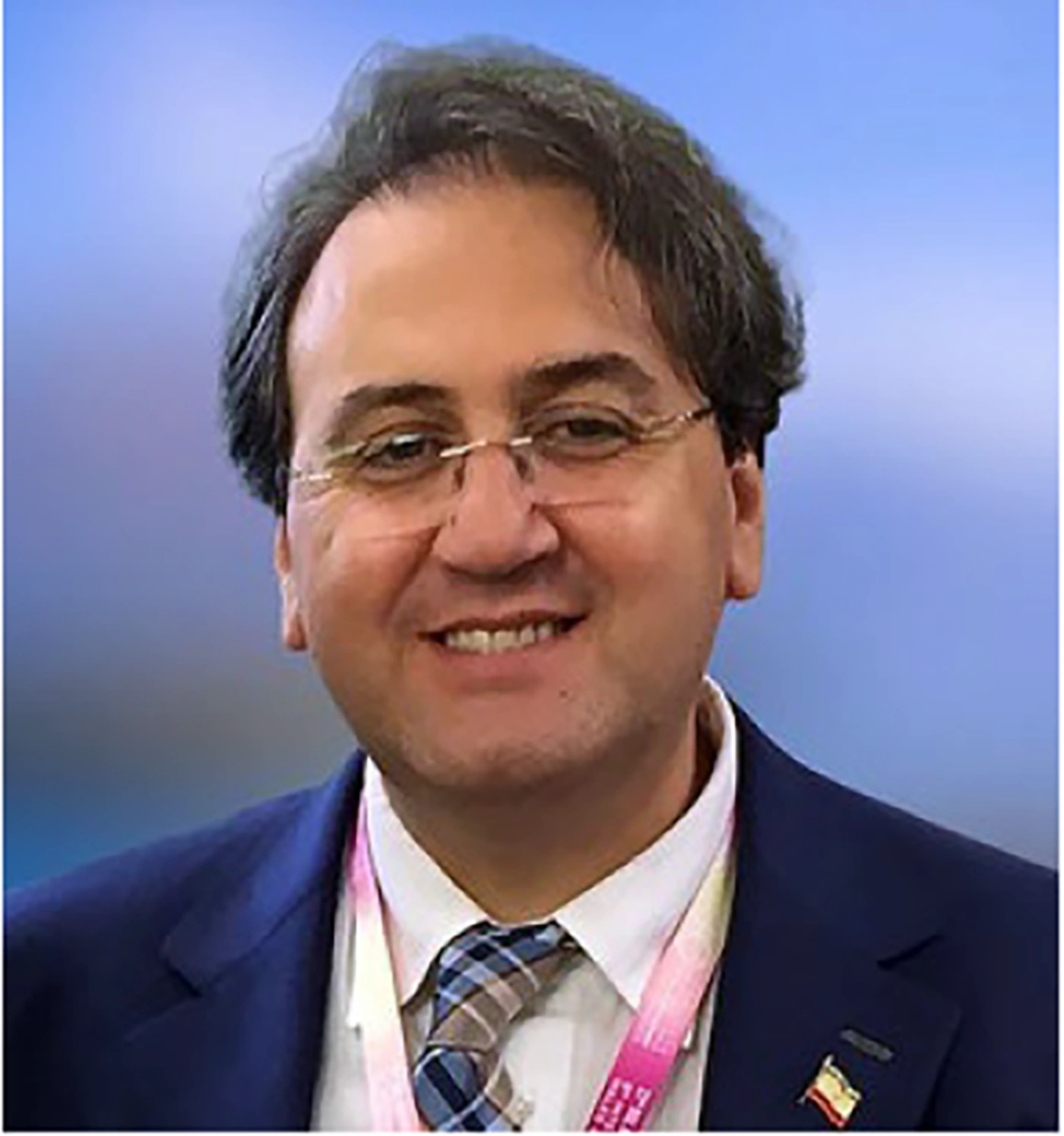
Figure 1.
Professor Reza Fekrazad (1967 – 2026). Published with permission.