
1. Background
Disasters can occur at any time and in any place. These events can adversely affect the quality of medical services because of the extensive damage they cause. During disasters, a main priority is to increase the capacity of the medical system to respond to the healthcare needs of injured people (1). Crises can have catastrophic human, economic, social, strategic, and security consequences, depending on whether their onset is sudden or gradual, whether they are natural or human-made, and whether they arise from external threats or internal emergencies (2).
Biological incidents impose substantial human, economic, environmental, and material costs. Such events can severely challenge governments' capacity to respond effectively to public health threats. In workplaces such as laboratories, biological-agent risks include infectious contamination by microorganisms such as bacteria, viruses, fungi, and parasites (3). The aim of biological-threat control is to contain infectious agents that pose risks to personnel and the environment. A safety policy is successful when it is developed, maintained, and implemented by a responsible and competent manager. The manager's responsibilities should begin at the laboratory design and equipment installation stage. Responses to natural, accidental, and deliberate biological events have been compared, relevant international mechanisms for managing disease outbreaks have been reviewed, and prerequisites for effective disease response have been examined, regardless of whether an event occurs naturally, accidentally, or deliberately (3).
Biological events result from the natural or intentional release of biological agents into a population and may lead to mass-casualty incidents, such as epidemics or pandemics. These events can occur naturally, such as severe acute respiratory syndrome and H1N1 influenza, or intentionally, such as through the release of anthrax, pneumonic plague, or smallpox. Although biological events resemble other mass-casualty events in some respects, they also have important differences. In a biological event, large numbers of people typically seek care at health facilities. This influx can cause shortages of physical and human resources and compromise normal health-system functioning. Another distinguishing feature is the potential for rapid spread; numerous examples demonstrate the rapid global spread of pathogens (4).
Strengthening organizational structures and improving command and management capabilities are essential for countering biological terrorism in military hospitals (5). Training and practical exercises play a vital role in improving medical personnel's preparedness for biological threats. Effective information and communication management is also essential in biological crisis management. The development of management infrastructure and resilience, safety and security, and healthcare and laboratory systems is important for effective and timely responses to biological incidents (6).
Hospitals' ability to effectively manage biological disasters is critical for reducing mortality, strengthening trust in national leadership, and increasing public confidence in government operations. Adequate preparedness not only saves lives but also shapes how societies perceive the effectiveness and reliability of institutions during crises. A well-equipped healthcare system can mitigate the immediate effects of emergencies and contribute to long-term social stability. It demonstrates national readiness to confront major challenges and reassures citizens that their safety is being protected. Therefore, emphasizing hospital preparedness is an important step toward strengthening resilience and public trust during crises (7).
Hospital biopreparedness involves strengthening infection-prevention measures, including isolation precautions, hand hygiene, and environmental disinfection, along with adequate staffing and surge planning (8). At Iran University of Medical Sciences, studies have shown that biopreparedness depends not only on physical resources but also on the development of a management structure, continuous training and practice, information and communication management, diagnostic infrastructure, safety protocols, patient management, and organizational resilience (9). Biopreparedness also refers to the United States framework for addressing biological threats, including the development and distribution of medical countermeasures to mitigate the effects of naturally occurring diseases and human-made outbreaks and to enhance national security and public health response capabilities (10).
2. Objectives
Assessing the preparedness of selected military hospitals to respond to biological disasters in 2025 is a critical, evidence-based endeavor. Such an assessment can identify infrastructure deficiencies, discrepancies between current practices and national standards, gaps in staff competency, and challenges in management and implementation. These findings can inform policy adjustments, strategic planning, and capacity strengthening to enable effective responses to biological disasters. Accordingly, this study aimed to evaluate the performance and preparedness of a selected military hospital in responding to biological accidents and disasters.
3. Methods
This descriptive cross-sectional study was conducted in a selected military hospital in 1404. The study evaluated the performance of a selected military hospital during biological accidents and disasters to help prevent casualties and ensure the provision of appropriate services to affected individuals in the event of such incidents. The study used the “Assessment of Hospital Preparedness Capacity in Biological Events” tool, a 147-item checklist. Scoring was based on available documentation using a Likert scale ranging from 0 to 2, with response options of not at all, somewhat, and completely. The questionnaire comprised 8 main areas and 20 subareas.
The reliability of the instrument was assessed using inter- and intra-rater reliability methods and the intraclass correlation test.
After the face and content validity of the initial instrument were reviewed and confirmed, it was distributed to hospitals across the country to evaluate construct validity. A total of 400 hospitals completed the instrument, and its construct validity was confirmed.
After coordination, the level of hospital preparedness was determined based on the completed instrument items, and the scores were summed to calculate the overall preparedness level. The scoring criteria are presented in Table 1.
Table 1.
Scoring of Hospital Preparedness
| Hospital Bio Preparedness Level | Hospital Preparedness (%) | Hospital Score |
|---|---|---|
| Weak | 0 - 33 | 0 - 98 |
| Medium | 34 - 66 | 99 - 196 |
| Good | 67 - 99 | 197 - 294 |
4. Results
The selected military hospital is a specialized facility with 170 approved beds and 200 active beds and admits approximately 4,500 patients annually. The hospital has 410 staff members, 6 adult intensive care unit (ICU) beds, and 10 standard isolation beds, but no negative-pressure isolation beds. It has a microbiology laboratory and an infectious disease and infection control specialist. The hospital's role in recent biological incidents has been defined as "support." The hospital characteristics are presented in Table 2.
Table 2.
Selected Military Hospital Specifications
| Variables | Values |
|---|---|
| Number of approved beds | 170 |
| Number of approved beds | 200 |
| Number of active beds | 200 |
| Number of annual admissions | 4500 |
| Total number of employees | 410 |
| Type of service (general, single specialty) | Specialized |
| Normal isolation bed | 10 |
| Negative pressure isolation | 0 |
| Negative pressure isolation | 0 |
| Microbiology Laboratory | yes |
| Infectious disease and infection control specialist | yes |
| Role in recent biological events | Supporter |
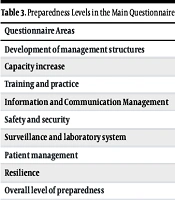
The Hospital Preparedness Assessment Questionnaire for Biological Events is based on eight key areas and includes 147 questions. Each area has a specified number of questions and a maximum score: Development of management structures, 15 questions and a maximum of 30 points; Capacity increase, 33 questions and a maximum of 66 points; Training and practice, 11 questions and a maximum of 22 points; Information and communication management, 12 questions and a maximum of 24 points; Safety and security, 30 questions and a maximum of 60 points; Care and laboratory system, 15 questions and a maximum of 30 points; Patient management, 19 questions and a maximum of 38 points; and Resilience, 12 questions and a maximum of 24 points. Finally, the hospital's overall level of preparedness is calculated as the sum of the question scores, with a total score of 432 points, indicating its level of preparedness for biological crises. The results for the main areas are presented in Table 3.
Table 3.
Preparedness Levels in the Main Questionnaire Areas
| Questionnaire Areas | Number of Questions in Each Area | Maximum Score | Hospital Score | Preparedness Percentage |
|---|---|---|---|---|
| Development of management structures | 15 | 30 | 24 | 80 |
| Capacity increase | 33 | 66 | 39 | 59.09 |
| Training and practice | 11 | 22 | 16 | 72.72 |
| Information and Communication Management | 12 | 24 | 18 | 75 |
| Safety and security | 30 | 60 | 48 | 80 |
| Surveillance and laboratory system | 15 | 30 | 23 | 76.66 |
| Patient management | 19 | 38 | 31 | 81.57 |
| Resilience | 12 | 24 | 17 | 70.83 |
| Overall level of preparedness | 147 | 294 | 216 | 73.46 |
The preparedness of the selected military hospital for biological events was assessed using a standard questionnaire covering eight main areas and a total of 264 possible scores. The results demonstrated strengths and weaknesses across dimensions. The highest preparedness was observed in patient management (81.57%), followed by development of management structures and safety and security (both 80%), care and laboratory system (76.66%), information and communication management (75%), education and training (72.72%), and resilience (70.83%). Capacity increase had the lowest preparedness level at 59.09%. Overall, the hospital scored 216 out of 294, corresponding to 73.46% preparedness and the Good category. This finding underscores the need for particular attention to capacity building and improved planning for biological crises.
4.1. Preparedness in Subdimensions
The results of the hospital preparedness assessment questionnaire showed variation across areas. The hospital performed very well in planning and diagnosis and treatment management, with preparedness levels of 100% and 94.4%, respectively. Education and training (91.7%), communication and coordination (87.5%), and infection prevention and control (84.2%) were also high. However, several areas require substantial attention and improvement. The lowest preparedness was observed for medicine, equipment, and medical supplies (43.8%). Structure and practice and maneuver were also lower, each with 50% preparedness. Organizing, environmental safety and health, and essential support services also require improvement, each with 60% preparedness. These findings indicate that the hospital is strong in management and training but requires greater investment and planning in key infrastructure, including equipment provision, operational structures, and regular maneuvers. Improvement in these areas could increase the hospital's overall preparedness for biological crises. The subdimension results are presented in Table 4.
Table 4.
Preparedness Levels in Questionnaire Subdimensions
| Questionnaire Areas | Number of Questions in Each Area | Minimum and Maximum Score | Hospital Score | Preparedness Percentage |
|---|---|---|---|---|
| Planning | 7 | 0 - 14 | 14 | 100 |
| Organizing | 5 | 0 - 10 | 6 | 60 |
| Legal requirements | 3 | 0 - 6 | 4 | 66.7 |
| Structure | 14 | 0 - 28 | 14 | 50 |
| Medicine, equipment and medical supplies | 8 | 0 - 16 | 7 | 43.8 |
| Staff and volunteers | 11 | 0 - 22 | 18 | 81.8 |
| Education and training | 6 | 0 - 12 | 11 | 91.7 |
| Practice and maneuver | 5 | 0 - 10 | 5 | 50 |
| Risk information and communication | 8 | 0 - 16 | 11 | 68.8 |
| Communication and coordination | 4 | 0 - 8 | 7 | 87.5 |
| Environmental safety and health | 5 | 0 - 10 | 6 | 60 |
| security | 6 | 0 - 12 | 10 | 83.3 |
| Infection prevention and control | 19 | 0 - 38 | 32 | 84.2 |
| Laboratory diagnostic capacity | 6 | 0 - 12 | 8 | 66.7 |
| Early warning and surveillance system | 9 | 0 - 18 | 15 | 83.3 |
| Biological triage | 6 | 0 - 12 | 8 | 66.7 |
| Diagnosis and treatment management | 9 | 0 - 18 | 17 | 94.4 |
| Corpse Management | 4 | 0 - 8 | 6 | 75 |
| Continuity of performance | 7 | 0 - 14 | 11 | 78.6 |
| Essential support services | 5 | 0 - 10 | 6 | 60 |
A comprehensive review of the hospital preparedness assessment data revealed heterogeneous and uneven preparedness across dimensions. While patient management (81.57%) and safety and security (80%) achieved desirable levels, other critical areas, including capacity enhancement (59.09%) and resilience (70.83%), showed important weaknesses. This discrepancy suggests that hospital development strategies and resource allocation are unbalanced and that vulnerabilities may arise during sudden pressures or widespread crises.
5. Discussion
Hospital preparedness for biological threats is critical to ensuring the continuity of healthcare delivery and minimizing impacts on communities. Biological threats, whether natural, such as pandemics, or intentional, such as bioterrorism, pose persistent challenges to national healthcare systems. Preparedness aims to ensure that hospitals can respond effectively to biological events and mitigate their consequences.
The goal of preparedness is to reduce the effects of disasters. Hospital disaster preparedness is an ongoing process comprising several elements. Hospital preparedness plans are largely all-hazards based, but a specific plan for biological hazards is particularly important (11). Although the hospital achieved acceptable standards in some operational and service areas, it had substantial shortcomings in infrastructural and strategic components, such as capacity development and resilience, which are fundamental to crisis response and the ability to meet gradually increasing demand. Progress toward a fully prepared and resilient healthcare facility requires an integrated and comprehensive approach. This study provides an overview of the preparedness of a selected military hospital for biological threats and shows that preparedness is not a binary concept but rather a continuum of interrelated strengths and weaknesses.
The present study classified the hospital's overall preparedness as Good. This finding is consistent with the study by Sehdeh et al., who audited the preparedness of a selected military hospital for biological threats using an action-research design (12). In contrast, the Irannjad study, titled "Investigating the Level of Preparedness of Hospitals in Markazi Province for Biological Incidents," examined hospital preparedness in 2016 and assessed preparedness in hospitals in Markazi Province as poor (7). These findings are not consistent with the present study. Therefore, continuous assessment of medical-center preparedness and response plans for biological crises remains necessary (7).
The findings indicate that the selected hospital, although having acceptable managerial and clinical capacity for biological threats, also has substantial operational and capacity-related weaknesses. Similar heterogeneous patterns between managerial and operational preparedness have been reported in other studies, showing that many hospitals perform well in planning and training but face challenges related to resources, equipment, practical exercises, and structural resilience (11-14). In education and diagnosis and treatment management, the findings are consistent with systematic reviews indicating that staff training, response protocols, and documented management frameworks are key components of improved hospital response to biological incidents (11, 14, 15). Thus, theoretical preparedness and specialized knowledge are useful for crisis operations but represent only one component of actual preparedness.
Weaknesses in medicines, medical equipment, strategic stockpiling, and operational capacity have also been highlighted in many studies. Global surveys have shown that hospitals often have deficiencies in resource management, the provision and maintenance of personal protective equipment (PPE), and physical and information technology infrastructure, which can limit operational response (13-16). In particular, experiences during the COVID-19 pandemic showed that shortages of resources and supplies were among the most important factors reducing the effectiveness of hospital responses (16, 17). Qualitative research on hospital challenges in responding to biological incidents has identified infection control, patient management, risk communication, and laboratory surveillance as key preparedness areas that are often not implemented adequately (14, 18). These findings suggest that without continuous improvement in these areas, even hospitals with good theoretical plans may not perform optimally during actual crises.
Other studies have emphasized the role of policy frameworks and interdisciplinary training in strengthening hospital preparedness and have highlighted the importance of practical training, simulation exercises, and comprehensive exercises in preparedness programs (14, 15, 17). This view is consistent with evidence showing that many tools lack complete and standardized coverage of all operational dimensions (11, 14). Experiences from recent pandemics such as COVID-19 also indicate that stronger management structures, intersectoral coordination, and national policies to improve resilience have been important factors in successful crisis responses (13, 19, 20). Hospital preparedness for both preventive and reactive roles requires alignment with national and global strategies. Studies of national health systems have shown that countries prioritizing investment in prevention and strategic preparedness responded better to major threats such as COVID-19 (19, 20).
Recent research also identifies rapid response, human resource management, supply-chain support, and comprehensive training programs for healthcare personnel as determinants of optimal responses to pandemics and other biological threats (13, 17, 19). Deficiencies in these areas may disrupt clinical services, increase the risk of infection transmission, and delay responses (13, 14, 17). Ultimately, the findings of the present study emphasize that sustained preparedness requires a comprehensive approach that includes resource management, increased operational capacity, improved infrastructure, practical exercises, and stronger structural and human resilience; these components have been identified in global studies as essential for effective responses to biological threats (11, 15, 19, 20).
5.1. Conclusions
The assessment highlights an uneven pattern of preparedness within the hospital. While operational areas such as patient management and safety showed satisfactory performance, capacity enhancement remained a substantial weakness. The overall preparedness score was 216 out of 294 (73.46%), corresponding to the Good category, and was broadly consistent with the average percentage across the different areas (approximately 72%). Building stronger resilience will require prioritizing improvements in weaker infrastructure areas, particularly capacity enhancement. Without focused resource allocation and strategic reforms in these areas, achieving full preparedness will remain difficult. Therefore, the hospital should implement a comprehensive development plan to address these weaknesses.