
1. Background
Panic disorder disrupts an individual's cognitive evaluation of internal and environmental safety, extending beyond transient episodes of anxiety (1). Patients frequently misinterpret normal physiological fluctuations, such as an elevated heart rate or changes in respiration, as evidence of imminent catastrophe or death (2). This catastrophic misattribution prompts avoidance of potential triggers, including crowded spaces, traveling alone, or waiting in lines, substantially restricting daily functioning and contributing to social isolation (3). Even in the absence of acute panic attacks, individuals experience chronic anticipatory anxiety about their health and future episodes (4). Panic disorder has a global prevalence of approximately 2% to 3%, peaks in early adulthood, disproportionately affects women, and substantially impairs quality of life, necessitating targeted clinical interventions (5).
A key mechanism contributing to the maintenance and relapse of panic disorder is meta-worry, defined as the distressing tendency to worry about worrying itself (6). Meta-worry is central to metacognitive pathology and is underpinned by negative metacognitive beliefs, including beliefs that worry is uncontrollable, inherently dangerous, or capable of triggering a somatic crisis (7). According to Wells' metacognitive model, patients fear not only acute panic symptoms but also the loss of cognitive control over their emotional states (8). This secondary fear is often more distressing than the primary somatic apprehension, leading patients to monitor their cognitive and bodily signals excessively and thereby exacerbating the distress they seek to reduce (9).
Experiential avoidance is another important maintenance factor in panic pathology (10). It encompasses a persistent unwillingness to remain in contact with aversive internal experiences, including unpleasant emotions, intrusive thoughts, distressing memories, and somatic sensations (11). To escape these experiences, patients rely on maladaptive emotion-regulation strategies, such as thought suppression, distraction, or withdrawal from situations that provoke distress (12). Although these strategies may provide temporary relief from acute anxiety, they increase sensitivity to internal stimuli and reduce distress tolerance over time (13). Consequently, experiential avoidance hinders emotional processing and exposure, reinforcing the chronicity of panic disorder and preventing spontaneous recovery (14).
Despite advances in pharmacological treatments, particularly selective serotonin reuptake inhibitors, a substantial proportion of patients experience residual symptoms or relapses, highlighting the need for cognitive interventions (15). Cognitive therapy is a first-line psychological intervention that targets dysfunctional cognitive processes that maintain anxiety (16). It equips patients with skills to challenge and restructure catastrophic misinterpretations of benign physical symptoms and replace them with realistic, evidence-based evaluations (17). Cognitive therapy also counteracts experiential avoidance through structured emotional exposure (18). Rather than suppressing distress, patients are guided to confront anxiety-provoking stimuli safely, supporting adaptive emotion regulation and enduring changes in their cognitive schemas (19).
A growing body of literature supports the efficacy of cognitive interventions in addressing these cognitive vulnerabilities (20). Previous studies have demonstrated that cognitive therapy reduces meta-worry and improves subjective sleep quality in diverse patient populations (21). Related studies have also shown reductions in experiential avoidance and improvements in emotional expression among individuals experiencing severe emotional distress (22). Broader transdiagnostic research indicates that cognitive therapy reduces rumination, chronic worry, somatization, and emotional reactivity across anxiety and depressive disorders (23). A key clinical advantage of cognitive therapy is the sustainability of its effects, as cognitive restructuring may protect against future psychiatric relapse (24).
Despite the debilitating nature of panic disorder, contemporary interventions in Iran have predominantly focused on symptom reduction, often overlooking meta-worry and experiential avoidance as primary therapeutic targets. This gap in culturally contextualized research, particularly in Shiraz, hinders the development of comprehensive treatment protocols that address the underlying causes of psychological distress. Addressing these metacognitive and emotion-regulation deficits is essential for standardizing evidence-based care and reducing the socioeconomic burden of the disorder.
2. Objectives
This study aimed to investigate the efficacy of cognitive therapy in reducing meta-worry and experiential avoidance among individuals with panic disorder in Shiraz.
3. Methods
3.1. Study Design and Participants
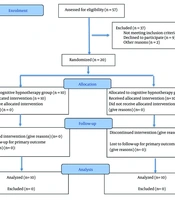
This clinical trial used a pretest-posttest control-group design with a two-month follow-up and included individuals diagnosed with panic disorder in Shiraz, Iran, in 2025. Using purposive sampling, 20 eligible patients aged 18 - 45 years were recruited from local psychological counseling centers and allocated to an experimental group (n = 10) or a waitlist control group (n = 10). Inclusion criteria were a diagnosis of panic disorder by a clinical psychologist or psychiatrist based on the Diagnostic and Statistical Manual of Mental Disorders, Fifth Edition (DSM-5), written informed consent, at least a high school diploma, and baseline scores exceeding clinical cutoffs on the study questionnaires. To control for confounding variables, patients were excluded if they were concurrently receiving psychiatric medication or other psychological interventions, missed more than two therapy sessions, experienced severe unforeseen stressful life events during the trial, or voluntarily withdrew from the study.
3.2. Instruments
Meta-Worry Questionnaire (MWQ): The metacognitive dimension of participants’ anxiety was assessed using the MWQ, developed by Wells and Cartwright-Hatton in 2004. This tool comprises seven items that quantify beliefs about the inherent dangers and uncontrollability of worrying. Higher total scores indicate more pronounced metacognitive pathology, wherein individuals perceive their own worry processes as catastrophic (25). The reported internal consistency of the Persian MWQ was 0.71 (26). In the present study, Cronbach’s alpha for the MWQ was 0.84.
Experiential Avoidance Scale (EAS): To assess patients’ rigid reluctance to engage with distressing internal states, the refined 10-item version of the EAS, originally conceptualized by Hayes et al. in 2004, was used. Participants rate statements on a seven-point Likert scale ranging from 1 (completely false) to 7 (completely true). Elevated scores signify a deeply ingrained pattern of cognitive and behavioral avoidance of unpleasant emotions and bodily sensations, which is recognized as a core maintenance factor in anxiety pathology (27). Previous Iranian normative studies have corroborated its structural integrity, reporting alpha values between 0.82 and 0.84 (28). The current study likewise found optimal internal consistency for this scale, with a Cronbach’s alpha of 0.82.
3.3. Intervention Program
The experimental group received a structured cognitive therapy program consisting of ten 90-minute sessions delivered twice weekly. The initial sessions focused on psychoeducation about the mind-body connection, an introduction to the cognitive-behavioral triangle, and training in identifying cognitive distortions and logical errors. Subsequent modules addressed cognitive restructuring and emotion regulation through thought-stopping exercises, positive imagery, and access to core emotions using Greenberg's emotional model. Mid-treatment sessions emphasized physiological desensitization through progressive muscle relaxation. Later sessions incorporated imaginal systematic desensitization, logical analysis of dysfunctional assumptions, and the downward arrow technique to identify maladaptive schemas. The final sessions focused on consolidating therapeutic gains through perceptual shifting and voluntary cortical inhibition exercises.
3.4. Data Analysis
Data were processed and analyzed using SPSS version 27. Repeated-measures analysis of variance (RM-ANOVA) was used to assess the effects of the intervention across the pretest, posttest, and follow-up phases. Least significant difference post hoc tests were used for pairwise comparisons.
4. Results
The final sample comprised 20 individuals with panic disorder: 10 in the cognitive therapy group and 10 in the waitlist control group. Participants were aged 18 - 45 years. The mean age was 29.80 years (standard deviation [SD] = 6.12) in the experimental group and 29.20 years (SD = 5.85) in the control group. The experimental group included 6 women (60.0%) and 4 men (40.0%), whereas the control group included 5 women (50.0%) and 5 men (50.0%). Independent-samples t tests and chi-square analyses showed no statistically significant baseline differences between the groups in age (P = 0.828) or gender distribution (P = 0.655).
Table 1 summarizes the means and standard deviations for meta-worry and experiential avoidance at baseline, postintervention, and the two-month follow-up. At baseline, both groups had comparably high levels of meta-worry and experiential avoidance. Following the intervention, the cognitive therapy group showed substantial reductions in both outcomes at posttest, and these gains were maintained at follow-up. In contrast, the waitlist control group maintained stable, elevated scores across all three assessment points, indicating no spontaneous symptomatic remission.
Table 1.
Descriptive Statistics for Outcome Variables Across Study Phases a
| Variables and Groups | Pretest | Posttest | Follow-up |
|---|---|---|---|
| Meta-worry | |||
| Experimental | 23.65 (3.67) | 10.12 (1.11) | 9.59 (1.27) |
| Control | 23.20 (3.50) | 22.90 (3.40) | 23.10 (3.60) |
| Experiential avoidance | |||
| Experimental | 50.24 (3.91) | 26.76 (3.70) | 26.18 (4.17) |
| Control | 49.80 (4.10) | 49.10 (3.95) | 49.50 (4.20) |
a Values are expressed as mean (SD).
Before the RM-ANOVA, the statistical assumptions were assessed. Normality was confirmed across all study phases, with skewness ranging from -0.85 to +0.92 and kurtosis ranging from -0.78 to +1.10, within the acceptable range of -2.00 to +2.00. Levene's test supported homogeneity of error variances across groups for all variables at all assessment points (P > 0.05). Mauchly's test indicated that sphericity was met for experiential avoidance (P = 0.182) but violated for meta-worry (P = 0.008). The degrees of freedom for meta-worry were therefore adjusted using the Greenhouse-Geisser correction (ϵ = 0.68).
A series of 2 (group: experimental vs control) × 3 (time: pretest, posttest, and follow-up) mixed RM-ANOVAs was performed to evaluate treatment effects over time and between groups. As shown in Table 2, significant main effects of time and group were observed for both outcomes (P < 0.001). Significant time-by-group interactions were also found for meta-worry and experiential avoidance (P < 0.001), supporting the primary hypothesis. The effect sizes indicate that the reductions in psychological distress over time were attributable to the cognitive therapy intervention rather than temporal or retesting effects.
Table 2.
Mixed Repeated-Measures Analysis of Variance Results for Main and Interaction Effects a
| Variables and Sources | Sum of Squares | df | Mean Square | F | P Value | Partial η2 |
|---|---|---|---|---|---|---|
| Meta-worry | ||||||
| Time | 1085.40 | 1.36 | 798.09 | 142.35 | < 0.001 | 0.69 |
| Group | 1120.80 | 1 | 1120.80 | 115.60 | < 0.001 | 0.67 |
| Time × Group | 978.60 | 1.36 | 719.56 | 128.45 | < 0.001 | 0.68 |
| Experiential avoidance | ||||||
| Time | 2215.30 | 2 | 1107.65 | 210.18 | < 0.001 | 0.72 |
| Group | 2450.60 | 1 | 2450.60 | 184.22 | < 0.001 | 0.71 |
| Time × Group | 2095.40 | 2 | 1047.70 | 198.75 | < 0.001 | 0.72 |
a Abbreviation: df, degrees of freedom.
Fisher's least significant difference post hoc tests were used to examine pairwise differences between assessment points. As shown in Table 3, the experimental group had significant decreases from pretest to posttest in meta-worry (mean difference = 13.53, P < 0.001) and experiential avoidance (mean difference = 23.48, P < 0.001). There were no significant differences between posttest and follow-up in meta-worry (mean difference = 0.53, P = 0.132) or experiential avoidance (mean difference = 0.58, P = 0.550), indicating that the posttreatment improvements remained stable over the two-month follow-up. The control group showed no statistically significant changes across pairwise comparisons between assessment points (P > 0.05). Figure 1 illustrates the trajectories of both outcomes across the three study phases in the experimental and control groups.
Table 3.
Least Significant Difference Post Hoc Pairwise Comparisons Across Time Points in the Experimental Group
| Variables and Comparison Phases | Mean Difference | Standard Error | P Value | 95% Confidence Interval |
|---|---|---|---|---|
| Meta-worry | ||||
| Pretest vs posttest | 13.53 | 0.97 | < 0.001 | (11.48, 15.58) |
| Pretest vs follow-up | 14.06 | 0.96 | < 0.001 | (12.03, 16.09) |
| Posttest vs follow-up | 0.53 | 0.34 | 0.132 | (-0.19, 1.25) |
| Experiential avoidance | ||||
| Pretest vs posttest | 23.48 | 1.17 | < 0.001 | (20.99, 25.97) |
| Pretest vs follow-up | 24.06 | 1.08 | < 0.001 | (21.76, 26.36) |
| Posttest vs follow-up | 0.58 | 0.96 | 0.550 | (-1.46, 2.62) |
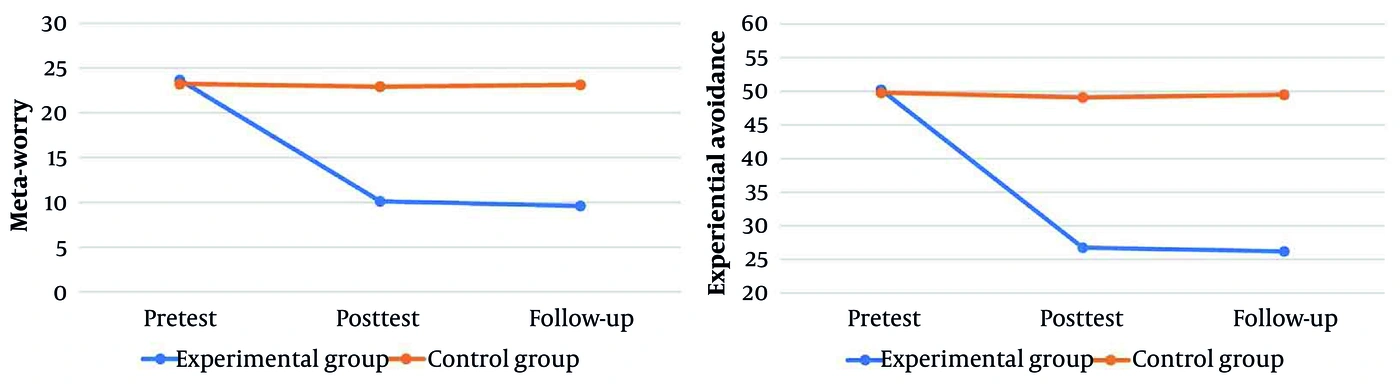
Figure 1.
Longitudinal change trajectories for meta-worry and experiential avoidance across pretest, posttest, and 2-month follow-up evaluation points in experimental and control groups.
5. Discussion
This study examined the efficacy of protocolized cognitive therapy in addressing core transdiagnostic maintenance factors, specifically meta-worry and experiential avoidance, in individuals with panic disorder. The findings support sustained effects of cognitive therapy on the cognitive and behavioral processes that perpetuate panic symptoms. These psychological changes can be understood in terms of the mechanisms through which they disrupt the chronic cycle of panic.
The reduction in meta-worry supports the theoretical premise that targeting secondary cognitive appraisals provides clinical benefits. This finding is consistent with the transdiagnostic meta-analysis by Stenzel et al. (29), which demonstrated the efficacy of cognitive interventions in addressing maladaptive metacognitive processes in anxiety-related psychopathology. Meta-worry represents a secondary layer of distress in which patients catastrophize their cognitive processes and hold rigid beliefs that worry is uncontrollable, harmful, or capable of inducing a somatic crisis (8). Through techniques such as cognitive restructuring and detached mindfulness, the protocol challenged the perceived causal relationship between thinking about a panic attack and its actual physical occurrence. Patients learned to decenter cognitively and view catastrophic thoughts as transient mental events rather than physiological facts. Addressing this metacognitive process is important because patients may remain vulnerable to relapse while it persists, even if the frequency of acute panic attacks temporarily decreases.
The intervention also produced a sustained reduction in experiential avoidance. This finding is consistent with the outcomes reported by Piro and Taha (30) and supports the capacity of cognitive therapy to encourage emotional engagement rather than avoidance. Experiential avoidance in panic disorder often involves reliance on safety behaviors, such as carrying unnecessary anxiolytic medication, leaving agoraphobic situations, or suppressing distressing physiological arousal. These behaviors can amplify the perceived threat of somatic sensations and impede emotional processing. Cognitive therapy disrupts this cycle through gradual exposure to feared interoceptive cues, thereby developing distress tolerance (31). Through psychoeducation and controlled exposure exercises, patients restructured catastrophic misinterpretations of benign somatic sensations. For example, they learned through experience that a rapid heartbeat or breathlessness does not necessarily indicate an impending myocardial infarction or asphyxiation. This experiential learning promotes extinction of the conditioned fear response and demonstrates that tolerating short-term emotional and somatic discomfort can lead to sustained symptomatic relief.
The stability of the therapeutic gains at follow-up is an important aspect of these findings. The persistence of the improvements indicates that the cognitive and behavioral changes achieved during treatment reflect changes in coping strategies rather than transient fluctuations. By internalizing cognitive restructuring and interoceptive exposure techniques, patients acquire skills to manage symptoms independently. This self-efficacy enables them to apply adaptive emotion-regulation strategies when encountering new anxiety-provoking stimuli, reducing the risk of panic recurrence and improving quality of life. Integrating these cognitive modules into standard care could help reduce the socioeconomic burden of panic disorder.
Several methodological limitations should be considered. The small sample size and recruitment of adults aged 18 - 45 years from a single geographic region limit generalizability to other populations. The two-month follow-up also precludes definitive conclusions about the maintenance of treatment gains over longer periods.
5.1. Conclusions
The findings provide preliminary evidence that protocolized cognitive therapy may reduce meta-worry and experiential avoidance in individuals with panic disorder. Although the therapeutic gains remained stable over the two-month follow-up, the small sample size and short evaluation period warrant cautious interpretation. Cognitive therapy nevertheless appears promising as a nonpharmacological intervention targeting core transdiagnostic mechanisms that maintain panic symptoms. Larger longitudinal randomized controlled trials are needed to establish its long-term efficacy and broader clinical generalizability.