
1. Background
Generalized anxiety disorder (GAD) is a highly prevalent and impairing psychiatric condition worldwide, characterized by persistent, excessive, and difficult-to-control worry about everyday matters. Women have a markedly higher risk of GAD, with substantially higher prevalence and more severe symptoms than men, potentially owing to biological vulnerabilities, such as hormonal fluctuations, as well as distinct socioenvironmental pressures (1). In female populations, this disorder often manifests as increased somatic tension, difficulties concentrating, and profound disruption in social and occupational functioning (2). Recent epidemiological data suggest that environmental stressors, combined with distinct psychological vulnerabilities, render women more susceptible to the maintenance of this disorder (3). Despite the availability of traditional pharmacological and cognitive interventions, studies focusing on predominantly female samples indicate that many women continue to experience residual symptoms, underscoring the need for deeper exploration of the mechanisms that sustain GAD in this demographic (4).
Self-criticism has emerged as a critical transdiagnostic factor that significantly exacerbates GAD pathology. Comparative self-criticism involves negatively judging oneself against others, whereas internalized self-criticism reflects a deep internal sense of inadequacy and failure. Self-criticism entails harsh internal dialogue characterized by self-judgment, feelings of inadequacy, and an inability to extend self-compassion during times of failure (5). In women with GAD, self-criticism often functions as a maladaptive regulatory strategy in which individuals internalize perceived societal or personal expectations, leading to chronic shame and emotional distress (6). Recent evidence highlights the mediating role of shame and self-criticism in anxiety disorders, showing that these factors maintain emotional distress and impede adaptive emotion regulation (7). Furthermore, compassion- and emotion-focused therapies have demonstrated efficacy in reducing internal self-criticism, shame, and maladaptive perfectionism in diverse populations, including patients with chronic conditions such as vitiligo (8) and mothers of children with disabilities (9). Research indicates that high levels of self-criticism are strongly associated with treatment resistance and a higher risk of relapse (10). By constantly attacking the self, individuals activate the brain's threat-protection system, which fuels the cycle of anxiety and inhibits the development of psychological resilience and self-reassurance (11).
Intolerance of uncertainty is another foundational cognitive vulnerability that plays a pivotal role in the onset and maintenance of GAD. It is defined as a negative dispositional response to uncertain situations and their consequences, whereby the individual perceives the unknown as inherently threatening and unacceptable (12). This construct encompasses several dimensions, including prospective anxiety, or apprehension about future events; inhibitory anxiety; and uncertainty paralysis, which completely halts decision-making. In women with GAD, intolerance of uncertainty acts as a catalyst for “worry as a coping mechanism,” reflecting an attempt to mentally prepare for every possible negative outcome (13). This cognitive bias leads to substantial avoidance behaviors and emotional paralysis, as individuals find it difficult to function effectively in environments in which outcomes are not guaranteed (14). Studies have shown that reducing intolerance of uncertainty is essential for clinical recovery because it directly addresses the core “what if” thinking patterns that characterize chronic anxiety (15).
Compassion-focused therapy (CFT) was designed to address these psychological challenges by integrating evolutionary psychology, neuroscience, and attachment theory. It seeks to strengthen the soothing system to counteract the excessively activated threat system commonly observed in individuals with anxiety (16). Prior studies have shown that CFT effectively diminishes shame and self-critical behaviors in diverse clinical groups (17). Longitudinal studies have also shown that compassion-based interventions can significantly reduce anxiety by fostering self-warmth and emotional regulation (9). Furthermore, preliminary evidence suggests that CFT can improve patients' capacity to tolerate uncertainty by providing a secure internal base from which to face life's ambiguities (18).
Although traditional cognitive behavioral therapy focuses on the content of thoughts, it often does not address the emotional tone of self-criticism or the deep-seated fear of uncertainty in women with GAD. A notable gap remains in the literature regarding the combined effects of CFT on these two transdiagnostic variables in Middle Eastern clinical contexts. In Iran, cultural expectations and traditional gender roles may amplify shame, self-judgment, and anxiety among women, making culturally attuned, compassion-based approaches particularly relevant. Given the prevalence of GAD among women in this region and the cultural nuances of self-judgment, a rigorous trial is needed to validate more inclusive therapeutic modalities. Addressing these core vulnerabilities through targeted interventions may help bridge this research gap and lead to more sustainable recovery outcomes and improved quality of life.
2. Objectives
This study aimed to evaluate the effectiveness of CFT in reducing self-criticism and intolerance of uncertainty in women diagnosed with GAD at posttreatment and at the 2-month follow-up.
3. Methods
3.1. Design
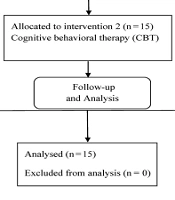
This study used a randomized controlled trial design with pretest, posttest, and 2-month follow-up assessments and was conducted in accordance with CONSORT guidelines. The primary aim was to evaluate the efficacy of CFT compared with a wait-list control condition. Participant flow through the study phases is shown in Figure 1.
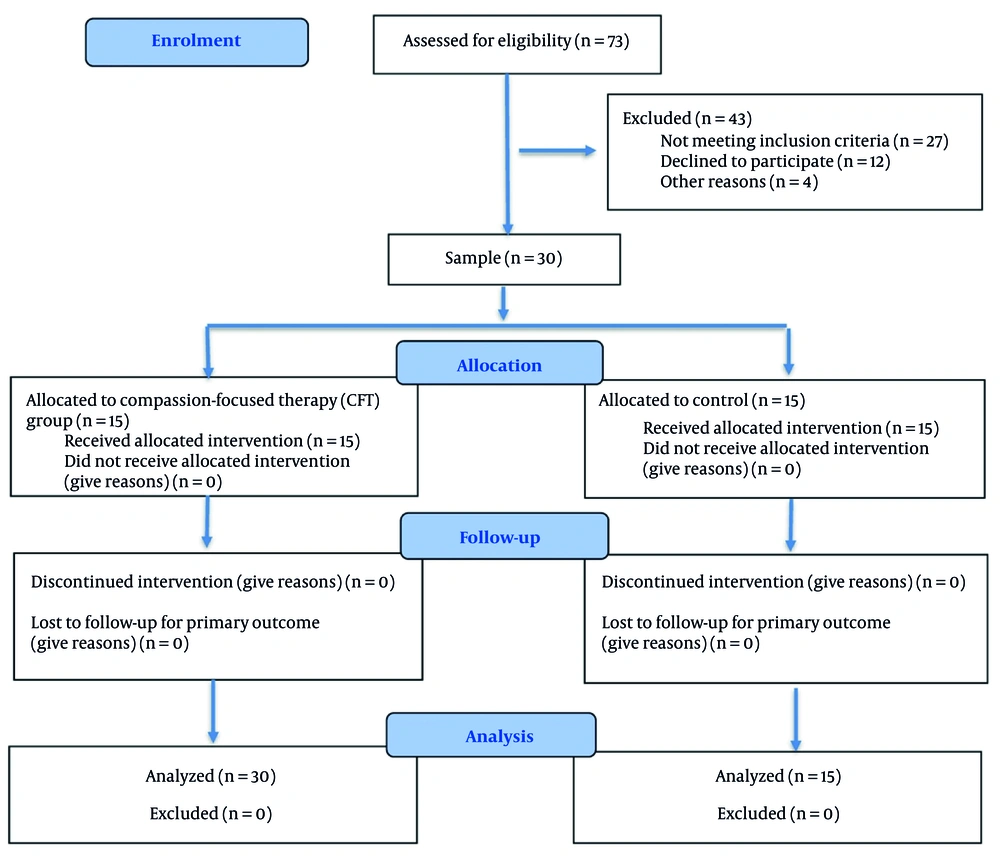
Figure 1.
CONSORT diagram of the study
3.2. Participants
The study population consisted of women diagnosed with GAD who sought psychological services at specialized clinics in Ahvaz, Iran. Recruitment occurred between January and May 2025. The required sample size was determined using G*Power software (version 3.1). Based on an a priori power analysis for repeated-measures analysis of variance (within-between interaction), assuming an anticipated moderate-to-large effect size of f = 0.25, an alpha level of α = 0.05, and statistical power of 1 - β = 0.80, the minimum required sample size was calculated as 24. To accommodate a potential attrition rate of approximately 20% across the follow-up period, the final sample size was increased to 30 participants.
Participants were selected by convenience sampling based on the inclusion criteria, including a formal diagnosis of GAD by a psychiatrist, and were then randomly allocated. Randomization was performed by an independent researcher using a computer-generated random number sequence to ensure allocation concealment. Participants were assigned using a random number table to either the experimental group (n = 15) or the wait-list control group (n = 15). To minimize bias, independent assessors who administered the outcome measures at all time points were blinded to participants' group allocation. Missing data across the assessment phases were handled using an intention-to-treat approach.
3.3. Ethical Considerations
All procedures involving human participants were performed in accordance with the ethical standards of the institutional and/or national research committee. Informed consent was obtained from all participants included in the study. To ensure strict data confidentiality, all participant data were deidentified using coded IDs, digital files were stored in password-protected formats, and physical consent forms were stored securely and separately from the primary data.
3.4. Measures
Levels of Self-Criticism Scale: The Levels of Self-Criticism Scale was used to assess participants' internal judgments and feelings of inadequacy. Developed by Thompson and Zuroff (18), this 22-item instrument measures two dimensions: comparative self-criticism and internalized self-criticism. Responses are rated on a 7-point Likert scale ranging from 1 (not at all like me) to 7 (very much like me). Higher scores reflect a stronger tendency toward self-critical behaviors. International research has reported strong internal consistency for the scale (Cronbach's alpha = 0.87) (19). In this study, the Persian adaptation yielded a Cronbach's alpha of 0.84, supporting its reliability among the study participants.
Intolerance of Uncertainty Scale: The Intolerance of Uncertainty Scale-27 was used to measure cognitive, emotional, and behavioral reactions to uncertain situations. This scale, originally designed by Freeston et al. (20), consists of 27 items assessing emotional, cognitive, and behavioral reactions to ambiguous situations. Participants rate items on a 5-point Likert scale from 1 (not at all characteristic) to 5 (entirely characteristic). Total scores range from 27 to 135, with higher values indicating greater intolerance of uncertainty. Previous Iranian studies have reported Cronbach's alpha values above 0.89 (21). In the current trial, Cronbach's alpha was 0.91, indicating excellent internal consistency and robust psychometric properties.
3.5. Intervention
After the pretest evaluation, individuals in the experimental group attended ten weekly 90-minute group-based CFT sessions, whereas the wait-list control group received no treatment during the study period. The program followed Gilbert's standard CFT protocol (22), focusing primarily on stimulating the affiliative soothing system to improve emotion regulation and reduce excessive activation of the threat-protection system typical of anxiety disorders. Session contents are outlined in Table 1. All sessions were conducted by a trained clinical psychologist experienced in CFT. Homework assignments were provided to reinforce in-session learning and promote skill consolidation. Posttest assessments were administered immediately after the final session, and follow-up assessments were conducted 2 months later.
Table 1.
Summary of Compassion-Focused Therapy Session Content a
| Session | Primary Objectives and Contents |
|---|---|
| 1 | Introduction to CFT principles, establishment of group guidelines, and overview of the evolutionary model comprising the three affect regulation systems: threat, drive, and soothing. |
| 2 | Differentiation among the threat, drive, and soothing systems and conceptualization of GAD within this tripartite framework. |
| 3 | Exploration of the developmental origins of self-criticism and its function as a maladaptive safety strategy in anxiety maintenance. |
| 4 | Development of compassionate imagery exercises and cultivation of a compassionate self-identity to counteract internal criticism and hostility. |
| 5 | Training in soothing rhythm breathing and mindfulness-based grounding techniques to facilitate access to the soothing system. |
| 6 | Application of compassionate practices to intolerance of uncertainty, fostering acceptance and a nonjudgmental stance toward ambiguity. |
| 7 | Guided compassionate letter-writing exercises targeting personal shortcomings to alleviate self-directed shame. |
| 8 | Functional analysis of self-criticism and reframing from self-judgment to constructive self-correction. |
| 9 | Identification and resolution of fears, blocks, and resistances associated with receiving and expressing compassion. |
| 10 | Review of individual progress, formulation of relapse prevention strategies, and integration of ongoing self-compassion practices into daily life. |
a Abbreviations: CFT, compassion-focused therapy; GAD, generalized anxiety disorder.
3.6. Data Analysis
Data were analyzed using SPSS version 26. Descriptive statistics, including means and standard deviations, were calculated to summarize the results. Repeated-measures analysis of variance was used to assess the main effects of time and group, as well as their interaction, to test the study hypotheses. Bonferroni post hoc tests were used for pairwise comparisons among the pretest, posttest, and follow-up phases.
4. Results
The study included 30 women diagnosed with GAD who were randomly assigned to either the CFT group (n = 15) or the wait-list control group (n = 15). The CFT group had a mean age of 28.39 years (SD = 2.17), compared with 27.76 years (SD = 2.24) in the control group. One-way analysis of variance indicated no significant between-group difference in age (P = 0.44), indicating that the groups were comparable at baseline.
Table 2 presents the means and standard deviations for self-criticism and intolerance of uncertainty across the three assessment points by group. In the CFT group, substantial reductions in both variables were observed from pretest to posttest, and these gains were largely maintained at the 2-month follow-up. In contrast, scores in the wait-list control group remained relatively stable across all time points.
Table 2.
Descriptive Statistics for Self-Criticism and Intolerance of Uncertainty by Group and Assessment Phase a
| Variables and Groups | Pretest | Posttest | Follow-up |
|---|---|---|---|
| Self-criticism | |||
| CFT | 87.53 (5.31) | 64.88 (6.80) | 65.20 (6.43) |
| Control | 89.26 (5.58) | 88.20 (6.02) | 88.33 (6.13) |
| Intolerance of uncertainty | |||
| CFT | 85.20 (3.74) | 67.48 (3.68) | 69.73 (6.67) |
| Control | 84.87 (5.15) | 83.93 (4.20) | 84.73 (4.68) |
a Abbreviations: CFT, compassion-focused therapy. Values are expressed as mean (SD).
Before the main analyses, the data were examined for assumptions underlying repeated-measures analysis of variance. Shapiro-Wilk tests confirmed residual normality for both outcome variables (P > 0.05), and Levene's test confirmed homogeneity of variances across groups at each assessment point (P > 0.05). However, Mauchly's test of sphericity indicated violations for self-criticism (P = 0.002) and intolerance of uncertainty (P = 0.007). Therefore, Greenhouse-Geisser corrections were applied to the degrees of freedom to adjust for these violations. The Greenhouse-Geisser epsilon values were ε = 0.74 for self-criticism and ε = 0.79 for intolerance of uncertainty.
The repeated-measures analysis of variance yielded significant main effects of time and group, as well as significant time × group interactions, for both self-criticism and intolerance of uncertainty. These main effects and interactions were highly statistically significant (P < 0.001). The findings were accompanied by substantial effect sizes, with partial eta-squared (η2) values ranging from 0.44 to 0.74 (Table 3), indicating the high clinical significance of the intervention. This pattern indicates that changes in self-criticism and intolerance of uncertainty over time differed markedly between the CFT and control groups. Subsequent Bonferroni post hoc tests confirmed significant decreases in mean scores for both self-criticism and intolerance of uncertainty in the experimental group at posttest and follow-up (P < 0.001), whereas the control group showed no notable changes across time points.
Table 3.
Repeated-Measures Analysis of Variance Results for Self-Criticism and Intolerance of Uncertainty
| Variables and Sources | SS | df | MS | F | P | η2 |
|---|---|---|---|---|---|---|
| Self-criticism | ||||||
| Time | 2762.06 | 1.47 | 1865.15 | 491.97 | 0.001 | 0.74 |
| Group × Time | 2311.40 | 1.47 | 1560.82 | 511.70 | 0.001 | 0.73 |
| Group | 5808.10 | 1 | 5808.10 | 55.02 | 0.001 | 0.46 |
| Intolerance of uncertainty | ||||||
| Time | 1503.02 | 1.58 | 1560.82 | 411.70 | 0.001 | 0.70 |
| Group × Time | 1298.75 | 1.58 | 817.12 | 218.77 | 0.001 | 0.68 |
| Group | 2423.21 | 1 | 2423.21 | 50.84 | 0.001 | 0.44 |
Bonferroni-corrected pairwise comparisons in the experimental group indicated significant declines in self-criticism from pretest to posttest (mean difference = 22.66, SE = 1.42, P = 0.002) and from pretest to follow-up (mean difference = 22.33, SE = 1.38, P = 0.002), but no significant change between posttest and follow-up (mean difference = -0.33, SE = 0.91, P = 0.999). Likewise, intolerance of uncertainty showed marked reductions from pretest to posttest (mean difference = 17.73, SE = 1.05, P = 0.001) and from pretest to follow-up (mean difference = 15.46, SE = 1.62, P = 0.001), with no notable difference between posttest and follow-up (mean difference = -2.26, SE = 1.54, P = 0.241). These results indicate that the intervention benefits persisted at follow-up (Table 4).
Table 4.
Bonferroni-Adjusted Post Hoc Pairwise Comparisons for Time Effects in the Experimental Group
| Variables and Times | Mean Difference | SE | P | 95% CI Lower | 95% CI Upper |
|---|---|---|---|---|---|
| Self-criticism | 22.66 | 1.42 | 0.002 | 18.12 | 27.20 |
| Pretest vs Posttest | |||||
| Pretest vs Follow-up | 22.33 | 1.38 | 0.002 | 17.94 | 26.72 |
| Posttest vs Follow-up | -0.33 | 0.91 | 0.999 | -3.12 | 2.46 |
| Intolerance of uncertainty | 17.73 | 1.05 | 0.001 | 14.28 | 21.18 |
| Pretest vs Posttest | |||||
| Pretest vs Follow-up | 15.46 | 1.62 | 0.001 | 10.24 | 20.68 |
| Posttest vs Follow-up | -2.26 | 1.54 | 0.241 | -6.98 | 2.46 |
5. Discussion
This study investigated the therapeutic effectiveness of CFT in reducing self-criticism and intolerance of uncertainty among women with GAD. The repeated-measures analysis of variance results confirmed that participants in the experimental group experienced significant and sustained reductions in both variables compared with those in the control group. These findings suggest that, by addressing the emotional tone of internal dialogue and the cognitive fear of the unknown, CFT provides a robust framework for managing the core symptoms of chronic anxiety.
The significant reduction in self-criticism observed in this study aligns with the theoretical foundations of CFT, which posit that individuals with GAD often have an overactive threat system and an underdeveloped soothing system (22). High self-criticism serves as a maladaptive safety behavior in which individuals attack themselves to preempt perceived external judgment. By fostering a compassionate self, CFT enables patients to replace harsh self-judgment with self-warmth and understanding (23). This finding is consistent with Brown and Ashcroft (24), who demonstrated that compassion-based interventions significantly attenuate shame and self-attacking in clinical populations. Furthermore, our results are consistent with Han and Kim (25), who reported that cultivating self-compassion leads to measurable decreases in psychological distress and self-critical rumination among individuals with high-trait anxiety. From a clinical perspective, when patients learn to activate their soothing-affiliative system, the physiological and psychological urgency of the threat system diminishes, enabling more adaptive emotion regulation and reducing the physiological hyperarousal typical of GAD.
Regarding the second variable, the results indicated a substantial decrease in intolerance of uncertainty. In the context of GAD, intolerance of uncertainty is a central cognitive vulnerability that triggers chronic worry as an attempt to control future outcomes. Compassion-focused therapy addresses this vulnerability by promoting psychological flexibility and courageous presence. Instead of responding to uncertainty with threat-based avoidance or worry, participants learn to approach the unknown with a compassionate and accepting stance (26). By developing a secure internal base through compassion practices, the perceived threat of uncertain situations is neutralized. This outcome is supported by previous studies, such as that by Rahbarian et al. (27), which suggest that mindfulness and compassion interventions increase the capacity to remain present in the face of ambiguity. Additionally, our findings align with Larochelle et al. (28), who emphasized that addressing the emotional intolerance of not knowing is essential for long-term recovery in GAD.
The durability of these effects, as observed at the 2-month follow-up, underscores the transformative potential of CFT. Unlike interventions that target only thought content, CFT shifts individuals' fundamental relationship with their internal and external worlds. By mitigating self-criticism, the internal environment becomes less hostile, and by reducing intolerance of uncertainty, the external world becomes less threatening. This dual impact may explain the significant clinical improvement observed in participants' overall anxiety profiles, highlighting CFT as a viable alternative or adjunct to traditional cognitive behavioral therapies.
5.1. Limitations
Although the study yielded notable results, several limitations should be considered when interpreting the findings. Convenience sampling and the restriction of the sample to women from Ahvaz may limit the applicability of the findings to other genders, age groups, or cultural settings. Furthermore, reliance on self-report instruments may introduce response bias and shared method variance. Methodologically, the use of a wait-list control group rather than an active treatment control limits the ability to control for nonspecific therapeutic factors, such as therapist attention and positive expectancy. Additionally, the 2-month follow-up period was relatively short, precluding conclusions about the long-term maintenance of treatment gains. Future studies should use larger and more diverse samples, incorporate active control conditions such as standard cognitive behavioral therapy, extend follow-up assessment periods to 6 or 12 months, and include physiological indicators of stress, such as heart rate variability or cortisol levels, to strengthen the objective validation of clinical results.
5.2. Conclusions
This randomized controlled trial demonstrates that CFT is an effective intervention for mitigating core psychological drivers of GAD in women. By systematically reducing self-criticism and fostering a more resilient approach to intolerance of uncertainty, CFT facilitates a fundamental shift from a threat-based internal environment to one rooted in self-security and emotional warmth. These findings suggest that addressing how individuals relate to their distress is as critical as addressing the content of anxiety itself. Consequently, integrating CFT into clinical settings may provide mental health professionals with a sustainable and transdiagnostic tool to enhance emotion regulation and long-term recovery in patients with chronic anxiety disorders. Future research building on these findings may help refine CFT protocols specifically tailored for generalized anxiety and ultimately improve treatment trajectories for this highly prevalent condition.