1. Background
Collagen represents the single most abundant animal protein existing in extracellular matrix (ECM) of mammalian cells (1, 2). Collagenous proteins, not only consider as an important raw material for the production of leather, gelatin and glues, but also are widely used in the production of foodstuff, cosmetics, pharmaceuticals, and are even used in human medicine (3-6). Furthermore, collagen scaffolds can be used for military applications due to their wound healing properties. During the last 20 years, increased interest has emerged in the use of collagen and tissues that contains collagen for medicinal and pharmaceutical applications. Two main approaches have been followed. One involves collagen extraction from collagen-rich tissues to transform them into implantable prostheses. Chemical treatment is usually necessary to change extracted collagen structure to implantable collagen. Examples for this approach are heart valves, vascular grafts, tendons, ligaments and pericardium. Another approach involves the use of purified collagen obtained from animal tissue to generate a large number of products that have applications in the medical field, and cosmetics manufacturing (1, 7). Collagen and its derivatives are used extensively as scaffolds in tissue engineering because of their low antigenicity. Significant biocompatibility, biodegradability and suitable mechanical and cell-binding properties, makes collagen an excellent candidate and as a novel biomaterial for biomedical applications.
Different approaches to prepare an ECM with collagen gel have been executed. However, mechanical strength of collagen is too small that its triple-helix structure easily deforms to a random coil structure by heating. The low mechanical strength of collagen and its deformability make collagen shrink due to external stimuli. These aspects make it difficult to use collagen as an extra cellular matrix. Consequently, cross-linkers have been used and investigated to overcome these problems and to use collagen properly as an extra cellular matrix (8). The construction of an extracellular matrix (ECM) has been performed by many researchers. The fact that ECM is mainly composed of collagen and elastin made many researchers attempted to prepare a collagen or elastin based composition to construct an ECM. Weinberg and Bell succeeded in preparing a blood vessel using collagen (9). When collagen generates in vivo, cross-linking occurs enzymatically and inter- and intra- covalent molecular bonds forms which provide enough mechanical strength and proteolytic resistance. These same cross-links are not formed in neutral pH in collagen, therefore cross-linking is an area of consideration in the production of artificial collagen based structures and collagen based scaffolds (10).
Physical, chemical and enzymatic methods are three kinds of cross-linking methods which have been employed to improve the stability of the collagen matrix. The physical agents include the use of photooxidation, dehydrothermal treatments (DHT), UV and gamma irradiation and calcium and phosphate ion trigger that can avoid introducing potential cytotoxic chemical residuals (11). Enzymatic crosslinking can provide biocompatible collagen with no toxicity. Lower mechanical strength and hydrothermal stability is the disadvantage of this method. But most of the physical and enzymatic crosslinking cannot yield sufficient cross-linking efficiency for tissue engineering application demands. Consequently, chemical treatment methods are still necessary in most cases (12).
Low tendency for calcification and a good biocompatibility of EDC/NHS cross-linked collagen have been reported in rat subdermal implantation studies (13). It seems that limiting calcium binding sites by the amide crosslinks may cause beneficial anti-calcification properties. Combination of EDC/NHS can be applied in combination with diamine or di-acid compounds to make ‘extended’ cross-links structure. The carboxylic acid groups of either collagen or di-acid molecules will activate with EDC/NHS following by reaction with the amine groups of diamine molecules or collagen, respectively.
2. Objectives
The main objectives are: 1) To provide a convenient method to obtain pure calf skin collagen, 2) To provide the best molar ratio of EDC/NHS cross-linking agents to obtain stronger collagen structure, 3) To meausre porosity and mechanical strength of the cross-linked collagen for various applications in pharmaceutics and tissue engineering.
3. Methods
3.1. Materials
All the reagents and chemicals used here are analytical grade. Acetic acid, sodium hydroxide, sodium chloride, pepsin, Tri-hydroxy methyl amino ethan, glycerine, sodium dodecyl sulfate, β-mercaptoethanol and bromophenol blue were purchased from Merck Millipore Co., Germany. 1-ethyl-3-(3-dimethylaminopropyl)-carbodiimide, N-hydroxy succinimide and 2-(N-morpholino) ethanesulfonic acid were purchased from Fluka and Sigma Chemicals Co.
3.2. Preparation of Calf Skin Collagen and Collagen Extraction from Calf Skin Tissues
The calf skins collected from local slaughter house were manually isolated from the surrounding hairs and extra fat layers, followed by washing in distilled water. They were cut into small bits of 2 - 3 mm each with a sharp surgical blade and then washed three times and each time for 10 minutes in double distilled water (DDW). The washed calf skin tissues were suspended in 0.1 M sodium hydroxide solution with solid/solvent ratio of 1:10 for 2 hours. The sodium hydroxide solution was discarded and another fresh 0.1 M sodium hydroxide solution were added to the tissues and stirred for 2 hours. This procedure repeated one more time for another 2 hours. In this step, most non-collagenous proteins will denature due to the high pH and alkali solution of sodium hydroxide. Tissues were washed with distilled water three times and each time for 10 minutes. The NaOH treated tissues were defatted using 10% butyl alcohol with solid/solvent ratio of 1:10 (w/v) for 48 hours and the solvent was changed every 8 hours. Defatted calf skin tissues were washed with DDW three times and each time for 10 minutes. Skin tissues were then soaked in 0.5 M acetic acid with solid/solvent ratio of 1:15 (w/v) for 24 hours. The mixture was treated using ultrasonic for 3 hours to increase mass transfer of the collagen macro-molecules into the acidic solution. The mixture was filtered and the skin tissues were re-extracted with the same solvent and the same molar ratio of solid/solvent for another 24 hours. The mixture was treated again using ultrasonic for 3 hours and then filtered. Both filtrates were mixed together. Collagen was salted out using sodium chloride powder to a final concentration of 2.6 M NaCl. Addition of NaCl powder were performed in the presence of 0.05 M Tris(hydroxymethyl) aminomethane at pH 7.0. The precipitated collagen was collected by centrifuging the mixture at 20,000 g for 60 minutes. Precipitated collagen was freeze dried for 48 hours. Freeze dried collagen was washed with DDW at pH = 7 for 6 times and each time for 5 minutes to remove sodium chloride residues. Collagen was then freeze dried again for 48 hours. All procedures in this study are in accordance with the guide for the care and use of animal products as adopted by the ethics committee of Iran University of Medical Sciences.
3.3. Analysis of the Extracted Collagen Using SDS-PAGE
SDS-PAGE was performed according to the methods of Laemmli by 5% stacking gel and 7.5% resolving gel. The sample was dissolved in 0.6 M Tris-HCl buffer at pH 6.8 that contained 25% glycerine (v/v), 2% SDS (w/v), 5% β-mercaptoethanol (v/v), and 0.1% Bromophenol blue (w/v). After electrophoresis, gels were visualized with Coomassie Brilliant Blue R-250 (14).
3.4. Preparation of Collagen Scaffold
Collagen was dissolved in 0.5 M of acetic acid. Solutions with different collagen concentration were prepared. These solutions with collagen concentration of 5 mg/mL, 10 mg/mL and 20 mg/mL were injected into a mold (diameter: 1.5 cm; depth: 1 cm). Samples were frozen at -20°C for 1 hour and then lyophilized for 24 hours to obtain a porous structure.
3.5. Cross-Linking Treatment of Collagen Scaffolds
The freeze dried collagen scaffolds were incubated in 3 mL of 50 mM MES (pH = 5.5) solution for 1 hour at room temperature. Then 3 mL solution of 50 mM MES/20 mM EDC/20 mM NHS (EDC/NHS = 1:1) or 50 mM MES/40 mM EDC/20 mM NHS (EDC/NHS = 2:1) or 50 mM MES buffer (with no cross-linker) were added and then incubated for 24 hours at room temperature. After 24 hours, scaffolds were washed with 0.1 M solution for two times and each time for 1 hour and then washed with DDW four times and each time for 30 minutes. Scaffolds were frozen at -20°C and for 1 hour and then freeze dried.
3.6. Characterization
3.6.1. Morphological Analysis
Morphological changes of uncross-linked and cross-linked collagen matrices were analyzed using scanning electron microscopy (SEM). Aldehyde-fixed samples were washed in phosphate buffer with pH = 7.4, osmicated, washed again in buffer, dehydrated in increasing concentrations of ethanol and subsequently in acetone. Using liquid carbon dioxide substitution, the dehydrated specimens were subjected to critical-point drying, mounted on aluminum stubs and gold-coated in a sputter coater or poloran. The micrographs for the surface were obtained by operating the SEM (15).
3.6.2. FT-IR Spectral Analysis
The structural clarification of collagen scaffolds were analyzed using Fourier transforms infrared spectral analysis. All spectra were recorded from 400 to 4000 cm-1 with a resolution of 4 cm-1.
3.6.3. Mechanical Properties
Mechanical strength of scaffolds was analyzed using an Anton Paar rheometer (8). The sample was placed between two plates with 2.5 cm diameter. The lower plate is fixed and the upper plate rotates to apply force on the sample. Anton Paar rheometer measures G’ and G’ of samples which G’ is a measure of storage modulus and G’’ is viscous loss modulus which shows layer structure of samples. By plotting G’ against frequency storage modulus of cross-linked and uncross-linked scaffolds were compared.
3.6.4. Statistical ANALYSIS
All the experiments have been repeated thrice. The standard deviation of the results was calculated and represented as mean ± SD. Probability level of P < 0.05 is considered as statistically significant.
4. Results
4.1. Gel Electrophoresis of Calf Skin Collagen
Subunit compositions of the extracted acid soluble calf skin collagen were examined by SDS-PAGE (Figure 1). The extracted collagen was shown to contain at least two different α chains, α1- and α2. According to the stronger relative staining intensity of α1 to α2 chain, the molar ratio of α1 to α2 is approximately 2:1 as a result of precipitation properties by NaCl under acidic pH. Therefore the extracted collagen should most likely be classified as type I collagen. Similar electrophoretic patterns of type I collagen have been reported by Singh et al. (16). The molecular weight of two α chains of α1 and α2 were approximating 125 kDa and 150 kDa. Apart from α -chains, the extracted collagen also contained high molecular weight β and γ components with approximate molecular weight of 200 kDa.
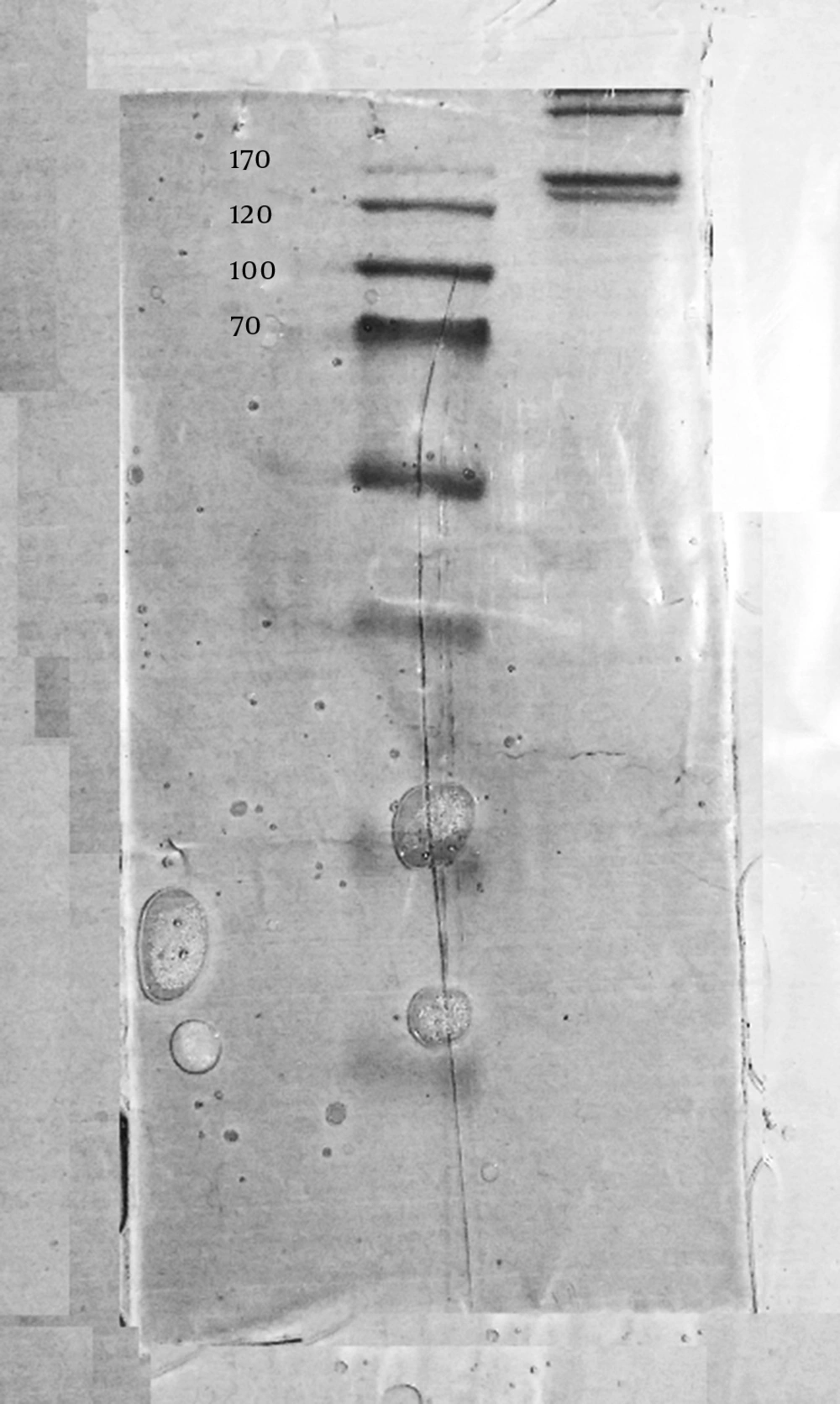
Figure 1.
Lane1, high molecular weight markers; Lane2, The extracted acid soluble calf skin collagen
4.2. SEM Analysis
The ultrastructure of calf skin collagen matrices with and without EDC/NHS-crosslinking (EDC/NHS molar ratio of 2:1 and 1:1) were analyzed by SEM (Figure 2). No significant differences between morphologies of the two cross-linked collagen matrices were noted. Average pore size of the scaffold from EDC/NHS cross-linker with molar ratio of 1:1 was less than the scaffold from EDC/NHS cross-linker with molar ratio of 2:1 (12.2 for EDC/NHS molar ratio of 1:1 and 15.6 for EDC/NHS molar ratio of 2:1). The average pore size of the uncross-linked collagen was more than cross-linked scaffolds (20.2 μm). Furthermore, by comparing cross-linked and uncross-linked collagen scaffolds it can be concluded that cross-linking treatment of scaffolds cause pore size variation in collagen matrices.
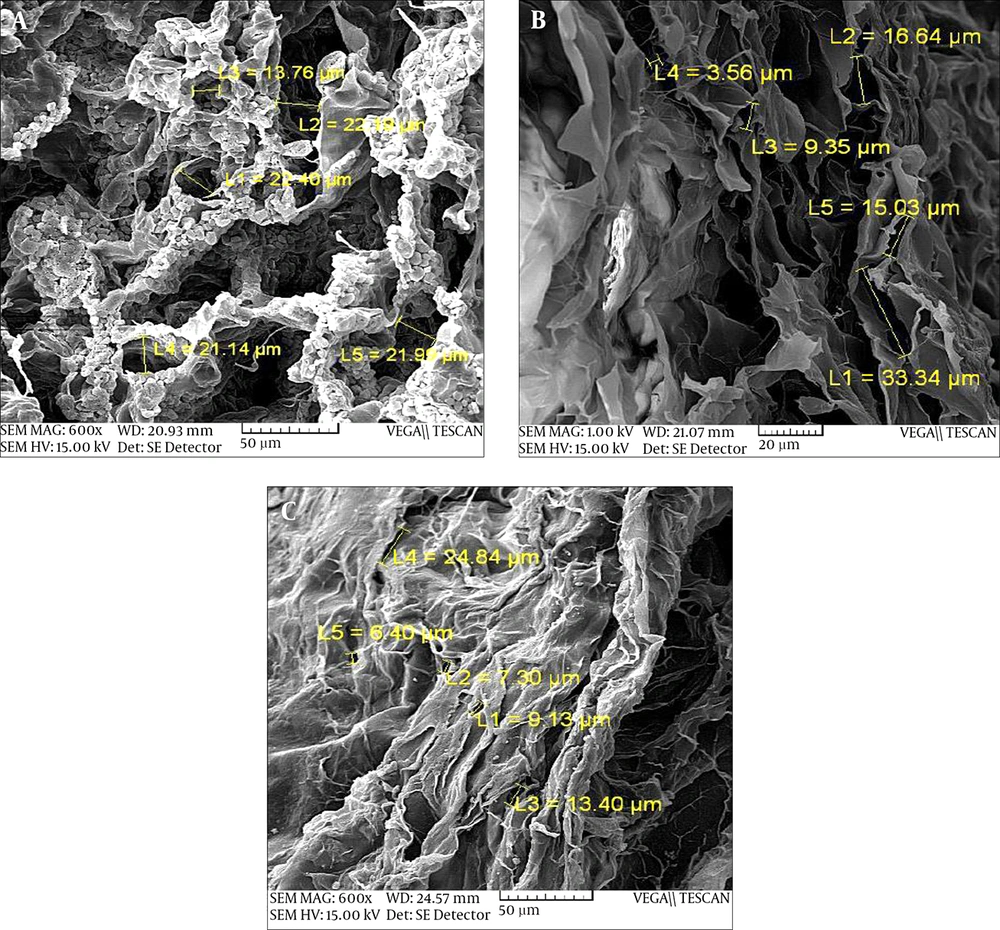
Figure 2.
A, uncross-linked collagen; B, cross-linked collagen with EDC/NHS ratio of 2:1; C, cross-linked collagen with EDC/NHS ratio of 1:1.
4.3. FT-IR Analysis
The FT-IR spectral analyses determine the structural changes of uncross-linked and cross-linked collagen scaffolds (Figure 3). The spectra were scaled to equal absorption at 3350 cm-1 which is assigned to the -CH2 chemical group. -CH2 group remains unchanged during the crosslinking reaction of collagen. It can be seen in the Figure 3 that crosslinking of collagen matrices by EDC/NHS has increased its transmittance (decreased it absorbance) at 1712 cm-1 comparing to the native collagen matrix. It can be concluded from decreasing absorbance at 1712 cm-1 that carboxyl (-COOH) groups in collagen matrix have been reduced due to the cross-linking reaction. Furthermore, it can be seen a decreased transmittance (increased absorbance) at 1155 cm-1 after cross-linking of collagen matrix. It can be concluded from increasing absorbance at 1155 cm-1 that cross-linking of collagen makes more amide bonds between collagen macro-molecules. Moreover, decreased transmittance (increased absorbance) of cross-linked collagen at 2923 cm-1 is due to increasing -CH2 bonds by cross-linking agents of EDC and NHS.
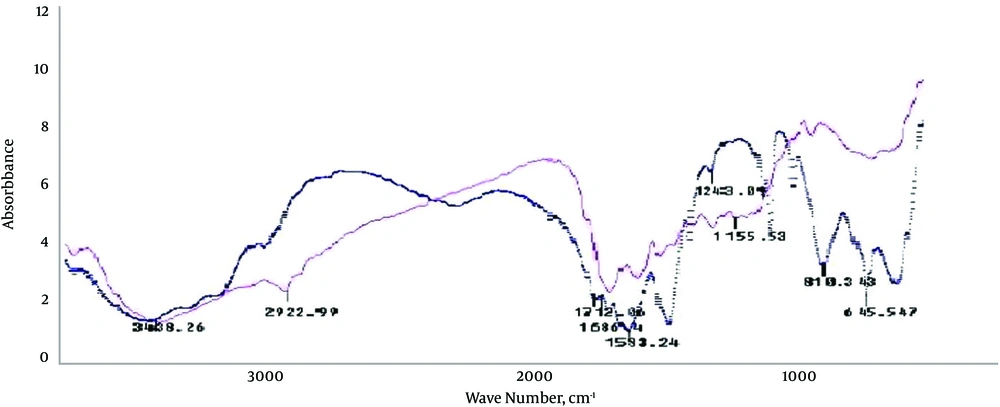
Figure 3.
FT-IR Analysis of Uncross-Linked and EDC/NHS Cross-Linked Collagen Matrices
The EDC/NHS reagents generate crosslinks between carboxylic acid and amine groups, without themselves being incorporated. The cross-linking mechanism presented by Olde Damink et al. (13) validates the results of FT-IR spectral analysis of the present study (8, 13, 17) (Figure 4).
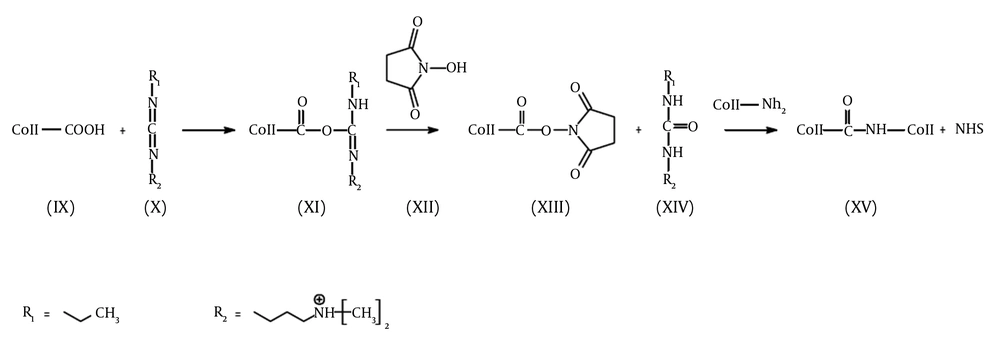
Figure 4.
Cross-Linking Mechanism of Collagen by EDC and NHS
4.4. Mechanical Properties of Scaffolds
Biomechanical tests were performed to estimate the adequacy of scaffold mechanical strength. Storage modulus (G’) were measured from a constant strain frequency sweep over a frequency range of 1-100 rad s-1 (Figure 5). As seen from Figure 5 cross-linked collagen scaffolds that were cross-linked with EDC/NHS molar ratio of 1:1 have higher values of comparing to scaffolds cross-linked with EDC/NHS molar ratio of 2:1. It can be seen in the Figure 4 that stoichiometric molar ratio of the cross-linking reaction between collagen, EDC and NHS is 2:1:1. Thus the molar ratio of EDC/NHS based on the cross-linking mechanism of collagen with EDC and NHS is 1:1. Consequently, it seems that adding cross-linkers of EDC and NHS with molar ratio of 1:1 is more efficient due to the stoichiometric molar ratios of collagen cross-linking reaction. Furthermore, by adding excess EDC with 2:1 EDC/NHS molar ratio more carboxyl groups of collagen will react with EDC and forms (XI) molecules (Figure 4) but there are not enough NHS molecules to react with (XI) molecules to make cross-linking bonds. Consequently, the number of (XI) molecules will increase in collagen matrix with no cross-linking reactions. So (XI) molecules make steric hindrance for (XIII) molecules in collagen matrix that tend to react with -NH2 groups of collagen macromolecules. It seems that this steric hindrance makes cross-linking reaction of collagen more difficult in EDC/NHS molar ratio of 2:1 comparing to 1:1 EDC/NHS molar ratio. Consequently, the number of cross-linking bonds and mechanical strength of collagen scaffolds that were cross-linked using 2:1 EDC/NHS molar ratio will decrease.
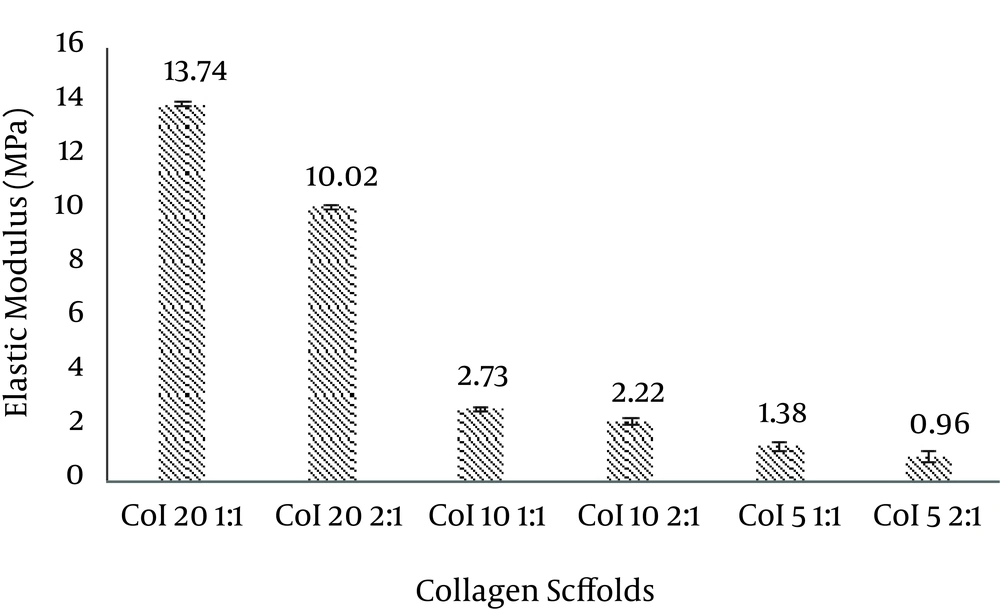
Figure 5.
Elastic Modulus Curve of Cross-Linked and Uncross-Linked Collagen Scaffolds
Furthermore, Figure 5 shows that scaffolds with higher collagen concentration have more mechanical strength (more elastic modulus). It seems that the increased mechanical strength of scaffolds with higher collagen concentration is due to increasing carboxyl- group of the constructs. When carboxyl- groups increase, it is more probable for cross-linking agents to bond collagen molecules together. Bonding molecules of collagen together lead to more elastic and mechanical strength in collagen scaffold construct. Moreover, cross-linked collagen scaffolds have higher values of comparing to uncross-linked collagen. Obviously, this increased mechanical strength is due to the chemical bonds between collagen macromolecules that have been made by EDC/NHS cross-linking reactions.
5. Discussion
Collagen’s unique hierarchical organization and chemical composition in vivo can only be partially reproduced in vitro. A typical feature of collagen is its three polypeptide chains which twist together into a right-handed triple helix. Each polypeptide chain of collagen consists of a regular arrangement of glycine, proline and hydroxyproline (Gly, Pro and Hyp) amino acid sequence. This sequence is repeated over 300 times in one strand of fibrillar collagen (5-7). Various forms of collagen including soluble, insoluble, hydrolyzed and reconstituted can be obtained according to the source, type and process of extraction. Among these different types of collagen, the insoluble type I collagen has often been used to construct biomaterials for drug delivery and tissue engineering applications. In clinical practice, different forms of the collagen matrices have been formulated and used such as membranous, porous, gel, solution, filament, tubular and composites (18). Glutaraldehyde is the predominant chemical agent that has been investigated for the treatment of collagenous tissues which gives materials with the highest degree of crosslinking comparing to other known methods such as formaldehyde, epoxy compounds, cyanamide and the acyl-azide method (19). The reactions involved during cross-linking of proteins with glutaraldehyde have been extensively studied, but the mechanism of the reaction is very complicated and still not thoroughly understood. Free aldehyde, mono- and di-hydrated glutaraldehyde and monomeric and polymeric hemiacetals are the main components of glutaraldehyde aqueous solutions. Concentration of free, monomeric aldehydes in concentrated, commercial solutions is usually low due to the ease of hydration and cyclization of them. Olde Damink et al. (13) have shown that the concentration of monomeric glutaraldehyde can increase using distillation. Furthermore, based on his calculations the content of polymeric glutaraldehyde in the reaction solution was rather low. Generally, aldehydes react with the amine groups of (hydroxy) lysine residues of the collagen, which yields a Schiff base that can be stabilized by a reduction reaction. It is now known that the durability of glutaraldehyde fixed biological scaffolds is not as good as one thought. It seems that because of the cross-linking process gutaraldehyde treated materials calcify to a large extent. For instance, failure of bioprosthetic heart valves occurs due to the calcification phenomena. Moreover, release of the monomeric and highly cytotoxic glutaraldehyde into the recipient occurs due to the depolymerization of polymeric glutaraldehyde cross-links (8, 19).
Recently, epoxy compounds have been extensively used for the stabilization of collagen based materials including porcine aortic heart valves. Generally mixtures of bi- and tri-functional glycidyl ethers based on glycerol are applied. A broad range of multifunctional epoxy containing cross-linkers can be used. Epoxide groups are susceptible to a nucleophilic attack due to their highly strained three membered ring where a reaction with the amine groups of (hydroxy) lysine residues will occur (20, 21). Epoxide groups can react with the secondary amine groups of histidine. Furthermore, reactions with the carboxylic acid groups of aspartic and glutamic acid exist, therefore increasing the versatility of the cross-linking. Generally, biological tissues are cross-linked in basic solutions (pH > 8.0) that contain relatively high concentrations of epoxy compounds ranging from 1 to 5% w/w. Implant studies in rats revealed that grafts that were cross-linked using epoxy compounds displayed a lower calcification. Acceptable results have been reported by in vitro studies for the cytotoxicity of several epoxide containing compounds (22).
The carbodiimide reagent offers a method for generating crosslinks between carboxylic acid and amine groups. An important point in carbodiimide cross-linkers is that they cross-link without itself being incorporated (13). The water-soluble carbodiimide 1-ethyl-3-(3-dimethyl aminopropyl) carbodiimide (EDC) is often used for cross-linking collagen. EDC activates the carboxylic acid groups of aspartate or glutamate residues (I) by EDC (II) to give O-acylisourea groups (III). In order to suppress side reactions of O-acylisourea groups such as hydrolysis and the N-acylshift, N-hydroxysuccinimide (NHS) (IV) is used to convert the O-acylisourea group into a NHS activated carboxylic acid group (V), that is very reactive towards amine groups of (hydroxy) lysine (VII), which yields a so-called zero length cross-link (VIII). EDC does not incorporate in the matrix but convert to 1-ethyl-3- (3-dimethyl-aminopropyl)-urea (VI) (10, 11, 13).
In the present study, acid soluble calf skin collagen was extracted. SDS-PAGE was carried out for the extracted collagen and the results were compared with the data obatained by other researchers regarding collagen extraction. The results confirmed that the extracted collagen does not have protein impurities. Furthermore, the results of our experiments showed similar bands and molecular weight comparing to previous studies (10, 16).
EDC and NHS have special benefits as collagen cross-linkers including biocompatibility and not being incorporated in collagen matrix. These cross-linkers just make cross-linking reaction happens and they can be washed out easily. Although EDC and NHS have many benefits comparing to other collagen cross-linking agents like glutaraldehyde, they consider as expensive materials in comparison with that. Consequently, it is important to have knowledge about optimized application conditions of these materials. In the present study, the effects of two different molar ratios of EDC/NHS on collagen physiochemical properties were investigated. Interestingly, our results showed that the physicochemical properties of collagen could be effectively improved by using EDC/NHS with 1:1 molar ratio comparing to 2:1 ratio. Hence, use higher values of EDC by cross-linking collagen, 2:1 EDC/NHS cross-linker, reduces the mechanical strength. The results of mechanical test were also interpreted using collagen cross-linking mechanism.