
1. Background
Nutritional support is essential in the intensive care unit (ICU), where malnutrition is highly prevalent and debilitating, affecting 35 - 78% of critically ill patients (1, 2). Malnutrition is associated with adverse outcomes, including poor wound healing, prolonged hospitalization, increased disease risk, and higher mortality (1). This problem is compounded by the rapid loss of 5 - 10% of skeletal muscle mass per week among critically ill patients (2). For patients unable to eat orally, enteral nutrition, often delivered through a nasogastric tube, is the physiologically preferred method of maintaining intestinal integrity (3, 4).
Enteral nutrition is frequently complicated by gastric intolerance, which manifests as increased gastric residual volume (GRV), vomiting, and abdominal distension (5). Abdominal distension can impede diaphragmatic movement and reduce lung capacity (2), whereas elevated GRV, a key indicator of intolerance, often leads to feeding interruption and failure to meet target caloric intake (4). Nurses in the ICU play a vital role in monitoring these complications by assessing bowel sounds, palpating for distension (6), and measuring GRV (4).
Standard interventions to improve gastric emptying, such as prokinetic drugs, can cause adverse effects, including bronchospasm and abdominal cramps, whereas reducing feeding rates increases the risk of malnutrition (2, 4). Abdominal massage is a low-cost, low-risk, nonpharmacological intervention hypothesized to enhance gastrointestinal blood flow, stimulate peristalsis, and activate parasympathetic responses (5). Evidence of its efficacy is mixed: some studies have reported reductions in GRV and distension (2, 6), whereas others have reported conflicting results, highlighting the need for further research, particularly on nurse-performed massage (5).
Combining massage with therapeutic oils, such as olive oil, has shown promise (7). Medicinal plants such as peppermint have a long history of use and contain known bioactive compounds. These plants offer therapeutic potential for gastrointestinal symptoms, and their compounds can be effectively absorbed through the skin (8, 9).
Given the critical need to manage enteral feeding complications, the limitations of pharmacological options, the potential of abdominal massage, and the gastrointestinal benefits of peppermint, this study aimed to compare the effects of abdominal massage with and without peppermint extract on GRV and abdominal distension in enterally fed ICU patients.
2. Objectives
This study aimed to compare the effects of abdominal massage with and without peppermint extract on GRV and abdominal distension in intensive care unit (ICU) patients receiving enteral nutrition.
3. Methods
3.1. Study Design and Setting
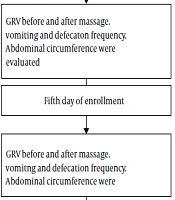
A single-blind randomized clinical trial was conducted to evaluate and compare the effects of abdominal massage with and without peppermint extract on GRV and abdominal distension in patients receiving enteral nutrition. Participants were effectively blinded to group allocation because their level of consciousness was low (Glasgow Coma Scale score ≤ 7). However, the assessor measuring GRV and abdominal circumference was not blinded to group allocation. Thus, the study had a single-blind design. The study was conducted in 2025 in the neurosurgical intensive care units (ICUs) of selected hospitals affiliated with Iran University of Medical Sciences. The trial was designed and reported in accordance with the Consolidated Standards of Reporting Trials (CONSORT) guidelines (Figure 1).
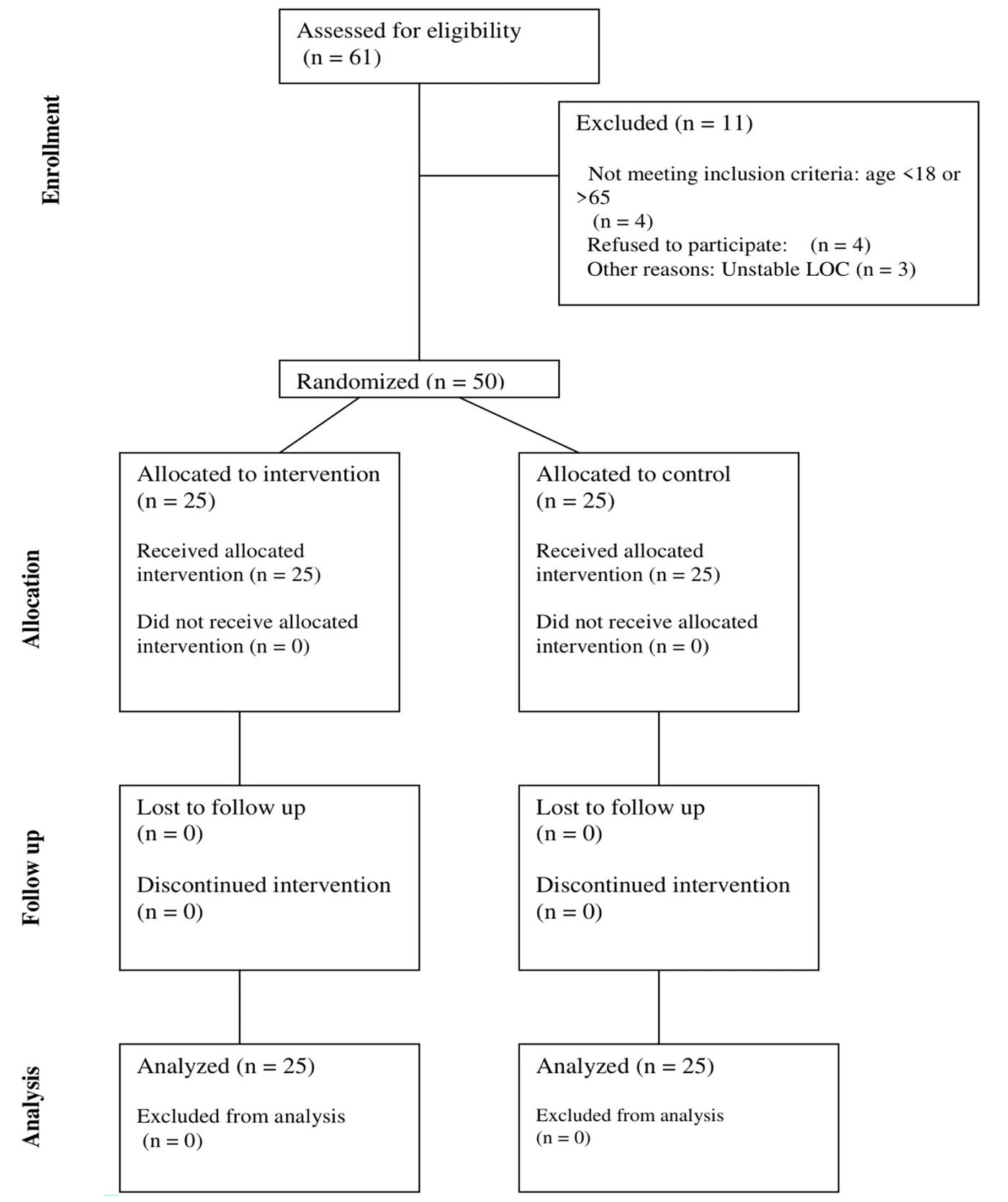
Figure 1.
CONSORT diagram
3.2. Participants and Sampling
The study population comprised all patients receiving enteral feeding in the neurological ICUs. Inclusion criteria were age 18 - 65 years; hospitalization in the ICU requiring enteral nutrition through a nasogastric tube, with feeding recently initiated; no use of prokinetic medications to avoid interaction with the intervention; a Glasgow Coma Scale score ≤ 7; no history of abdominal surgery or radiotherapy within the preceding 6 weeks; no contraindications to abdominal massage, such as abdominal hernia, irritable bowel syndrome, intestinal cancer, active abdominal wounds, or pregnancy; absence of bowel obstruction or diarrhea; and a normal diet before hospitalization. Exclusion criteria were failure to complete the intervention because of discharge, death, or cessation of enteral feeding, and development of diarrhea during the study period.
The sample size was calculated based on the study by Momenfar et al. (10), using a formula for comparing 2 means, with a 99% confidence level, 80% power, and an assumed 10% attrition rate for GRV (11).
A minimum of 25 participants per group was required. Ultimately, 50 eligible patients were randomly assigned by lottery to receive abdominal massage with peppermint extract (n = 25) or without peppermint extract (n = 25). All patients completed the study after randomization, and no participants were excluded.
Randomization was performed using 50 sealed, numbered envelopes. All envelopes were identical in appearance and numbered from 1 to 50 to maintain the sequence. Half contained the phrase "massage with peppermint extract," and the remaining envelopes contained "massage without peppermint extract." The envelopes were then sealed with tape. After informed consent was obtained, a ward nurse who was not a member of the research team selected and opened an envelope for each patient in order of admission. Patients were allocated to the corresponding study group according to the contents of the selected envelope.
3.3. Data Collection Tools and Measurements
Data were collected using (a) a demographic questionnaire covering age, sex, place of residence, and reason for hospitalization; (b) a nutritional status monitoring checklist covering the date and time of assessment, enteral feeding volume, GRV before and after massage, number of vomiting episodes, feeding interruptions, and aspiration events; (c) a 60-mL SUPA-brand enteral syringe for GRV aspiration; and (d) a flexible measuring tape (cm) for measuring abdominal circumference.
The validity of the monitoring checklist had previously been confirmed by Momenfar et al. (10), and its reliability had been established using equivalence reliability. The syringe and measuring tape were regarded as standard, valid instruments for their respective measurements. In the present study, all measurements were performed by a trained researcher whose measurement reliability had been evaluated before data collection.
3.4. Ethical Considerations and Procedure
The study was approved by the Research Deputy and the Ethics Committee of Zabol University of Medical Sciences (approval code: IR.ZBMU.REC.1403.133) and registered in the Iranian Registry of Clinical Trials (registration code: IRCT20250514065728N1). After administrative permissions were obtained from the participating hospitals, the study objectives and procedures were explained to the patients' families or legal guardians, who provided written informed consent. Given the patients' reduced level of consciousness, consent was obtained from their surrogate decision-makers. Confidentiality and the right to withdraw from the study at any time were assured.
3.5. Intervention Protocol
Two liters of 1% peppermint extract from Barij Co., derived from peppermint essential oil, were prepared at the required concentration. Paraffin—an odorless, inert massage oil from Barouj Pharmaceutical Co.—was used for the control group at the same concentration as the peppermint extract. Paraffin oil has no known pharmacological effects on the skin or gastrointestinal tract and served as a neutral vehicle. The containers for both oils were identical in color and size.
Because of their low level of consciousness, patients could not detect the peppermint odor and were unaware of which substance was used for abdominal massage.
Abdominal massage was performed for female patients by the primary researcher, a master's student in nursing certified by the Chista Massage Training Institute, and for male patients by a trained male research assistant with a nursing degree, in accordance with ethical, legal, and cultural norms.
The intervention lasted 3 consecutive days for each participant. Patients received a standardized 20-minute abdominal massage twice daily. In both groups, 10 - 15 mL of extract or oil was used per session, depending on the size of the abdominal area being massaged. The volume was measured using a syringe. No adverse events were recorded during the study.
According to the ICU protocol, enteral feeding was administered every 3 hours; consequently, 2 feedings occurred during the 6-hour interval between the first and second daily massage sessions.
3.6. Massage Technique and Monitoring
During each session, the patient was positioned supine, with the head elevated 30 - 45 degrees and the knees flexed and supported by a small pillow to relax the abdominal muscles. The researcher stood on the patient’s right side. The massage protocol consisted of stroking, gentle touch, kneading, and vibration based on standard Swedish massage techniques. A trained researcher performed the massage using a standard checklist (2, 6). Throughout each session, the patient’s facial expressions, signs of discomfort, and vital signs, including respiratory rate, heart rate, and pulse oximetry, were monitored. Massage was discontinued immediately if any sign of an adverse reaction occurred.
3.7. Outcome Measurement Procedures
Correct placement of the nasogastric tube was confirmed in both groups using air insufflation with epigastric auscultation before data collection. Gastric residual volume was assessed twice daily, before the first massage session and 1 hour after the second session, using a 60-mL syringe. The aspirate was obtained by slow suction, its volume was recorded, and the gastric contents were reinfused. If GRV exceeded 250 mL, the attending physician was notified for further evaluation (10). When minimal or no aspirate was obtained, the measurement was repeated to verify whether the stomach was empty (4).
Abdominal circumference was also measured twice daily, before the first massage session and after the second session, using a flexible measuring tape. The tape was consistently positioned at the level of the umbilicus, and the measurement site was marked to ensure reproducibility. Readings were taken at end-expiration (4). During the intervention, privacy was maintained by exposing only the abdominal region from the anterior superior iliac spine to the subcostal margin, while the rest of the body was covered with a sheet.
4. Results
A total of 50 patients receiving enteral feeding in the neurological intensive care unit (ICU) were enrolled. All randomized participants completed the 3-day intervention and were included in the final analysis. The mean age was 43.24 ± 11.12 years in the intervention group (abdominal massage with peppermint extract) and 45.12 ± 10.82 years in the control group (abdominal massage without peppermint extract). An independent-samples t-test showed no statistically significant difference in age between the groups (P = 0.548), indicating baseline homogeneity.
Chi-square analysis also showed no statistically significant between-group differences in sex, educational level, place of residence, or reason for hospitalization (all P > 0.05), as presented in Table 1.
Table 1.
Demographic Characteristics of Patients Receiving Enteral Nutrition in the Experimental and Control Groups a
| Variables | Control Group | Experimental Group | Test Statistic | P value b |
|---|---|---|---|---|
| Gender | 0.199 | 0.656 | ||
| Female | 14 (56) | 13 (52) | ||
| Male | 11 (44) | 12 (48) | ||
| Education level | 2.35 | 0.309 | ||
| Primary | 4 (16) | 8 (32) | ||
| Diploma | 16 (64) | 11 (44) | ||
| Higher education | 5 (20) | 6 (24) | ||
| Place of residence | 0.32 | 0.571 | ||
| City | 13 (52) | 11 (44) | ||
| Village | 12 (48) | 14 (56) | ||
| Reason for hospitalization | 0.251 | 1.000 | ||
| Head trauma | 12 (48) | 12 (48) | ||
| Stroke | 4 (16) | 5 (20) | ||
| Brain tumor | 9 (36) | 8 (32) |
a Values are expressed as No. (%).
b Chi-square test.
The Shapiro-Wilk test confirmed that age, GRV, and abdominal circumference data assessed before and after massage on 3 consecutive days were normally distributed in both groups (P ≥ 0.05).
As shown in Table 2, the independent-samples t test indicated a statistically significant between-group difference in mean GRV at all time points (P < 0.001). Table 3 shows that analysis of covariance, adjusted for baseline GRV, confirmed a significant between-group difference on all 3 days (P < 0.001), with partial eta squared values of 0.24, 0.27, and 0.43 on days 1, 2, and 3, respectively. In contrast, Table 4 shows no statistically significant between-group difference in mean abdominal circumference at any time point (all P ≥ 0.05). Although vomiting episodes, feeding interruptions, and aspiration events were initially considered, none occurred during the study period.
Table 2.
Mean and Standard Deviation of Gastric Residual Volume at Baseline and After Intervention in the Experimental and Control Groups a
| Day | Time Point | Experimental Group, mL | Control Group, mL | t-Score | 95% CI of the Difference (mL) | P value |
|---|---|---|---|---|---|---|
| Day 1 | Baseline | 250.48 (7.52) | 275.4 (4.73) | -14.01 | -28.49, -21.34 | < 0.001 |
| Day 1 | After intervention | 232.92 (6.47) | 263.40 (4.58) | -17.96 | -31.66, -25.29 | < 0.001 |
| Day 2 | Baseline | 248.32 (7.36) | 273.32 (4.80) | -14.22 | -28.53, -21.46 | < 0.001 |
| Day 2 | After intervention | 230.12 (6.11) | 257.12 (3.83) | -18.71 | -29.90, -24.09 | < 0.001 |
| Day 3 | Baseline | 246.04 (7.29) | 271.08 (4.67) | -14.46 | -28.54, -21.55 | < 0.001 |
| Day 3 | After intervention | 227.56 (4.69) | 252.92 (2.81) | -19.96 | -27.91, -22.80 | < 0.001 |
a Values are expressed as mean (SD) unless otherwise indicated. Abbreviations: mL, milliliter; df, degree of freedom; CI, confidence interval; SD, standard deviation.
Table 3.
Adjusted Mean and 95% Confidence Interval of Gastric Residual Volume in the Experimental and Control Groups a
| Day | Experimental Group, mL | Control Group, mL | F-Score | df | Difference (mL) | P value | Partial Eta Squared |
|---|---|---|---|---|---|---|---|
| Day 1 | 191.32 (177.23, 205.40) | 231.07 (216.99, 245.16) | 15.14 | 1, 47 | -60.31, -19.20 | < 0.001 | 0.24 |
| Day 2 | 172.00 (158.94, 187.02) | 217.83 (202.81, 232.85) | 18.10 | 1, 47 | -67.49, -24.14 | < 0.001 | 0.27 |
| Day 3 | 151.89 (139.83, 163.95) | 202.50 (190.44, 214.57) | 35.45 | 1, 47 | -67.71, -33.51 | < 0.001 | 0.43 |
a Values are expressed as adjusted mean (95% CI) or 95% CI. Abbreviations: mL, milliliter; df, degree of freedom; CI, confidence interval.
Table 4.
Mean and Standard Deviation of Abdominal Circumference Before and After Measurements in the Experimental and Control Groups a
| Day | Time Point | Experimental Group, cm | Control Group, cm | t-Score | 95% CI of the Difference (cm) | P value | Cohen's d |
|---|---|---|---|---|---|---|---|
| Day 1 | Baseline | 80.88 (10.15) | 76.56 (12.76) | 1.32 | -2.23, 10.87 | 0.191 | -0.42 |
| Day 1 | After measurement | 80.80 (10.08) | 76.40 (12.68) | 1.35 | -2.12, 10.92 | 0.181 | -0.45 |
| Day 2 | Baseline | 80.64 (9.92) | 76.16 (12.76) | 1.38 | -2.02, 10.98 | 0.172 | -0.31 |
| Day 2 | After measurement | 80.40 (9.87) | 76.04 (12.60) | 1.36 | -2.08, 10.79 | 0.180 | -0.32 |
| Day 3 | Baseline | 80.24 (9.97) | 75.92 (12.71) | 1.33 | -2.18, 10.82 | 0.188 | -0.31 |
| Day 3 | After measurement | 80.12 (9.84) | 75.92 (12.65) | 1.31 | -2.45, 10.65 | 0.196 | -0.32 |
a Values are expressed as mean (SD) unless otherwise indicated. Abbreviations: cm, centimeter; SD, standard deviation; CI, confidence interval.
5. Discussion
This study investigated the effects of abdominal massage with and without peppermint extract on GRV and abdominal distension in enterally fed patients admitted to a neurological intensive care unit (ICU). The main finding was that abdominal massage combined with peppermint extract resulted in a significantly greater reduction in GRV than massage alone. Abdominal massage may facilitate bowel motility through changes in intra-abdominal pressure and mechanical stimulation of intestinal activity. However, the observed effect may also be reflexive, resulting from massage-induced vagal stimulation rather than being attributable solely to the topical application of peppermint extract. Evidence of transdermal absorption of peppermint oil in critically ill patients remains limited, and further studies are needed to clarify the mechanism.
Evidence from the literature supports the antispasmodic properties of peppermint, including its topical efficacy in reducing tension-type headaches and migraines, improving peripheral blood flow, and producing a cooling effect on the skin during physical activity (9, 12). The underlying mechanism is primarily attributed to calcium-channel antagonism and smooth muscle relaxation within the gastrointestinal tract (13). In addition, Kiani et al. demonstrated in 2014 that peppermint extract reduced pyloric spasm during endoscopy, further supporting its gastrointestinal relaxant effect (14).
To our knowledge, no previous study has evaluated the effect of topical peppermint extract combined with abdominal massage on GRV in ICU patients. Nevertheless, Ebrahimian et al. reported that enteral administration of peppermint extract significantly reduced GRV in mechanically ventilated trauma patients (15). Although the route of administration differed, their findings are consistent with those of the present study, demonstrating a beneficial effect on GRV.
Abdominal distension did not differ significantly between the groups, despite 20-minute abdominal massage sessions with peppermint extract twice daily for 3 consecutive days. This result was unexpected, given the established carminative properties of peppermint (12). Previous studies have generally reported beneficial effects of massage alone in reducing distension. For example, Uysal et al. recommended routine nurse-led abdominal massage to prevent abdominal distension in patients receiving enteral nutrition (4). Other studies have also reported that abdominal massage reduces abdominal distension in critically ill patients receiving enteral feeding (2, 5, 16).
The discrepancy between the present findings and earlier evidence (2, 4) may be explained by methodological differences, including variations in massage technique, session duration, daily frequency, and total intervention length. For example, Aldugiem et al. (2) implemented a 5-day intervention, whereas the present study was limited to 3 days. Uysal et al. (4) used 15-minute sessions 3 times daily, compared with 20-minute sessions twice daily in the present study. Differences in massage technique may also have contributed to the inconsistent findings. Although no significant reduction in abdominal distension was observed, this finding does not necessarily indicate a lack of efficacy; rather, it suggests the need for a larger sample adequately powered to detect this outcome.
5.1. Limitations
The study was limited by the inability to implement full blinding because outcome assessors were not blinded to group allocation, and by the relatively short intervention period, which may have influenced outcome sensitivity. In addition, abdominal circumference is an indirect measure and may not reflect true abdominal distension in the presence of ascites, obesity, or edema.
5.2. Conclusions
Abdominal massage combined with peppermint extract appears more effective than massage alone in reducing GRV in enterally fed neurological ICU patients. Given that elevated GRV may lead to clinical complications and considering the low cost and ease of application, peppermint-enhanced massage may be considered an adjunctive nursing intervention for managing GRV. However, no significant effect was observed on abdominal distension, which may be related to variations in technique, duration, frequency, or overall intervention length. Future research should examine these variables using larger samples and more rigorous blinding designs.