


1. Background
Infants born earlier than the 37th week of pregnancy are called preterm (1). Early birth may cause several consequences such as low birth weight (LBW) (2). It can be of different typologies due to which the neonates born with the weight lower than 2500 g are called LBW. In case neonates are born with the weight lower 1500 g, they are called very low birth weight (VLBW) infants, and for neonates born with the weight lower than 1000 g, the term extremely low birth weight (ELBW) is used (3). Birth weight is a fundamental indication of mental and physical maturity of infants (4). Higher degrees of prematurity and ELBW may cause neural and muscular deficiencies; therefore, the infants with lower birth weights are the most vulnerable ones (3). Furthermore, LBW makes infants vulnerable to infections and diseases including respiratory distress syndrome and intracranial hemorrhage (5). Many complications such as mental disorders, growth retardation, lack of concentration even up to school age and etc. are other faces of LBW (6). Additionally, financial burden imposed by healthcare services to the families of such infants can be another problem (7). Long-term hospitalization of preterm and LBW newborns in the neonatal intensive care unit (NICU) makes them unsecured with respect to the sensory-rich environment of the uterus. Compared to uterus, the NICU is very crowded and noisy, and to solve the problem (8), supportive interventions including music and massage are used to simulate the environment of uterus to direct and lead the growth of the neonates (9, 10). Touching the skin of neonates is among the useful interventions, affecting their growth and development (11). It might be called massage only if it is repeated systematically and regularly (12). Technology of massage dated back to two centuries B.C. It is originally from China, while the neonate massage goes back to India. Indian grandmothers massage their grandsons as soon as they are born using herbal oils. It is an ancient tradition passed from generation to generation (13). To this end, a study entitled massage with or without oil was conducted. It was concluded that newborns massaged with oil behaved calmly during massage and expressed no tensions. Additionally, cortisol level of their saliva was lower than the other groups (14). As for the positive effects of massage, it can be stated that it helps infants to have a better sleep pattern, lower tension, reduced fluctuations of body temperature, and improved relationship with parents along with weight gaining (15-18). On the other hand, there are different studies indicating that due to increasing vagus activity, extension and flexion exercises may lead to increased digestive activities and secretion soars of hormones such as insulin, which affects food intake and consequently weight gain (19). Some researchers consider massage as a supportive, non-pharmaceutical tool, while others consider the same role for the mixture of massage and exercise. Exercise is a subgroup of massage and the only difference is that exercise devotes more time to the treatment process and is purposefully conducted on the targeted organs (12).
2. Objectives
Accordingly, massage and exercise can help to actualize the goal. Since lack of weight gain can be a warning sign and due to the low cost of massage and exercises, and also with regard to the fact that recent studies focused on massage without any exercise (20), the current study aimed at comparing the effects of massage therapy with or without physical exercises on weight gain of LBW infants admitted to the NICU.
3. Methods
The current randomized, clinical trial was conducted in Shohada Hospital of Bandar Lengeh, Iran in 2017 on preterm neonates admitted to the NICU. Eligible neonates were randomly assigned to three groups (massage, massage and exercise, control) using random digit tables. According to the objectives of the current study and with regard to the previous studies (21), test power was 80%, 15 = α, and 12 = β. After statistical counseling, and according to the objectives and the type of the study and considering the similar studies, NCSS software was employed to calculate the sample size; then, considering the test power of 80%, and a15 and 15β = 0, the sample size was determined 15 in each group (Figure 1).
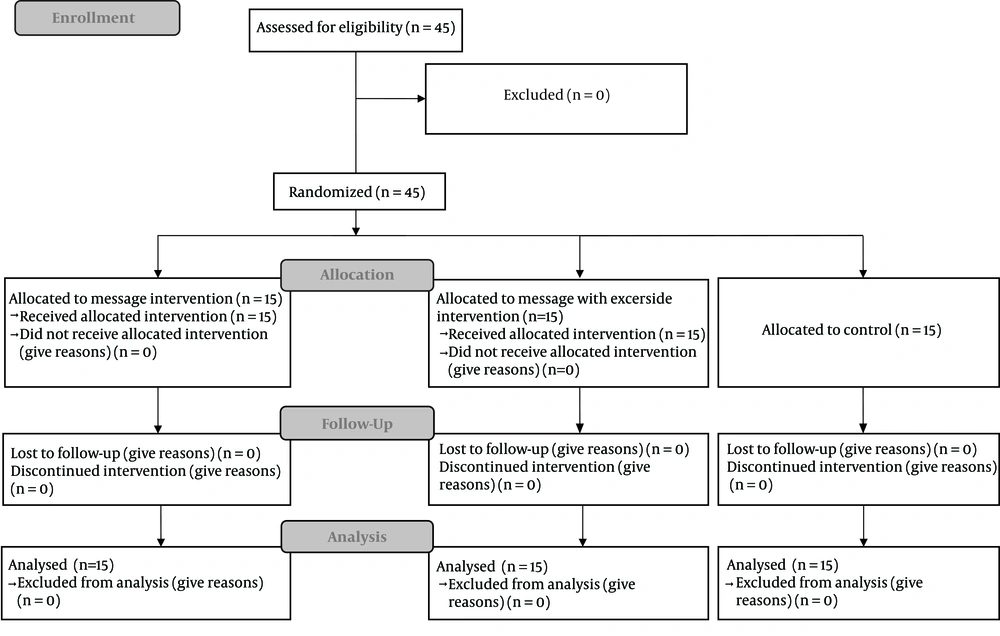
Figure 1.
CONSORT diagram shows the flow of patients through each group of a randomized trial.
Inclusion criteria were: willingness of the parents, gestational age of 30 - 36 weeks, lack of any evidence of congenital disorders (chromosome-based or neural), LBW below 2500 g, no need of surgery, Iranian nationality, lack of evidence of developmental disorders, stable physiological conditions, grown up with breast feeding, and neonate age over one week. Exclusion criteria were: no parental agreement, transferring neonate to another hospital for any reason, and physical complications. The instruments used to collect data were a demographic questionnaire, a scale to weigh infant, and olive oil (yellow color olive oil, produced by Oqab Parande Shiraz Company, Iran) to massage infants. The demographic questionnaire (including gender, weight on the 1st and the 5th minutes of birth, neonate age, mother’s age, and method of delivery) was designed by researchers. The given questionnaire was confirmed by the faculty members. Baby weight checklist included the weight of neonate before and after the intervention. The Seca scale (Germany) was used to weigh the infants.
The protocol of the current randomized, clinical trial was approved by the Ethics Committee of Shiraz University of Medical Sciences (code: 95-7673); the study was also registered in the Iranian Registry of Clinical Trials (code: IRCT20170520034039N3). Eligible newborns were selected based on block permutation. Parents of selected infants were informed about the study objectives and they signed a written informed consent to participate in the study. The current study included three groups (massage, massage + exercise, control) and each group composed of 15 infants. The treatment group included two groups of 15 infants (totally 30). The only difference was that the first group of infants received only massage, while the second group received both massage and exercise. The control group underwent no intervention. Massage was performed twice a day (each 15 minutes) for five consecutive days (morning and noon, after breastfeeding), while the infant was in prone position according to the six-stage protocol (each stage took 10 seconds): (1) head to neck, (2) neck to back, (3) feet (from toes) towards the right and left, (4) shoulders to palms (left and right hands), and then stage four was repeated. The massage and exercise group received extension and flexion of the trunk, after the massage stages as well. To this end, the infant was in a supine position and five extensions and flexion exercises were conducted. This stage started with opening and closing arms and legs for one minute. The order would be right hand and then left hand, and after that right and then left foot. Finally, both legs were exercised in cycling movements simultaneously for five minutes. The next stage was the repetition of the first stage. Infants were weighed by research assistants who were blind to groupings at baseline and on the 5th day of intervention, and the values were recorded. Massage protocol was performed based on field protocol designed by Badiee (21). Exercises were administered under the supervision of a chiropractic expert. Data analysis was performed using SPSS version 21. Analytical and descriptive statistical methods were employed. Descriptive statistics included mean, standard deviation, and percentile, while analytical statistics included paired and independent samples t-tests and analysis of variance (ANOVA).
4. Results
According to ANOVA results, the three groups were homogenous in terms of gestational age, neonate age, birth weight, and weight at baseline (Table 1).
Table 1.Frequency of Gestational Age, Neonate Age, Birth Weight, and Weight at Baseline in the Three Groupsa
| Values | P Value | |
|---|---|---|
| Gestational age, wk | 0.709 | |
| Massage | 34.13 ± 1.45 | |
| Massage and exercise | 34.331 ± 1.23 | |
| Control | 34.53 ± 1.23 | |
| Neonate age, d | 0.797 | |
| Massage | 8.13 ± 0.63 | |
| Massage and exercise | 8.26 ± 0.59 | |
| Control | 8.16 ± 0.65 | |
| Birth weight, g | 0.228 | |
| Massage | 2077.75 ± 186.49 | |
| Massage and exercise | 2165.63 ± 225.66 | |
| Control | 2047.67 ± 158.111 | |
| Weight at baseline, g | 0.190 | |
| Massage | 2087.33 ± 196.28 | |
| Massage and exercise | 2178.4 ± 227.28 | |
| Control |
aValues are expressed as mean ± SD.
The mean gestational age for the massage, massage + exercise, and control groups were 34.13, and 34.33, and 34.53 weeks, respectively. Based on the one-way ANOVA results, there were no statistically significant differences among the three groups. Mean neonate age for the massage, massage + exercise, and control groups were 8.13, 8.26, and 8.16 days, respectively. One-way ANOVA results indicated no significant differences among the three groups. The mean birth weight for the massage, massage + exercise, and control groups were 2077, 2165, and 2047 g, respectively. One-way ANOVA results indicated no significant difference among the three groups. Moreover, there was no significant difference among the groups in terms of weight at baseline. According to the results of paired samples t-test, there was a significant difference between the weight at baseline and the 5th day of intervention in the massage group (Table 2). According to the paired samples t-test results, there was a significant difference between the neonates’ weight at baseline and after the intervention in the massage with exercise group. Hence, massage with exercise may improve weight gain in the LBW infants.
Table 2.Frequency of Changes in Neonate Weight After the Intervention in the Three Groupsa
| Group | Time | Values | P Value |
|---|---|---|---|
| Massage, g | Weight at baseline | 2087.33 ± 196.218 | 0.01 |
| Weigh on the 5th day of intervention | 2547.33 ± 515.18 | ||
| Massage + exercise, g | Weight at baseline | 2178.40 ± 227.28 | 0.001 |
| Weigh on the 5th day of intervention | 2706.44 ± 640.68 | ||
| Control, g | Weight at baseline | 2049.00 ± 157.57 | 0.293 |
| Weigh on the 5th day of intervention | 2195.76 ± 335.86 |
aValues are expressed as mean ± SD.
There was no significant difference between infants’ weight at baseline and after the intervention in the control group (P = 0.293) (Table 2). In comparison between the massage and the massage + exercise groups, independent samples t-test indicated no statistically significant difference (P = 0.65), while the same test showed a significant difference between the massage and the control groups in terms of weight gain. Also, the comparison between the massage and the massage + exercise groups indicated a significant difference in weight gain (P = 0.008) (Table 3).
Table 3.Mean of Weight Change Before and After the Intervention in the Three Groupsa
| Group | Difference Before and After the Intervention | P Value |
|---|---|---|
| Control, g | 146.8 ± 327.37 | 0.33 |
| Message, g | 460 ± 418.23 | 0.65 |
| Massage + exercise, g | 528.04 ± 395.196 | 0.008 |
aValues are expressed as mean ± SD.
5. Discussion
There was a significant difference between the mean weight on the 1st and the 5th days of the intervention (P < 0.05) in the intervention groups. In the study by Javadifar et al. (20), in Ahvaz, Iran, the weight of the neonates increased significantly at the end of the intervention in comparison with the 1st day, which was consistent with the results of the current study.
A study by Field et al. (22), in the United States on premature infants undergoing 5 - 10 days massage therapy showed that the mean weight at the end of the intervention increased 27% - 48% compared to that of the 1st day, consistent with the current study results. These studies confirm that massage therapy can increase weight in newborns. Massage reduces stress and cortisol secretion and increases the secretion of the melatonin hormone in the newborns; increasing the level of melatonin hormone makes the neonate feel better and improves the sleep pattern and increases his/her weight (14).
The weight of newborns increased significantly after five days of intervention in the massage and exercise group (P < 0.05).
Massaro et al. (23) examined the effects of exercise and massaging on LBW infants and divided the infants into three groups of 20 as massage, control, and massage with exercise. At the end of each day, the infants were weighed and the results indicated that infants receiving massage stimulation at the end of the intervention had a significant weight gain, and their mean weight change was statistically significant (23), which was in line with the findings of the current study.
Regarding the results of the present and previous studies, it can be concluded that exercise stimulation along with massage accelerates the weight gain in the newborns and can be an effective and practical method to increase the weight of newborns. Exercise increases the bone mineral density and improves the bone growth (23). Also, the increase in protein synthesis in some studies is due to exercise stimulation and weight gain (24). Therefore, the sport-induced massage can be useful to improve weight gain in LBW infants. Sports stimulants along with massage increase gastrointestinal activity, and by increasing the intake of food, weigh increases in LBW infants (19).
In this regard, Badiee et al. (21) conducted a study on the comparison of the effect of massage by mother and nurse on preterm infants of 28 - 34 weeks, and found that massage therapy for premature infants older than 28 weeks of age was safe and can significantly improve their weight gain in comparison with the control group (25).
Lee (26), investigated the effect of massage on weight and height as well as relationship with mother in infants. The results indicated no significant increase in the weight of newborns receiving massage compared to the control group. Nevertheless, other beneficial effects such as positive mother-infant relationship were reported at the end of the study (26). In any case, even if weight gain is not effective, the benefits of massage for babies cannot be ignored.
And the current study suggested that massage with exercise stimulates weight gain in LBW infants. Therefore, it is recommended as an evolutionary support for weight gain in LBW infants. In various studies, different hypotheses are presented as the cause of weight gain in newborns receiving massage and exercise stimulation including increased caloric intake and average sleep time (23).
According to the results of the current study, the group receiving the massage with exercise stimulation had the highest weight gain. Compared to the control group, both groups had more weight gain. Although the difference in weight gain between the groups receiving massage with exercise stimulation and exercise alone was not statistically significant, it can be considered as an effective method for weight gain in the LBW infants.
According to the results of the current study, a part of the hypothesis related to the difference in weight variation among the massage the massage with exercise, and the control groups was confirmed. But, the other part of the hypothesis regarding the difference in the mean weight changes between the two groups of the massage and the exercise with massage was not confirmed, which can be due to the short duration of the study. However, further studies are recommended to obtain more conclusive results. Finally, it can be concluded that massage alone or with exercise stimulates weight gain in the LBW infants.
Therefore, it is suggested that further studies be conducted on the effect of massage therapy on weight gain in preterm infants with long-term follow-up, the effect of maternal massage therapy on weight gain in preterm infants, or the effect of massage therapy on weight gain in infants with telephone follow-up.
5.1. Conclusions
The current study concluded that massage with or without exercises may cause weight gain in LBW neonates. Massage may lead to weight gain; hence, knowledge about this issue might be useful in weight gain of the neonates.



