Image Credit:J Cell Mol Anesth
Outline
Predictive Value of P50 in the Clinical Outcome of the Patients With Severe COVID-19 Pneumonia: A Retrospective Cohort Study: Significance of P50 in the prognosis of severe COVID-19 patients
Authors
Abstract
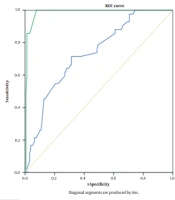
Background: The oxygen tension at half-saturation (P50) was found to be increased in patients with respiratory distress. However, the roles of P50 calculated upon hospital admission in predicting the prognosis of severe COVID-19 patients are not well-investigated. Thus, this study aimed to investigate whether P50 values obtained from hypoxic severe COVID-19 patients upon admission were associated with a later need of invasive mechanical ventilation (IMV). This study also aimed at finding independent predictors of IMV. Methods: 151 patients with confirmed severe COVID-19 were enrolled in this study between August and December 2020. Overall, 63(41.7%) progressed to IMV, and 88(58.2%) did not need IMV. Demographic data, clinical outcome, and laboratory measurements were recorded and P50 was calculated. P50 that discriminated patients required IMV and patients did not require IMV was determined using the ROC curve. The risk factors for the need for IMV were identified through logistic regression. Results: The calculated P50 of all patients was higher than the normal value (P<0.005). Moreover, P50 was significantly higher in patients who required IMV (P=0.002). ROC curve verified the discriminatory ability of P50, providing an area under the ROC curve of 0.647(95%CI 0.558-0.736; P=0.002) for a cut-off of 29.29mmHg. Calculated P50?29.29mmHg was a risk factor for the need of IMV(OR=3.306, 95%CI 1.676-6.525; P=0.001). In multivariate analysis, the independent predictors of the need for IMV were older age, male sex, high P50, high aspartate transaminase, and low PO2 (P<0.05). Conclusion: Calculated P50 on hospital admission might serve as a promising predictor of IMV in severe COVID-19.
Highlights
References
- 1.References are in the PDF file of the article.
Copyright
© 2022, Author(s). This open-access article is available under the Creative Commons Attribution 4.0 (CC BY 4.0) International License (https://creativecommons.org/licenses/by/4.0/), which allows for unrestricted use, distribution, and reproduction in any medium, provided that the original work is properly cited.
Similar Articles
Predicting Risk Score for Mechanical Ventilation in Hospitalized Adult Patients Suffering from COVID-19
Kafan S, Tadbir Vajargah K, Sheikhvatan M, Tabrizi G, Salimzadeh A, et al. Predicting Risk Score for Mechanical Ventilation in Hospitalized Adult Patients Suffering from COVID-19. Anesth Pain Med. 2021;11(2):e112424. doi: https://doi.org/10.5812/aapm.112424
Clinical Features and Prognosis of Invasive Ventilation in Hospitalized Patients with COVID-19: A Retrospective Study
Rahimzadeh P, Faiz HR, Farahmandrad R, Hassanlouei B, Habibi A, et al. Clinical Features and Prognosis of Invasive Ventilation in Hospitalized Patients with COVID-19: A Retrospective Study. Anesth Pain Med. 2020;10(6):e108773. doi: https://doi.org/10.5812/aapm.108773
Predictors of Non-invasive Ventilation Failure and Associated Factors Among the COVID-19 Patients Admitted to Intensive Care Unit
Varpaei HA, Bayraktar N, Mohammadi M. Predictors of Non-invasive Ventilation Failure and Associated Factors Among the COVID-19 Patients Admitted to Intensive Care Unit. Anesth Pain Med. 2023;13(6):e140847. doi: https://doi.org/10.5812/aapm-140847
Deciding When to Intubate a COVID-19 Patient
Farhadi N, Varpaei HA, Fattah Ghazi S, Amoozadeh L, Mohammadi M. Deciding When to Intubate a COVID-19 Patient. Anesth Pain Med. 2022;12(3):e123350. doi: https://doi.org/10.5812/aapm-123350
Evaluation of Diagnostic Accuracy of HACOR Score in Predicting the Success Rate of CPAP in Patients with COVID-19-Induced Hypoxemia
Jahangiri Mehr A, Mehri Z, Adineh M, Nematollahzadeh Z. Evaluation of Diagnostic Accuracy of HACOR Score in Predicting the Success Rate of CPAP in Patients with COVID-19-Induced Hypoxemia. Middle East J Rehabil Health Stud. 2023;10(4):e134745. doi: https://doi.org/10.5812/mejrh-134745
- Scopus by DOI: 0
Last Update: 1 month ago
- Scopus by Title: 0
Last Update: 1 month ago
- Scopus by Title (Ref): 0
Last Update: 1 month ago
- CrossRef: 0
Last Update: 6 days ago
- OpenAlex: 0
Last Update: 1 day ago
- OpenCitations: 0
Last Update: 4 days ago
