
1. Background
Today, technological advances in the treatment and nursing care increase the survival rate of premature neonates (1-4). The current challenge of experts and nurses in the neonatal intensive care units (NICUs) is not limited to the survival of these neonates, rather includes support and facilitation of their optimal growth and development (5). Nutrition is one of the most important aspects in the growth of premature neonates (6). In addition to infant’s growth, feeding forges a positive infant-parent relationship (7). Not just for survival, successful feeding also improves communication and speaking skills of neonates (8). Feeding difficulties in preterm neonates born prior to 37 weeks are due to poor muscle tone, weakness, and uncoordinated movements, poor vigilance, irritability, uncoordinated behavior, and body posture instability (7, 9). Therefore, complications such as apnea, decreased arterial oxygen saturation, transient bradycardia, and aspiration rate, and bradypnea prolong preterm neonates’ oral feeding readiness (9-11). It is thus important to design an oral feeding initiation pattern that provides required energy for growth without adding complications and disrupting the development (7, 9, 12, 13). The initiation of full oral feeding in preterm neonates hospitalized in the NICU is always a challenge to doctors, parents, and nurses. In 1998, the American Academy of Pediatrics declared full oral feeding tolerance as a discharge criterion (14). Today, several studies are conducted on NNS in preterm neonates to maximally speed up independent oral feeding (15-18). Non-nutritive feeding during gavage increases the secretion of digestive enzymes and improves digestion (12, 19, 20). Studies showed that non-nutritive feeding not only evolves sucking habit, but also facilitates intestinal digestion, enhances oral feeding, and increases the activity of digestive system (12, 17, 20, 21). Results of relevant studies in different countries on physiological response of preterm neonates to NNS and also the effect of NNS on full oral feeding attainment are contradictory (22). In the majority of studies, NNS was mostly on a pacifier and administered with the researcher or therapist, without parental involvement (13, 23). Since preterm neonates are immediately hospitalized in the NICU, breastfeeding is an unknown experience that decreases the chance for success. Non-nutritive sucking by mother, as a subset of developmental care, may have positive effects on premature neonates (22). A successful oral feeding attainment shortens the length of hospital stay, leading to the reduction of financial burden on society and establishment of an emotional neonate- parent relationship (6). According to available sources, the mean length of NICU stay of neonates born prior to 30 weeks is 11 - 12 weeks, which limits sucking opportunity (24). In general, the motor-oral stimulations of NICU neonates are limited to a series of medical methods including feeding tubes or airway suction. The majority of neonates born prior to 30 weeks have problems such as uncoordinated sucking, swallowing, and breathing. These feeding problems prolong the duration of hospital stay. Regarding an increase in survival rate of neonates born before 30 weeks and that the majority of them have feeding problems, it is essential to know whether oral stimulations are suitable and effective for such neonates. Therefore, the current study aimed at investigating the effect of NNS by the mother during gavage on the duration of full oral feeding attainment and physiological stability of preterm infants. It is hoped that the results of the current study is a novel and effective step in the process of feeding preterm neonates hospitalized in the NICU.
2. Methods
The statistical population of the current clinical trial included preterm neonates hospitalized in the NICU. Inclusion criteria were gestational age of 26 - 34 weeks, gavage feeding, being healthy, no need to assisted ventilation, and no wound in mother’s finger. Exclusion criteria were taking medication (including drugs that affect the central nervous system of neonate) during the research and maternal intervention of less than 2 sessions. Subjects were selected by the convenience random sampling method, and assigned to control and intervention groups through randomized block design. The sample size of 34 subjects was computed according to the research by Tian-Chan Lyu et al. Due to probable sample loss, 38 subjects were considered for each group. Data collection instruments included a demographic form and an observation checklist prepared in 2 parts. The demographic form included mother information and the infant information obtained from medical records. The admission and discharge dates were also recorded in this form.
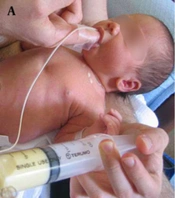
Observation checklist included a table of infant’s physiological criteria, including arterial oxygen saturation values, respiratory rate, and heart rate. To determine validity of data collection instruments, content validity analysis was used. To evaluate the instrument reliability, all physiological factors were recorded by a trained researcher-assistant. The cardiac monitoring device and pulse oximeter were periodically calibrated according to the hospital’s instruction. Before the initiation of the study, the researcher was trained in NNS by an occupational therapist and obtained “non-nutritive sucking competence and skill” license. Then, the researcher trained mothers how to perform NNS correctly. To implement the intervention, mother’s finger was first examined for probable wounds, eczema, and any other types of injury, as well as fingernail length. Then, mothers received the following trainings to perform NNS: a) washing hands up to the wrist with soap and water for 40 - 60 seconds under the researcher’s supervision according to the protocol of hospital, 2) mild stimulation of neonate’s lower lip, 3) slow insertion of the little finger into the neonate’s mouth, 4) mild stimulation of the tongue from the tip backward until the neonate start sucking, and 5) sucking stimulation throughout the gavage feeding process. This intervention was repeated for 3 times per day (early in the morning, afternoon, and evening) during the first 10 minutes of gavage. The test was not conducted at night shift due to the absence of mother and/or researcher. In both groups, mother’s milk was used for gavage done according to nursing standards. In the intervention group, correct administration of NNS stimulation was observed by the researcher, and mothers received required recommendations. Infants in the control group received routine care under the supervision of an experienced neonatal nurse. To eliminate the effect of mother presence, mothers in the control group were also present next to their infants in the first 10-minute of 3 gavage sessions held early in the morning, afternoon, and evening. The infants were followed up from the beginning of the study to the initiation of oral feeding, and the intervention continued until the first breastfeeding. Heart rate and arterial oxygen saturation level were measured by connecting the monitoring probe to the infant’s right hand; in addition, respiratory rate was measured and recorded based on the researcher assistant’s observations. Physiological factors (respiratory rate, heart rate, and arterial oxygen saturation level) of the intervention group were measured 3 times per day (5 minutes prior to the intervention, during gavage feeding, and 5 minutes after the intervention). Physiological factors (respiratory rate, heart rate, and arterial oxygen saturation level) of the control group were also measured 3 times per day (before, during, and after each gavage feeding). The length of infants’ hospital stay (in day) was recorded by referring to their medical files. In the current study, at least 8 oral feeding sessions per day (120 mL/kg/day) were regarded as the criterion for independent oral feeding. The infants’ capability to initiate oral feeding was evaluated by a neonatologist (the division director) unaware of the infants’ groups. For data analysis, the descriptive-inferential statistics were employed. Data analysis was conducted at significance level of 95% through independent t test and chi-square with SPSS version 16.
2.1. Ethical Concerns
Since the current study was a clinical trial, the study was registered at Iranian registry of clinical trial (no. IRCT-201501205163) and the required permissions were also obtained. It was also approved by the ethical committee of Tehran University of Medical Sciences (approval code: 93-04-28-27919), and the required permissions were obtained.
3. Results
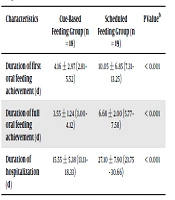
Research subjects were homogeneous in terms of demographic information. Thus, there was no significant difference between the groups in this regard. The independent t test showed no significant difference between the groups in terms of the neonates’ physiological signs (heart rate, arterial oxygen saturation level, and respiratory rate) before, during, and after the intervention (P > 0.05). The mean duration of full oral feeding attainment was 22 ± 14.51 and 30.05 ± 18.58 days for the intervention and control groups, respectively. According to the results of independent t test, the difference between the groups in duration of full oral feeding attainment was statistically significant (P < 0.026). The mean of hospitalization stay in the intervention and control groups was 31.26 ± 16.89 and 41.82 ± 23.07 days, respectively. According to the results of independent t test, there was statistically significant difference between the groups in terms of the length of hospital stay (P < 0.022). Regarding the research findings, the intervention had no effect on physiological signs of the neonates; whereas, it resulted in a significant difference in the number of hospitalization days and duration of full oral feeding attainment (Tables 1 - 5).
Table 1.
The Measures of Heart Rate in the Study Groupsa
| Intervention | Control | t Independent | ||
|---|---|---|---|---|
| F | P Value | |||
| Measurment 1 | ||||
| Before | 143.13 ± 42.63 | 142.10 ± 75.03 | 0.245 | 0.662 |
| During | 141.13± 66.76 | 140.11± 37.04 | 0.203 | 0.654 |
| After | 141.14± 42.01 | 140.14± 66.09 | 0.056 | 0.813 |
| Measurment 2 | ||||
| Before | 144.16± 32.03 | 143.15± 95.88 | 0.010 | 0.92 |
| During | 144.14± 55.03 | 143.13± 55.59 | 0.022 | 0.884 |
| After | 145.13+- 74.56 | 143.13+- 29.54 | 0.620 | 0.434 |
| Measurment 3 | ||||
| Before | 144.10± 32.3 | 147.11± 26.92 | 1.329 | 0.253 |
| During | 145.1±13.97 | 145.12±74.38 | 0.051 | 0.822 |
| After | 143.1± 95.56 | 146.11± 68.93 | 1.120 | 0.293 |
aValues are expressed as mean ± SD.
Table 2.
The Measures of SPO2 in the Study Groupsa
| Intervention | Control | t Independent | ||
|---|---|---|---|---|
| F | P Value | |||
| Measurment 1 | ||||
| Before | 91.1± 63.34 | 91.1 ± 68.19 | 0.033 | 0.854 |
| During | 92.45±1 | 91.1 ±53.08 | 2.597 | 0.111 |
| After | 92.1±72.05 | 91.1 ± 60.13 | 1.793 | 0.185 |
| Measurment 2 | ||||
| Before | 91.1± 74.22 | 92.1 ± 24.08 | 1.467 | 0.232 |
| During | 91.1±60.6 | 91.1 ± 14.95 | 1.151 | 0.282 |
| After | 92.1± 24.58 | 92.1 ± 16.37 | 0.054 | 0.817 |
| Measurment 3 | ||||
| Before | 92.1± 5.09 | 91.1 ± 79.02 | 1.184 | 0.280 |
| During | 92.1± 10.27 | 91.1 ± 18.95 | 0.317 | 0.577 |
| After | 92.1 ± 18.54 | 91 ± 87.99 | 1.130 | 0.291 |
aValues are expressed as mean ± SD.
Table 3.
Duration of Receive to Complete Oral Nutrition in the Study Groupsa
| Duration of Full Oral Feeding Attainment | Intervention | Control | Add | t Independent* | ||||
|---|---|---|---|---|---|---|---|---|
| Under 30 w | After 30 w | Add | Under 30 w | After 30 w | Add | |||
| 5 - 20 | 4 (26.74) | 18 (78.3) | 22 (57.9) | 13 (54.2) | 13 (34.2) | 13 (46.1) | T = 2.277; df = 74; P = 0.026 | |
| 21-35 | 7 (46.7) | 5 (21.7) | 12 (31.6) | 6 (42.9) | 6 (33.3) | 14 (36.8) | 26 (34.2) | |
| 36-50 | 1 (6.7) | 0 | 1 (2.6) | 4 (28.6) | 2 (8.3) | 6 (15.8) | 7 (9.2) | |
| 51-65 | 2 (13.3) | 0 | 2 (5.3) | 3 (21.4) | 3 (7.9) | 5 (6.6) | ||
| 66-80 | 1 (6.7) | 0 | 1 (2.6) | 1 (7.1) | 0 | 1 (2.6) | 2 (2.6) | |
| > 81 | 0 | 0 | 0 | 0 | 1 (4.2) | 1 (2.6) | 1 (1.3) | |
| Add | 1515 (100) | 23 (100) | 38 (38) | 14 (100) | 24 (100) | 100 | 76 (100) | |
| Mean | 22 | 30.05 | 26.03 | |||||
| SD | 14.51 | 18.58 | 17.05 | |||||
| Max- min | 8 - 75 | 7 - 91 | 7 - 91 | |||||
aValues are expressed as No. (%).
Table 4.
Duration of Hospitalization in the Study Groupsa
| Duration of Hospitalization | Intervention | Control | Add | t Independent* | ||||
|---|---|---|---|---|---|---|---|---|
| Under 30 w | After 30 w | Add | Under 30 w | After 30 w | Add | |||
| 5 - 25 | 2 (13.3) | 13 (56.5) | 15 (39.5) | 0 | 9 (37.5) | 9 (23.7) | 24 (31.6) | T = 2.342; df = 74; P = 0.022 |
| 26 - 45 | 7 (46.7) | 10 (43.5) | 17 (44.7) | 7 (50) | 10 (41.7) | 17 (44.7) | 34 (44.7) | |
| 46 - 65 | 3 (20) | 0 | 3 (7.9) | 4 (28.6) | 2 (8.3) | 6 (15.8) | 9 (11.8) | |
| 66 - 85 | 3 (20) | 0 | 3 (7.9) | 2 (14.3) | 2 (8.3) | 4 (10.5) | 7 (9.2) | |
| 86 - 105 | 0 | 0 | 0 | 0 | 1 (4.2) | 1 (2.6) | 1 (1.3) | |
| > 105 | 0 | 0 | 0 | 1 (7.1) | 0 | 1 (2.6) | 1 (1.3) | |
| Add | 5 (100) | 3 (100) | 38 (100) | 14 (100) | 24 (100) | 38 (100) | 76 (100) | |
| Mean | 31.26 | 41.82 | 36.54 | |||||
| SD | 16.89 | 23.07 | 20.77 | |||||
| Min-Max | 9 - 82 | 10 - 111 | 9 - 111 | |||||
aValues are expressed as No. (%).
Table 5.
The Means of Consumed Milk By/Infants
| Mean ± SD | t | df | P Value | |
|---|---|---|---|---|
| Intervention | 109.54 ± 35.98 | 0.579 | 74 | 0.569 |
| Control | 104.94 ± 34.16 |
4. Discussion
According to the results of statistical analysis, both groups were homogeneous in terms of demographic variables; therefore, the obtained results can be attributed to the effects of intervention at the higher level of confidence.
Physiological factors: in general, findings of the current study suggested no significant difference between the groups in terms of physiological variables. Results from various studies showed that NNS had different effect on the improvement of infant’s physiological factors; however, these findings were not similar in all studies. For example, McCain showed that heart rate decreased during NNS (25). Another study by McCain showed that NNS did not have a significant effect on heart rate changes (26). Pickler et al. showed a difference between the control and intervention groups in terms of heart rate (13). On the other hand, Burroughs et al., investigated the effects of NNS on arterial oxygen saturation level of infants undergoing mechanical ventilation and showed its elevation during and after the administration of mechanical ventilation (27). Nading and Landes (in a study found that NNS significantly increased arterial oxygen saturation level in preterm neonates during oral-gastric tube feeding (28). Lappi et al. did not observe a significant impact on heart rate after using pacifier (29). Pinelli and Symington found that NNS had no significant effect on neonate’s heart rate and behaviors (18). Hwang et al. performed prefeeding oral stimulation for 19 NICU neonates in Taiwan. Results showed that the 5-minute oral stimulation had no effect on the peripheral capillary oxygen saturation (SPO2) level and heart rate during feeding (30). Kamhawy et al. observed no statistically significant relationship in terms of heart rate; whereas, NNS had positive effects on behavioral status of preterm neonates (31). They also showed no difference between the control and intervention groups in terms of arterial oxygen saturation level in the first 2 days of study. Since the third day onward, significantly higher oxygen saturation values were observed during and after nasogastric tube feeding in the intervention group. This increase in arterial oxygen saturation continued until the 10th day. In terms of non-nutritive sucking effects on neonates’ heart rate, Kamhawy showed a significant difference between the groups only on the 2nd, 5th, and 10th days of the study. Moreover, the heart rate in the test group increased on the 2nd day during and after nasogastric tube feeding; whereas, this increase on the 5th and 10th days occurred only during nasogastric tube feeding. Kamhawy et al. considered heart rate stability as a desirable criterion; however, the current study adopted the intervention-induced heart rate reduction as criterion on the basis of literature. It seems that heart rate stability is also a rational criterion. Although the presumption of the current study concerning neonate’s comfort after sucking can be true in terms of heart rate reduction, the study findings showed no change in physiological symptoms. This lack of difference between the groups indicated the need for further investigations. With respect to the arterial oxygen saturation level, Kamhawy et al. showed an increase during and after NNS in the intervention group (31). This increase in the arterial oxygen saturation level may be due to a decrease in the movements and relaxed fetal position of neonates.
According to clinical experiences of the research team, lack of difference between the groups in physiological factors may be justified through the high skill of nurses. This is because the NICU nurses, as professionals, work in a bid to maintain the stability of neonatal physiological signs during the whole period of gavage feeding, and before and after it. Since the fundamental prerequisite for nursing care in gavage feeding is the stability of physiological symptoms. The control nurses, thus, monitored gavage process for any physiological changes. As a result, the chance for a significant difference between the 2 groups was eliminated. According to these findings, the measurement of nursing measures, taken in favor of physiological indices stability, is recommended instead of the measurement of indices. It seems that results of the current study were affected by the nurses’ expertise in controlling physiological indices of neonates during gavage feeding. It is therefore recommended to consider the effects of this expertise in future studies by measuring nurses’ attempt in controlling the indices, instead of the indices in isolation.
Full oral feeding: results of the current study indicated that the mean duration of full oral feeding attainment was 30.05 and 22 days in the control and intervention groups, respectively; 8.05 days shorter in the intervention group (P = 0.026). Younesina et al. showed that the control and intervention infants attained 8 independent oral feedings per day at the corrected age of 34.47 and 32.50 weeks, respectively (P < 0.001) (7). Findings of Younesian et al. showed that oral-motor stimulations in preterm infants sped up oral feeding attainment, which had a significant effect on the reduction of gavage feeding problems. Mahmoodi et al. showed that the mean duration of oral feeding attainment was 9.55 and 11.5 days in the intervention and control groups, respectively (P = 0.034) (9). This difference in duration of oral feeding attainment was because Mahmoudi investigated the initiation of oral feeding in preterm neonates; whereas, the current study explored the duration of full oral feeding attainment from the initiation of trophic feeding in the intervention and control groups. Valizadeh et al. showed that the intervention group attained independent oral feeding significantly sooner than the control group (P < 0.001). However, there was statistically no significant difference between oral massage group and non-nutritive sucking group in duration of independent oral feeding attainment (P = 0.915) (32). Lessen considered 6 nutritional phases in his study. Completion of the first phase took two more days from the control infants. On average, the completion of the 4th and 6th phases (6th phase: 8 times oral feeding per day; 5th phase: 6 times oral feeding per day; 1st, 2nd, 3rd, 4th phases: 1, 2, 3, and 4 times oral feeding per day, respectively) took one more day from the control group. According to the results, there was no significant difference between the intervention and control groups at the time of oral feeding initiation and oral feeding completion, taking post-fertilization age into account; whereas, the length of transition from gavage feeding to oral feeding was shorter in the intervention group 18.1 days versus 23.4 days in the control group (24). Harding et al. showed no significant difference in the length of full oral attainment between the control group and 2 intervention groups. Although no significant difference was observed between the groups, neonates in the intervention group attained oral feeding very sooner than the controls. In addition, a greater number of neonates were on breastfeeding in the intervention groups than control group at discharge (33).
Kamhawy et al. showed that NNS group initiated breastfeeding 5 days sooner than the control group (8.4 days versus 13.6 days) (31). In contrast, some researchers such as Bragelien et al. showed that oral stimulation program did not affect the length of full oral feeding attainment (34). Since they used different methods for similar studies, their findings are debatable. However, they mentioned the use of different methods in interpretation of findings, in which they stimulated outside of the mouth on the jaws or even chests, without any direct stimulation of different oral areas including the mouth. Many other studies also showed that the use of a comprehensive (inside and outside) oral stimulation contributes to the acceleration of full oral feeding attainment in gavage feeding neonates. The aforementioned studies investigated the administration of NNS alone or in comparison to oral massage method and/or the Beckman oral-motor approach; whereas, the current study investigated NNS on mother’s finger. Regarding research findings, it seems that sucking mother’s finger alone can be as effective as other methods proposed by other studies (some of which need certain training). Another point that came to researchers’ attention was wide range of gestational age considered in the current study (26 to 34 weeks), which probably can affect full oral feeding attainment. Although this effect was eliminated through homogenizing the groups, the great difference and high variance of the length of full oral feeding attainment can be due to this wide range of gestational age. Therefore, researchers recommended stricter age limitation in future studies.
Importance of mother-infant interaction during feeding: One obvious difference between current study and other studies was the central role of mothers throughout the interventions. Since preterm infants, born prior to 32 weeks, are not neurologically matured enough to coordinate sucking, swallowing, and breathing, they are inevitably tube-feeding dependent, which inhibits proper mother-infant interactions (19, 35). Successful and enjoyable experiences during feeding encourage the infants to gain control over the breast in mouth, smile, and social games. Therefore, feeding gradually takes the role of a social activity (8, 19). According to the researchers, any failure in infant-caregiver interactions may suppress infant’s desire for eating. It implies the importance of mother-infant interactions during feeding. Due to this importance, the family-centered care (FCC) is expanding in most NICUs in recent years. In this approach, families are more involved in medical care and discharge planning. These programs not only improve oral feeding performance of preterm neonates but also create greater opportunity for neonates-caregiver interactions, which per se have very positive effects on their development. The current study used no instrument to measure these interactions, and thus it is recommended that the mechanism and value of such interactions be measured in future studies.
The length of hospital stay: This factor was 31.26 and 41.82 days in the intervention and control groups; 10.56 days shorter in the intervention group (P = 0.022). According to Younesian et al. (2011), the length of hospital stay was significantly shorter (by one week) in the intervention group (P = 0.013). The mean gestational age in this study was 30 weeks (7). Mahmoudi et al. (2012) showed that the mean length of hospital stay was shorter in the intervention group than control group (16.50 days versus 19.4 days) (P = 0.027) (9). This difference in the length of hospital stay in Mahmoudi’s study can be attributed to gestational age of subjects (28 to 32 weeks), which according to evidence need shorter hospital stay than the subjects with gestational age of 26 to 34 weeks in the current study. According to the results of the current study, the length of hospital stay of the majority of neonates born prior to 30 weeks (intervention group: 46.7%; control group: 50%) was within the range of 26 - 45 days; whereas, the length of hospital stay of the majority of infants born after 30 weeks was within the range of 5 - 25 days in the intervention group (56.5%) and 26 - 45 days in the control group (41.7%). Valizadeh et al. (2014) showed that the mean length of hospital stay in oral massage group, non-nutritive sucking group, and control group were 34.66, 38.95, and 38.45 days, respectively, indicating no statistically significant difference between these groups (P = 0.342) (32). The mean gestational age in the current study was 29 weeks. Pinelli and Symington (2005) reported that NNS can significantly reduce the length of hospital stay of preterm neonates, have positive effects on a shift from tube-feeding to bottle-feeding, and result in higher bottle-feeding performance (18). In Roca’s (2006) study, the mean length of hospital stay was 41.9 and 52.3 days in the intervention and control groups, respectively (P < 0.01) (4). According to Lessen (2012), the mean length of hospital stay was 41.8 and 44.4 days in the intervention and control groups, respectively, indicating no statistically significant difference between the groups (P = 0.541) (24). Harding et al. (2014) showed a significant difference in the length of hospital stay between two intervention groups and the control group (group 1: 21.74 days; group 2: 31 days; group 3: 36.85 days) (P = 0.022) (33). Kamhawy et al. (2014) showed that the intervention neonates were discharged at lower corrected age (36.7 weeks versus 37.3 weeks) (31). Fusil et al. (2002) did not observe any significant difference in the length of hospital stay between the groups. They put that different factors affect NICU discharge (36). The average gestational age in Fusil’s study was 28 weeks. Since the neonates’ gestational age in the current study was lower, their neurological development needed for oral feeding attainment was longer, which prolonged hospital stay. A study, in which a similar oral stimulation protocol with 3 times larger sample size (98 infants) were used, reported 10 days shorter discharge in the non-nutritive oral stimulation group than the control group. In general, no contradictory result was found in the majority of available texts; therefore, it can be put that non-nutritive sucking on mother’s finger can decrease the length of hospital stay of preterm neonates. This difference in the length of hospital stay of preterm neonates in different studies may be due to stricter discharge criteria set by different hospitals. It can also be attributed to the mean gestational age of subjects, which may act as an effective factor in decreasing or increasing the length of hospital stay. A review on Cochran’s article by Pinelli and Symmington showed that preterm neonates receiving NNS on pacifier were discharged sooner (18). This is probably because oral feeding attainment can be a milestone for neonates’ discharge. As said earlier, NNS can speed up the transition from gavage feeding to oral feeding. Results of the current study, thus, were consistent with those of other studies indicating that NNS can reduce the length of hospital stay.
Gestational Age of Research Subjects: Some studies included preterm neonates with gestational age lower than 30 weeks; whereas, the mean gestational age in the current study was 31.24 and 31.18 weeks in the intervention and control groups, respectively. The underlying reason behind selecting gestational age of lower than 32 weeks was that neonates’ neurological development required for sucking, swallowing, and respiration was attained within the gestational age of 24 - 32 weeks. Therefore, all these studies intended to investigate the effect of oral-motor stimulations on the development of sucking pattern before it was acquired by the neonate. It seems that making interventions in the age range of 26 - 28 and 30 - 32 weeks and comparing their results are required to find probable effectiveness of such interventions in lower age. According to the results of the current and other studies, NNS increases oral feeding tolerance, reduces the length of hospital stay, speeds up full oral feeding attainment, and improves feeding status of preterm neonates. Reduction of the full oral feeding attainment duration has significant impact on the reduction of gavage feeding consequences and improves neonate’s feeding skill. Since nutrition plays a critical role in neural, emotional, and health development of neonates, and full oral feeding attainment is usually one of the last criteria for discharge, few days shorter length of full oral feeding attainment can potentially lead to sooner discharge, which is obviously associated with economic and psychological values (37). Maternal intervention in the current study added several advantages, such as parent-neonate interaction and empowered sense of self-usefulness in parents, to other benefits mentioned in other studies. These new advantages increase mothers’ knowledge about infant care at discharge. Since NNS does not need certain skills and expertise, participation of mothers is recommended. Teaching this procedure to mothers lets neonates benefit from the positive effects of NNS and that of mother-neonate interaction.