
1. Background
At present, learning is the key to survival and endurance. Human life is largely dependent on various acquired knowledge and skills. The more updated and optimal acquired knowledge and skills, the greater the human ability to adapt to the environment (1). But, the rapid changes and developments of environmental factors have also confronted the management of organizations with serious challenges (2). In the last three decades, new information and communication technologies have provided opportunities for the design of new organizational forms and new pedagogic models and methods, and this has accelerated since the emergence of the internet and the world wide web (3).
Modern organizations will not have the timeouts of the past ones, and they must update their capabilities, resorting to speed and skill management cybernetics is one of the significant factors, which is useful in this field, and may result in the efficiency of employees (4). Cybernetics is the science of controlling and overruling smart phenomena, through controlling and awareness of information flow (5). main subject of cybernetics is the investigation of the nature of control in humans, animals and machines and the science of governance and control over intelligent phenomena through control and control over the flow of information (6). In this regard, cybernetic management seeks to remove structures traditional and inefficient and facilitating communication between departments and systems it is an internal subsidiary (7). Silas believes that regulation, received information finishing, information storage, environmental coordination, self-regulation, self-production, and strategic behavior are among the common features of all cybernetic systems (8). In addition to management cybernetics, there is another component, called strategic intelligence, that can improve the productivity and performance of managers and employees (9). Strategic intelligence usually supports senior managers, responsible for designing and implementing overall organizational strategies (10), The researchers concluded that strategic intelligence is measured by foresight, strategic involvement, motivation, and systems thinking in the organization (11). Both management cybernetics and strategic intelligence are organizational requirements; the same is true of universities, and due to managerial challenges in universities and the lack of each component, universities may be placed in a critical situation (12). Among the management challenges, we can mention the lack of correct and accurate organizational information to make future decisions of the organization, the lack of budget and technology facilities for the efficiency and productivity of employees and other middle and operational managers, as well as the lack of knowledge management in the organization (13). One of the important and basic solutions in the current situation in order to reduce managerial and organizational challenges is the use of virtual education (14). Virtual education has evolved education and learning in the 21st century, relying on information and communication technology and focusing on the human being as a learner, and has attempted to respond to the challenge of increasing social demand for education and the lack of adequate educational references (15). E-learning and virtual education are new paradigms for organizational teaching and learning mechanisms (16). Virtual education is a dynamic, modern, and efficient method to create educational opportunities. It is provided at any time, place, and budget, creating learning opportunities for people (17), and it can decrease the costs of building and maintaining educational spaces by virtual training courses (18).
In research, Jafari et al. concluded that virtual education justice and realization are always one of the most major mottos in the field of education (19). Kazempour et al. study (20) showed that the proper use of academic culture capacity in virtual education requires to be evolved for its audience in the context and artifacts of cyber space. Bagherzade Homai study (21) showed that people can attend this space to improve their own training quality, recognizing, observing, and controlling the aspects and dimensions overseeing this phenomenon. Aramseresht et al. study (22) indicated that organizational processes intelligence, human resources intelligence, business intelligence, information management intelligence, knowledge management intelligence, and macro environmental intelligence are the components of Tehran municipality’s strategic intelligence model, and there is a significant correlation between strategic intelligence and the mentioned components.
The results of Nikbakhsh et al. study (23) showed that management cybernetics has a direct effect on organizational health and an indirect effect on the learning process. The results of Alhamadi indicated that strategic intelligence, as measured by foresight, future vision, strategic involvement, motivation, and systems thinking, has a significant impact on sustainable competitive advantage (12). Schwaninger concluded that management cybernetics can be trusted as an effective factor for smart organizations. In the same way, it can be said that educational managers, like academic managers, have an urgent need for various training courses by various methods (24). It is possible to reinforce organizational managers’ supervision and control through modern approaches to virtual training courses, and finally, to place management cybernetics at a higher level. Therefore, extensive research is required in this regard so that the findings could be provided to different professors and educational officials to enhance the current teaching methods and increase the quality of teaching (25). In that sense, managers will make more proper decisions to reduce organizational challenges.
2. Objectives
In this regard, the present study was conducted with the aim of virtual education to promote cybernetic management and strategic intelligence from the point of view of educational managers of universities in Kermanshah province.
3. Methods
The present research is mixed methods research (qualitative-quantitative); in terms of objective, it is applied, and in nature, it is exploratory. The research data were gathered by a survey technique. The research statistical population included 1,200 people of educational managers (including educational assistants, departmental heads, responsible experts, and etc.) of universities in Kermanshah Province (N = 1,200). The research qualitative and quantitative sample sizes were specified through theoretical saturation (15 samples) and the Cochran formula, respectively. The research sample was estimated 291 people.
In the qualitative section (interviews with the experts), the research tool was an open-response semi-structured questionnaire. Since participants play a central role in this section, clear standards should be selected for them; thus, the number of participants depends on the research subject, time, and available references. Then, data were collected from the experts (professors and specialists in the field of educational management, and those, related to virtual education). In this part, the research data was saturated after 15 interviews, and the process of data gathering was stopped.
In the quantitative section, the final research tool included 3 questionnaires: (1) the researcher-made questionnaire of virtual education, consisting of 15 questions, its reliability was equal to 0.87, using Cronbach’s alpha coefficient; (2) the researcher-made questionnaire of management cybernetics, including 10 questions, its reliability was equal to 0.88, using Cronbach’s alpha coefficient. The validity of researcher-made questionnaires was measured by Lawshe’s content validity ratio, and the validity of the research tool was proper; (3) Maccoby’s standard questionnaire for strategic intelligence (2007) included 25 questions. These questionnaires were compiled, based on a 5-point Likert scale (strongly agree, agree, slightly agree, disagree, and strongly disagree). According to Maccoby, the face and content validity of the questionnaire were proper (26).
Eventually, the validity of the research tool was approved; then, the research data were gathered, using a stratified random sampling method according to the sample size. So, the total sample size was derived for the universities of Kermanshah Province; then, based on the population of educational managers in each university, the number of samples was specified by an appropriate stratified method. Then, a final sample was selected randomly for each university (Table 1). In other words, after deriving the universities’ total sample size, the number of samples was determined according to the population of educational managers in each university. In order to avoid ethical issues, the interviewees and the respondents to the questionnaire questions were fully assured about the confidentiality of the results.
Table 1.
Selected Sample Size, According to the Universities of Kermanshah Province
| University | Populations | Male Samples | Female Samples | Total Samples |
|---|---|---|---|---|
| University of Medical Sciences | 302 | 45 | 31 | 76 |
| Payam Noor University | 290 | 41 | 29 | 70 |
| Islamic Azad University | 282 | 38 | 28 | 66 |
| University of Applied Sciences | 91 | 10 | 12 | 22 |
| Razi University | 88 | 12 | 9 | 21 |
| Nonprofit University | 39 | 4 | 6 | 10 |
| Total | 1200 | 162 | 129 | 291 |
3.1. Research Findings
Each interview was implemented to analyze the qualitative data and derive the intended items to respond to the research questions, and basic concepts were derived. It should be mentioned that the basic concepts were too close to the interviewees’ remarks, and in some way, they were fully taken from their words; then, they were reviewed to specify the concepts related to virtual education and management cybernetics (Table 2).
Table 2.
The Dimensions and Components Identified by Interviews with Experts
| No. | Variable | Identified Components |
|---|---|---|
| 1 | Virtual education | Mutual interactions, the quality of educational content, professors’ mastery, users’ technical proficiency, electronic literacy, infrastructures, bandwidth, software and hardware, the quality of educational materials, culture creation, saving time and money, the quality of professors’ teaching, public education, internet speed, modern teaching methods, evaluation, quick feedback, learning flexibility, the quality of information and content. |
| 2 | Management cybernetics | Principles implementation, control system and process, supervision and control, organizational hierarchy, organizational structure, collaborative decision-making, organizational leadership, organizational justice, continuous training, organizational structure, organizational trust, flat structures, creativity, organizational hierarchy, knowledge management, use of various sciences, true information flow, control. |
At the qualitative stage, the variables of virtual education and management cybernetics were initially identified; then, the identified components, with the standard component of strategic intelligence, were provided to the experts, in the form of a questionnaire with 62 questions (Likert scale), for an exploratory factor analysis. The results are shown in Tables 3 and 4.
Table 3.
Variance Between Two Matrices, Based on Bartlett’s Test
| Variables | No. |
|---|---|
| Significance level | 0.000 |
| Degrees of freedom | 743 |
| Bartlett’s test statistic (chi-square distribution) | 7082.684 |
| KMO | 0.931 |
Table 4.
Rotated Components Correlation Matrix
| Factors Components | Factor 1 | Factor 2 | Factor 3 |
|---|---|---|---|
| Q1 | 0.785 | 0.324 | 0.219 |
| Q2 | 0.771 | 0.235 | 0.328 |
| Q3 | 0.435 | 0.447 | 0.472 |
| Q4 | 0.697 | 0.132 | 0.411 |
| Q5 | 0.684 | 0.239 | 0.428 |
| Q6 | 0.647 | 0.226 | 0.469 |
| Q7 | 0.628 | 0.417 | 0.423 |
| Q8 | 0.626 | 0.306 | 0.296 |
| Q9 | 0.417 | 0.388 | 0.445 |
| Q10 | 0.606 | 0.383 | 0.430 |
| Q11 | 0.588 | 0.479 | 0.425 |
| Q12 | 0.583 | 0.473 | 0.288 |
| Q13 | 0.579 | 0.269 | 0.698 |
| Q14 | 0.573 | 0.428 | 0.385 |
| Q15 | 0.569 | 0.369 | 0.471 |
| Q 16 | 0.428 | 0.423 | 0.445 |
| Q17 | 0.569 | 0.320 | 0.487 |
| Q18 | 0.723 | 0.245 | 0.357 |
| Q19 | 0.420 | 0.330 | 0.368 |
| Q20 | 0.245 | 0.326 | 0.484 |
| Q21 | 0.430 | 0.472 | 0.413 |
| Q22 | 0.325 | 0.405 | 0.703 |
| Q23 | 0.420 | 0.417 | 0.687 |
| Q24 | 0.298 | 0.425 | 0.659 |
| Q25 | 0.411 | 0.259 | 0.648 |
| Q26 | 0.422 | 0.389 | 0.584 |
| Q27 | 0.384 | 0.471 | 0.445 |
| Q28 | 0.385 | 0.730 | |
| Q29 | 0471 | 0.298 | 0.325 |
| Q30 | 0.435 | 0.484 | 0.720 |
| Q31 | 0.397 | 0.463 | 0.498 |
| Q32 | 0.284 | 0.403 | 0.611 |
| Q33 | 0.447 | 0.397 | 0.322 |
| Q34 | 0.328 | 0.359 | 0.684 |
| Q35 | 0.326 | 0.445 | 0.785 |
| Q36 | 0.317 | 0.371 | |
| Q37 | 0.306 | 0.330 | 0.435 |
| Q38 | 0.388 | 0.725 | 0.397 |
| Q39 | 0.383 | 0.720 | 0.284 |
| Q40 | 0.279 | 0.698 | |
| Q 41 | 0.173 | 0.611 | 0.628 |
| Q42 | 0.469 | 0.722 | 0.390 |
| Q43 | 0.428 | 0.684 | 0.410 |
| Q44 | 0.369 | 0.785 | 0.412 |
| Q45 | 0.223 | 0.771 | 0.307 |
| Q46 | 0.420 | 0.735 | |
| Q47 | 0.345 | 0.697 | 0.330 |
| Q48 | 0.330 | 0.684 | 0.209 |
| Q49 | 0.425 | 0.647 | 0.420 |
| Q50 | 0.120 | 0.628 | 0.398 |
| Q51 | 0.498 | 0.626 | 0.215 |
| Q52 | 0.385 | 0.617 | 0.322 |
| Q53 | 0.371 | 0.606 | 0.301 |
| Q54 | 0335 | 0.588 | 0.285 |
| Q55 | 0.497 | 0.745 | |
| Q56 | 0.347 | 0.730 | |
| Q57 | 0.428 | 0.725 | 0.175 |
| Q58 | 0.226 | 0.720 | |
| Q59 | 0.417 | 0.698 | |
| Q60 | 0.106 | 0.526 | |
| Q61 | 0.219 | 0.628 | |
| Q62 | 0.108 | 0.590 |
3.2. Exploratory Factor Analysis
Based on the estimated values, the chi-square distribution for the difference in means between the two matrices is significant at an error level than 0.01. In other words, the value of error is equal to 0.000; since the value is less than 0.01, it can be concluded that the two matrices are not distributed equally. Consequently, the minimum condition was established for responding to the questions, but one of the other data scales is sampling adequacy. The following table, introducing the standards of this scale, is used for better understanding.
4. Results
The results for the table of the rotated component matrix are used to categorize the components, based on their factor loads. This table shows the correlation matrix between components and factors after rotation, in which the correlation value fluctuates between -1 and +1. Based on the table, the researcher categorizes each component according to its largest factor load and its correlation with other components. Also, variables (components) are usually categorized among factors, based on the first variable of factors and its implicit meaning. According to the results of this test, all indices of the initial questionnaire, including 3 factors and 62 components, were categorized into 3 factors (15 items for virtual education, 10 items for management cybernetics, and 25 items for strategic intelligence). In other words, all items, with a factor load less than 0.500, were removed, and finally, 50 items remained for the questionnaire. Next, a new questionnaire was designed, using these 50 items, and it was redistributed among the experts; gathered data were used for the model fitting and confirmatory factor analysis.
4.1. Model Validation and Fitting
Next, we tested the correlation of the research constructs. To do this, the intended model was implemented in Amoss 24 software; the model fitting and variables correlation were tested, modeling the structural equations.
The significance level (0.019) and path coefficient of 0.148 between variables indicate that there is a significant correlation between virtual education and management cybernetics. NFI and CFI indices are 0.974 and 0.908 respectively, higher than 0.9. RMSEA values (0.041) and chi ratio to degrees of freedom of 4.733 indicate an optimal fitting for the model (Figure 1).
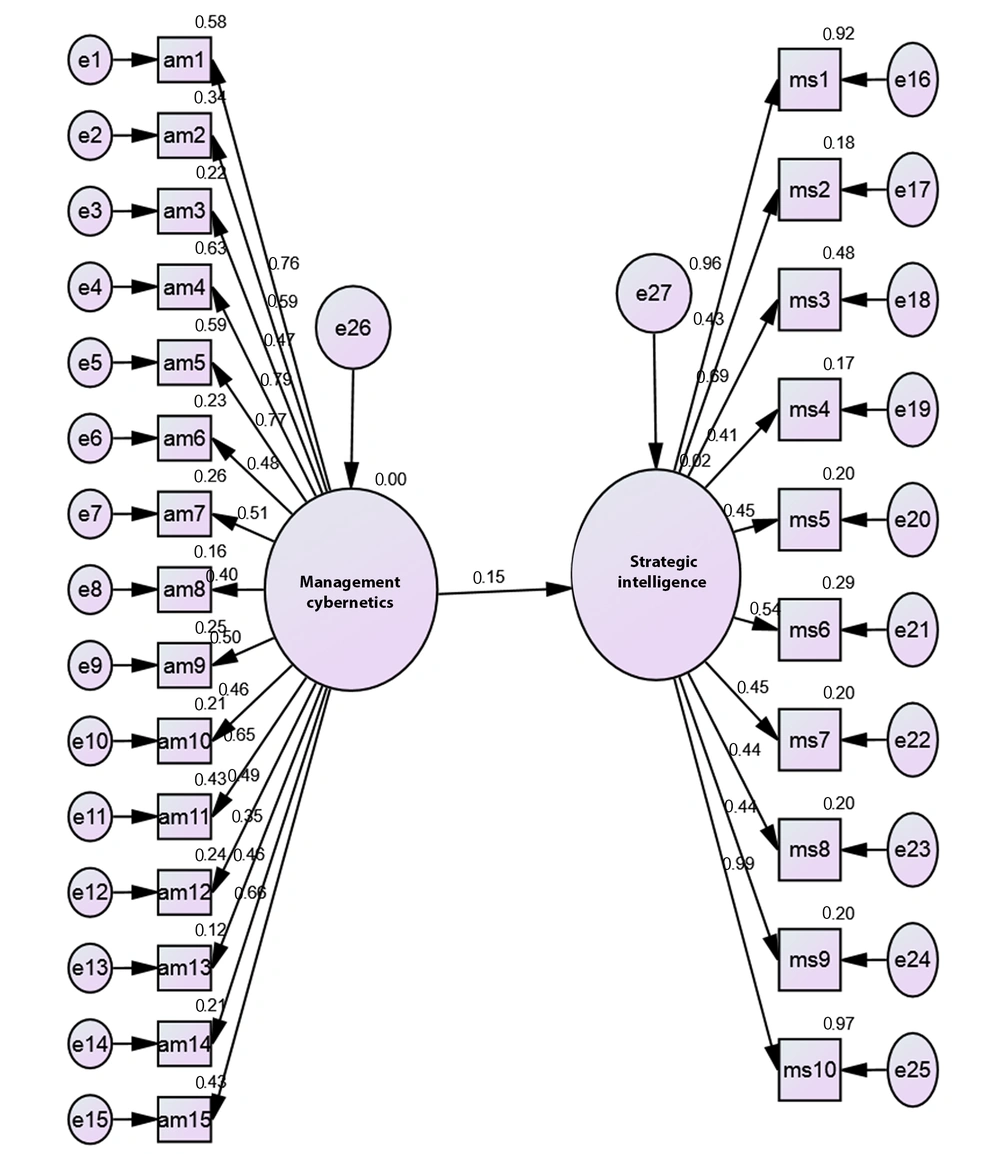
Figure 1.
Modeling structural equations for virtual education effectiveness on management cybernetics
The significance level (0.001) and path coefficient of 0.871 between variables indicate that there is a significant correlation between virtual education and strategic intelligence. NFI and CFI indices are 0.913 and 0.935 respectively, higher than 0.9. RMSEA values (0.080) and chi ratio to degrees of freedom of 3.732 indicate an optimal fitting for the model (Figure 2).
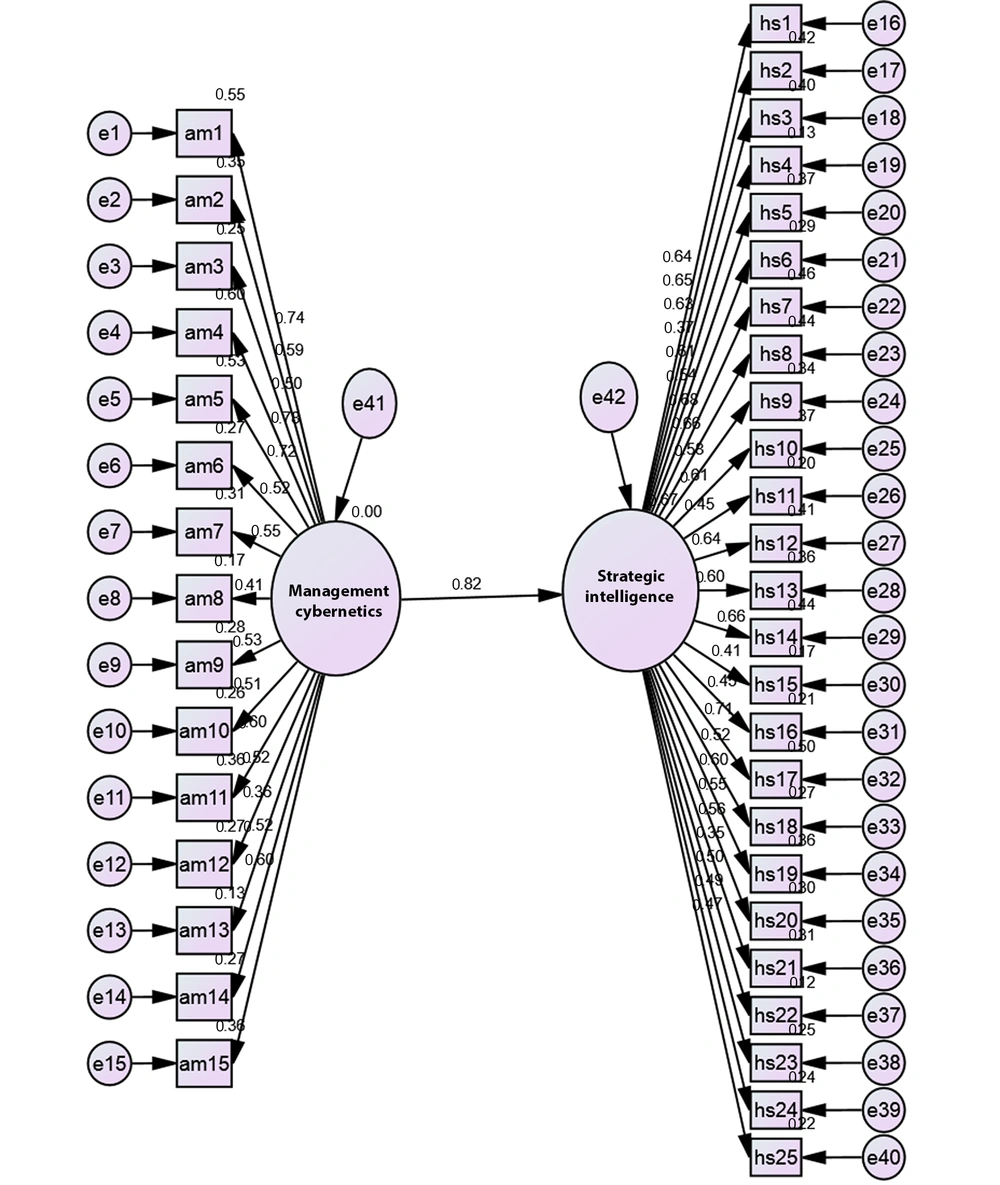
Figure 2.
Modeling structural equations for virtual education effectiveness on strategic intelligence
The significance level (0.02), and a path coefficient of 0.078 between variables indicate that there is a significant correlation between management cybernetics and strategic intelligence. NFI and CFI indices were 0.952 and 0.951 respectively, higher than 0.9; RMSEA values (0.058), and chi ratio to degrees of freedom of 4.691 indicate an optimal fitting for the model. It shows that the model has the best fitting (Figure 3).
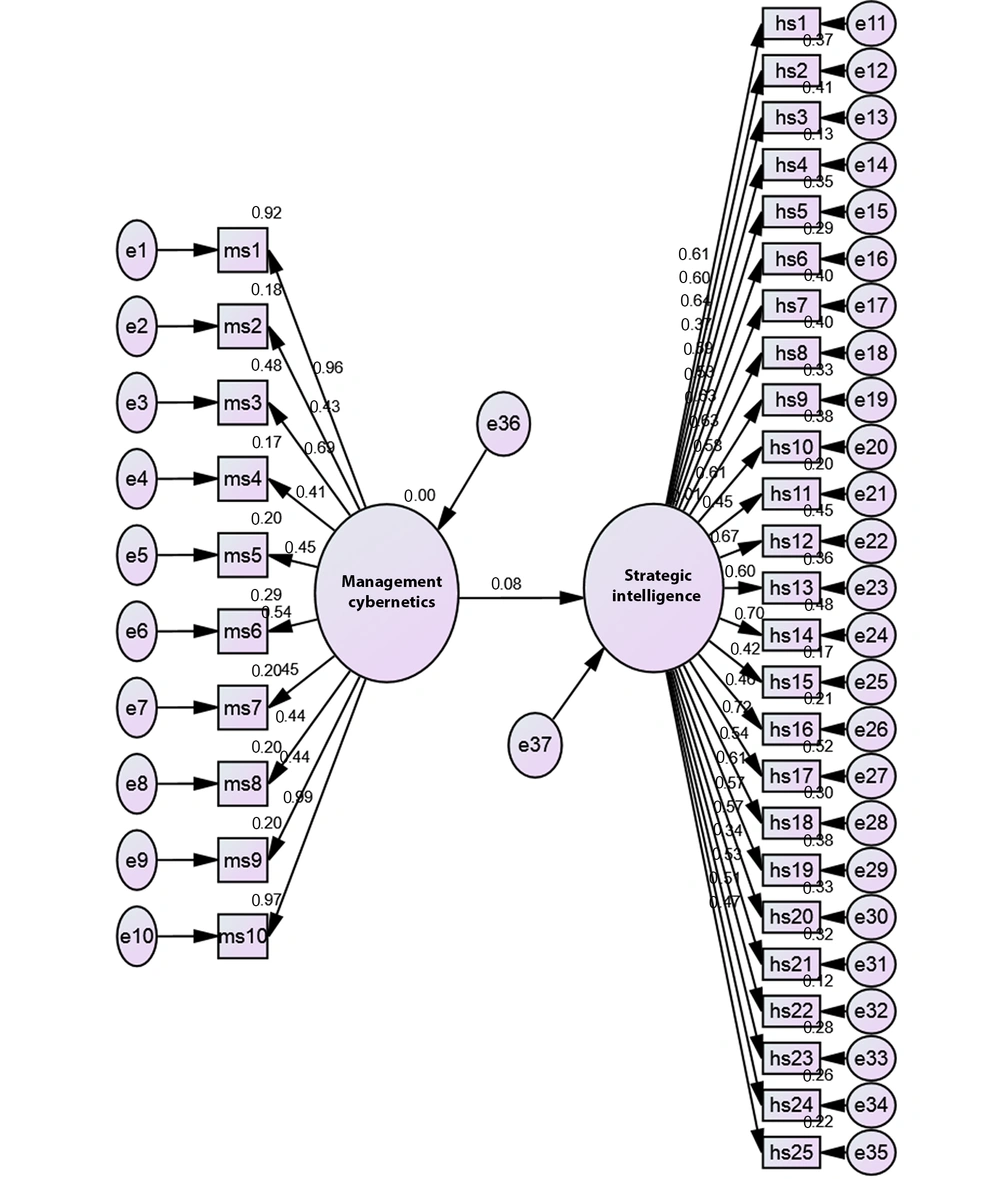
Figure 3.
Modeling structural equations for management cybernetics effectiveness on strategic intelligence
The results of the model indicate that the factor load between the variable of virtual education and management cybernetics is equal to 5%, and the factor load between the variable of virtual education and strategic intelligence is 11%. Thus, these results show that the correlation between virtual education, management cybernetics, and strategic intelligence is also significant (Figure 4).
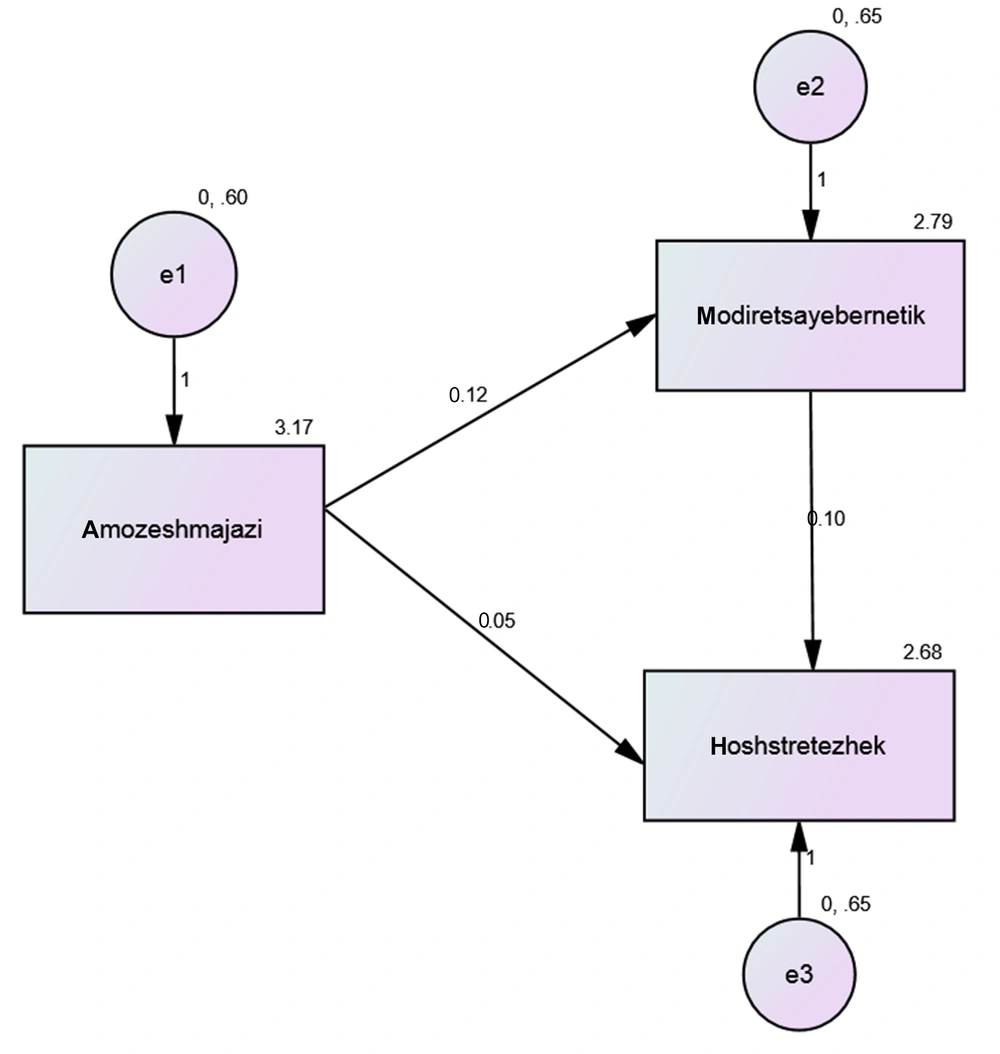
Figure 4.
The final standardized research model
5. Discussion
The present research attempts to develop a model for the structural equations of virtual education to promote educational managers’ management cybernetics and strategic intelligence in universities of Kermanshah Province. To achieve this goal, first, the research variables were identified by interviewing experts; the results of this section indicate that 17 components of virtual education, 13 components of management cybernetics, and 7 components of strategic intelligence were identified. Next, a 37-question questionnaire was prepared, using the identified components, and given to the experts for an exploratory factor analysis; then an exploratory analysis was performed, the final components of each variable were identified, and the final questionnaire was designed for a confirmatory factor analysis, and confirming the identified model. The findings of the confirmatory factor analysis, in addition to confirming the best fitting of the components for the management cybernetics variable, show that there is a significant correlation between virtual education and management cybernetics. Management cybernetics, with the main goal of organizational self-control, attempts to organize organizational activities, remove traditional and ineffective structures, and replace them with dynamic and collaborative structures. Thus, it can be said that it is a proper and practical approach to organizational dynamics, particularly for educational managers in universities. Virtual education is one of the approaches, that may put management cybernetics at a more ideal level. All organizational managers and employees require training. Training will improve managerial thinking and knowledge, and in this case, organizational challenges will be removed. One of the advantages of virtual education is that it can be followed at any place and time, and given educational managers’ high activities, it is viewed as an acceptable approach for them; it can be expected to improve the organizational conditions, in particular, management cybernetics in universities, improving managers’ media and electronic literacy in this field. It can be said that virtual education has a significant and positive effect on management cybernetics, reviewing the achieved contents and results. The achieved results are aligned with the research of Kazempour et al. (20), Kortz et al. (27), and Schwaninger (24), indicating the effect of training on organizational management cybernetics improving. The results of these researches show that management cybernetics will improve educational managers’ efficiency and performance, and facilitates their future decisions to improve the educational environment.
Also, the results of confirmatory factor analysis indicate a significant correlation between virtual education and strategic intelligence. Organizational intelligence, particularly strategic intelligence, is one of the factors that may lead to quick organizational improvements. Strategic intelligence is managers’ proper understanding of the business environment, which makes organizational processes be performed more properly and acceptably. Today, in any organization, particularly for the educational planning of universities, strategic intelligence is known as a fundamental principle, making organizational planning be implemented more accurately. As strategic intelligence is at an optimal level in an organization, the process of decision implementation and planning is shorter and more accurate. Strategic intelligence is effective on both various internal organizational dimensions (employees’ performance, financial performance) and external organizational dimensions (customers, in an academic environment, who are students). Virtual education is a modern approach to improving organizational strategic intelligence, allowing educational managers to lead their organization in a better way through their high thinking and intelligence. Strategic intelligence will spread to managers while its facilities and infrastructures will be provided through training. Thus, the visual features of virtual education make managers learn in a better way and increase their learning rate. Learning in the context of technology may have better results for educational managers. Through this educational approach, managers’ strategic intelligence may be improved and their managerial abilities and skills may be reinforced. The requirements for managers’ virtual education include electronic literacy, software and hardware facilities, equipment’s, managers’ tendency for such training courses, and the like. Considering the lack of time for educational managers in universities, it can be concluded that virtual education is a positive and efficient approach. The results are aligned with the research of Bagherzade Homai (21), Aramseresht et al. (22), and Schwaninger (24), showing that strategic intelligence is a dynamic and efficient approach that may help the educational managers of universities improve academic atmosphere and motivate students and researchers to study and research. Strategic intelligence will direct organizational activities and shorten the path toward achieving organizational goals. Strategic intelligence will increase organizational efficiency and effectiveness; managers can identify organizational and educational gaps, and fill them with their managerial knowledge and measures.
5.1. Limitations
- The present research has been investigated among educational managers of universities in Kermanshah province, and the results of this research cannot be generalized to other universities in Iran.
- This research was done cross-sectionally; because of this, it makes it difficult to draw conclusions about causality.
- Due to coronavirus restrictions and the shift work of university personnel, the researcher was challenged to access the target group to collect data.
- Data collection was difficult because of the geographical dispersion of the universities and coronavirus circumstances; the researcher had to dedicate more time to data collection.
5.2. Conclusions
Considering the research findings that there is a correlation between virtual education, management cybernetics, and strategic intelligence, it can be acknowledged that the increase of strategic intelligence in an academic environment will lead to more interactions between managers, professors, and employees, as well as constructive relationships between professors and students; so, strategic intelligence is a dynamic and active approach that can be useful for all departments of the university. To achieve the important issue, management cybernetics is a kind of management that can be effective for educational managers’ strategic intelligence through internal supervision and control. Management cybernetics can monitor educational managers’ performance to warn them, in case of observing their individual mistakes, and improve their strategic intelligence. Management cybernetics is a factor, controlling organizational performance through monitoring educational managers’ performance, as one of the most important university personnel, so they can perform their optimal organizational activities. Eventually, it can be said that since management cybernetics provides internal organizational controls, it can improve educational managers’ performance and increase their strategic intelligence. Considering the role that virtual education plays to create particular capabilities for educational managers in universities, proposals for decisions and applications in higher education may be useful. Since virtual education will increase the power of organizational control and supervision, to achieve this goal, it is proposed to expand internet speed and bandwidth for students and professors. To improve organizational management cybernetics, the officials must also pay attention to the contexts of electronic teaching, improve the infrastructures of electronic education, and make essential plans to remove the obstacles in this field. Mid-term and long-term organizational visions should be reinforced through supervision and control, collaborative decision-making, continuous training, etc.; finally, it is proposed that some training courses, such as organizational creativity, knowledge management, and collaborative decision-making, be held to improve organizational performance and occupational motivation among employees and professors.