
1. Background
Virtuality is a term borrowed from computer sciences when computer technologies such as "virtual reality" became increasingly popular to replace real experiences in the mid-1990s (1). Farrell believes the term "virtual university" was coined in around 1995, when the graphical web browser enabled widespread Internet use (2).
Many researchers have spared effort to define the concept of ‘virtual university’. While the International Council for Distance Education (ICDE) defines virtual institutions as "institutions that offer curriculum only through electronic means and are not necessarily open universities" (3), Ryan et al. also define the virtual university as "a university that has lost a large part of its geographical location (geographical virtuality)." The term "virtual university" has been used in many studies to indicate a wide range of educational activities of various institutions, and it is referred to as a metaphor for various types of electronic teaching-learning environments (4).
Cornford also defines ‘virtual university’ as a flexible and always changing wall-less university. It is an institution that is exempted from the constraints of geographical boundaries and alternatively uses new communication technologies to connect students, professors, employees, graduates, researchers, and managers. On the one hand, the virtual university is an emerging phenomenon coinciding with the technological revolution and the arrival of the Internet. It is considered a type of distance education, on the other hand (5).
Davis also introduced ‘virtual university’ as a learner-oriented university. He believes that the development of diverse educational frameworks and systems is required for the growth of educational systems as we move toward the new millennium. Among these new systems is "virtual" education, which can transform learning opportunities in a higher education system, rapidly becoming a part of the global market economy (6).
The number of virtual universities has grown rapidly, and the number of online curricula has also been constantly increasing during the past 20 years (7). D'Antoni conducted a study upon the request of UNESCO. They estimated that the number of virtual universities exceeded 115, excluding online curricula offered primarily at universities or non-academic online settings by many companies to train employees (8).
Garrison and Akyol investigated virtual universities with a more global perspective and highlighted the positive effects of such an institution on increasing global interaction (9).
Ostad et al. also conducted a review study to describe the course of e-learning evolution in Iran's universities of medical sciences and introduced the virtual university of medical sciences. The results indicated that the development of the virtual university of medical sciences promoted education, research, and academic ranking and expanded the boundaries of knowledge in the field of cyberspace regarding the goals of the development and innovation program in medical education (10).
On the other hand, regarding the challenges of higher education in the third millennium and considering the 20-year national vision of the Islamic Republic of Iran and the potential of information and communication technology, the need to move towards virtual academic education is felt more than ever.
2. Objectives
Accordingly, attempts were made to discover the main and necessary factors affecting the development of a model for virtual university of medical sciences regarding Iran's cultural and social dimensions. Moreover, considering inadequate qualitative research, it was decided to conduct a qualitative study by examining the subjective phenomena and informants’ experiences in the field of virtual university of medical sciences in Iran to reveal their understanding of the main factors affecting the development of the local model for virtual universities of medical sciences.
3. Methods
This qualitative study adopted a thematic content analysis approach, which is characterized by its flexibility in a wide range of theoretical and epistemological frameworks, research questions, and study designs (11). The thematic analysis is an appropriate and powerful method used to delve into a set of experiences, thoughts, or behavior in a dataset. This implies that the data is described and classified in this method; however, no theory is developed (12).
3.1. Data Analysis
Braun and Clarke's six-step comparative thematic analysis method was used to analyze the data (13). The first step includes familiarization with the entire data set. In the second step, primary codes are generated. When the whole dataset is coded, themes are searched in the third step. The fourth step includes the theme analysis. At this step, data within each theme must have enough commonality and coherence and must be distinct enough to deserve separation. This analysis step is completed when the researcher ensures that the modified thematic map covers all codes to be included in the final analysis. In the fifth step, a narrative description of the themes is defined. Finally, the findings are reported. This final step is a continuation of the data analysis and interpretation process. The final report goes beyond the mere description of codes and themes. No software was used to analyze the collected data.
3.2. Data Collection Method
A semi-structured in-depth interview was used to collect the required data. First, the interview time was fixed with the participants via phone calls or emails. When the interviews began, the participants received some information about the research necessity and objectives. Interviews were conducted online in Persian using virtual communication networks. In total, nine interviews with seven participants were conducted. The interviews were recorded by a tape recorder to increase the accuracy of data collection. The interviews lasted 30 - 120 minutes as long as the participant were willing to continue. One-on-one semi-structured interviews were conducted using the interview guide (Table 1). First, the interview began with an open-ended question, and then indirect, exploration, follow-up, and interpretation questions were used to reach the main concept concerned by the participants.
Table 1.
Interview Guide
| Main Theme | Main Questions |
|---|---|
| Concept explanation | What does virtual university mean? |
| Pedagogical component | What basic elements can be considered for the pedagogical process in a virtual university? |
| Technology component | Considering the breadth of the concept of technology and its impact in various fields of mobile learning, how can you explain this concept? |
| Management component | What are the management principles in a virtual university of medical sciences? |
| Technology implementation | Considering all implementation challenges, what technologies in a virtual university of medical sciences are superior? |
| Administrative-educational management | What are the requirements of Administrative-educational management in a virtual university? |
The interviews were transcribed verbatim by the researchers.
3.3. Sampling Method and Participants
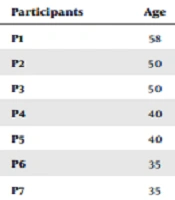
The present study was carried out using a purposive intensity sampling method. In this sampling method, the main goal is the detailed and in-depth examination of individuals with common main characteristics. The study population encompassed seven experts and key informants in the field of virtual education and e-learning who had relevant work experiences and had made decisions about virtual education institutions across Iran (Table 2).
Table 2.
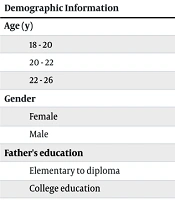
Participants’ Demographic Characteristics
| Participants | Age | Gender | Level of Education |
|---|---|---|---|
| P1 | 58 | Male | Professor |
| P2 | 50 | Female | Associate professor |
| P3 | 50 | Female | Associate professor |
| P4 | 40 | Female | Assistant professor |
| P5 | 40 | Male | Assistant professor |
| P6 | 35 | Female | Instructor |
| P7 | 35 | Male | Ph.D. candidate |
The researcher mainly focused on selecting experienced individuals in the field of virtual university. The sampling process and interviews continued as long as data saturation was reached and no new information was added (14).
3.4. Data Rigor
To ensure data rigor, Guba and Lincoln’s four criteria (credibility, confirmability, dependability, and transferability) were used (15).
To ensure credibility, four activities, including prolonged engagement, continuous observation, peer review of interviews, and re-examination, were carried out by the participants. Moreover, to achieve confirmability, the researcher recorded and kept a complete record of the raw data, i.e., the recorded primary data and the notes and details of the coding and analysis process. Accordingly, the processes and functions and any interpretations or claims made in the study were clearly stated at all research steps. To achieve dependability, a deep methodological description was presented to carefully check the integrity of the results and the possibility of repeating the study. To meet the last criterion, the methodological data, the number of participants, data collection methods, the number and length of the data collection sessions, and the intervals of data collection were mentioned.
4. Results
This qualitative study was conducted using a thematic content analysis approach, which aimed at identifying key informants' views in the field of virtual education. The data analysis led to the emergence of 520 primary codes. Braun and Clarke's six-step method were used to categorize the results into four main themes, 13 categories, and 38 subcategories (Table 3). The analysis steps were carried out as follows:
Table 3.
Themes, Categories, Subcategories, and Sample Codes
| Themes | Categories |
|---|---|
| 1. Education manifestation | Virtual pedagogy |
| 2. Technological appearance | Educational environment |
| 3. Iranian context | Virtual design of teaching-learning processes; infrastructure; technological flexibility; transformative technologies; transformative technologies; strategic review; capacity building; administrative bureaucracy; key stakeholders |
| 4. Institutional virtual medical education | Mission; philosophy |
(1) Reviewing collected data: After transcribing the data and descriptive details, the researcher studied them several times and wrote down the preliminary ideas. The qualitative data were repeatedly studied in this step to search for meanings and patterns.
(2) Generating initial codes: When the researcher became familiar with the data, initial coding was performed. The interesting features of the data were coded systematically according to their collection method. In this step, 600 initial codes were extracted from the interview.
(3) Searching for themes: In this step, the researcher identified potential themes; however, incomplete, unrelated, and duplicate codes were removed.
(4) Reviewing themes: In this step, the researcher arrived at the thematic analysis map by reviewing the themes and re-examining their relationship with the first-level codes and other second-level themes.
(5) Defining and naming themes: After getting a general picture of the themes and modifying the specific codes in each theme and the general story of the analysis, the main themes were labeled. Four main themes were identified at this stage after going back and forth among the sub-themes.
(6) Preparing final report: The main themes were reported in detail in the study's Discussion Section.
5. Discussion
The present study aimed to identify and extract the basic factors affecting the local model for the virtual university of medical sciences from the viewpoint of the informants in the field of virtual education of medical sciences in Iran. Data analysis revealed four main themes: Educational manifestation, technological appearance, Iranian context, and institutional virtual medical education.
Theme 1: Educational manifestation
According to the thematic data analysis, the first theme was "pedagogical phenomenon." The theme refers to the pedagogical approaches and references of a virtual university.
The participants in this study believed that the creation of a virtual educational environment has its specific approaches and prerequisites. Moreover, considering the differences between traditional and virtual educational approaches, the educational manifestation of a virtual university from the viewpoint of its audience should be specific, dynamic, and progressive.
For example, P2 states, "face-to-face and virtual education are highly different. Here we do not have face-to-face communication or student presence. Virtual education must be designed thoughtfully. The educational components and facilities are different. We must reinforce collaborative learning."
In this regard, in a study entitled "virtual university: An educational tool for higher education administration," Penrod and Perry suggest that virtual universities provide a realistic and extraordinary learning experience for postgraduate students to discover policies and coordination in decision-making. It provides access to higher education management and also enriches the learning experience of graduates from such universities (16).
Theme 2: Technological appearance
In the present study, this theme comprises four subcategories: Infrastructure, technological flexibility, transformative technologies, and technology implementation. In this research, the participants highlighted the importance of technology-based mechanisms in a virtual university of medical sciences. This is what brings educational differences and ensures learning achievements for learners.
Most experts agree with McLuhan’s statement," which was first expressed in the 1960s: "Technologies both affect and limit the type of application." Some technologies have specific pedagogical approaches in their hearts; hence, their application deeply affects curriculum design models (17).
In this regard, P7 notes, "we as educators are kind of strangers to technology. It seems like there are a bunch of individuals who are very different and necessarily study engineering. This is, while all personnel of a virtual university must be familiar with the technology."
In sum, all users of virtual networks have now become active knowledge producers using software and various information technology tools at different levels of complexity. From this perspective, the essential technological component of the virtual university in the health education system include "interactivity" and "the possibility of reusing technology". In this regard, technology implementation, one of the operational components of the model, has a prominent presence (18).
The educational technology laboratory of this service group is in charge of developing a website for academic disciplines, producing and using simulators, producing educational video software, designing audio-visual facilities, and expanding educational software and workshops to empower faculty members to implement educational technologies.
Theme 3: Iranian context
This theme consists of four subcategories: Strategic review, capacity building, administrative bureaucracy, and key stakeholders. In general, context is of utmost importance in education from the participant's viewpoint. For example, P1 states, "we must indigenize many technologies. For example, when we are talking about the learning management system, it must be indigenized. We must think about the production and use of native technologies."
Various studies have shown that all social institutions, including educational institutions, are the products of their society's culture. The social changes and global transformations have invalidated many traditions and have affected the cultural and civilizational components. Such advancements have resulted in a highly complicated situation for educational institutions (19).
Theme 4: Institutional virtual medical education
This theme consists of two subcategories, i.e., philosophy and mission. The participants believe that a strategic plan underpinned by a specific educational philosophy is one of the prerequisites for establishing such a university. For example, P3 mentions, "the vision of such a university should be based on philosophy. For example, consider successful foreign universities, they have a philosophy, and this philosophy, which shows itself in the vision, does not necessarily include competitive statements. For example, you should not say, "I want to be the first in the region." Learning should be a priority".
According to the existing texts, the distance education approach to follow the concept of a system refers to the regularity of thought on a specific educational issue or a phenomenon depicting the correlation between the principles and the objectives and realities of that phenomenon with the same scientific and theoretical infrastructure of the traditional educational system (20).
Each system first specifies models for fulfilling tasks by relying on scientific theories. However, the theories underpinning the traditional education system are not responsive to the new changes in distance education, and this shortcoming is a factor, which is often considered by the technologists as the administrator of this approach. Considering the existing ambiguities, it is not clear whether technology is based on education, overcomes it, and must follow the intellectual and philosophical foundations of technology, or whether technology is in the center of education and is a tool to present it more effectively to benefit from the rules of educational sciences.
It also seems that technology has overcome distance education and learning due to the lack of coherent philosophical support and appropriate scientific theories for distance education, especially electronic and online education. Under ideal conditions, technology must play an auxiliary and facilitating role in the learning process.
Such a shortcoming implies non-reliance on specific philosophical and scientific theories in distance education. The distance education system is a complicated system encompassing a set of elements, each of which is a system in turn and forms a larger whole with other system elements. It is necessary to analyze the internal elements and components as well as the connections between small and larger systems.
5.1. Conclusions
Data analyses revealed four basic factors effective in developing a model for the virtual university of medical sciences from the participants' viewpoint. They believed the virtual university should consider curriculum design based on learners’ cognitive needs as well as the effects of technologies on the formation of virtual education culture. Moreover, theories underpinning the traditional education system are no longer responding to the new changes in virtual education, and there is an urgent need for scientific theories tailored to virtual education to manage technology.