
1. Background
Diabetes is recognized as one of the most common metabolic disorders worldwide (1). One of the most important types of diabetes is type 2 diabetes. Type 2 diabetes is one of the most chronic medical diseases characterized by partial insulin imbalance caused by dysfunction of pancreatic beta cells and insulin resistance in target organs (2). There are 415 million people living with diabetes worldwide, and despite the increase in medical and general knowledge about diabetes, the prevalence of this disease is increasing worldwide (3). Physical illness is a risk factor for mental disorders (4). Psychological advances have shown that positive and negative metacognitive beliefs are involved in mental health. It seems that people's metacognitive beliefs have an effect on their psychological health. Metacognitions are knowledge about cognition in general, as well as awareness and knowledge about the person's own cognition in particular. According to metacognitive theory, disturbed beliefs about cognitions that produce metacognitions play a central role in the worsening and perpetuation of psychological disorders (5). It seems that there is a significant correlation between metacognitive beliefs and emotional problems. The main focus is not on symptoms or diagnosis, but on dysfunctional metacognitive beliefs and the executive function of self-regulation behind thoughts. This vulnerability appears to be due to the chronicity of the disorder, which is associated with a particular negative thinking style (6).
The metacognitive approach to diabetes believes that negative metacognitions can double the psychological problems of people with diabetes by increasing anxiety and stress (7). In this regard, Ashoori in a study showed that metacognitive therapy reduces anxiety and depression in patients with type 2 diabetes (8). Khodabakhshi Koolaee et al. showed that metacognitive beliefs can affect adaptation and quality of life in patients with diabetes (9). In another study, Samadifard and Narimani showed that cognitive avoidance and metacognitive beliefs can predict quality of life in patients with diabetes (10).
Having diabetes and the need for the patient to pay attention to prevent recurrence of the disease cause many challenges in daily life, which highlights the importance of using coping styles to adapt to the disease (11). Coping styles are the mental, emotional, and behavioral efforts that are made when faced with stress to overcome, tolerate, or minimize the effects of illness or difficulty. Researchers have categorized coping styles into different forms. One of the classifications has divided coping strategies into problem-oriented and emotion-oriented coping according to the orientation of the coping process towards the perceived problem or the individual's feelings (12). In a "problem-oriented" confrontation, also called a "task-oriented" confrontation, the person is directly confronted with a stressful situation in order to moderate the stressor and achieve the goal. Therefore, problem-oriented coping is "action-oriented" and is achieved by changing the relationship between the individual and the environment. In the face of emotion, to adjust the stressor and achieve the goal, the person adjusts the emotional states related to or caused by the stressor. This type of confrontation affects a person's behavior in considering the stressor and his evaluation and interpretation of that factor and deals with changing the meaning of the stressor (13).
There are many treatments to reduce the problems and complications of diabetes, such as medication, diet, exercise, etc. It seems that these treatments usually target the secondary features of the disease and not the disease itself. Therefore, one of the therapies that have not been considered by researchers so far is the effectiveness of cognitive-behavioral rehabilitation therapy based on immunization training against stress. This treatment is a combination of traditional cognitive-behavioral therapy and immunization training against stress (14). Immunization against stress strongly and directly emphasizes the thoughts, feelings, perceptions, and analysis of a person's daily life (14, 15). The second stage is the stage of acquiring skills and training. At this stage, the therapist works on cognitive and behavioral skills. These methods include new information, cognitive reconstruction, changing negative self-talk to positive self-talk, behavioral efforts to calm down, assertiveness, and self-confidence to deal with stressful situations (16, 17). The final step is to plan for the future, follow up on what you have learned to solve future problems, and apply stress reduction techniques to practice the skills learned in real life. In the field of cognitive-behavioral reconstruction of immunization against stress, the therapist can help patients to better cope with stress (14). Karimi Sani et al. found in a study that cognitive and behavioral therapy leads to behavioral changes in diabetic patients by changing dysfunctional thoughts and helping to accept the disease (4). In a study, Seyed Nour and Homaei found that cognitive-behavioral therapy was effective in improving self-care behaviors, mental well-being, and hope in patients with type 2 diabetes (18).
The number of people with diabetes is increasing, and this disorder causes problems in personal relationships, especially in the field of anxiety, depression, and personal and social relationships (19), so it is necessary to use an effective treatment method to help these people. Also, according to the background review, no study has investigated such research in people with diabetes, so this research tries to fill this research gap. According to the mentioned cases, the aim of this study was to evaluate the effectiveness of cognitive-behavioral rehabilitation based on stress immunization training on metacognitions and coping styles of women with type 2 diabetes.
2. Objectives
This study aims to address this research gap by evaluating the effectiveness of this innovative therapeutic approach.
3. Methods
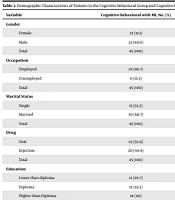
The method of the present study was quasi-experimental pre-test and post-test with a control group. The statistical population of the study included all women with type 2 diabetes in Sari. The sample consisted of 30 women with diabetes who were purposefully selected from people with diabetes who referred to the office of Dr. Mashayekh Bakhshi, a specialist in endocrinology and metabolism, and were simple random (random number table) assigned to experimental and control groups (15 people in each group). It should be noted that according to the source of research methods in the humanities and social sciences, the minimum sample size in experimental research for each group was 15 people. Therefore, the researchers in the present study considered the same number to conduct research (20). The method of sample selection was as follows: First, among all patients with type 2 diabetes who were treated in Dr. Farhad Mashayekhbakhshi's office, 45 people were purposefully selected and among them, 30 people were selected as the final sample based on inclusion and exclusion criteria. We selected and randomly replaced the experimental and control groups (15 people in each group). The experimental group was then exposed to 10 sessions of cognitive-behavioral rehabilitation group therapy based on immunization training against stress and the control group did not receive any treatment. Inclusion criteria were: Having type 2 diabetes, filling out the form of moral satisfaction, not suffering from mental disorders and addiction, etc. Also, the exclusion criteria were: Absence from more than two sessions of intervention, dissatisfaction with continuing Research, participating simultaneously in other intervention programs. The data were analyzed using the statistical method of multivariate analysis of covariance and SPSS-23 software.
3.1. Tools Used for Data Collection
3.1.1. Short Form of Metacognitions Questionnaire 30 (MCQ-30)
The short form of Wells and Cartwright-Houghton Metacognitive questionnaire was used to measure metacognitive beliefs (21). This questionnaire is a self-report scale of metacognitions consisting of 30 questions across five components. Each item is scored on a four-point scale, ranging from disagree (1) to strongly agree (4). Wells and Cartwright-Hatton reported the reliability of this scale with Cronbach's alpha coefficients ranging from 0.76 to 0.93 for the overall scale and subscales. The test-retest reliability was 0.75 for the overall scale and 0.87 to 0.95 for the subscales (21). In Iran, Jalili et al. reported the reliability of the questionnaire using Cronbach's alpha method as 0.82 (22).
3.1.2. Coping Styles Questionnaire
This scale, developed by Endler and Parker in 1990, consists of 48 items measuring three dimensions: Problem-oriented, emotion-oriented, and avoidance strategies (16 items each). Items are scored on a five-point Likert scale (1 = never to 5 = very often). The score for each dimension is calculated by summing the scores of its constituent items, resulting in a range of 16 to 80 for each dimension. A higher score indicates stronger features of that dimension (23). Endler and Parker confirmed the scale's structure validity using confirmatory factor analysis and reported its reliability with Cronbach's alpha coefficients of 0.92 for the problem-oriented dimension, 0.82 for the emotion-oriented dimension, and 0.85 for the avoidance dimension (23). In Iran, Sadr et al. reported the reliability of the Coping Styles questionnaire using Cronbach's alpha coefficients of 0.88 for the problem-oriented dimension, 0.85 for the emotion-oriented dimension, and 0.78 for the avoidance dimension (24).
3.2. Treatment Protocol
Cognitive-behavioral stress management sessions were conducted over 10 two-hour group sessions, with two 45-minute sessions per week, following the practical guide to cognitive-behavioral stress management by Antoni et al. (25) for the experimental group. The control group did not receive any intervention.
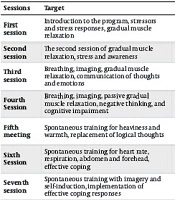
As shown in Table 1, a summary of cognitive-behavioral therapy sessions based on stress-safety training is provided.
Table 1.
Objectives and Content of Cognitive-Behavioral Rehabilitation Therapy Based on Stress Immunization Training
| Sessions | Target | Content |
|---|---|---|
| First session | Introduction to the program, stressors and stress responses, gradual muscle relaxation | Introduce yourself and the group members, provide general information about the program and purpose, explain the principle of confidentiality, and study the stressors, the physical effects of stress, the possible consequences of chronic stress on health, relaxation training and the implementation of gradual muscle relaxation. |
| Second session | The second session of gradual muscle relaxation, stress and awareness | Gradual muscle relaxation training for 8 muscle groups, completing a checklist of stress symptoms, reviewing the effects of stress and increasing awareness of the physical symptoms of stress. |
| Third session | Breathing, imaging, gradual muscle relaxation, communication of thoughts and emotions | Introducing diagrammatic breathing, gradual muscle relaxation training for 4 muscle groups, imaging and relaxation exercises, reviewing the signs and effects of stress, examining the relationship between thoughts and emotions, practicing thinking power. |
| Fourth Session | Breathing, imaging, passive gradual muscle relaxation, negative thinking, and cognitive impairment | Combining diaphragmatic breathing with imaging, gradual passive muscle relaxation (meaning that they do not contract any muscle) along with imaging a specific place, examining negative thinking and cognitive distortions, the effect of negative thinking on behavior, practicing negative thoughts. |
| Fifth meeting | Spontaneous training for heaviness and warmth, replacement of logical thoughts | Introducing spontaneous training and presenting its instructions, implementing spontaneous training for heaviness and heat, examining the difference between logical and irrational self-talk, introducing steps to replace logical thoughts, practicing logical thought replacement. |
| Sixth Session | Spontaneous training for heart rate, respiration, abdomen and forehead, effective coping | Introduction of diaphragmatic breathing, implementation of spontaneous training for heart rate, respiration, abdomen and forehead, discussion on integrating stress and relaxation management, definition of coping, introduction of effective and ineffective coping strategies, discussion on coping strategies. |
| Seventh session | Spontaneous training with imagery and self-induction, implementation of effective coping responses | Performing self-healing exercises with visual imagery and positive self-induction, performing sunlight meditation with self-healing, introducing effective coping steps, performing effective coping exercises, introducing softening techniques for exhausting stressors and performing its exercises. |
| Eighth session | Mantra meditation, anger management | Introducing meditation, present meditation postures and perform mantra meditation, discuss the benefits of regular practice, discuss the concept of anger and anger responses, help members self-assess anger, discuss anger and awareness, anger management training. |
| Ninth session | Breath counting meditation, expression training | Performing breath counting and sun meditation with self-born children, introducing interpersonal styles, discussing the barriers to expressive behavior, presenting the components of expressive communication, discussing the use of problem solving for conflicts, examining the steps of more expressive behavior. |
| Tenth session | Illustration and meditation, social support and program review | Reviewing relaxation exercises, perform beach scene imagery and breathing counting exercises, discuss social support and its benefits, discuss social maintenance barriers, teach stress management techniques to maintain social support, review the entire program, and help group members create a personal stress management program. |
4. Results
Based on demographic findings, the mean (and standard deviation) age of the subjects in the experimental group was 32.933 (7.759), and in the control group, it was 36.733 (9.254).
As can be seen in Table 2, all variables in women with type 2 diabetes in the pre-test and post-test in the experimental group show significant differences.
Table 2.
The Mean ± SD of Metacognitions and Coping Styles in Women with Type 2 Diabetes in Experimental and Control Groups
| Variables | Experimental | Control | Leven Test | P | Partial Eta Squared |
|---|---|---|---|---|---|
| Metacognitions | |||||
| Pre-positive beliefs about anxiety | 17.73 ± 2.57 | 16.73 ± 3.12 | 0.093 | 0.002 | 0.369 |
| Post-positive beliefs about anxiety | 10.33 ± 1.83 | 15.80 ± 3.78 | |||
| Pre-negative beliefs about uncontrollability | 14.86 ± 3.48 | 15.60 ± 3.66 | 0.567 | 0.001 | 0.410 |
| Post-negative beliefs about uncontrollability | 10.80 ± 2.45 | 16.06 ± 2.15 | |||
| Pre-lack of cognitive assurance | 17.13 ± 3.66 | 16.40 ± 3.01 | 0.540 | 0.000 | 0.486 |
| Post-lack of cognitive assurance | 10.20 ± 1.97 | 16.53 ± 2.97 | |||
| Pre-thought control | 15.40 ± 2.94 | 14.53 ± 3.09 | 0.752 | 0.000 | 0.496 |
| Post-thought control | 10.53 ± 1.95 | 15.73 ± 2.76 | |||
| Pre-self-awareness | 15.80 ± 2.88 | 16.46 ± 3.44 | 0.162 | 0.012 | 0.280 |
| Post-self-awareness | 10.73 ± 2.01 | 16.863.52 | |||
| Coping styles | |||||
| Pre-emotional oriented | 47.60 ± 8.78 | 49.33 ± 9.55 | 0.905 | 0.004 | 0.341 |
| Post-emotional oriented | 27.33 ± 7.82 | 46.53 ± 10.82 | |||
| Pre-problem oriented coping strategies | 36.33 ± 10.05 | 32.86 ± 9.51 | 0.419 | 0.010 | 0.291 |
| Post-problem-oriented coping strategies | 55.13 ± 13.81 | 35.20 ± 11.73 | |||
| Pre-avoidance oriented | 53.80 ± 12.90 | 49.93 ± 11.54 | 0.091 | 0.008 | 0.301 |
| Post-avoidance oriented | 26.86 ± 4.47 | 43.20 ± 12.01 |
The Kolmogorov-Smirnov test was used to check the normality of the distribution. The results showed that the significance levels of each research variable were greater than 0.05 (P > 0.05), indicating that the data for all variables were normally distributed.
To investigate the assumption of variance homogeneity, Levene's test was applied. The significance levels for this test were all higher than 0.05, indicating homogeneity of variance across variables. The significance levels of all tests permitted the use of analysis of covariance (ANCOVA).
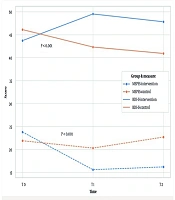
These findings indicate that stress immunization training is effective on metacognitions and coping styles of patients with type 2 diabetes (Wilks' Lambda = P < 0.05). According to the results in Table 2, after controlling for pre-test scores, the difference between metacognition components and coping strategies in the experimental and control groups was statistically significant (P < 0.05).
5. Discussion
The aim of this study was to evaluate the effectiveness of cognitive-behavioral rehabilitation treatment based on stress immunization training on metacognitions and coping styles of women with type 2 diabetes.
Based on the first finding of this study, it was determined that cognitive-behavioral rehabilitation treatment based on stress immunization training has a significant effect on the metacognitions of women with type 2 diabetes. This finding aligns with the results of Sohrabi et al. (26) and Fereshteh Zamani-Alavijeh et al. (27).
Explaining this finding, metacognition refers to knowledge about thinking and cognition and the factors influencing thoughts. Theoretical and therapeutic perspectives on metacognition emphasize negative beliefs and thoughts as outcomes of metacognitive control over cognition and highlight how metacognition contributes to the persistence and alteration of cognition. The metacognitive approach to diabetes posits that negative metacognitions exacerbate psychological problems in people with diabetes by increasing anxiety and stress (7).
Cognitive-behavioral therapy based on stress immunization is recognized as a successful approach in addressing various patient challenges. The fundamental principle of this therapy is to focus on reducing negative thoughts, disturbed emotions, and destructive behaviors, aiming to protect individuals from stress and adversity. Immunization against stress strongly and directly emphasizes addressing the thoughts, feelings, understanding, and analysis of a person's daily life, ultimately reducing their pain and suffering (14, 15).
Based on another finding of this study, it was determined that cognitive-behavioral rehabilitation treatment based on stress immunization training has a significant effect on the coping styles of women with type 2 diabetes.
This finding aligns with the results of Lee et al. (28) and Amire et al. (29). Studies indicate that stress immunization training reduces anxiety, depression, and perceived stress in women (30, 31), improves positive coping strategies while reducing negative coping strategies, and alleviates symptoms of post-traumatic stress disorder in victims of war and torture (32). In the context of cognitive reconstruction through stress immunization, therapists can help patients with diabetes develop better coping mechanisms to manage stress (33).
Asadi Haghighat et al. found that training in a cognitive-behavioral stress management program increases resilience in patients with multiple sclerosis by promoting resilience factors such as control, commitment, and the ability to challenge problems (33).
Explaining this finding, the coping skills guidelines within the stress immunization training program encourage individuals to approach problems in new ways during stressful situations and to reevaluate their previous beliefs. These beliefs can foster the adoption of positive and effective coping strategies. When individuals feel they can control environmental stressors, they are empowered to make changes to their surroundings, which, in turn, helps them reflect on successful experiences and increases their confidence in handling stressful life situations. This confidence can extend to other situations, promoting a positive inner understanding and improving stress management. Ultimately, this process reduces reliance on emotional problem-solving strategies in individuals with diabetes.
5.1. Conclusions
In the process of cognitive-behavioral rehabilitation treatment based on stress immunization training, patients with diabetes are encouraged to evaluate the relationship between negative spontaneous thoughts, feelings of depression, and behaviors resulting from those thoughts as a criterion for assessing their validity or correctness. This process helps them correct their self-talk. As a result, correcting self-talk reduces negative metacognitions, modifies emotional strategies, and improves problem-solving strategies in patients with diabetes, ultimately alleviating their problems.