


1. Background
Nursing has long been recognized as a highly stressful profession due to its inherent nature. Research on stress in nursing has shown how daily exposure to suffering, grief, and death, coupled with specific working conditions, can lead to high levels of occupational stress and burnout, which may therefore challenge nurses (1, 2). Occupational stress is stress that arises from work or non-work related stimuli that cannot be overcome, leading to disturbances with consequences beyond the stress itself, affecting the smoothness of performance (3). Conflict between nurses and patients and families, especially with difficult and complex patients, is one of the factors contributing to work stress in nurses (4, 5). In addition to work stress, hospitals are currently facing various challenges in the field of nursing, including nurse shortage, job dissatisfaction among nurses, and a poor working environment for nurses (5). Occupational stress occurs when expectations from the individual exceed their options and abilities. Nurses are constantly exposed to stress due to the sensitive nature of their profession, making stress a recognized component of modern nursing and a challenge for the nursing profession (6).
Life satisfaction refers to the level of subjective contentment derived from the fulfillment of individual needs and desires in various aspects of life (7). A recent study on nursing personnel found that nurses who were dissatisfied with their lives were more likely to develop mental disorders, with a risk up to 2.4 times higher (8). Several studies have shown that nurses' life satisfaction is associated with job satisfaction, compassion, and self-efficacy (8, 9). Additionally, life satisfaction is positively correlated with job burnout, and nurses with low life satisfaction are prone to job burnout (10). Therefore, promoting nurses' life satisfaction is crucial for job retention and mental health promotion.
Job satisfaction in nurses refers to their contentment with various aspects of their work environment, tasks, and relationships, which plays a significant role in improving and enhancing their life satisfaction by increasing well-being and reducing burnout (11, 12). A study by Lu et al. (13) found that job satisfaction is positively associated with life satisfaction among nurses, suggesting that a fulfilling work experience can contribute to their overall happiness and quality of life. In Iran, Javanmardnejad et al. (14) demonstrated that job satisfaction is a crucial factor influencing nurses' life satisfaction and mental health.
Nurses' life satisfaction is paramount to the effective functioning of healthcare systems. While prior research has examined the interrelationship between occupational stress, job satisfaction, and life satisfaction among nurses, the specific mediating role of job satisfaction warrants further exploration (15, 16). This study seeks to contribute to the existing literature by investigating the predictive relationship between occupational stress and life satisfaction, with a particular emphasis on the mediating role of job satisfaction. By elucidating the nuances of these relationships, this research can offer valuable insights for the development of targeted interventions and policies aimed at enhancing the well-being and job performance of nurses in healthcare settings.
This study draws upon the conservation of resources (COR) theory to examine the relationships between occupational stress, job satisfaction, and life satisfaction among nurses. According to COR theory, individuals endeavor to acquire and maintain resources that they deem valuable. When individuals experience stress, they may encounter threats to or lose their existing resources. Job satisfaction, as a valuable resource, can mitigate the adverse effects of occupational stress on life satisfaction. By comprehending the interplay between these factors, this study can provide valuable insights for the development of interventions and policies designed to enhance the well-being and job performance of nurses in healthcare settings.
2. Objectives
This study aims to predict nurses' life satisfaction by examining the role of occupational stress, with a focus on how job satisfaction mediates this relationship. By exploring these factors, we seek to gain insights that can inform interventions and policies designed to enhance nurses' well-being and job performance in healthcare settings.
3. Methods
This study employed a correlational design utilizing structural equation modeling (SEM) to investigate the relationships between variables. The target population comprised all nurses currently employed in hospitals within Ahvaz City in 2023. A convenience sampling approach was adopted, with the following inclusion and exclusion criteria: Nurses working in acute care settings, with a minimum of two years' clinical experience, and who were able to provide informed consent were included. Nurses who were unable to complete the questionnaires, on maternity leave or other extended absences, or not actively working at the time of the study were excluded. A sample size of 200 participants was predetermined to ensure adequate statistical power and to account for potential attrition. This sample size was based on a power analysis conducted using G*Power, assuming a medium effect size (f = 0.25), an alpha level of 0.05, and a power of 0.80. This analysis indicated that a sample size of 196 participants would be sufficient to detect a medium effect size with a power of 0.80. By adding a 10% buffer to account for potential attrition, a final sample size of 200 participants was determined. After obtaining informed consent, data collection commenced. Upholding ethical principles, participants retained the right to withdraw from the study at any point and were guaranteed anonymity throughout the research process. Following data cleaning procedures to address incomplete or corrupted questionnaires, the final analysis included 182 responses.
3.1. Research Instruments
3.1.1. Satisfaction with Life Scale
Life satisfaction was assessed using the well-established Satisfaction with Life Scale (SWLS) developed by Diener et al. (17). This five-item instrument employs a 7-point Likert Scale ranging from 1 (strongly disagree) to 7 (strongly agree), with total scores ranging from 5 to 35. The SWLS has a documented history of strong internal consistency, with Cronbach's alpha coefficients typically exceeding 0.83 (18). In the present study, the SWLS demonstrated excellent internal consistency, with a Cronbach's alpha of 0.83. This high alpha value suggests that the SWLS items effectively measure a unified construct: Life satisfaction.
3.1.2. The Minnesota Satisfaction Questionnaire
Job satisfaction was measured using the Minnesota Satisfaction Questionnaire (MSQ) (19). This established 19-item instrument employs a 5-point Likert Scale (1 = strongly disagree, 5 = strongly agree) to evaluate various aspects of job satisfaction. Total scores are derived by summing responses across all items, with higher scores reflecting greater satisfaction. Prior research has documented good internal consistency for the MSQ, with Cronbach's alpha coefficients exceeding 0.80 (20). In the current study, the MSQ demonstrated similar reliability, with a Cronbach's alpha of 0.88. This high alpha value suggests that the MSQ items effectively measure a unified construct of job satisfaction.
3.1.3. The Nursing Stress Scale
The Nursing Stress Scale (NSS) was developed by Gray-Toft and Anderson in 1981 (21). This 34-Item Questionnaire is the first instrument specifically designed to measure nursing stress rather than general occupational stress. The scale's questions are categorized into seven subscales: Death and dying, conflict with physicians, inadequate preparation, lack of support resources, conflict with other nurses, workload, and uncertainty about treatment. The instrument utilizes a 4-point Likert Scale (ranging from 1 to 4) (21). Total scores range from 34 to 136, and stress levels are categorized as follows: Low stress (≤ 68), moderate stress (69 - 103), and high stress (≥ 104). In general, higher scores on this questionnaire indicate higher levels of stress, while lower scores indicate lower levels of stress. In the present study, Cronbach's alpha was 0.82.
3.2. Data Analysis
Structural equation modeling was employed to analyze the collected data. This statistical technique allowed for the simultaneous examination of hypothesized relationships between multiple latent and manifest variables. The hypothesized model posited that occupational stress would have a direct negative effect on life satisfaction and an indirect negative effect through its impact on job satisfaction. Job satisfaction was hypothesized to mediate the relationship between occupational stress and life satisfaction. The software programs SPSS-25 and AMOS-24 were utilized for data management and model analysis, respectively. A significance level of α = 0.05 was adopted to assess the statistical significance of the hypothesized relationships in the model.
4. Results
The sample demographics revealed a predominantly female sample, with 71.8% women and 28.2% men. Most participants were between 31 and 35 years old (41.2%), followed by those aged 26 - 30 years (26.6%). Approximately half of the sample was married (48.0%), while the other half was single (51.0%). Work experience ranged from 5 years or less (26.0%) to over 20 years (5.0%).
Table 1 presents the descriptive statistics (mean, standard deviation) of the study sample and the results of Pearson's correlation tests to examine the relationships between the predictor, mediator, and criterion variables. The mean occupational stress score was 86.49 with a standard deviation of 20.03. The mean job satisfaction score was 61.07 with a standard deviation of 15.35. The mean life satisfaction score was 21.93 with a standard deviation of 7.61. The results indicated that occupational stress was significantly negatively correlated with job satisfaction (r = -0.47, P < 0.001) and life satisfaction (r = -0.27, P < 0.001). Job satisfaction was also significantly positively correlated with life satisfaction (r = 0.44, P < 0.001). These findings suggest that higher levels of occupational stress are associated with lower levels of job satisfaction and life satisfaction, while higher levels of job satisfaction are associated with higher levels of life satisfaction. To simultaneously test the hypothesized relationships in the current study, SEM was employed.
Prior to SEM analysis, the assumptions of multivariate normality, linearity, multicollinearity, and error independence were verified. Data normality was assessed using skewness and kurtosis tests. All study variables exhibited absolute skewness values below 2 and absolute kurtosis values below 3, satisfying the assumption of normality for the entire sample. Multicollinearity was evaluated through tolerance and variance inflation factor (VIF) statistics. Variance inflation factor values for all variables remained below 10, and tolerance values exceeded 0.1, confirming the absence of multicollinearity. Finally, Durbin-Watson's test was employed to assess error independence. The obtained value of 2.16 fell within the acceptable range of 1.5 - 2.5, indicating no significant autocorrelation among the residuals.
Table 2 summarizes the fit indices for the hypothesized and subsequently modified model. These indices include the chi-square statistic to degrees of freedom ratio (χ²/df), Incremental Fit Index (IFI), Comparative Fit Index (CFI), Normed Fit Index (NFI), Goodness-of-Fit Index (GFI), and root mean square error of approximation (RMSEA). Initial analysis indicated that the proposed model did not achieve satisfactory fit on some indices, particularly the RMSEA. Furthermore, as shown in Table 3 (not shown here), the direct paths from occupational stress to life satisfaction and from occupational stress to job satisfaction were non-significant. Consequently, these non-significant paths were removed, resulting in a modified model. The fit indices of the modified model were then re-evaluated. As presented in Table 2, the final modified model demonstrated acceptable fit across all indices (RMSEA = 0.06). A visual representation of the standardized path coefficients in the final tested model is provided in Figure 1.
Table 2.The Fit Indices of the Initial and Final Models
| Fit Indicators | χ2 | df | (χ2/df) | IFI | CFI | NFI | GFI | RMSEA |
|---|---|---|---|---|---|---|---|---|
| Initial model | 102.24 | 26 | 3.93 | 0.93 | 0.95 | 0.89 | 0.91 | 0.13 |
| Final model | 48.46 | 23 | 2.11 | 0.95 | 0.99 | 0.98 | 0.99 | 0.06 |
Table 3.Path Coefficients for Direct and Indirect Relationships of Variables in the Final Model
| Pathes | Final Model | |
|---|---|---|
| β | P | |
| Occupational stress → life satisfaction | -0.08 | 0.311 |
| Occupational stress → job satisfaction | -0.47 | 0.001 |
| Job satisfaction → life satisfaction | 0.40 | 0.001 |
| Occupational stress → life satisfaction through the mediating role of job satisfaction | -0.21 | 0.001 |
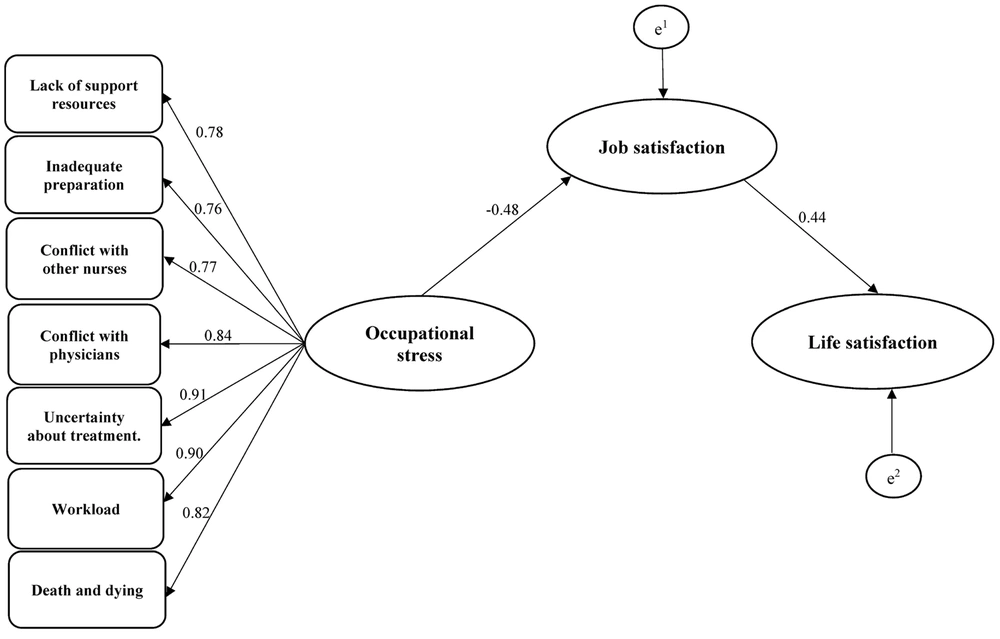
Figure 1.
Standard path coefficients of the final model
Table 3 presents the path coefficients and their standardized estimates for the final model. The findings revealed a significant negative association between occupational stress and job satisfaction among nurses (P < 0.001). Conversely, a significant positive relationship emerged between job satisfaction and life satisfaction (P < 0.001). Interestingly, the direct effect of occupational stress on life satisfaction was not significant. However, the analysis provided evidence for a significant indirect effect of occupational stress on life satisfaction, mediated by job satisfaction (P < 0.001).
5. Discussion
The current study aimed to investigate the relationship between occupational stress and life satisfaction, with job satisfaction serving as a mediating variable among nurses. The results revealed a significant negative association between occupational stress and job satisfaction among nurses, indicating that higher levels of occupational stress are associated with lower levels of job satisfaction. Conversely, a significant positive relationship was found between job satisfaction and life satisfaction, with nurses who reported greater job satisfaction also reporting higher levels of life satisfaction. Interestingly, the direct effect of occupational stress on life satisfaction was not significant. However, the analysis provided evidence for a significant indirect effect of occupational stress on life satisfaction, mediated by job satisfaction. This suggests that job satisfaction plays a crucial mediating role in the relationship between occupational stress and life satisfaction for nurses. These findings align with previous studies (22-24). For instance, Piotrowski et al. (22) found a strong inverse relationship between occupational stress and job satisfaction among healthcare professionals during the COVID-19 pandemic. Similarly, Glaz (23) observed a negative correlation between occupational stress and job satisfaction in Polish nurses. However, the current study diverges from previous research regarding the relationship between job satisfaction and life satisfaction. While Hadizadeh Talasaz et al. (24) reported a positive association between job satisfaction and job performance, our findings suggest a stronger link between job satisfaction and life satisfaction. This could be attributed to the unique challenges faced by nurses during the COVID-19 pandemic, which may have amplified the impact of job satisfaction on overall well-being. Furthermore, the indirect effect of occupational stress on life satisfaction mediated by job satisfaction is a novel contribution to the existing literature. Previous studies have primarily focused on the direct relationship between these variables, neglecting the potential mediating role of job satisfaction. Our findings highlight the importance of considering job satisfaction as a key factor in understanding the impact of occupational stress on nurses' overall quality of life.
The findings of this study supported the hypothesis that nurses exposed to elevated levels of stress are more likely to report lower levels of job satisfaction. This association is readily explicable. The demanding nature of nursing, characterized by heavy workloads, extended shifts, and unpredictable schedules, can create a sense of burnout and disillusionment with the profession (25). Nurses occupy a pivotal position within the healthcare system, with their dedication and expertise forming the cornerstone of patient care and overall well-being. However, the very nature of their profession often exposes them to a complex interplay between occupational stress, job satisfaction, and life satisfaction (26). Occupational stress among nurses is a pervasive concern, stemming from a multitude of factors inherent to the profession. These factors include heavy workloads, extended shifts, and unpredictable schedules, all of which can contribute to burnout and job dissatisfaction (2). Additionally, inadequate staffing, lack of supervisory support, and feelings of undervaluation further exacerbate stress and erode job satisfaction (25).
The findings align with the notion that nurses with greater job satisfaction tend to experience higher levels of life satisfaction. This underscores the importance of cultivating a positive work environment that addresses nurses' needs and fosters a sense of accomplishment. When nurses feel valued, supported, and empowered in their roles, it likely translates into a more positive overall well-being, encompassing life satisfaction (14). Chronic job dissatisfaction, often accompanying occupational stress, can indeed compromise life satisfaction for nurses. It can permeate various aspects of life, leading to sleep disturbances, emotional exhaustion, and a diminished ability to enjoy personal activities (1). This can spiral into a vicious cycle, where elevated stress levels further diminish job satisfaction, which in turn exacerbates life dissatisfaction. However, it is crucial to acknowledge that this cycle represents a general trend. Individual variations play a significant role. Some nurses demonstrate superior stress management abilities, while others may find solace and meaning in aspects of their work that outweigh the challenges.
Interestingly, the analysis revealed a direct effect of occupational stress on life satisfaction that was not statistically significant. This seemingly counterintuitive finding suggests that job satisfaction plays a crucial mediating role in the relationship between occupational stress and life satisfaction for nurses. The significant indirect effect highlights that occupational stress primarily influences life satisfaction through its impact on job satisfaction. In simpler terms, nurses experiencing high levels of stress are more likely to report lower job satisfaction. This diminished job satisfaction, in turn, spills over into other aspects of life, leading to lower life satisfaction. This underscores the importance of intervening at the level of job satisfaction to mitigate the negative impact of occupational stress on nurses' overall well-being.
The intricate relationship between occupational stress, job satisfaction, and life satisfaction among nurses warrants further attention. The significant indirect effect of occupational stress on life satisfaction, mediated by job satisfaction, underscores the crucial role of job satisfaction in buffering the negative impact of occupational stress on nurses' well-being. Potential mechanisms underlying this mediating effect include fostering a sense of belonging and support within the workplace, influencing how nurses perceive and interpret stressors, and promoting a healthy work-life balance. Understanding these mechanisms is critical for developing effective interventions that promote nurse well-being and, consequently, enhance healthcare delivery. By addressing these critical areas, healthcare institutions and policymakers can foster a supportive work environment that promotes nurse well-being, leading to improved patient outcomes and a more resilient healthcare system.
The interpretation of the study findings necessitates acknowledging potential limitations that may have influenced the results. The study employed a sample of nurses from hospitals and healthcare centers within Ahvaz, Iran. Cultural, organizational, and healthcare system variations could potentially impact the observed relationships in different settings. The generalizability of the study findings to other populations and settings should be considered with caution. Additionally, data collection solely relied on self-report questionnaires, introducing potential biases associated with self-reported measures.
5.1. Conclusions
This study investigated the complex interplay between occupational stress, job satisfaction, and life satisfaction among nurses. Key findings revealed a strong negative association between occupational stress and job satisfaction, and a positive relationship between job satisfaction and life satisfaction. Importantly, job satisfaction was found to mediate the impact of occupational stress on life satisfaction, suggesting that improving job satisfaction is crucial for enhancing nurses' well-being. These findings underscore the need for healthcare institutions to prioritize creating supportive work environments that promote job satisfaction among nurses. By addressing factors contributing to occupational stress, such as workload management, staffing levels, and supervisory support, institutions can not only improve nurses' well-being but also indirectly enhance patient outcomes and contribute to a more resilient healthcare system.


