
1. Background
Electronic health records (EHRs) are critical healthcare innovations (1); however, implementation alone is insufficient. Their effectiveness depends on their ability to support clinical decision-making and reduce discrepancies. Despite widespread adoption, challenges related to infrastructure, training, and user acceptance persist (2-3). In neurosurgery, integrated care pathways have been shown to improve outcomes; however, they often lack an evidence-based design (4). Understanding the complexity of these pathways is essential for developing EHR systems that effectively support multidisciplinary neurosurgical care. Quality-improvement studies emphasize innovation in data recording and protocols to enhance care (5).
Incomplete documentation negatively affects outcomes, multidisciplinary decision-making, and quality control (6). EHR transitions require effective change management (7). Retrospective studies identify trends, risk factors, and process weaknesses (8), and large datasets improve outcome evaluations (9). Resource-limited settings face challenges in data extraction, making gap analysis essential before EHR implementation (10). Incomplete documentation does not necessarily reflect suboptimal clinical care; however, it poses significant risks during care transitions, when reliance on written records is greatest.
2. Objectives
This study identified information gaps and documentation patterns in neurosurgical care to develop an evidence-based roadmap for EHR design that prioritizes patient safety. The study was guided by five research questions:
1) What are the frequency and location of documentation gaps across the neurosurgical care pathway?
2) At which transition points does documentation completeness decline most substantially (breakpoints)?
3) How does documentation completeness compare with established clinical documentation standards?
4) What potential causes, hypothesized from documentation patterns and workflow analysis, may underlie the observed gaps?
5) What EHR design requirements can be derived from the observed gaps and hypothesized causes to improve documentation completeness?
3. Methods
3.1. Study Design and Setting
This cross-sectional, retrospective record review was conducted in the neurosurgery department of Khatam-al-Anbiya Hospital, Shoushtar, Iran. The study reviewed the medical records of neurosurgical patients admitted during the 12 months from October 2024 through September 2025.
3.2. Sample Size and Sampling
A total of 665 consecutive records were identified, of which 621 met the inclusion criteria after exclusions.
3.3. Inclusion and Exclusion Criteria
The study included patients aged ≥ 18 years who underwent any neurosurgical procedure, including craniotomy, burr-hole surgery, hematoma evacuation, tumor resection, external ventricular drain (EVD) placement, decompressive craniectomy, or elective procedures such as lumbar disc surgery, and who had a complete hospital stay. Exclusion criteria were discharge against medical advice (n = 12), death within 24 hours (n = 8), missing or damaged records (n = 5), and repeat admissions, for which only the first admission was included (n = 19). The final analysis included 621 records. Elective cases comprised approximately 80% of the sample (eg, disc herniation and benign tumors), which may partly explain the lower urgency of documenting time-sensitive items.
3.4. Data Collection Tool
A 31-item checklist was organized into 4 sections covering demographic and baseline data, preoperative and intraoperative documentation, postoperative ICU documentation, and inter-ward transfer/discharge documentation.
The checklist was developed in 4 steps: literature review, expert-panel review (Content Validity Index > 0.85), pilot testing on 30 records, and reliability assessment (Cronbach α = 0.87). Documentation was required to be clear, legible, and complete according to predefined criteria consistent with prior studies.
3.5. Data Analysis
Data were entered into SPSS version 22.0. Descriptive statistics, including frequency, percentage, and the mean and standard deviation for age, were calculated. Chi-square tests were used for subgroup comparisons of categorical variables, and independent t tests were used for continuous variables. A P value < 0.05 was considered statistically significant. All analyses were performed using SPSS version 22.0.
Documentation completeness was additionally compared between elective and emergency procedures, age groups (< 65 vs. ≥ 65 years), and major procedure categories (eg, craniotomy, burr-hole surgery, and lumbar disc surgery).
3.6. Ethical Considerations
The study was approved by the Research Ethics Committee of the Shoushtar Faculty of Medical Sciences (IR.SHOUSHTAR.REC.1405.003). Patient confidentiality was maintained throughout the study, and no names or personal identifiers were extracted from the records.
3.7. Data Extraction and Inter-Rater Reliability
Two trained reviewers, a neurosurgeon and a health informatician, extracted the data after 2 days of training using 20 practice records, which were excluded from the analysis. Inter-rater reliability was assessed in 50 randomly selected records (8%): κ = 0.79 - 0.96 (mean, 0.88) for categorical items, and the intraclass correlation coefficient for age was 0.99 (95% CI, 0.98 - 0.99).
3.8. Root Cause Analysis Approach
To identify potential causes of documentation gaps, we used a PRISMA-inspired framework to map current versus ideal workflows, identify deviations, and categorize causes into 3 domains: Process-related factors, human factors, and systemic issues. These categories were based on missing-data patterns and the literature but were not formally validated with clinical staff; therefore, they remain hypotheses requiring further investigation.
For research questions (RQs) 1 - 3, we used descriptive statistics. For RQ4, we applied the framework to hypothesize causes. For RQ5, we derived EHR requirements from the observed gaps; however, formal requirements engineering was beyond the scope of this study.
4. Results
We reviewed 621 records (mean age, 51.8 ± 19.3 years; 54.3% male; 80% elective). National ID, age, and gender (≥98%), as well as drug allergy status (96.9%), were well documented. However, past medical history documentation was incomplete, particularly for coagulopathy, which was recorded in 55.1% of records and is clinically relevant to bleeding risk. Table 1 presents the completeness of demographic and baseline data.
Table 1.
Completeness of Demographic and Baseline Data (N = 621) a
| Data Item | Operational Definition | Documented (n) | Percentage (%) |
|---|---|---|---|
| National ID | Clear, legible, and correct | 610 | 98.2 |
| Age | Recorded in years | 610 | 98.2 |
| Gender | Male or female clearly indicated | 620 | 99.8 |
| History of HTN | Present/absent clearly stated | 435 | 70.0 |
| History of DM | Present/absent clearly stated | 410 | 66.0 |
| History of coagulopathy | Present/absent clearly stated | 342 | 55.1 |
| History of prior CVA | Present/absent clearly stated | 370 | 59.6 |
| Drug allergy | Specific allergen stated or "none" recorded | 602 | 96.9 |
a Abbreviations: HTN, hypertension; DM, diabetes mellitus; CVA, cerebrovascular accident.
Preoperative data, including the primary diagnosis (91.9%) and informed consent (91.6%), were relatively complete, whereas intraoperative documentation was poor. Prophylactic antibiotic details were documented in 49.4% of records, and intraoperative complications were documented in only 15.8%. Most records (84.2%) lacked any complication documentation, including either a documented complication or an explicit statement of "none," suggesting underreporting rather than the true absence of complications, particularly given that 80% of cases were elective. Table 2 presents the completeness of preoperative and intraoperative documentation.
Table 2.
Completeness of Preoperative and Intraoperative Documentation (N = 621) a
| Data Item | Operational Definition | Documented (n) | Percentage (%) |
|---|---|---|---|
| Preoperative | |||
| Primary diagnosis on surgery request | Specific diagnosis (eg, disc herniation or tumor) | 571 | 91.9 |
| Informed consent form | Signed by patient or legal guardian | 569 | 91.6 |
| CBC results | Hb, Hct, WBC, and platelet values recorded | 590 | 95.0 |
| Pre-anesthesia evaluation | Complete form signed by anesthesiologist | 482 | 77.6 |
| Intraoperative | |||
| Name of surgical procedure | Exact procedure name | 621 | 100 |
| Incision time | Hour and minute recorded | 383 | 61.7 |
| Closure time | Hour and minute recorded | 379 | 61.0 |
| Prophylactic antibiotic | Drug name, dose, and administration time all recorded | 307 | 49.4 |
| Intraoperative complication | Any complication explicitly stated, or "none" clearly documented | 98 | 15.8 |
a Abbreviations: CBC, complete blood count; Hb, hemoglobin; Hct, hematocrit; WBC, white blood cell.
Table 3 presents the completeness of documentation for ICU admission and ICU-to-ward transfer. Major documentation deficits were identified for pupil examination (34.8% documented), neurological status at transfer (37.5% documented), and the active medication list at transfer (19.8% documented).
Table 3.
Completeness of Postoperative ICU and Inter-Ward Transfer Documentation (N = 621) a
| Data Item | Operational Definition | Documented (n) | Percentage (%) |
|---|---|---|---|
| Postoperative (ICU Admission) | |||
| GCS on ICU admission | First GCS recorded after OR transfer | 507 | 81.6 |
| Systolic BP on ICU admission | Numeric value in mm Hg | 532 | 85.7 |
| Pupil examination | Size, equality, and reaction to light all documented | 216 | 34.8 |
| IV antibiotic order | Drug name, dose, and time clearly ordered | 492 | 79.2 |
| Antiseizure medication order | Drug name, dose, and frequency | 419 | 67.5 |
| Pain/agitation protocol | Specific drug and dose ordered | 326 | 52.5 |
| Inter-Ward Transfer (ICU-to-Ward) | |||
| Last GCS before transfer | GCS recorded within 4 hours before transfer | 388 | 62.5 |
| Neurological status | Motor power and any new deficits documented | 233 | 37.5 |
| Active medication list | All medications to be continued on the ward listed | 123 | 19.8 |
a Abbreviations: GCS, Glasgow Coma Scale; OR, operating room; BP, blood pressure; IV, intravenous.
Table 4 presents the completeness of discharge documentation. A final pathology report was available in only 23.8% of records at discharge.
Table 4.
Completeness of Discharge Documentation (N = 621) a
| Data Item | Operational Definition | Documented (n) | Percentage (%) |
|---|---|---|---|
| Discharge summary | Complete clinical course and procedure summary | 538 | 86.6 |
| GCS at discharge | Last GCS before discharge recorded | 491 | 79.1 |
| Residual neurological deficits | Specific deficits or "none" | 405 | 65.2 |
| Discharge medications | Name, dose, duration, and quantity all specified | 452 | 72.8 |
| Follow-up visit date | Specific date for outpatient follow-up | 439 | 70.7 |
| Final pathology report | Histopathology report attached or summarized | 148 | 23.8 |
a Note: GCS, Glasgow Coma Scale.
Figure 1 summarizes information gaps, care-pathway breakpoints, comparisons with standards, potential causes, and 5 proposed EHR requirements. The fact that 80% of cases were elective partially explains the low rate of complication documentation.
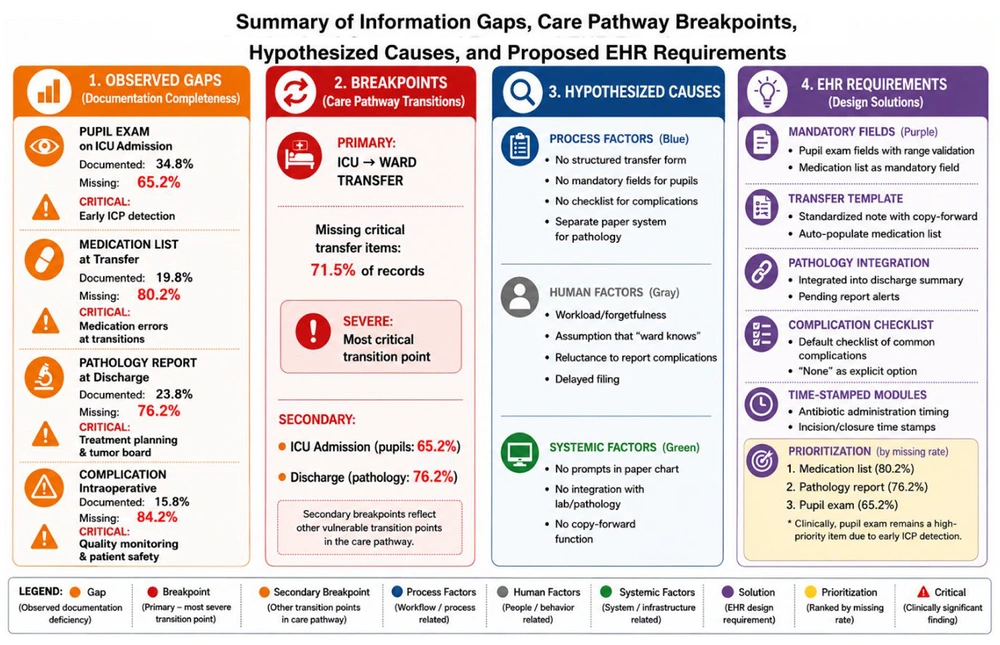
Figure 1.
Summary of information gaps, care pathway breakpoints, potential causes, and proposed EHR requirements for neurosurgery
Subgroup analysis (Table 5) showed that emergency cases had significantly better documentation of time-sensitive items, including pupil examination (45.2% vs. 32.1%; P = 0.008) and GCS at transfer (71.8% vs. 60.2%; P = 0.02). However, the medication list at transfer remained poorly documented regardless of urgency (P = 0.72). No differences were found across age groups or procedure types. These findings suggest that the documentation gaps are systemic rather than patient- or procedure-specific.
Table 5.
Subgroup Analysis of Documentation Completeness a
| Documentation Item | Elective (n = 497) | Emergency (n = 124) | P-Value |
|---|---|---|---|
| Pupil examination on ICU admission | 32.1 | 45.2 | 0.008 |
| GCS at transfer | 60.2 | 71.8 | 0.02 |
| Active medication list at transfer | 19.5 | 21.0 | 0.72 |
| Pathology report at discharge | 23.5 | 24.2 | 0.85 |
a Values are expressed as percentage. No significant differences were observed across age groups (< 65 vs. ≥ 65 years) or procedure categories (P > 0.05 for all comparisons).
These findings support the need for systemic EHR interventions.
5. Discussion
In this large review of 621 neurosurgical records, administrative data were complete; however, information gaps consistently occurred at clinical transition points and in specific assessments.
5.1. Comparison With Previous Studies
Previous studies have identified gaps in neurosurgical integrated care pathways (4), challenges in EHR implementation (11), and infrastructure barriers (12). In Iran, electronic medical record implementation improved documentation time but showed limited generalizability to complex settings such as neurosurgery (13). Iranian studies have also highlighted poor documentation quality (14, 15). Technological solutions, including personal digital assistants (16), AI-based ICU admission prediction (17), and intraoperative checklists (18), have shown promise. Our findings support the need for similar tools in our setting, specifically targeting transition-related gaps.
5.2. Frequency and Location of Information Gaps
Major documentation gaps included missing pupil examination data on ICU admission in 65.2% of records, a concerning deficit given that pupillary changes can indicate elevated intracranial pressure (19, 20). Active medication lists were missing in 80.2% of ICU-to-ward transfers, which is critical because medication errors are a risk during transitions in neurosurgical patients with complex regimens (21). Intraoperative complication status was missing in 84.2% of records, consistent with the literature describing persistent documentation challenges (6). Although the 80% elective case rate may partly explain a low incidence of complications, the absence of an explicit "no complication" entry suggests systematic underreporting. Final pathology reports were missing at discharge in 76.2% of records, potentially compromising tumor treatment planning and multidisciplinary decision-making (22). Postoperative monitoring requires systematic documentation, and integrated pathology reporting represents a critical gap in this pathway.
5.3. Current Information Flow Map and Breakpoints
Intradepartmental documentation was relatively complete (admission, 98%; procedure names, 100%). However, breakpoints occurred at transitions, consistent with the literature on handoff failures (21). The most severe breakpoint was ICU-to-ward transfer (71.5% missing critical items), reflecting vulnerability to information loss during care transitions (6). Secondary breakpoints were ICU admission (pupil examination, 65.2% missing) and discharge (pathology report, 76.2% missing). These breakpoints occurred despite complete intradepartmental documentation, suggesting that the core problem lies in the information-transfer mechanism, including the absence of structured templates and clinical integration, rather than documentation capacity. This distinction is important: interventions should improve data flow between units rather than merely add fields within departments.
5.4. Quality of Documentation Against Standards
Demographic documentation (98% - 100%) and informed consent (91.6%) met acceptable standards (23). Prophylactic antibiotic documentation was low at 49.4%. Pupil examination documentation (34.8%) was also below expected standards for neurologic assessment (19, 20). Overall, clinical safety items showed substantially lower compliance than administrative items.
5.5. Hypothesized Causes of Information Gaps
Based on missing-data patterns and the literature, we propose unvalidated hypotheses for 4 documentation gaps. Pupil examination data were missing in 65.2% of records; possible causes include the absence of a mandatory field (process-related), workload or forgetfulness (human factors), and the absence of prompts (systemic). Active medication lists at transfer were missing in 80.2% of records; possible causes include the lack of a structured form, reliance on verbal handoffs, and the absence of a copy-forward function. Final pathology reports were missing in 76.2% of records; possible causes include a paper-based system, delayed filing, and lack of integration. Intraoperative complication status was missing in 84.2% of records; possible causes include the lack of a structured section, underreporting, and the absence of a checklist. Medication lists (80.2% missing) and pupil examinations (65.2% missing) should therefore be prioritized. The pupil examination gap of 65.2% may reflect the absence of a mandatory field, workload, and lack of prompts, consistent with the neurosurgical quality-improvement literature (6) and Iranian studies on structured fields (15). Infrastructure barriers (24) are also consistent with our systemic findings, reinforcing the need for structured, user-centered EHR design.
5.6. Key Requirements for EHR Design
Based on our findings and the neurosurgical quality-improvement literature (6, 11, 21), 3 prioritized EHR requirements emerge: 1) mandatory pupil-examination fields on ICU admission with validation and visual prompts; 2) a standardized transfer template with a mandatory medication list and copy-forward function; and 3) pathology integration into the discharge summary with pending-result alerts. Additional requirements include complication checklists and time-stamped intraoperative modules for antibiotic documentation. These recommendations are hypothesis-generating results of the gap analysis rather than formal engineering requirements and require future validation through stakeholder engagement, usability testing, and implementation research.
5.7. Elective Case Explanation
Although the 80% proportion of elective surgeries may partly explain the low documented complication rate of 15.8%, gaps in pupil examination, medication lists, and pathology reports are urgency-independent systemic deficiencies. Missing "no complication" entries reflect documentation failure rather than clinical reality alone.
5.8. Strengths and Limitations
Strengths of this study include the large sample size of 621 records, coverage of the full care pathway, an operationally defined checklist, and a structured root cause analysis. Limitations include the single-center design and the predominance of elective cases (80%), which limit generalizability to emergency neurosurgery. Missing documentation may not indicate that information was unknown or that care was not provided. The checklist requires further validation for broader generalizability. The hypothesized causes were inferred rather than directly measured and require formal qualitative confirmation. This study documents documentation gaps rather than care gaps, and the EHR recommendations were derived solely from gap analysis and require user-centered validation.
5.9. Answers to the Five Research Questions
RQ1 identified substantial documentation gaps: pupil examination data were missing in 65.2% of records, active medication lists in 80.2%, final pathology reports in 76.2%, and intraoperative complication status in 84.2%; prophylactic antibiotic documentation completeness was 49.4%. For RQ2, the primary breakpoint was ICU-to-ward transfer (71.5%). For RQ3, demographic and informed-consent documentation met the stated standards, whereas antibiotic and pupil-examination documentation remained comparatively poor. For RQ4, the proposed process-related, human, and systemic causes remain unvalidated hypotheses. For RQ5, the 5 proposed EHR requirements are mandatory pupil fields, a standardized transfer template, pathology integration, a complication checklist, and antibiotic time stamps; formal requirements engineering was not conducted.
5.10. Distinguishing Documentation Gaps from Care Gaps
We distinguish documentation failure from clinical care failure because this study measured documentation completeness rather than clinical performance. For example, 65.2% missing pupil-examination documentation does not mean that pupil examination was not performed. This distinction avoids erroneous conclusions about quality of care, separates documentation from clinical interventions, and keeps the focus on EHR design. We view incomplete documentation as a communication risk during transitions rather than evidence of negligence. Four modifiable gaps were identified: active medication lists missing in 80.2% of records, pupil-examination documentation missing in 65.2%, final pathology reports missing in 76.2%, and intraoperative complication documentation missing in 84.2%. These findings provide a phased EHR roadmap that prioritizes high-impact missing data. Although the pattern may be generalizable to similar centers, multicenter validation is needed, and formal validation through interviews, workflow analysis, and usability testing is required before implementation.