
1. Background
Soccer is among the most widely played sports globally; however, it also carries a high risk of lower-extremity injuries. Despite its well-established benefits for physical fitness and health, sport-specific demands, such as rapid accelerations, frequent changes of direction, and high-impact landings, place considerable stress on the knee joint (1). Among adolescent soccer players, knee injuries are common and clinically important. Noncontact ACL injuries account for a considerable proportion of these injuries. Previous epidemiological research has reported knee injury rates between 10 and 35 per 1000 player-hours, with a substantial number arising from noncontact events associated with deficits in neuromuscular control and movement biomechanics that may be amenable to targeted intervention (2).
Excessive dynamic knee valgus, a reduced knee flexion angle during landing, and impaired dynamic balance are among the most consistently identified modifiable risk factors for ACL injury (3). Dynamic knee valgus, characterized by medial knee collapse, increased tibial internal rotation, and hip adduction, reflects poor multiplanar control of the lower-extremity kinetic chain. Importantly, this movement pattern is often exacerbated by a restricted ankle dorsiflexion range of motion and insufficient proximal hip stability (3). Limited ankle dorsiflexion can reduce sagittal-plane knee excursion during landing tasks, leading to compensatory increases in knee valgus and elevated ACL loading (4). Similarly, deficits in dynamic balance compromise an athlete’s ability to maintain proper lower-limb alignment during sport-specific tasks.
The STOP-X program is a comprehensive neuromuscular training approach established by the German Knee Society to enhance hip and trunk control, optimize landing biomechanics, and improve movement efficiency. Evidence from previous studies suggests that participation in the STOP-X program is associated with reductions in dynamic knee valgus and may contribute to a lower incidence of knee and ACL injuries among young athletes (5). However, the standard STOP-X program primarily targets proximal neuromuscular control and does not specifically address ankle joint mobility.
Emerging evidence indicates that restricted ankle dorsiflexion is an independent contributor to increased dynamic knee valgus and suboptimal landing kinematics (4). Given the biomechanical interdependence of the lower-extremity kinetic chain, integrating targeted ankle mobilization exercises with proximal neuromuscular training may provide additional benefits beyond those achieved with STOP-X training alone.
2. Objectives
The present study aimed to determine whether adding ankle mobilization exercises to an 8-week STOP-X neuromuscular training program would provide additional benefits beyond those achieved with the STOP-X program alone. Specifically, changes in landing biomechanics and dynamic postural stability were evaluated in adolescent male soccer players with excessive dynamic knee valgus. We hypothesized that the combined intervention would yield greater improvements in knee movement patterns during landing and dynamic balance performance than the STOP-X program alone.
3. Methods
3.1. Study Design and Participants
A 3-arm, parallel, randomized controlled trial was conducted to evaluate the effectiveness of an 8-week intervention consisting of the STOP-X program, either alone or combined with ankle mobilization exercises. The study focused on adolescent male soccer players with excessive dynamic knee valgus and assessed changes in balance performance and knee alignment during dynamic tasks.
3.2. Sample Size Calculation
An a priori power analysis was performed using G*Power (version 3.1.9.7) to determine the required sample size. The calculation was based on an effect size of 0.42 for anterior dynamic balance reported in a previous randomized controlled trial involving adolescent female basketball players with dynamic knee valgus, a population with a lower-limb movement impairment and an outcome measure similar to those of the present study (6). Assuming a significance level of 0.05 and statistical power of 95%, the minimum required sample size for the planned 3-group, 2-time-point analysis was estimated to be 27 participants. To improve the precision and robustness of the findings, recruitment continued until 45 eligible athletes were enrolled, with 15 participants allocated to each study group.
3.3. Participants
A total of 45 male soccer players aged 12 to 14 years who demonstrated dynamic knee valgus were selected from regional soccer academies through purposive recruitment. Inclusion criteria required participants to present with a dynamic knee valgus angle exceeding 10° during the single-leg drop landing test (7), to have at least 3 years of regular academy-based soccer experience, and to participate in soccer training at least 3 times weekly. Participants were excluded from the final analysis if they missed more than 2 consecutive sessions or more than 3 sessions in total during the intervention, sustained a lower-extremity injury, underwent surgery within the previous 6 months, engaged in another injury-prevention intervention, or failed to complete follow-up measurements. All assessments were performed on the participant's dominant limb. Limb dominance was defined as the participant's preferred kicking leg and was determined by asking each participant which leg he would naturally use to kick a ball.
Before enrollment, detailed information regarding the study procedures was provided to the athletes and their parents or legal representatives, after which written consent was obtained. The research protocol was approved by the Ethics Committee of Bu-Ali Sina University. Furthermore, all stages of the investigation were conducted in accordance with internationally accepted ethical standards for human research, as specified in the Declaration of Helsinki.
3.4. Randomization, Allocation Concealment, and Blinding
Participants were randomly assigned to 1 of the 3 study groups using a computer-generated randomization sequence created with a random number generator. Allocation concealment was ensured using sequentially numbered, opaque, sealed envelopes prepared by an independent researcher who was not involved in participant recruitment, assessment, or intervention delivery. Due to the nature of the exercise interventions, the trainers delivering the exercise programs could not be blinded. However, participants were not informed of the specific study hypotheses or the expected superiority of any intervention, and the outcome assessor remained blinded to group allocation throughout all preintervention and postintervention assessments to minimize assessment bias.
3.5. Outcome Measures
Participants underwent testing on 2 occasions: once before the intervention and again after 8 weeks of training. To quantify landing mechanics, participants performed a single-leg drop landing task from a 30-cm box while movement was recorded from frontal and sagittal viewpoints. Knee valgus and knee flexion angles were extracted from the video recordings using Kinovea (version 0.8.15), and the mean value across 3 acceptable trials was entered into the analysis (7). A trial was considered acceptable if the participant landed on the designated limb, maintained balance for at least 2 seconds after landing without placing the contralateral foot on the ground, and completed the task without additional hops or loss of balance. Trials that did not meet these criteria were discarded and repeated. All video recordings were analyzed offline by a single experienced assessor who was blinded to group allocation. Previous studies have demonstrated that Kinovea provides good-to-excellent intrarater (ICC > 0.85) and interrater (ICC > 0.90) reliability for lower-limb joint angle measurements, with acceptable agreement compared with 3-dimensional motion analysis systems. Furthermore, Kinovea has been shown to be a valid and reliable tool for 2-dimensional kinematic analysis in sports biomechanics (8).
Dynamic postural stability was assessed using the Y-Balance Test according to the standardized protocol described by Plisky et al. Before testing, participants completed a standardized warm-up followed by familiarization trials. During testing, participants kept their hands on their hips while standing on the dominant limb and performed reaches in the anterior, posteromedial, and posterolateral directions. Three successful trials were completed in each direction, and the maximum reach distance for each direction was recorded. Reach distances were normalized to leg length, and the composite score was calculated as the sum of the maximum reach distances in the 3 directions divided by 3 times the limb length and multiplied by 100. A trial was repeated if the participant removed his hands from his hips, failed to maintain single-leg stance, moved the stance foot, or used the reaching foot for support, in accordance with the standardized Y-Balance Test protocol (9).
3.6. Intervention
3.6.1. STOP-X Exercise
The STOP-X program was implemented over 8 weeks, with 3 supervised sessions per week. Each session lasted approximately 25 to 40 minutes, depending on the stage of progression. The sessions followed a standardized structure consisting of 4 sequential components: 1) warm-up, including light running and dynamic mobility exercises; 2) balance and neuromuscular control exercises; 3) lower-extremity and trunk strengthening exercises; and 4) jumping and landing technique drills. Balance exercises focused on postural control and single-leg stability. Strength exercises targeted the hip abductors, hip extensors, quadriceps, hamstrings, and core muscles using body-weight exercises. Jump training emphasized proper landing mechanics, lower-limb alignment, and dynamic knee control.
Exercise progression was achieved by gradually increasing exercise volume (sets and repetitions), task complexity, and neuromuscular demands throughout the intervention. During weeks 1 to 2, participants performed basic balance, strength, and landing exercises, with an emphasis on correct movement technique and neuromuscular control. During weeks 3 to 5, exercise volume and task complexity were progressively increased by adding sets and repetitions, reducing external support, and introducing more challenging balance and landing tasks. During weeks 6 to 8, participants performed advanced balance, strength, and plyometric exercises requiring greater dynamic stability, movement control, and sport-specific landing mechanics. Progression to the next level was permitted only after participants demonstrated correct movement quality without compensatory movement patterns (5, 10).
3.6.2. Ankle Mobilization Exercise
The combined group performed a 15-minute ankle mobilization program at the beginning of each training session before completing the STOP-X program, resulting in a total session duration of approximately 40 to 55 minutes. The ankle mobilization program was designed to improve ankle dorsiflexion range of motion and was performed bilaterally throughout the 8-week intervention. The protocol consisted of 4 exercises: 1) self-myofascial release of the plantar flexors, performed for 3 sets of 30 seconds per limb; 2) static stretching of the plantar flexors with the knee flexed, performed for 2 sets of 60 seconds per limb; 3) single-leg heel-drop exercises, performed for 3 sets of 12 to 15 repetitions per limb; and 4) band-assisted ankle dorsiflexion stretching, performed for 3 sets of 20 seconds per limb. Stretching exercises were performed to the point of mild discomfort without pain, whereas heel-drop and band-assisted mobilization exercises were performed using controlled movement throughout the available range of motion. Exercise progression was achieved by gradually increasing stretch duration, elastic-band resistance, and movement excursion over the 8-week intervention while maintaining correct movement quality. During the first 2 weeks, participants performed all exercises using the initial prescribed dosage and light resistance. Between weeks 3 and 5, exercise intensity was increased by using greater elastic-band resistance and encouraging a larger pain-free dorsiflexion range. During weeks 6 to 8, participants continued the exercises with further increases in resistance and movement excursion while maintaining the same exercise technique and dosage. All ankle mobilization exercises were performed under the direct supervision of a certified exercise therapist, who monitored exercise technique, ensured adherence to the protocol, and determined progression based on correct execution without compensatory movement patterns (11).
Throughout the intervention period, the control group participated only in routine soccer training and did not receive any additional structured intervention. All participants were recruited from the same soccer school and followed the same training schedule under the supervision of the coaching staff. Routine training comprised 3 sessions per week, with each session lasting approximately 90 minutes and consisting of a standardized warm-up, technical skill drills, tactical exercises, small-sided games, and match-play activities.
3.7. Statistical Analysis
Normality was assessed using the Shapiro-Wilk test, and homogeneity of variances was evaluated using Levene's test. Because the within-subject factor (time) consisted of only 2 levels (preintervention and postintervention), the assumption of sphericity was inherently satisfied; therefore, Mauchly's test was not required. To examine the effects of the interventions, repeated-measures ANOVA was performed to evaluate the main effects of time and group, as well as the time × group interaction. Where baseline differences were identified for the posterolateral reach outcome, ANCOVA was performed using baseline values as covariates to adjust for pre-existing between-group differences. Post hoc pairwise comparisons were adjusted using the Bonferroni correction to account for multiple comparisons. Effect sizes were reported as partial eta squared (ηp2), and statistical significance was set at P < 0.05. All statistical analyses were performed using SPSS software.
4. Results
All participants completed the study and were included in the final statistical analyses. Accordingly, no data were missing, and a per-protocol analysis was conducted. Baseline assessment indicated that the groups were comparable in terms of age, height, body weight, BMI, and years of soccer participation. No statistically significant between-group differences were observed for these variables at study entry (all P values > 0.05), as shown in Table 1.
Table 1.
Baseline Characteristics of Participants Across Study Groups a
| Variables | STOP-X + Ankle Mob. (n = 15) | STOP-X (n = 15) | Control (n = 15) | P-Value |
|---|---|---|---|---|
| Age (y) | 13.34 ± 0.64 | 13.65 ± 0.63 | 13.14 ± 0.60 | 0.087 |
| Height (cm) | 172.8 ± 5.3 | 173.2 ± 5.6 | 172.5 ± 5.4 | 0.092 |
| Body mass (kg) | 53.2 ± 4.1 | 53.8 ± 4.3 | 53.0 ± 4.0 | 0.938 |
| BMI (kg/m2) | 18.1 ± 1.4 | 18.3 ± 1.5 | 18.0 ± 1.6 | 0.549 |
| Training experience (y) | 4.73 ± 0.78 | 4.29 ± 0.92 | 4.36 ± 0.88 | 0.325 |
a Values are expressed as mean ± SD.
At baseline, the groups also showed comparable values across all measured outcomes, including dynamic knee valgus angle (P = 0.835), knee flexion angle (P = 0.708), Y-Balance Test composite score (P = 0.299), anterior reach (P = 0.827), and posteromedial reach (P = 0.503). The exception was the posterolateral reach direction, for which a significant between-group difference was present at pretest (P = 0.011), necessitating the use of ANCOVA with baseline adjustment for this variable. All post hoc pairwise comparisons were adjusted using the Bonferroni correction to account for multiple comparisons.
Changes in dynamic knee valgus angle over time differed significantly between groups, with both intervention conditions demonstrating greater reductions than the control condition and the combined training approach producing the most pronounced improvement (all post hoc comparisons, P ≤ 0.009). A similar pattern was observed for knee flexion angle during landing, with the greatest improvements in the combined group, followed by STOP-X alone, whereas the control group showed no meaningful change (all between-group comparisons, P < 0.05).
Y-Balance Test composite score performance improved over time across groups; however, between-group contrasts did not reach statistical significance, despite a favorable trend toward the combined intervention. Anterior reach and posteromedial reach both increased significantly from pretest to posttest, but these changes did not yield clear between-group differences in pairwise comparisons. In contrast, posterolateral reach showed a clear group effect after adjustment for baseline values, with the combined intervention outperforming both STOP-X alone and the control condition, and STOP-X also exceeding the control group (P ≤ 0.001).
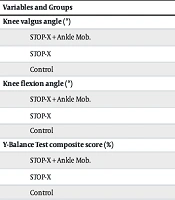
Overall, within-group analyses confirmed consistent pre-post improvements in both intervention groups across all variables, whereas no significant changes were observed in the control group. Detailed descriptive statistics are presented in Table 2.
Table 2.
Mean ± SD of Knee Kinematics and Dynamic Balance Across Groups and Time Points
| Variables and Groups | Pretest | Posttest | P-Value |
|---|---|---|---|
| Knee valgus angle (°) | |||
| STOP-X + Ankle Mob. | 23.60 ± 2.55 | 13.13 ± 1.95 | < 0.001 a |
| STOP-X | 23.07 ± 3.36 | 18.67 ± 3.81 | 0.009 a |
| Control | 23.60 ± 2.38 | 23.33 ± 2.92 | 0.524 |
| Knee flexion angle (°) | |||
| STOP-X + Ankle Mob. | 44.67 ± 2.55 | 65.47 ± 4.32 | < 0.001 a |
| STOP-X | 44.60 ± 2.53 | 55.73 ± 2.98 | < 0.001 a |
| Control | 45.27 ± 2.12 | 44.67 ± 3.22 | 0.322 |
| Y-Balance Test composite score (%) | |||
| STOP-X + Ankle Mob. | 76.67 ± 3.72 | 82.71 ± 3.51 | < 0.001 a |
| STOP-X | 73.04 ± 7.60 | 75.40 ± 6.84 | < 0.001 a |
| Control | 74.60 ± 6.90 | 73.67 ± 7.50 | 0.080 |
| Anterior reach (%) | |||
| STOP-X + Ankle Mob. | 53.67 ± 5.85 | 59.60 ± 5.90 | < 0.001 a |
| STOP-X | 54.40 ± 6.91 | 56.73 ± 6.06 | < 0.001 a |
| Control | 52.93 ± 6.68 | 52.07 ± 6.92 | 0.109 |
| Posteromedial reach (%) | |||
| STOP-X + Ankle Mob. | 87.33 ± 7.08 | 93.60 ± 6.04 | < 0.001 a |
| STOP-X | 84.07 ± 10.08 | 86.40 ± 9.63 | < 0.001 a |
| Control | 87.00 ± 7.51 | 86.13 ± 7.74 | 0.121 |
| Posterolateral Reach (%) | |||
| STOP-X + Ankle Mob. | 89.00 ± 2.20 | 94.93 ± 3.21 | < 0.001 a |
| STOP-X | 80.67 ± 8.82 | 83.07 ± 8.22 | 0.001 a |
| Control | 83.87 ± 8.68 | 82.87 ± 10.00 | 0.136 |
a Statistically significant difference (P < 0.05).
5. Discussion
This investigation evaluated and compared two 8-week interventions in adolescent soccer players with excessive dynamic knee valgus: the STOP-X program alone and the same program supplemented with ankle mobilization exercises. Overall, both interventions produced significant improvements compared with the control group. However, the combined intervention resulted in greater reductions in dynamic knee valgus and larger increases in knee flexion angle during landing than the STOP-X program alone. Regarding dynamic balance, the combined intervention produced significantly greater improvements in the posterolateral reach direction, whereas changes in the composite Y-Balance Test score and in the remaining reach directions were more modest and did not differ significantly between the intervention groups.
The outcomes of this study are generally consistent with earlier investigations reporting positive effects of the STOP-X injury prevention protocol. For instance, Rostami et al. (6) documented decreases in knee valgus angles along with improved postural stability after an 8-week training period in female athletes with dynamic knee valgus. Similarly, Hasani Chenari et al. (12) observed improvements in hip muscle strength, joint mobility, and dynamic balance following a structured training program in adolescent male soccer players. Rouhi et al. (13) also reported positive effects on dynamic knee valgus and kinetic variables following STOP-X training. Petersen et al. (5) emphasized the value of the STOP-X program for neuromuscular control and ACL injury prevention.
Despite the established benefits of STOP-X training, the present study indicates that adding ankle mobilization exercises may further enhance outcomes, particularly with respect to frontal-plane knee control and certain aspects of dynamic balance. From a biomechanical perspective, this finding may be explained by evidence indicating that restricted ankle dorsiflexion is associated with increased medial knee displacement during functional tasks (14). Although ankle dorsiflexion range of motion was not directly assessed in the present study, the observed improvements may be partially attributable to enhanced ankle mobility following the mobilization intervention. Improved ankle mobility may have facilitated better force absorption through increased knee and hip flexion, reduced compensatory knee valgus collapse, and enhanced lower-extremity kinetic chain function. This proximal-distal approach aligns with previous evidence suggesting that addressing both the hip and ankle segments yields superior results in dynamic knee valgus control compared with single-region interventions (15).
From a clinical perspective, these findings support a shift toward more comprehensive, multisegment interventions in knee injury prevention programs. Incorporating ankle mobilization exercises into the STOP-X program may be a practical and inexpensive strategy to enhance movement quality, with potential implications for reducing biomechanical patterns associated with ACL injury risk in adolescent soccer players.
The present study has several limitations that should be considered when interpreting the findings. First, although the final sample size exceeded the a priori estimated minimum required by the power analysis, the study may still have been underpowered to detect small effects in some secondary outcomes. Therefore, nonsignificant findings for these variables should be interpreted with caution. Second, the relatively small sample size and the exclusive inclusion of adolescent male soccer players may limit the generalizability of the findings to other athletic populations. Third, ankle dorsiflexion range of motion was not directly assessed before and after the intervention. Although ankle mobilization is intended to improve dorsiflexion mobility, the absence of these measurements precludes confirmation that the observed improvements in landing mechanics and dynamic postural control were mediated by increased ankle dorsiflexion. Consequently, the proposed mechanism should be interpreted with caution. Fourth, the 8-week intervention period may not have been sufficient to capture longer-term neuromuscular adaptations, and the absence of follow-up assessments precludes conclusions regarding the persistence of the observed training effects. Finally, potentially influential factors such as participants' additional training load, dietary intake, and sleep patterns could not be fully controlled.
Future research should include larger and more diverse athletic populations, including female athletes and different age groups, to improve the generalizability of the findings. In addition, future studies should incorporate pre- and postintervention assessments of ankle dorsiflexion range of motion to clarify the mechanisms underlying the effects of ankle mobilization. Studies with longer intervention and follow-up periods are also warranted to determine the long-term effectiveness of the intervention. Furthermore, incorporating advanced biomechanical and neuromuscular assessment techniques, such as 3-dimensional motion analysis, kinetic analysis, and electromyography, may provide a more comprehensive understanding of the mechanisms underlying the observed improvements.
5.1. Conclusions
The addition of ankle mobilization exercises to the STOP-X protocol produced significantly greater improvements in dynamic knee valgus angle and knee flexion during landing compared with STOP-X training alone. The combined approach also resulted in greater enhancements in dynamic balance, most notably in posterolateral reach. Overall, addressing both proximal neuromuscular control and distal ankle mobility appears to be a more effective strategy within knee injury prevention programs for adolescent male soccer players with valgus knee collapse.