Cover image of the article: A survey on fertility trend of the women born in Kermanshah in  ‎1956-95‎

Image Credit:J Clin Res Paramed Sci

A survey on fertility trend of the women born in Kermanshah in ‎1956-95‎

Authors

Marziyeh Kaboudi1, Hossein Karim2,*, Ali Ramezankhani3, Bijan Kaboudi4, Hooman Manouchehri5, Ebrahim Hajizadeh6
1Department of Midwifery, School of Nursing and Midwifery, Kermanshah University of Medical Sciences, Kermanshah‎, Iran
2Cardiology Department, School of Medicine, Kermanshah University of Medical Sciences, Kermanshah‎, Iran
3Department of Public Health, School of Public Health, Shahid Beheshti University of Medical Sciences, Tehran‎, Iran
4General Practitioner, Kermanshah University of Medical Sciences, Kermanshah‎, Iran
5Department of Basic Sciences, School of Nursing and Midwifery, Shahid Beheshti University of Medical Sciences, Tehran‎, Iran
6Biostatistics Department, Faculty of Medical Sciences, Tarbiat Modares University, Tehran‎, Iran
*Corresponding Author: Corresponding author: Hossein Karim, Cardiology Department, School of Medicine, Kermanshah University of Medical Sciences, Kermanshah‎, Iran, E-mail: Email: bkaboudi@yahoo.com

Journal of Clinical Research in Paramedical Sciences:Vol. 3, issue 4; e82137
Published online:Feb 23, 2015
Article type:Research Article
Received:Jul 20, 2014
Accepted:Jan 23, 2015
How to Cite:Kaboudi M, Karim H, Ramezankhani A, Kaboudi B, Manouchehri H, et al. A survey on fertility trend of the women born in Kermanshah in ‎1956-95‎. J Clin Res Paramed Sci. 2015;3(4):e82137. doi:

Abstract

Background: Total fertility rate has fallen below the replacement level in several provinces of the Islamic Republic of Iran, including Kermanshah. The aim of this study was to investigate fertility
trends, in 5-year birth cohorts in Kermanshah.
Methods: In this survey, using multi stage random sampling, fertility trend of married women born in 1956-95 were assessed in eight birth cohorts. Linear regression with least squares method
was used to evaluate the relationship between marriage age and child number.
Results: The number of children born by women before the age of 35, has decreased from 4.05 to 2.41 among women born in 1956- 60 and 1971-75 respectively. There was an inverse relationship
between age at marriage and the number of children in women of up to 40 years old (r= -0.5; P<0.02).
Conclusion: According to the findings on this research, it is predicted that the speed of fertility slope reduction will be decreased.
 

Highlights

Fulltext

The full text of this article is available on PDF.

References

  • 1.
    The References of this article is available on PDF.

Copyright

© 2015, Journal of Clinical Research in Paramedical Sciences. This open-access article is available under the Creative Commons Attribution-NonCommercial 4.0 (CC BY-NC 4.0) International License (https://creativecommons.org/licenses/by-nc/4.0/), which allows for the copying and redistribution of the material only for noncommercial purposes, provided that the original work is properly cited.
Similar Articles

27
Feb
2015
Factors associated with Total Fertility Rate (TFR) In Kermanshah-2011

Factors associated with Total Fertility Rate (TFR) In Kermanshah-2011

Soheyla Reshadat,
Alireza Zanganeh,
Shahram Saeidi,
Nader Rajabi Gilan,
Elaheh Bavandpour,
Seyyed Ramin Ghasemi

Reshadat S, Zanganeh A, Saeidi S, Rajabi Gilan N, Bavandpour E, et al. Factors associated with Total Fertility Rate (TFR) In Kermanshah-2011. J Kermanshah Univ Med Sci. 2015;18(11):e74001. doi: https://doi.org/10.22110/jkums.v18i11.1988
20
Mar
2016
Comparative Study of the Cultural Effective Factors on Women’s Total Fertility Rate in Fertile Age

Comparative Study of the Cultural Effective Factors on Women’s Total Fertility Rate in Fertile Age

Sohyla Reshadat,
Alireza Zanganeh,
Shahram Saeidi,
S. Ramin Ghasemi,
Nader Rajabi-Gilan,
Ali Karbasi
,et al.

Reshadat S, Zanganeh A, Saeidi S, Ghasemi SR, Rajabi-Gilan N, et al. Comparative Study of the Cultural Effective Factors on Women’s Total Fertility Rate in Fertile Age. Zahedan J Res Med Sci. 2016;18(3):e6271. doi: https://doi.org/10.17795/zjrms-6271
1
Nov
2015
Analysis of trends in birth outcomes and fertility measures in the rural population of east Azerbaijan province, Iran: 2001 - 2013

Analysis of trends in birth outcomes and fertility measures in the rural population of east Azerbaijan province, Iran: 2001 - 2013

Mahasti Alizadeh,
Hossein Jabbari Birami,
Siavash Moradi

Alizadeh M, Jabbari Birami H, Moradi S. Analysis of trends in birth outcomes and fertility measures in the rural population of east Azerbaijan province, Iran: 2001 - 2013. J Nurs Midwifery Sci. 2015;2(3):e141288. doi: https://doi.org/10.7508/jnms.2015.03.002
27
Aug
2023
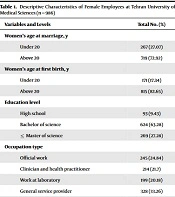
Childbearing: The First Birth Interval and Its Determinants in the Employees of Tehran University of Medical Sciences, Iran, 2018 - 2021

Childbearing: The First Birth Interval and Its Determinants in the Employees of Tehran University of Medical Sciences, Iran, 2018 - 2021

Morvarid Ghasabshirazi,
Masud Yunesian,
Nasim Partash,
Elham Ebrahimi

Ghasabshirazi M, Yunesian M, Partash N, Ebrahimi E. Childbearing: The First Birth Interval and Its Determinants in the Employees of Tehran University of Medical Sciences, Iran, 2018 - 2021. J Nurs Midwifery Sci. 2023;10(2):e138155. doi: https://doi.org/10.5812/jnms-138155
18
Jul
2023
Fertilities Acceleration (Tempo) and Factors Affecting the First Birth Interval in Iranian Women: A Survival Analysis

Fertilities Acceleration (Tempo) and Factors Affecting the First Birth Interval in Iranian Women: A Survival Analysis

Raheb Ghorbani,
Maryam Gharibi,
Fayeze Ansari-Nia,
Narges Ghorbani,
Habib-Allah Safari,
Mehdi Kahouei
,et al.

Ghorbani R, Gharibi M, Ansari-Nia F, Ghorbani N, Safari H, et al. Fertilities Acceleration (Tempo) and Factors Affecting the First Birth Interval in Iranian Women: A Survival Analysis. Health Scope. 2023;12(3):e135562. doi: https://doi.org/10.5812/jhealthscope-135562

More by these authors

Marziyeh KaboudiPubMedScholar
Hossein KarimPubMedScholar
Ali RamezankhaniPubMedScholar
Bijan KaboudiPubMedScholar
Hooman ManouchehriPubMedScholar
Ebrahim HajizadehPubMedScholar
Share
Cited by
Metrics