
1. Background
The population rate is one of the most important concerns of some countries around the world. The fertility pattern can be described by several indicators, such as the first birth interval (FBI). The first birth interval is defined as the duration of time spent by married couples to have their first child (1). This event can have a strong effect on the future life of each couple and their families, proving the couple’s fertility power and preventing marriage deterioration (2). Indeed, the community will also benefit from the birth of the first child in the family, increasing happiness and hope. The time between marriage and meeting the first pregnancy is the early practice for accepting parenthood responsibilities (3-5). In addition, this decision can have significant health and demographic consequences.
Demographically, the tendency to have a child in a couple is so important since the majority of countries in the world today are facing a dramatic decline in population growth (5). Some researchers believe that decreasing the time between marriage and first pregnancy can significantly affect population growth between communities (6).
2. Objectives
This study aimed to determine the associated factors of FBI in the women who were employees of Tehran University of Medical Sciences (TUMS).
3. Methods
This cross-sectional study was the first phase of the TUMS Employees Cohort Study (TEC) from January 2018 to March 2021. Iran National Committee for Ethics in Biomedical Research approved this study (code: IR.TUMS.SPH.REC.1399.124). All participants completed the written consent form, and the data were given to the researcher in an anonymous form.
The participants were 986 married women with at least 1 child who were employees at TUMS. They were enrolled in this study by the census method. All participants’ information was included in the study with the coordination of human resources of the university. The questionnaires for data collection were adapted from model survey instruments developed to measure the TEC project and reflect the health status of any participants who had any employment relationship with TUMS. All forms were filled out by the researcher and their colleagues.
The dependent variable was FBI, which was calculated by estimating the difference between the woman's age at the time of the birth of the first child and her age at the time of marriage. The covariates in this study were derived from the literature review, which mainly concentrated on the determinants of childbearing, including age at marriage, women’s occupation type and educational level, age cohort, and wealth status of women after marriage.
SPSS version 21 (SPSS Inc, Chicago, IL, USA), mean, SD, frequency, and Cox regression survival model with hazard ratios were used for investigating the effect of predictors on the time of the first pregnancy. P-values less than 0.05 were considered statistically significant.
4. Results
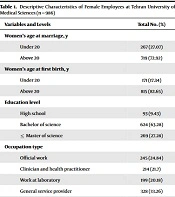
The data of 986 married women were included in the analysis. The mean age of women was 42.69 years (SD = 8.0). The mean age of marriage and first birth were 25.2 (SD = 5.1) and 27.1 (SD = 5.25), respectively. Table 1 shows the characteristics of the study participants. The prevalence of having the first child after 5 years of marriage was 84%.
Table 1.
Descriptive Characteristics of Female Employees at Tehran University of Medical Sciences (n = 986)
| Variables and Levels | Total, No. (%) |
|---|---|
| Women’s age at marriage, y | |
| Under 20 | 267 (27.07) |
| Above 20 | 719 (72.92) |
| Women’s age at first birth, y | |
| Under 20 | 171 (17.34) |
| Above 20 | 815 (82.65) |
| Education level | |
| High school | 93 (9.43) |
| Bachelor of science | 624 (63.28) |
| ≤ Master of science | 269 (27.28) |
| Occupation type | |
| Official work | 245 (24.84) |
| Clinician and health practitioner | 214 (21.7) |
| Work at laboratory | 199 (20.18) |
| General service provider | 328 (33.26) |
| Wealth status | |
| Low | 179 (18.15) |
| Moderate | 531 (53.85) |
| High | 276 (28) |
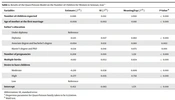
Table 2 shows the predictors of the FBI. The risk of FBI for women with bachelor's, master’s, or higher degrees was 66% and 71%, respectively, higher than those who had high school degrees (P < 0.001). Compared with the workers at the laboratory, the clinicians and health practitioners had significantly the greatest risk (66%) of delaying the first birth, whereas the general service providers had the lowest risk (5%). Accordingly, women who married before 20 years old had an early age at first birth. The results showed that the risk in both extremes of wealth was similar, and it was not statistically significant. Women who were born in older generations were less likely to become pregnant early compared to those born more recently.
Table 2.
The Results of the Cox Proportional Hazard Model Analysis for Age at the First Birth Interval According to the Characteristics
| Characteristics | Hazard Ratio | P-Value | Standard Error | 95% CI |
|---|---|---|---|---|
| Education level | ||||
| High school a | ||||
| Bachelor of science | 0.34 | < 0.001 | 0.0958968 | (0.19 - 0.59) |
| ≤ Master of science | 0.30 | < 0.001 | 0.0858573 | (0.16 - 0.52) |
| Occupation type b | ||||
| Official work | 0.67 | 0.03 | 0.09 | (0.34 - 0.86) |
| Clinician and health practitioner | 0.34 | 0.046 | 0.18 | (0.59 - 0.96) |
| General service provider | 0.95 | 0.02 | 0.09 | (0.56 - 0.89) |
| Work at the laboratory a | ||||
| Marriage age, y | < 0.001 | 0.15 | (1.09 - 1.89) | |
| Under 20 | 1.87 | |||
| Above 20 a | ||||
| Wealth status | ||||
| Low | 0.75 | 0.17 | 0.22 | (0.47 - 1.18) |
| High | 0.74 | 0.02 | 0.03 | (0.56 - 0.97) |
| Moderate a | ||||
| Age cohort (decades of birth) | ||||
| 1981 | 0.803 | 0.739 | .52 | (0.22 - 2.91) |
| 1971 | 1.16 | 0.822 | .77 | (0.31 - 4.28) |
| 1961 | 1.26 | 0.722 | 0.85 | (0.34 - 4.71) |
| < 1961 a |
a Reference category
b Based on the Human Resource Categorization in Tehran University of Medical Sciences
5. Discussion
According to the study, the prevalence of having the first child after 5 years of marriage was 84%. Consistent with our results, in a study conducted in Iran, the majority of participants wanted to have their first child between 4 - 5 years after marriage. In this study, only 28.3% had a birth interval < 2 years, and 25% had a birth interval ≥ 6 years (9). Also, another study showed that 70% of the participants had their first child in the first 5 years of marriage. Among them, 50% of the women had their first birth almost 3 years (38 months) after marriage but spaced their second birth by more than 4 years (55 months) (10). Moreover, a review article showed that over 85% of women gave birth to their first child in the first 5 years of married life (11). In another study, which was done by using the data from the Demographics and Health Survey Project, it was indicated that over 90% of women had their first child in the first 5 years of married life, which it was not common to have no child in Iranian society, and only 2% of the couples would remain without a child in the first 10 years of married life (12). This variation between studies examining birth intervals in Iran may be attributed to the differences in education levels and job status. In studies examining the general population (particularly those involving housekeepers with lower education levels), the tendency to have a child immediately after marriage was higher than in the other studies. The other reason was the effect of ethnicity. In some provinces of Iran, having children (especially male children) is a value, and infertility has more stigma than the other parts. Thus, couples in these areas often try to have their first child soon after marriage, and there is a desire to have more children.
This study showed that women with higher levels of education experienced approximately 25% lower first birth than those who had lower education levels. This may be attributed to the tendency among higher educated women to have better jobs and higher incomes; thus, the cost of taking care of children for them may be more than the other women. Besides, women’s views on childbearing can be influenced by education levels, as education brings new perspectives, roles, and outlooks on life (13). Educated women want to exploit new chances that come along and postpone their pregnancy (14). The women's education level can also be the main obstacle to reaching more than one pregnancy (15). Occupation status had a negative role in the first pregnancy in our study. Clinician and health practitioners (which was one of the top occupation categories in this study) had their first child at a later age. The effect of occupation on the tendency for the first birth is controversial. However, it is an accepted fact that couples usually delay their first child until the stabilization of their work or state (14). Women who have a lot of responsibility always try to juggle the demands of work and family life, which prevents them from childbearing (15). The investigation of the precise impact of a job on a child is more complicated than it sounds. It can be cultural, familiar, or even individual. Despite these studies, a mother’s job can be effective in pregnancy tendency through the possible financial security role of it (1, 16). Analysis of the effect of women’s age at marriage indicated a strong positive effect of early marriage on age at first birth in our study. This result is consistent with the other studies (1, 17). One of the best justifications is that lower age at marriage, in many cases, is accompanied by the younger age of couples, less planning for pregnancy, and use of contraceptive methods. Also, mothers’ age at marriage may be associated with cultural and social determinants, which may be associated with first birth (18); this could play an important role in every woman's life. Some studies have shown that older women give birth soon after marriage to have the desired number of children (8, 19). According to our study, findings supported economic theories that the wealth status of a woman after marriage determines the time of first birth; this effect was significant only in the high-income group than in the moderate-income group. The wealth status of the family is an important predictor variable for fertility in Iran (20); the high percentage of economic problems can lead to a feeling of insecurity for families. These findings are also consistent with other studies, showing that low economic levels can contribute to a longer interval between marriage and childbearing, which leads to a lower birth rate (21, 22). The age cohort of participants also plays a significant role in the first birth age. The cohort effect can identify the precise changes of a generation in childbearing preferences (14). Although our study showed that the older generation may be a preventive factor for early age at birth, this effect was not significant. Factors such as culture and huge events (which occurred between generations, such as war) have impacts on the result.
One of the limitations of this study was related to the secondary data, which limited us to check or enter some of the major predictors of FBI. In addition, the study population did not include all classes of society; thus, its generalizability is limited.
5.1. Conclusions
Age at first birth is significantly related to women’s education, occupation, marriage age, and wealth status. However, the age cohort did not have any significant role in this domain. These statistical outcomes about the age at first birth and exploration of significant factors of women can be an emerging area for population management.