
1. Background
Lighting affects humans in many ways, including intelligence, body temperature, and sleep patterns that leads to higher alertness, lower sleepiness, and improved performance (1, 2). According to studies, artificial lighting affects humans as an essential physical factor in office and educational environments (1). According to an analysis of the individuals’ mood levels, lighting can affect activity, inactivity, and fatigue (2). In general, changes in amount and type of lighting cause problems in office work in closed environments, affecting the individuals’ behavior and mood (3). Lack or excess of lighting can affect the individuals’ health such as visual fatigue, headache, visual impairment, gazing, physical fatigue, alertness, body temperature, sleep patterns, and work performance, and cause psychological effects and even accidents. Fatigue can be affected by workplace lighting, which is also seen in people with physical and mental illnesses, and its prevalence is generally estimated at 14 to 20%. According to studies, mental fatigue levels after exposure to different levels of lighting are higher than before exposure (3). Changes in reflective and gazing levels and improving the ambient lighting conditions are recommended to reduce visual fatigue (4). Sleeping constitutes one-third of human life as an essential circadian cycle affecting humans’ physical and mental health.
The quality and quantity of sleep significantly affect cognitive function and concentration in daily tasks. Sleep disturbances can cause physical and mental disintegration, digestive disorders, heart problems, nervous fatigue, decentralization, emotional incompatibility, aggression, memory loss, mental problems, and car accidents. Therefore, workplace conditions should be optimized in terms of heat and light in workplaces requiring attention and reaction to stimuli by considering sleep quality and mental fatigue (5). Giménez et al. indicated that the sleep durations of patients treated by intervening in the lighting of their hospital rooms increased by 29 minutes (about 7.3%) after five days of hospitalization compared to the normal state. Improving the room lighting for patients revealed that their satisfaction increased Limited exposure to night light (low brightness) could improve dimensions of depression and the quality of sleep (6).
Students constitute a more prone group to sleep disturbances than the general population. The students’ problem with sleep habits is a global issue and causes many concerns. Significant prevalence of poor sleep quality, sleepiness, and sleep disturbances in students can affect the quality of education.
2. Objectives
The present study aimed to evaluate the level of satisfaction with lighting and measure mental task load, visual fatigue, and sleep quality.
3. Methods
This descriptive-analytical study was performed as a cross-sectional survey among students at the Faculty of Nursing and Midwifery, Saveh University of Medical Sciences, Saveh, Iran. A total of 100 students were selected from the Faculty of Nursing and Midwifery at the Saveh University of Medical Sciences, Saveh, Iran and included in the study after obtaining personal and informed written consent.
We used the standard questionnaires to examine the levels of satisfaction with lighting and measure the levels of mental task load, visual fatigue, and sleep quality. The questionnaires included the demographic questionnaire, lighting satisfaction questionnaire, visual fatigue questionnaire, Pittsburgh sleep quality index (PSQI), Epworth Sleepiness Scale (ESS), sleepiness, and mental task load questionnaire.
The sociodemographic characteristics include age (≤ 18 years, 18 - 22 years, and > 23 years), sex, department, year of study (1st year, 2nd year, 3rd year), marital status (single, married, co-habit, divorced, and widowed), field of study.
The questionnaire of satisfaction included 14 questions about the quality of lighting and satisfaction to determine the level of satisfaction with lighting. We also assessed the visual fatigue using the visual fatigue measurement questionnaire on video terminal users, consisting of 15 items and four subscales of visual strain (4 questions), visual impairment (5 questions), visual surface disorder (3 questions), and extra-visual problems (3 questions). The questionnaire scoring was based on the Likert scale (from none = 0 to very severe = 10).
The validity and reliability of the ESS with eight questions are proven (7) and used to determine the state of mental sleepiness in individuals. In the present study, we used a questionnaire to determine the students’ sleepiness in different situations. In the ESS, the individuals rate their recent sleepiness level in eight daily situations from 0 (I never take a nap) to 3 (I do not most likely take a nap). These daily situations include sitting and reading, watching TV, sitting idly in a public place (e.g., in a theater or a lecture session), sitting in a car as a passenger for an uninterrupted hour, lying down to rest in the afternoon when the conditions are right, sitting and talking to someone, sitting quietly after lunch, and being in a vehicle while stopping for a few minutes in traffic. The following questionnaire asks individuals to consider how these situations will affect them, even if they haven't experienced some of these situations recently.
We collected the amount of mental task load using a specialized questionnaire of the National Aeronautics and Space Administration-task load index (NASA-TLX) (6).
The data were collected between January and March 2020 by face-to-face interview or self-administration demographic questionnaire, lighting satisfaction questionnaire, visual fatigue questionnaire, PSQI, ESS, sleepiness, and amount of mental task load questionnaire. We initially distributed the instruments among 20 students at the institution whose data were excluded in the final data analysis (8).
4. Results
The results indicated that the scores of task load and visual fatigue were higher in men, and sleepiness scores were higher in women (Table 1). The scores of quality of sleep and lighting satisfaction were higher in women. About 21.7% of the respondents were aged 17 to 20, 55.4% were from 21 to 25 years, and 22.8% were from 26 to 45 years. The results indicated that lighting satisfaction and sleep quality were higher from 17 to 20 years old. Task load and sleepiness were also higher from 17 to 20 years old than other age groups. The highest amount of visual fatigue was observed from 26 to 45 years old.
Table 1.
The Correlation Between Gender and Sleep Quality, Task Load, Sleepiness, Visual Fatigue, and Lighting Satisfaction a
| Variables | Sleep Quality | Task Load | Sleepiness | Visual Fatigue | Lighting Satisfaction |
|---|---|---|---|---|---|
| Male | 10.64 ± 3.17 | 4.65 ± 1.6 | 1.04 ± 0.72 | 3.69 ± 2.01 | 2.21 ± 0.45 |
| Total | 22 | 26 | 26 | 26 | 26 |
| Female | 11.22 ± 2.46 | 4.23 ± 1.8 | 1.33 ± 0.61 | 3.21 ± 2.45 | 2.26 ± 0.35 |
| Total | 63 | 70 | 70 | 70 | 70 |
| Sum | 11.07 ± 2.65 | 4.34 ± 1.75 | 1.25 ± 0.65 | 3.34 ± 2.18 | 2.25 ± 3.96 |
| Total | 85 | 96 | 96 | 96 | 96 |
a Values are expressed a mean ± SD.
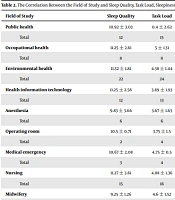
According to the Table 2, the participants were educated in public health (15.8%), occupational health (8.4%), environmental health (25.3%), health information technology (13.7%), anesthesia (6.3%), operating room (4.2%), medical emergencies (4.2%), nursing (16.8%), and midwifery (5.3%). The participant in the operating room and emergency fields had the least participation, and the environmental health had the most participation in completing the questionnaires. According to the data obtained from the questionnaire, the highest quality of sleep was observed among environmental health students, and the highest light satisfaction was seen among emergency medical students. The highest amount of sleepiness was among public health students, the highest task load took place among occupational health students, and the highest visual fatigue was among the midwifery students.
Table 2.
The Correlation Between the Field of Study and Sleep Quality, Task Load, Sleepiness, Visual Fatigue, and Lighting Satisfaction a
| Field of Study | Sleep Quality | Task Load | Sleepiness | Visual Fatigue | Lighting Satisfaction |
|---|---|---|---|---|---|
| Public health | 10.92 ± 3.03 | 0.4 ± 2.62 | 1.53 ± 0.64 | 2.53 ± 2.62 | 2.42 ± 0.35 |
| Total | 12 | 15 | 15 | 15 | 15 |
| Occupational health | 11.25 ± 2.61 | 5 ± 1.31 | 1 ± 0.53 | 3.38 ± 1.68 | 2.01 ± 0.41 |
| Total | 8 | 8 | 8 | 8 | 8 |
| Environmental health | 11.32 ± 1.81 | 4.38 ± 1.44 | 1.17 ± 0.76 | 3.62 ± 1.9 | 2.33 ± 0.37 |
| Total | 22 | 24 | 24 | 24 | 24 |
| Health information technology | 11.25 ± 2.56 | 3.69 ± 1.93 | 1.46 ± 0.52 | 2.15 ± 1.9 | 2.27 ± 0.3 |
| Total | 12 | 13 | 13 | 13 | 13 |
| Anesthesia | 9.83 ± 3.66 | 3.67 ± 1.63 | 0.83 ± 0.75 | 1.83 ± 1.16 | 2.02 ± 0.36 |
| Total | 6 | 6 | 6 | 6 | 6 |
| Operating room | 10.5 ± 0.71 | 3.75 ± 1.5 | 1.25 ± 0.96 | 4.25 ± 1.7 | 2.23 ± 0.27 |
| Total | 2 | 4 | 4 | 4 | 4 |
| Medical emergency | 10.67 ± 2.08 | 4.75 ± 0.5 | 1.25 ± 0.5 | 5 ± 0.81 | 2.46 ± 0.32 |
| Total | 3 | 4 | 4 | 4 | 4 |
| Nursing | 11.27 ± 3.61 | 4.88 ± 1.36 | 1.31 ± 0.48 | 3.69 ± 1.81 | 2.06 ± 0.42 |
| Total | 15 | 16 | 16 | 16 | 16 |
| Midwifery | 9.25 ± 1.26 | 4.6 ± 1.52 | 1.2 ± 0.84 | 5.8 ± 2.38 | 2.36 ± 0.55 |
| Total | 4 | 5 | 5 | 5 | 5 |
| Sum | 10.99 ± 2.64 | 4.32 ± 1.72 | 1.26 ± 0.66 | 3.33 ± 2.12 | 2.25 ± 0.39 |
| Total | 84 | 95 | 95 | 95 | 95 |
a Values are expressed a mean ± SD.
According to Table 3, 43.3% of the participants were married, and 65.7% were single. The highest quality of sleep, task load, and sleepiness were observed in single participants, but the highest lighting satisfaction and visual fatigue were seen in married participants. Among those who used computers, most of them used laptops (54.5% vs. 45.5% of desktop computers), and most of them observed a distance of 50 cm from the screen while working (33.8%). Evaluating the level of lighting satisfaction indicated that the final score was 2.24 (lighting scores ranging from strongly agree = 0, agree = 1, natural = 2, disagree = 3, and strongly disagree = 4) indicating no idea about the lighting, that is, not entirely in agreement with the current lighting and not completely dissatisfied with the current lighting. The mean score of the visual fatigue questionnaire was 3.14 out of 10, indicating low visual fatigue among the participants.
Table 3.
The Correlation Between Visual Fatigue and Demographic and Contextual Variables (Type of Laptop, Monitor Size, Distance from Monitor, etc.) Load
| Variables and Items | Distance from Monitor | Monitor/Laptop Size | Age |
|---|---|---|---|
| Age | |||
| Correlation | 0.16 | -0.073 | 1 |
| Significance | 0.19 | 0.58 | |
| Monitor size | |||
| Correlation | -0.02 | 1.00 | -0.073 |
| Significance | 0.89 | 0.58 | |
| Distance from monitor | |||
| Correlation | 1.00 | -0.02 | 0.16 |
| Significance | 0.89 | 0.19 | |
| Lighting Satisfaction | |||
| Correlation | 0.06 | -0.1 | -0.16 |
| Significance | 0.64 | 0.45 | 0.13 |
| Visual fatigue | |||
| Correlation | 0.08 | 0.34 | 0.07 |
| Significance | 0.5 | 0.009 | 0.5 |
| Sleepiness | |||
| Correlation | -0.24 | 0.24 | -0.18 |
| Significance | 0.044 | 0.07 | 0.094 |
| Task load | |||
| Correlation | 0.16 | 0.1 | -0.12 |
| Significance | 0.17 | 0.44 | 0.26 |
| Sleep quality | |||
| Correlation | -0.13 | 0.26 | -0.06 |
| Significance | 0.25 | 0.054 | 0.59 |
Based on the results of the sleepiness questionnaire, the mean score was 1.27 ± 0.65, indicating mild sleepiness. According to the findings of NASA-TLX, the mean score of task load was 4.32 ± 1.75, indicating the average task load. We utilized the PSQI to assess the sleep quality, whose results were summarized in six fields, including mental quality of sleep, sleep latency, sleep duration, sleep disturbances, using the sleeping medication, and daytime dysfunction (Table 4). A total score above five on the whole questionnaire means poor sleep quality. According to the results, the mean total score was 11.06 ± 2.61; hence, the sleep quality was poor. According to the results presented in Table 5, visual fatigue and lighting satisfaction have a significant and inverse relationship. Therefore, the individuals with visual fatigue have less lighting satisfaction. Visual fatigue and task load have significant and direct relationships so that a person with high visual fatigue can bear more task load.
Table 4.
Respondents' Results in Terms of Sleep Quality
| Items | Mean ± SD |
|---|---|
| Subjective sleep quality | 0.87 ± 0.85 |
| Sleep latency | 1.3 ± 0.84 |
| Sleep duration | 6.76 ± 1.42 |
| Sleep disturbances | 1.16 ± 0.64 |
| Use of sleeping medication | 0.26 ± 0.65 |
| Daytime dysfunction | 0.9 ± 0.95 |
| Sum | 11.06 ± 2.61 |
Table 5.
The Relationship of Sleep Quality Score with Scores of Other Questionnaires
| Items | Task Load | Sleepiness | Visual Fatigue | Lighting Satisfaction | Sleep Quality |
|---|---|---|---|---|---|
| Sleep quality | |||||
| Correlation coefficient | 0.078 | 0.19 | 0.13 | -0.044 | 1 |
| Significance | 0.47 | 0.082 | 0.21 | 0.68 | |
| Lighting satisfaction | |||||
| Correlation coefficient | -0.13 | -0.004 | -0.26 | 1 | -0.044 |
| Significance | 0.18 | 0.97 | 0.01 | 0.68 | |
| Visual fatigue | |||||
| Correlation coefficient | 0.34 | 0.08 | 1 | -0.26 | 0.13 |
| Significance | 0.001 | 0.44 | 0.01 | 0.21 | |
| Sleepiness | |||||
| Correlation coefficient | 0.13 | 1 | 0.08 | 0.004 | 0.19 |
| Significance | 0.21 | 0.49 | 0.97 | 0.08 | |
| Task load | |||||
| Correlation coefficient | 1 | 0.13 | 0.34 | -0.135 | 0.08 |
| Significance | 0.21 | 0.001 | 0.18 | 0.47 |
5. Discussion
The university and classroom are places for educational activities, most of which are done in reading or writing. Lighting should be provided according to the person and type of work to prevent damage to the sense of sight. Proper lighting reduces sleepiness and requires less mental effort to maintain alertness. The classroom is an important work environment, which requires optimal performance for learning. Lighting is the most important environmental factor in learning and affects visual fatigue. According to Linhart and Scartezzini visual fatigue decreases after optimizing the amount of lighting (9). The present study indicated that visual fatigue and lighting satisfaction were significantly and inversely related. In other words, the individuals with higher visual fatigue were less satisfied with lighting. The questionnaires indicated a significant and direct relationship between visual fatigue and task load so that a person with more significant visual fatigue tolerated more task load. Xu et al. examined the relationship between task load and lighting changes (10) and found that changing lighting altered the amount of task load, which was consistent with the results of the present study. Tseng et al. indicated that intervening in the workplace lighting decreased the computer users’ mental task load, which was consistent with the present study. According to available scientific reports, reducing mental workload in students and staff increases efficiency and learning (11).
The results obtained from the Lighting Satisfaction Questionnaire indicated that most answers to the questions about the lighting satisfaction were not difference. Zare et al. found that the individuals were completely satisfied with the light in the light of about 400 lux and felt more comfortable than about 200 lux (12). Numerous studies have found that proper lighting positively affected work performance and reduced the rate of accidents. Inadequate lighting also increased visual fatigue, reduced performance, and led to accidents. Numerous studies have indicated that about 75% of computer users have vision problems, and right lighting conditions should be created for people to function properly (13). Based on the score obtained from the PSQI (Table 4), students who scored above five implied poor sleep quality. Given the average score of sleep quality questionnaires, the statistical population of the study was in poor status in terms of sleep quality. In the research population, the students slept 6.72 hours a day, which was less than the recommended normal amount of sleep. Sundas et al. found that 44.23% of investigated students had poor sleep quality, which was higher in females (14). The mean duration of sleep among their students was 6.7 ± 1.6 hours according to our results.
Sleep disturbances refer to a condition characterized by disturbed sleep patterns or behaviors. Sleep latency is one of the disturbances, associated with negative mood, poor social functioning, physical and psychiatric illnesses, lower quality of life, organic diseases, skin lesions, weight loss, and daily sleepiness. There is a significant relationship between students’ sleep quality and professional and mental performance as an essential stratum of society. Sleep deprivation in students can affect their educational status and communication with others. In the present study, sleep quality was not significantly different between male and female students, but female students’ mean scores were better than male students. The results of this section were consistent with those of Ghanei et al., who reported that the sleep quality of male and female nursing students was not significantly different from each other (15). Sleep is a critical factor in mental and physical health, which is especially important in adolescence and an essential stage in biological growth and quality of life (14). Nighttime sleep disturbances can cause sleepiness and boredom during the day, stress and anxiety, headaches, and poor performance in academic curricula and school (16). In the present study, the task load and visual fatigue were higher in men, and sleepiness was higher in women. Furthermore, the sleep quality and lighting satisfaction scores were higher in women. In general, many researchers, such as Gebeyaw et al. study (17), have shown considerable mental distress in students, which needs to research the related places and interventions of students. The study had limitations, including the lack of willingness of all students to respond or respond incompletely to the questionnaires.
5.1. Conclusion
According to the results, task load and visual fatigue rates were higher in men, but sleepiness was higher in women. The sleep quality and lighting satisfaction were higher in women. The highest sleep quality was seen in environmental health students, the highest lighting satisfaction was observed among medical emergency students, and the highest sleepiness was shown among public health students. In addition, the highest task load was among occupational health students and the highest visual fatigue was among midwifery students. Adjusting the mental task load such as pausing and resting between training, increasing diversity in educational activities, appropriate training, and lighting should be investigated as the sleep quality, and mental task load could affect the quality of life.