1. Background
Sleep quality is known to impact many aspects of human life and well-being. Physical and mental health, quality of life, cognitive functions, social function and productivity might be deteriorated as a result of impaired sleep quality and its inadequate duration (1). Despite the importance of good sleep quality, the daily biological rhythm of sleep which is derived by the circadian timing system and a sleep homeostat (2) is frequently disturbed due to behavioral and environmental factors as well as personal choices to compensate for social requirements and schedules of modern life (3).
Sleep duration and quality is frequently altered in university students (4). Reduced family supervision, high-demand educational assignments, increased social responsibility, part-time jobs and voluntary and extracurricular activities are among the reasons that may result in change in some of the sleep dimensions (5). These changes may result in reduced social and academic performance (6, 7). Meanwhile, the transformations in social norms and life habits in the recent decades have resulted in lifestyle changes in all social groups. Some of these alterations are even more prominent in young university students who have also entered a new phase of their adult life (8). For instance, the advances in mobile technology and increased quality and speed of internet access have changed the pattern of many daily activities and social norms, especially in younger adults such as university students (9). Increased prevalence of smartphone ownership, longer duration of interacting with electronic devices and increased involvement in social networks are suggested to have deteriorating effects on people’s health and sleep (9, 10).
Although medical students generally have more desirable health behaviors compared with their peers (11), they usually suffer from chronic partial sleep deprivation (12). During clinical training of the medical students, overload of clinical duties and theoretical courses makes maintaining a healthy lifestyle even more difficult. Students may sacrifice sleep in favor of fulfilling other goals, while lack of sleep may affect their memory, concentration and attention, hence hampering their efforts (13). The condition can affect quality of training and promote future medical errors and threaten patient safety. This condition can lead to early burnout of medical students and even worsen the sleep quality (14). Sleep deprivation may highly affect the performance of medical students and residents, especially when they need to perform high vigilance tasks or use newly learned procedural skills (12).
Although sleep deprivation is more studied in medical students during their clinical trainings and residency (13, 15), it is important to investigate the changes and trends from the beginning of their medical education. Most studies highlight the presence of chronic partial sleep deprivation in this population, yet, there is a wide variability in the frequency of sleep disorders among medical students (12). One of the reasons for this variation might be the differences in definitions, outcome measures and instruments used for determining sleep disorders (15). Another important reason might be cultural differences among the studied populations. Many different demographic and cultural variables and socioeconomic demands (3, 16) affect the severity of sleep problems. Personal differences in vulnerability to sleep deprivation is reported, (17) but physical exercise, working while studying (15), mental health status (18) and social and emotional loneliness (19) are among the factors that might affect the degree of sleep problems and their effect on other health performance aspects.
It is believed that medical education has lagged behind other industries in addressing sleep deprivation and its consequences (12). In recent years, more attention has been given to health of medical students and physicians, highlighting the importance of their health on the quality of care provided to patients throughout their practice. Identifying the sleep pattern of medical students at the beginning of the medical education and during the clinical training phase, as well as monitoring the changes in sleep pattern can be an important step in designing culture-specific intervention plans for increasing sleep quality and reducing the adverse consequences of sleep deprivation.
2. Objectives
In this cross-sectional study, we sought to determine the sleep quality of medical students in the first two years of their training in an Iranian Medical University.
3. Methods
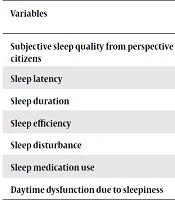
In this cross-sectional study, we invited 250 first and second-year students of medicine (who had not started their clinical training courses yet) to complete the Persian version of Pittsburgh Sleep Quality index (PSQI) in 2017. PSQI is a clinical instrument for the assessment of sleep quality which was developed in 1989 and its reliability and validity have been documented (20). The questionnaire has been translated into Persian and its validity has been evaluated in previous studies (21). PSQI is a self-administered questionnaire consisting of 19 items. The combination of these items provides seven subscales of sleep quality index, namely, subjective sleep quality, sleep latency, sleep duration, habitual sleep efficiency, sleep disturbance, use of sleep medications and daytime dysfunction. Each scale can acquire a score from 0 to 3, where 0 indicates no problem in the field. The scores sum up to provide a global PSQI score ranging from 0 to 21. Cutoff point of 5 is administered to assign participants either to good or poor sleep quality (20).
Time frame of the questionnaire is the previous month. Subjective sleep quality is evaluated with one question with answers ranging from very good to very bad. Sleep latency is the time it takes before the respondent falls asleep, which is considered problem-free if it is less than 15 minutes. Sleep duration is the actual time spent asleep. Habitual sleep efficacy is calculated by dividing the sleep duration by total time spent in bed. Sleep disturbance indicates any change in desired sleep pattern due to physical, psychological or environmental conditions. These conditions may be urination urgency, breathing problems, coughing, snoring, temperature discomfort, nightmare and pain among the others. Medication use is aimed at any prescribed or over the counter drug used to help the person sleep. Daytime dysfunction is defined as experiencing difficulty staying awake while driving, eating, engaging in social activities and maintaining the enthusiasm for completing the tasks.
The participants where provided with information on the aim of the study as well as questionnaire characteristics, privacy and anonymity of their information. After completing the informed consent form, those who agreed to participate would be given the PSQI as well as demographic questionnaire.
SPSS version 19 was used for statistical analysis. Descriptive statistics was applied and normality of the data was tested by Shapiro-Wilk test. Continuous data were presented as mean and median with SD and IQR accordingly. Chi-square was performed to compare subgroups and Mann-Whitney test was run to compare distribution between the two groups. P value less than 0.05 was considered significant.
4. Results
Out of the 250 distributed questionnaires, 154 returned completed (response rate = 62%). Among the respondents, 86 (55.8%) were female. Mean age of the participants was 19.1 (± 0.99) years, ranging from 17 to 23 years. Fifty-eight (37.6%) students lived in dormitory and 60.4% were freshmen. Two participants had a medical history of sleep disorders. Median wake-up time was 6 o’clock and median sleep duration was 6.25 hours.
Global PSQI score ranged from 0 to 15 and its median was 5 (IQR = 3). Poor sleep quality (PSQI score > 5) was observed in 65 students (42.2%, 95% CI = 35% to 50%).
Table 1 shows the participants’ score in the seven domains of PSQI. Participants seemed to score worst in sleep duration and daytime dysfunction subscales. Among the 154 students, 17 (11%, 95% CI = 7% to 17%) experienced inadequate sleep duration more than twice a week, while none of the inadequate sleepers reported day time dysfunction. Meanwhile, 130 (84.4%, 95% CI = 78% to 90%) of the total participants reported some degree of daytime dysfunction.
Table 1.Number of Participants in Each Score of the Seven Dimensions of Pittsburgh Sleep Quality Questionnaire
| Scale | Scorea | Median (IQR) | |||
|---|---|---|---|---|---|
| 0 | 1 | 2 | 3 | ||
| Subjective sleep quality | 36 | 83 | 29 | 6 | 1 (0) |
| Sleep latency | 105 | 32 | 8 | 2 | 0 (1) |
| Sleep duration | 49 | 55 | 33 | 17 | 1 (2) |
| Habitual sleep efficiency | 117 | 22 | 6 | 9 | 0 (0) |
| Sleep disturbance | 10 | 118 | 25 | 1 | 1 (0) |
| Need for sleep medications | 140 | 11 | 1 | 2 | 0 (0) |
| Daytime dysfunction | 24 | 84 | 38 | 8 | 1 (1) |
aLower score indicates better sleep quality, i.e. zero means no problem is reported in the respective dimension.
The majority (105 cases) had no problem falling asleep. More than 90% of the participants reported no use of sleep medication, although only 2 out of 14 medication users were among the good sleepers. Among 154 respondents, 36 rated their subjective sleep quality as very good, while 2 of them were considered to have poor sleep quality based on the PSQI.
Table 2 demonstrates the association between participants’ characteristics and PSQI. Neither of the variables sex, age, place of residence, being a freshman or having a history of sleep problems showed any significant association with sleep quality.
Table 2.Distribution of Poor Sleep Quality in Students According to Their Characteristicsa
| Good Sleepers | Poor Sleepers | P Value | |
|---|---|---|---|
| Sex: female | 50 (56.2) | 36 (55.4) | 0.922 |
| Age | 19.15 ± 1.061 | 65 ± 19.06 | 0.601 |
| Residence: dormitory | 35 (39.3) | 22 (33.8) | 0.523 |
| Freshmanship | 56 (62.9) | 37 (56.9) | 0.452 |
| History of sleep problem | 1 (1.1) | 1 (1.5) | 0.822 |
aValues are expressed as mean ± SD or No. (%).
No significant association was reported while evaluating the effect of these variables on the PSQI subscales, except for freshmanship. Among the freshmen, 24.7% had not report any sleep duration problem, while it was 42.6% in the second-year students (P = 0.02). Medication use was more common in second-year students (14.8% versus 5.45, P = 0.04). No daytime dysfunction was present in 21.5% of the freshmen, while only 6.6% of the second-year students were dysfunction-free (P = 0.01).
5. Discussion
The findings of this study demonstrate the high prevalence of poor sleep quality in a group of medical students in a Medical University in Tehran before entering clinical training courses. About 40% of the participants were considered to have poor sleep quality, although more than 70% of the participants rated their sleep quality as very or fairly good. The high prevalence of poor sleep quality has also been reported in other medical universities in Iran (22). The prevalence of poor sleep quality is widely different according to various studies from various parts of the world, ranging from less than 10% in Palestinian medical students, to 57% of a group of college students in Hong Kong (23) and to 60% in a study among 1125 college students in United States of America (4).
Considering the subscales of sleep quality, participants largely had problems in sleep duration and daytime dysfunction subscales. The students had lower average sleep duration than the optimum 7 hours. Although a study on Palestinian undergraduate students showed similar sleep duration (6.4 hours) (24), the average total sleep time was different in other studies from various parts of the world, ranging from about 8 hours in a study among Lebanese students (3), to 6.7 hours in a group of Taiwanese students (25) and to 6 hours in a study in Saudi medical students. (26) In a study of 2316 medical students of different years in the United States, the median sleep duration was reported about 7 hours (27). Medical students also demonstrated excessive daytime sleepiness (28).
The sleep duration problem was more dominant in the first year students, which may indicate their problem with coping with the new lifestyle. The association of short sleep duration (less than 6 hours) and academic performance is considered to be caused by lack of concentration on educational materials and reduced self-efficacy. Also, mental health issues might affect the association and prevalence of these problems (29).
About 10% of the participants used sleep medication in different intervals. The majority of them reported medication use and still experiencing poor sleep quality. It seems that there is a need to provide more information and support to avoid self-treatment and under-treatment in students experiencing sleep problems and providing support for understanding and resolving the underlying problems deteriorating sleep quality.
The prevalence of daytime dysfunction, which can be considered the outcome measure of sleep problems, was high in our sample. This condition was even more dominant in the second-year students. Considering the higher rate of sleep medication use in this subgroup, it can be considered a sign of participants’ effort to overcome the problems rooting in chronic sleep deprivation. In a similar study performed 10 years ago in the same university, the prevalence of sleep medication use in the past month was as low as 3.3%, even though their participants consisted of a wide range of medical students including undergraduates and residents (15). That study showed that the stress level of medical students increases when entering the clinical training phase (30). Excessive daytime sleepiness is observed in almost 35% of medical students (31).
Subjective sleep quality was described as poor or very poor only by 7% of participants in a study on a group of Estonian medical students, much lower than the 23% observed in our study (32). Subjective sleep quality is believed to correlate with exhaustion and burnout (33). In older ages, poor subjective sleep quality might be a sign of changes of cognitive decline (34). Impaired sleep quality might result in fatigue despite adequate sleep duration (35), which highlights the importance of considering all aspects of sleep in designing intervention programs.
Despite the observed effect of age on sleep in some previous studies (36), we did not obtain statistically significant results from the participants. This might be explained by the narrow age range of our participants who were in similar age groups or the weak nature of the association of age (37). The association might also be more dominant in older ages and in association of age-related changes in cognition (34).
Our study showed a difference in the pattern of three of the sleep quality subscales (i.e., sleep duration, medication use and daytime dysfunction) between the first and second-year students. It might suggest that prolonged sleep deprivation (which is imposed to the students at the beginning of the university education) is not well-coped and may present as daytime dysfunction and need for medication in consequent years.
None of the inadequate sleepers reported day time dysfunction in our study. This might be explained by the findings of the researchers who believe that there are interindividual differences in the magnitude of deteriorating consequences of sleep deprivation, which are believed to root in genetic differences (38). Some researchers even believe that sleep timing is a more determining factor than sleep quality and sleep length on academic performance and other activities (13, 26).
Overall, it is assumed that medical students around the world are obliged to prioritize academic responsibilities over a healthy sleeping pattern; however, putting sleep hygiene at risk may negatively affect their goals and academic performance (39, 40). There are a few studies that have evaluated the effect of sleep using interventional methods. These results have documented the impact of sleep quality on neurocognitive and academic performance (41).
Apart from the negative impacts on medical students, poor sleep quality of medical students may have implications for patient safety and the overall quality of health care. Sleep deprivation seriously endangers safety of physicians, trainees and the patients (42). Also, research suggests that physicians practicing healthier lifestyles in their personal life are generally more prone to the counselling of patients about preventive interventions (43). Changes in medical training should be planned and implemented to provide better measures for patient safety (44). Such preventive programs are needed at the beginning of the medical education to increase the efficiency of the interventions aiming to improve this condition (45). Also, various psychological interventions have been proposed to improve sleep in college students with variable effects (46).
The findings of our study should be considered with certain caveats. Data were collected from a single university in the capital city of Iran. As a result, part of the observed sleep disorders might be attributable to city characteristics. The students in our study may not actually represent all medical students in the country and the generalizability of the results cannot be ensured. Although our findings are mostly supported by other studies from Iran and other parts of the world, any future plans for intervention should be supported by more detailed evaluations. The self-administered nature of the questionnaire used for data collection may impose inaccuracies in both directions (overestimation and underestimation). The cross-sectional design of the study also makes causal inferences impossible.
5.1. Conclusions
Our study shows a warning degree of poor sleep quality in a group of young medical students in Tehran. Similar measurements in other universities should be made and evaluation of the effect of possible interventions, such as health education on sleep hygiene and counselling facilities for improved management of stress in medical schools, should be performed before proper programs are designed to improve students’ mental, physical and social health and their academic performance.