1. Background
The concept of vigilance was first introduced in 1923 by Henry Head, who described it as the highest level of physiological and psychological readiness to respond to environmental stimuli. In nursing, vigilance has long been emphasized as a fundamental component of practice. Florence Nightingale highlighted careful observation as the cornerstone of nursing care, underscoring the importance of continuous patient monitoring (1). In critical care units, nurses function as a vigilant safety system and can save patients’ lives through the early identification of clinical deterioration and emerging health problems (2). In contemporary research, vigilance has been defined as continuous monitoring, readiness to respond to changes in patients’ conditions, and proactive anticipation of potential clinical risks (3). Reduced vigilance among nurses may adversely affect patient safety by increasing the risk of clinical errors, inappropriate medication-related decisions, and impaired clinical reasoning when addressing patients’ care needs (4). Therefore, identifying factors associated with nurses’ vigilance is essential for improving care quality and patient outcomes. Subjective vigilance refers to an individual’s perceived level of alertness and cognitive readiness, which may not necessarily correspond to objective behavioral or physiological measures (5).
Emerging evidence indicates that sleep deprivation, fatigue, and perceived stress are key factors influencing nurses’ vigilance and may increase the risk of errors in critical care settings (6). Sleep disturbances and occupational stress are particularly common among nurses working in critical care units. Studies have shown that sleepiness is more prevalent among critical care nurses than among those working in other hospital wards (7), and approximately 70% of intensive care nurses report poor sleep quality (4). Increased sleepiness and fatigue are associated with reduced vigilance, slower problem-solving and reasoning processes, impaired psychomotor performance, and a higher likelihood of incorrect responses to clinical stimuli (8). Accordingly, the incidence of clinical errors has been reported to be directly related to nurses’ levels of vigilance (7).
Perceived stress refers to an individual’s appraisal of environmental demands as threatening or exceeding their coping capacity and health resources. Unlike objective measures of stress, perceived stress reflects individuals’ subjective experiences and emotional responses to stressful situations. Nursing is widely recognized as a highly stressful profession (9). Nurses working in intensive care units experience higher levels of perceived stress than those working in other wards because of heavy workloads, complex technologies, and the continuous need for rapid clinical decision-making (10). A recent mixed-methods study indicated that elevated perceived stress among critical care nurses may compromise patient safety and clinical performance (11). Despite growing evidence on the independent effects of sleep health and perceived stress on nurses’ performance, limited research has specifically examined their association with vigilance, particularly among critical care nurses. Furthermore, evidence on this issue remains scarce in Iran.
2. Objectives
This study aimed to determine the associations between sleep health and perceived stress and subjective vigilance among adult critical care unit nurses.
3. Methods
3.1. Study Design and Setting
This cross-sectional study was conducted between October 2023 and March 2024. The study population comprised nurses working in critical care units, including ICUs and CCUs, in teaching hospitals affiliated with Kurdistan University of Medical Sciences, Iran.
3.2. Participants and Sampling
The inclusion criteria were willingness to participate in the study, holding at least a bachelor’s degree in nursing, and having a minimum of 6 months of work experience in critical care units. Questionnaires with incomplete responses were excluded from the final analysis. All eligible nurses working in the ICU and CCU who met the inclusion criteria were invited to participate.
The required sample size was calculated using the finite population correction formula to ensure adequate statistical power to detect meaningful correlations. Based on this calculation, the minimum sample size was determined to be 160 participants. The initial sample size was estimated using the conventional sample size calculation formula and then adjusted using the finite population correction method to account for the limited population size.
Because the target population was finite and relatively small, the finite population correction (FPC) formula was applied to obtain a more accurate adjusted sample size. Given the cross-sectional design, the sample size was calculated based on data reported by Ajri-Khamsalo et al., which indicated a mean vigilance score of 3.86 ± 0.23 (3). Using a standard deviation of 0.23, a 95% confidence level, and a precision coefficient of 0.08, the required sample size was estimated to be 160 participants. Of the 264 eligible nurses, 203 agreed to participate and completed the questionnaires, yielding a response rate of 76.8%, which exceeded the minimum required sample size.
3.3. Data Collection
Data were collected using 3 paper-based questionnaires distributed in person to all eligible nurses working in the ICU and CCU. Data collection was conducted during working hours in designated staff rooms to minimize disruption to patient care. Before participation, nurses received a brief explanation of the study objectives and were assured of the confidentiality and anonymity of their responses. Data were collected using a demographic information form and 3 standardized instruments: the Nurses’ Vigilance Questionnaire, the Nurses’ Sleep Health Questionnaire, and the Perceived Stress Questionnaire.
3.4. Demographic Information Form
The demographic information form consisted of 9 items assessing participants’ sex, age, marital status, educational level, workplace ward, total clinical experience, duration of work experience in critical care units, average monthly working hours, and shift type.
3.5. Nursing Vigilance Scale
The Nurses’ Vigilance Questionnaire was originally developed by Geib in 2003. The Persian version was evaluated for validity and reliability by Ajri-Khameslou et al. in 2021 (3). The questionnaire is self-reported and comprises 40 items assessing the timely identification of changes in patient condition, familiarity with patients to recognize patterns, and clinical decision-making. Responses are rated on a 5-point Likert scale ranging from 1 (never) to 5 (always), with total scores ranging from 40 to 200. Higher scores indicate higher levels of vigilance. In the present study, reliability was confirmed using Cronbach alpha, demonstrating acceptable internal consistency (α = 0.83).
3.6. Becker’s Sleep Health Scale
This scale was initially evaluated by Brandolim Becker et al. (12). In the present study, the final 5-question version developed by Brandolim Becker et al. was used. Using the 6-point Likert scale, each item is scored from 0 (completely disagree) to 5 (completely agree). The total score ranges from 0 to 25, with higher scores indicating better sleep health. Reliability was assessed using Cronbach alpha, indicating acceptable reliability in the present study (α = 0.84).
3.7. Cohen’s Perceived Stress Scale
The Perceived Stress Scale (PSS) was originally developed by Cohen et al. in 1983 (13) and exists in 3 versions. In the present study, the 4-item version was used. Each item is rated on a 5-point Likert scale ranging from 0 (never) to 4 (often), with reverse scoring applied to positively worded items (items 2 and 3). Total scores range from 0 to 16, with higher scores indicating higher perceived stress. Face validity was assessed qualitatively with 5 nurses. The Persian version of the PSS used in this study was prepared using the forward-backward translation method, which is widely recommended for cross-cultural adaptation of instruments in health research. First, the original English version was independently translated into Persian by 2 bilingual experts in health sciences. A separate bilingual translator, blinded to the original version, then back-translated the Persian version into English. The research team compared the back-translated version with the original to resolve discrepancies and ensure conceptual equivalence. Content validity was evaluated by 10 faculty members from the Kurdistan School of Nursing. The content validity ratio for each item exceeded the Lawshe threshold of 0.72, indicating acceptable necessity for all items (range, 0.7 - 1.0). The content validity index for each item, as assessed by the experts, ranged from 0.8 to 1.0, confirming satisfactory content validity. Reliability was assessed using Cronbach alpha, demonstrating acceptable internal consistency in this study (α = 0.70).
3.8. Ethical Considerations
This study was approved by the Ethics Committee of Kurdistan University of Medical Sciences (Ethics Code: IR.MUK.REC.1402.072). All procedures were conducted in accordance with ethical guidelines and regulations, including the Declaration of Helsinki. Written informed consent was obtained from all participants before data collection. Participants’ confidentiality and anonymity were strictly maintained throughout the study.
3.9. Data Analysis
All data were entered and analyzed using SPSS version 26. The normality of continuous variables was assessed using the Kolmogorov-Smirnov test. Descriptive statistics, including means, standard deviations, and frequencies, were calculated for all relevant variables. Inferential analyses included independent t-tests and one-way analysis of variance, adjusted for demographic variables where appropriate. Pearson correlation coefficients were computed to examine associations between normally distributed continuous variables, specifically nurses’ sleep health, perceived stress, and vigilance scores. Multiple linear regression analysis was performed to identify significant predictors of nurses’ vigilance. A P value of less than 0.05 was considered statistically significant.
4. Results
4.1. Participant Characteristics and Demographic Associations
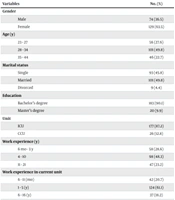
All analyses were conducted using the complete sample (N = 203), with no cases excluded because of missing data. Participants were adults aged 23 to 44 years. Most nurses were female, married, and held a bachelor’s degree. Group comparisons using independent t tests or one-way analysis of variance showed that subjective vigilance differed significantly by gender (P = 0.007), age (P = 0.03), work experience (P = 0.02), average monthly working hours (P = 0.04), and shift type (P = 0.001). Detailed demographic and occupational characteristics of the participants are presented in Table 1.
Table 1.
Demographic and Occupational Characteristics of Adult ICU and CCU Nurses and Comparison of Nurses’ Vigilance Across Demographic Characteristics
| Variables | No. (%) | Vigilance, Mean ± SD | P-Value |
|---|---|---|---|
| Gender | 0.007 | ||
| Male | 74 (36.5) | 144.00 ± 14.77 | |
| Female | 129 (63.5) | 150.15 ± 15.88 | |
| Age (y) | 0.030 | ||
| 23 - 27 | 56 (27.6) | 145.25 ± 14.55 | |
| 28 - 34 | 101 (49.8) | 147.26 ± 15.22 | |
| 35 - 44 | 46 (22.7) | 152.56 ± 17.49 | |
| Marital status | 0.425 | ||
| Single | 93 (45.8) | 146.92 ± 15.56 | |
| Married | 101 (49.8) | 148.28 ± 16.19 | |
| Divorced | 9 (4.4) | 153.88 ± 11.73 | |
| Education | 0.216 | ||
| Bachelor’s degree | 183 (90.1) | 147.45 ± 15.85 | |
| Master’s degree | 20 (9.9) | 152.05 ± 14.31 | |
| Unit | 0.349 | ||
| ICU | 177 (87.2) | 147.51 ± 15.95 | |
| CCU | 26 (12.8) | 150.61 ± 14.15 | |
| Work experience (y) | 0.021 | ||
| 6 mo - 3 y | 58 (28.6) | 146.10 ± 14.54 | |
| 4 - 10 | 98 (48.3) | 146.32 ± 16.05 | |
| 11 - 21 | 47 (23.2) | 153.44 ± 15.51 | |
| Work experience in current unit | 0.402 | ||
| 6 - 11 (mo) | 42 (20.7) | 150.66 ± 15.89 | |
| 1 - 5 (y) | 124 (61.1) | 145.23 ± 15.94 | |
| 6 - 16 (y) | 37 (18.2) | 153.75 ± 12.83 | |
| Average monthly working hours | 0.048 | ||
| 150 - 169 | 18 (8.9) | 160.22 ± 9.78 | |
| 170 - 209 | 143 (70.4) | 146.66 ± 16.30 | |
| 210 - 250 | 42 (20.7) | 146.88 ± 13.67 | |
| Shift type | 0.001 | ||
| Constant | 16 (7.9) | 160.56 ± 12.66 | |
| Circular | 187 (92.1) | 146.82 ± 15.52 |
4.2. Sleep Health, Perceived Stress, and Vigilance Scores
The mean scores for nurses’ vigilance, sleep health, and perceived stress are summarized in Table 2. Overall, nurses reported a moderate level of subjective vigilance.
Table 2.
Mean Scores of Vigilance, Sleep Health, and Perceived Stress Among Adult ICU and CCU Nurses
| Variables | Mean ± SD | Minimum-Maximum |
|---|---|---|
| Nurses’ vigilance | 147.91 ± 15.73 | 101 - 186 |
| Sleep health | 10.65 ± 5.34 | 1 - 22 |
| Perceived stress | 7.61 ± 2.87 | 0 - 16 |
Correlation analyses indicated a significant positive association between nurses’ subjective vigilance and sleep health, suggesting that better sleep health was associated with higher levels of vigilance (r = 0.552, P < 0.001). Conversely, subjective vigilance was significantly negatively correlated with perceived stress, indicating lower vigilance among nurses with higher stress levels (r = -0.390, P < 0.001). Multiple regression analysis showed that shift type (B = -0.138), sleep health (B = 0.427), and perceived stress (B = -0.206) were significantly associated with subjective vigilance among ICU and CCU nurses (Table 3). Specifically, better sleep health was associated with higher subjective vigilance, whereas higher perceived stress and working rotating shifts were associated with lower levels of vigilance.
Table 3.
| Variables | Unstandardized B | SE | β | t | P-Value |
|---|---|---|---|---|---|
| Gender (1 = male, 2 = female) | 3.798 | 2.029 | 0.116 | -0.820 | 0.063 |
| Age (y) | -0.408 | 0.497 | -0.137 | 1.871 | 0.413 |
| Marital status (1 = single, 2 = married, 3 = divorced) | 0.296 | 1.750 | 0.011 | 0.169 | 0.866 |
| Education (1 = BSN, 2 = MSN) | 0.951 | 3.092 | 0.018 | 0.307 | 0.759 |
| Unit (1 = ICU, 2 = CCU) | 1.466 | 2.924 | 0.031 | 0.501 | 0.617 |
| Work experience (y) | 0.528 | 0.544 | 0.173 | 0.970 | 0.333 |
| Work experience in current unit (y) | -0.095 | 0.478 | -0.016 | -0.198 | 0.844 |
| Work hours (h) | 0.029 | 0.045 | 0.043 | 0.650 | 0.517 |
| Shift type (1 = constant, 2 = circular) | -8.061 | .3.934 | -0.138 | -2.049 | 0.042 |
| Sleep health (score) | 1.258 | 0.196 | 0.427 | 6.414 | 0.001 |
| Perceived stress (score) | -1.128 | 0.355 | -0.206 | -3.175 | 0.002 |
a The model is a linear regression using the enter method. The independent variables were gender (male/female), age (years), marital status (single/married/divorced), education (BSN/MSN), unit (ICU/CCU), work experience (years), work experience in the current unit (months/years), work hours per month (hours), shift type (constant/circular), sleep health score, and perceived stress score. The dependent variable was the Nurses’ Vigilance Score. Abbreviation: SE, standard error.
b Model fit: R2 = 0614a, adjusted R2 = .341, F (df = 11, 191).
5. Discussion
Based on the theoretical score range and the observed mean in the present study, the subjective vigilance of nurses working in critical care units can be considered moderate. Although similar instruments were used to measure vigilance, the mean vigilance score in this study was lower than that reported in a previous study conducted in Iran (3). Nevertheless, the previous study indicated that nurses demonstrated relatively high levels of clinical knowledge-related vigilance, exceeding the expected average (3). International comparisons also provide context for these findings. A study conducted in Pennsylvania, United States, reported nurses’ vigilance scores above the expected average. In contrast, research from Turkey indicated that nurses working night shifts exhibited reduced psychomotor vigilance (14), whereas a study in Saudi Arabia found that fatigue and impaired alertness were prevalent among nurses in high-acuity settings, highlighting the susceptibility of vigilance to occupational demands (15). Previous investigations have also shown that ICU nurses have slower reaction times and higher error rates than floor nurses, supporting the notion that vigilance is challenged in critical care environments (7). These differences may be attributable to variations in personal and organizational factors, as well as to differences in the instruments used to assess vigilance. Additionally, discrepancies may reflect differences in study populations. While the present study included nurses from both ICU and CCU units, some studies focused exclusively on a single specialized unit (3). Such differences in clinical context may limit the comparability of results. Consequently, reduced or insufficient vigilance may predispose nurses to clinical errors or convert potential mistakes into actual adverse events (3).
In the present study, nurses reported relatively low sleep health based on the scale range. Importantly, sleep health was moderately and positively associated with subjective vigilance, indicating that nurses with better sleep health tended to report higher levels of vigilance. This association was further supported by multiple regression analysis, in which sleep health remained a significant predictor of vigilance after controlling for other variables. These findings are consistent with previous evidence demonstrating a high prevalence of poor sleep among nurses. A recent meta-analysis reported that approximately 61% of nurses worldwide experience poor sleep quality (16), with prevalence rates among ICU nurses reaching up to 70% (4). Similar trends have been reported in Iran, where a substantial proportion of nurses experience clinically significant sleep disturbances and daytime sleepiness (17). These data suggest that poor sleep health is a widespread concern among nurses, particularly those working in critical care settings. Variations in reported sleep health across studies may be influenced by differences in work schedules, cultural factors, measurement instruments, and healthcare system demands. The observed relationship between sleep health and vigilance is supported by prior research indicating that increased sleepiness impairs alertness and vigilance and increases the likelihood of errors (7). Nurses who experience insufficient sleep before work demonstrate reduced quality of care and compromised patient safety (18). Sleep disorders and sleep deficiency have been shown to adversely affect daily functioning and cognitive performance, including vigilance, which is essential for safe and effective nursing care. Research from Canada also indicates that even modest sleep loss can impair visual attention and behavioral responses, despite active efforts to maintain alertness (19). Moreover, fatigue and insomnia appear to weaken alertness more than other cognitive functions, potentially contributing to difficulties in clinical decision-making, an increased risk of misdiagnosis, and medication errors (7, 20). Critical care environments require sustained vigilance, making nurses particularly vulnerable to the negative effects of sleep disruption and fatigue (21). Several interventions have been found effective in improving nurses’ sleep at an individual level, including sleep education programs (22), relaxation techniques (23), aromatherapy and massage interventions (24), and limiting exposure to electronic media before sleep (25). Implementing one or more of these strategies may enhance sleep health among nurses, depending on individual needs and organizational circumstances.
This study found that nurses reported a moderate level of perceived stress based on the scale. Importantly, perceived stress was significantly and negatively associated with subjective vigilance, indicating that nurses experiencing higher stress tended to report lower levels of vigilance. This relationship remained significant in multiple regression analysis, suggesting that perceived stress is an important factor influencing vigilance among ICU and CCU nurses, even after controlling for other variables. Previous research has consistently shown that stress levels among nurses working in intensive care settings are high (26, 27). Similarly, studies from Turkey and Saudi Arabia have demonstrated that elevated perceived stress is linked to reduced psychomotor vigilance and impaired cognitive performance among nurses working night shifts and in high-acuity clinical environments, highlighting the susceptibility of vigilance to occupational demands (14, 15). High levels of stress may compromise nurses’ ability to perform their roles and responsibilities according to professional standards and have been associated with lower overall performance and higher error rates (28). The observed association between perceived stress and vigilance in this study may be explained by the cognitive load imposed by stress, which can deplete attentional resources necessary for sustained vigilance. These findings underscore the importance of implementing interventions aimed at stress reduction and management. Evidence suggests that occupational health promotion programs should focus on reducing perceived stress, enhancing coping skills, and promoting stress management strategies among nurses (29). Commonly recommended strategies include self-regulation (efforts to control one’s emotions and actions), structured problem-solving (analytical approaches to resolving work-related challenges), and seeking social support (efforts to obtain assistance and guidance). At the organizational level, measures such as flexible work scheduling, clear role definitions, interactive management, continuous learning opportunities, and ensuring occupational health and job security can help mitigate perceived stress among nurses (30).
Multiple linear regression analysis indicated that nurses working rotating shifts reported lower vigilance than those working fixed shifts. Specifically, nurses working rotating shifts reported lower levels of vigilance than those on fixed shifts, suggesting that variability in work schedules may influence attentional performance among ICU and CCU nurses. A rotating shift is defined as a work schedule in which a nurse has at least 1 shift per week that differs from the usual schedule (31). These findings are consistent with prior research indicating that nurses on rotating schedules experience unavoidable fatigue, which challenges optimal performance (32). Circadian disruption associated with rotating shifts has been linked to reduced vigilance and diminished work performance (33). Nurses working rotating shifts often struggle to maintain wakefulness during work hours and are at increased risk of medical errors (34). Furthermore, a cross-sectional survey using the job demands-resources model reported that rotating shifts disrupt circadian rhythms, reduce alertness during night shifts, and may increase patient safety risks (35). Rotating shifts have also been associated with higher perceived stress, which may further compromise attentional capacity and vigilance, whereas fixed shifts appear beneficial for reducing perceived stress (36). Although night-shift nurses may partially compensate for lost sleep during daytime hours (37), rotating shifts pose greater challenges because of continuous changes in sleep-wake patterns and limited opportunities for physiological adaptation, which may explain poorer vigilance outcomes than those of fixed schedules.
Taken together, shift work characteristics, sleep health, and perceived stress are interrelated factors that jointly influence nurses’ vigilance. Rotating shifts can disrupt circadian rhythms and limit recovery, negatively affecting sleep health. Poor sleep, combined with sustained work demands, may contribute to higher perceived stress. When recovery is insufficient and stress remains elevated, the attentional resources required for sustained vigilance may be compromised, particularly in high-acuity environments such as intensive care units. The observed associations among sleep health, perceived stress, shift type, and vigilance are consistent with theoretical frameworks on sleep-cognition and stress-cognition interactions, which demonstrate how fatigue and stress impair cognitive processing (38, 39). This provides a conceptual basis for understanding how sleep health and perceived stress may modulate vigilance performance in nurses. This study contributes to ICU and CCU nursing practice by identifying key factors influencing nurses’ vigilance. The findings can inform future research and workplace interventions aimed at maintaining vigilance and, consequently, promoting patient safety.
5.1. Limitations
Several limitations should be acknowledged. First, the use of self-reported data may be subject to reporting bias. Second, the cross-sectional design limits the ability to infer causal relationships. Finally, the study was conducted in a single region, which may limit the generalizability of the findings.
5.2. Conclusions
The findings of this study indicate that nurses working in critical care units report moderate levels of subjective vigilance and sleep health, along with moderate perceived stress. Sleep health was positively associated with nurses’ vigilance, whereas perceived stress and rotating shift work were associated with reduced vigilance, as confirmed by multiple regression analysis. Given the cross-sectional design, these relationships should be interpreted as associative rather than causal. Reduced vigilance among nurses may compromise patient safety by increasing the risk of clinical errors. These results highlight the potential benefits of organizational strategies that address shift scheduling and stress management to support nurses’ vigilance. However, the findings should be interpreted in light of the study’s limitations, including its cross-sectional design and reliance on self-reported data. Future research using cohort, case-control, or interventional study designs is recommended to further investigate these relationships and to develop evidence-based interventions aimed at maintaining nurses’ vigilance and enhancing patient safety.