1. Background
Aging is a phenomenon caused by changes in biology, physiology, biochemistry, and anatomy in body cells, and an older adult is a person who is 65 years old or older. The elderly is considered part of society’s vulnerable population, and the country’s health officials focus more on the issue of old age (1). As a result of the shrinking population and decrease in marriages and births, Iran now appears to be among the nations experiencing demographic aging. In the future, this country’s top demographic pyramid will be in the old age area. According to the country’s civil registration organization statistics, the growth rate of the population over 60 years old in Iran from 2011 - 2050 is predicted to be more than 26%, which is expected to be 33% by 2050 (2).
Acute and chronic diseases often cause older adults to be hospitalized for extended periods and occupy more hospital beds. Therefore, older adults need more specialized care according to their complex conditions. The healthcare system has various parts, each of which plays its role in some way (3). Nursing is one of the essential elements of this system that directly affects health and disease indicators. Nurses establish the most human relationship with elderly patients regarding duration and depth of communication (4).
On the other hand, nursing has been considered an inherently ethical profession due to the need for caring others. Providing optimal and ethical patient care requires the nurse’s personal, social, ethical, and spiritual abilities. Nurses usually face challenging ethical issues in practice, making it difficult to make decisions. On the other hand, nurses are ethically responsible and should be accountable for their behavior (5).
Ethical action involves caring for oneself and others. Ethical sensitivity is a person’s ability to recognize ethical conflicts along with the emotional and intellectual perception of vulnerable situations and awareness of ethical consequences in making decisions about others (6).
Nurses should understand the ethical decision-making process and respect the ethical rights of patients without compromising their ethical conscience. According to Goethals et al. (as cited by Izadi et al.), the inability to face problems causes several nurses to leave their profession or want to change their workplace (7). Nurses frequently should make ethical decisions in their work environment. Ethical sensitivity is one of the components of the ethical decision-making process, defined as a person’s ability to judge and make correct and logical decisions in dealing with everyday ethical challenges. The ability to understand ethical problems is one of the prerequisites for the ethical practice of nurses. Therefore, nurses should develop sensitivity skills, ethical sensitivity, understanding, and ethical analysis for practical application (8).
On the other hand, nurses, who are in direct contact with patients and visitors in health and treatment centers, need proper training, and conducting studies to improve their skills can be very effective. High-level education effectively creates a competent nursing workforce for the healthcare system. However, the concern about the low quality of nursing care and poor competence among nurse caregivers is increasing (9).
Ethical sensitivity affects the nursing staff’s ability, and developing nursing ethics is necessary to improve the profession and services. Thus, enhancing ethical sensitivity in the nursing staff improves the quality of nursing services (10). Today, nursing care of the elderly has become an emerging phenomenon, and correct clinical decision-making in nursing measures leads to rational care planning with maximum effectiveness. Nursing attitude is one of the critical factors related to ethical sensitivity. Generally, attitudes are more stable and consist of various positive or negative beliefs. The attitude toward the care of elderly patients is one of the issues determining caring behavior, which significantly impacts the health and recovery of the elderly (11). Various research findings on nurses’ attitudes toward the elderly have shown positive, negative, and neutral attitudes toward the elderly. Research in Queensland, Australia, showed that even though nurses had a positive attitude towards the elderly, they lacked knowledge regarding the care of the elderly (12). A study in Sweden determined the attitude of nursing students and nurses towards caring for the elderly and showed that most students and nurses had a neutral or slightly positive attitude towards the elderly with enough misconceptions about their capabilities (13).
The studies conducted on ethical sensitivity and the attitude of nurses have not yet been able to show the different dimensions of this issue well. A measure of ethical sensitivity in nursing groups towards elderly patients is also necessary to investigate the effects of other conditions on this issue. Therefore, the quality of providing care to the elderly is affected by many factors, including nurses’ attitudes and ethical sensitivity.
2. Objectives
This study was conducted to determine nurses’ attitudes and ethical sensitivity toward elderly patients.
3. Methods
3.1. Study Design
This descriptive-analytical study (2022) was conducted on four training and non-training hospitals affiliated with the Ilam University of Medical Sciences, Iran. The population included nurses working in the hospitals mentioned above, who were selected by simple random sampling according to the quota assigned to each department (380 people). The inclusion criteria included experience of more than six months, age range of 25 - 50 years, and willingness to participate in the study.
3.2. Data Collection
Data were collected using two questionnaires, each with two parts. The first part of both questionnaires evaluates the participants’ personal and social characteristics. In contrast, the second part of the first questionnaire is related to assessing nurses’ ethical sensitivity in decision-making, including the questionnaire on Kogan’s attitude towards the elderly.
3.3. Questionnaires
The standard questionnaire on nurses’ ethical sensitivity was compiled by Lutzen et al. (as cited by Abbaszadeh et al.) in Sweden. This 25-item questionnaire measures the ethical decision-making status of nurses when providing clinical services. The score of each question is based on a five-option Likert scale as completely agree (= 4), somewhat agree (= 3), somewhat disagree (= 2), completely against (= 1), and neutral (= 0). According to the questionnaires, the highest score is 100, and the lowest score is zero. Hence, a total score between 0 - 50 shows a low ethical sensitivity, 50 - 75 is moderate ethical sensitivity, and 75 - 100 indicates a high ethical sensitivity. The questionnaire has six dimensions of ethical sensitivity, which include the level of respect for the client’s independence, awareness of communication with the patient, professional knowledge, the experience of ethical problems, application of ethical concepts in ethical decisions, honesty, and benevolence (10).
Another part of the required information was obtained with the nurses’ attitude questionnaire toward the elderly. Kogan first designed this questionnaire in 1961 to investigate the attitude of nurses toward the elderly. This questionnaire contains 34 attitude statements (17 positive and 17 negative) about the elderly. Respondents’ attitudes toward the elderly were evaluated by this questionnaire. For this purpose, a six-point Likert scale was used, ranging from completely disagree (score = 1) to completely agree (score = 7) and for the phrase no opinion (score = 4). The scores of negative statements were reversed to obtain the total score. The range of general attitude scores is from 34 to 238, and a score of 102 was considered as a neutral attitude toward the elderly. Finally, a score higher than 102 was a more positive attitude.
3.4. Validity and Reliability of Questionnaires
The validity and reliability of the standard ethical sensitivity questionnaire were determined by its author and used by many researchers. The face and content validity of this well-known questionnaire on nursing ethics was first investigated by Abbaszadeh et al. in Kerman, Iran, equal to 97% (10). The face and content validity of the attitude questionnaire toward the elderly was reported as much as 95% (14). Further, this scale has been recognized as a valid and reliable tool for measuring people’s attitudes toward the elderly (15). A test-retest reliability method was used to analyze the questionnaires in 20 nurses. As mentioned, 90% and 87% of the reliability coefficient were used in the leading group.
3.5. Statistical Analysis
SPSS software version 24 was used for data analysis. Pearson’s correlation coefficient and Cramer’s V were used to analyze the data related to considered demographic variables in present study including age, sex, marital status and education level. Finally, sampling was performed after obtaining permission from legal authorities to start the research. Moreover, all participants were informed of the necessary information about the study, as well as the participants’ rights, including the right to withdraw from the research and the confidentiality of the data. Verbal and informed consent was obtained from all participants in the study based on the principles and rules of the Ethics Committee of Ilam University of Medical Sciences.
4. Results
Among the 380 nurses who participated, ten refused to participate in the survey, and 34 failed to return their questionnaires. Finally, 336 working nurses participated with an average age of 32.6 ± 9.10 years. The average score of ethical sensitivity of participating nurses was 65.56 ± 6.27, indicating the moderate level of the ethical sense of nurses. In addition, the attitude of nurses was 136.22 ± 11.62, showing a moderate level of attitude. Based on the results, nurses had a positive attitude toward the elderly.
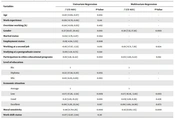
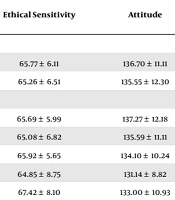
The findings found no significant relationship between nurses’ average attitude and ethical sensitivity scores toward elderly patients (r = 0.013, P = 0.807). Based on the correlation coefficient between ethical sensitivity and nurses’ ages in the study, no significant relationship was found between ethical sensitivity and age. However, there was a significant relationship between age and nurses’ attitudes. No significant relationship was observed between other demographic variables (gender, marriage, and education level) and nurses’ ethical sensitivity and attitudes (Table 1).
Table 1.
Demographic Characteristics of Nurses and Their Relationship with the Level of Ethical Sensitivity and Attitude a
| Variables | Number | Ethical Sensitivity | Attitude | Statistical Analysis | |
|---|---|---|---|---|---|
| Ethical Sensitivity | Attitude | ||||
| Sex | Cv = 0.275, P = 0.853 | Cv = 0.385, P = 0.596 | |||
| Female | 195 | 65.77 ± 6.11 | 136.70 ± 11.11 | ||
| Male | 141 | 65.26 ± 6.51 | 135.55 ± 12.30 | ||
| Age (y) | R = 0.010, P = 0.859 | R = -0.118, P = 0.031 | |||
| 25 - 30 | 188 | 65.69 ± 5.99 | 137.27 ± 12.18 | ||
| 31 - 35 | 96 | 65.08 ± 6.82 | 135.59 ± 11.11 | ||
| 36 - 40 | 38 | 65.92 ± 5.65 | 134.10 ± 10.24 | ||
| 41 - 45 | 7 | 64.85 ± 8.75 | 131.14 ± 8.82 | ||
| 46 - 50 | 7 | 67.42 ± 8.10 | 133.00 ± 10.93 | ||
| Marital status | Cv = 0.245, P = 0.345 | Cv = 0.374, P = 0.702 | |||
| Single | 213 | 65.93 ± 6.01 | 137.36 ± 11.92 | ||
| Married | 123 | 64.91 ± 6.68 | 134.24 ± 10.84 | ||
| Level of education | R = 0.083, P = 0.129 | R = 0.010, P = 0.853 | |||
| B.S | 244 | 65.27 ± 6.5 | 136.13 ± 11.61 | ||
| M.Sc. | 85 | 66.16 ± 5.76 | 136.96 ± 11.40 | ||
| Ph.D. | 7 | 68.14 ± 2.73 | 130.28 ± 14.41 | ||
a Values are expressed as mean ± standard deviation (SD) unless otherwise indicated.
In addition, there was no significant relationship between work history, work shift type, and workplace sector with the level of nurses’ ethical sensitivity and attitudes (Table 2).
Table 2.
Frequency of Employed Nurses According to Work History, Type of Work Shift and Workplace Department and Their Relationship with Ethical Sensitivity and Attitude a
| Variables | Number | Ethical Sensitivity | Attitude | Statistical Analysis | |
|---|---|---|---|---|---|
| Ethical Sensitivity | Attitude | ||||
| Workplace department | Cv = 0.644, P = 0.401 | C = -0.796, P = 0.467 | |||
| Internal medicine | 86 | 66.34 ± 6.84 | 137.52 ± 10.83 | ||
| Surgery | 74 | 65.40 ± 6.07 | 137.24 ± 13.15 | ||
| Emergency | 70 | 65.35 ± 6.21 | 135.26 ± 10.76 | ||
| Critical care | 91 | 64.06 ± 6.39 | 135.26 ± 10.76 | ||
| Psychiatric nursing | 15 | 65.35 ± 6.11 | 136.26 ± 14.86 | ||
| Work history (y) | R = 0.084, P = 0.122 | Cv = 0.072, P = 0.191 | |||
| 3 > | 29 | 66.86 ± 5.17 | 138.06 ± 13.61 | ||
| 3 - 5 | 62 | 66.11± 6.67 | 136.04 ± 11.21 | ||
| 5 - 10 | 165 | 65.40 ± 6.15 | 136.84 ± 11.88 | ||
| 10 < | 80 | 65.00± 6.59 | 134.40 ± 10.55 | ||
| Type of work shift | Cv = 0.459, P = 0.383 | Cv = 0.516, P = 0.878 | |||
| Morning | 144 | 65.03 ± 6.48 | 136.70 ± 11.92 | ||
| Noon | 120 | 65.65± 6.14 | 137.38 ± 10.91 | ||
| Night | 72 | 66.47± 6.06 | 133.30 ± 11.83 | ||
a Values are expressed as mean ± standard deviation (SD) unless otherwise indicated.
5. Discussion
This study aimed to determine the relationship between the level of nurses’ attitudes and ethical sensitivity and their effect on the personal-social characteristics of nurses. The results showed no significant difference between nurses’ ethical sensitivity and attitudes. The level of ethical sensitivity of participating nurses was moderate, and the results were similar to those of other studies. In Kim et al., nurses’ ethical sensitivity score was reported as moderate (16). Sadrollahi and Khalili examined the ethical sensitivity of 221 nurses in hospitals affiliated with the Golestan University of Medical Sciences and showed that nurses’ ethical sensitivity level was moderate (17). The results of Maghami et al. (15), Zuzelo (18), and Filipova (19) were consistent with those of the present study (7, 15). However, the score of ethical sensitivity was high in Zuzelo (18) and low in Filipova (19). The results revealed a positive attitude in nurses towards the elderly, which was consistent with similar studies (20-23) and inconsistent with others (24-26). This difference in the nurses’ attitudes towards hospitalized older adults can be caused by temporal, geographical, cultural, and social variables governing the research environments, which may be affected by the different attitude measurement questions used in other studies (25).
In this study, social-individual characteristics such as age, gender, level of education, and marriage, as well as work experience, type of shift, and workplace department, had no significant relationship with the level of ethical sensitivity of nurses. Maghami et al. (15), Fazljoo et al. (26), Murayama (27), and Zeinaly et al. (28) showed no significant relationship between the level of ethical sensitivity and demographic characteristics (age, sex, marriage, and academic semester). Zirak et al. found no significant relationship between nurses’ personal-social characteristics and their level of ethical sensitivity (29). Woods concluded that nurses in different educational levels (diploma, post-diploma, bachelor’s, and master’s degrees) do not differ in ethical sensitivity types (30). Maghami et al. indicated that clinical history has no significant relationship with the level of ethical sensitivity (15). However, Ketefian showed that the ability to reason ethically has a significant relationship with clinical history so that the level of ethical sensitivity decreases with the increase in alcoholism (31). Further, Fazljoo et al. detected a significant relationship between clinical history and level of ethical sensitivity (26).
Furthermore, nurses’ attitudes towards the elderly had no significant relationship with individual-social characteristics such as gender, level of education, and marriage, as well as work experience, work shift type, and workplace sector. The results were consistent with those of Maghami et al. (15) and Hsu et al. (32). In addition, Hamadanizade et al. found no significant relationship between nurses’ attitudes and education level (24). Contrary to the present research, a significant relationship was found between the type of attitude and gender in Hosseini Seresht et al. (20).
The age variable had a significant relationship with the type of attitude of nurses towards the elderly, which becomes weaker with increasing age. Hosseini Seresht et al. found a significant and direct relationship between age and the type of attitude (20).
The lack of difference in the ethical sensitivity of nurses in different departments might be due to the lack of difference in the work procedure and work routines in the inpatient departments, the attitude of nurses regarding the importance of patient care, and the supervision of managers and officials in the department.
5.1. Limitations
The limitations of this research were the condition of COVIED-19 and the lack of acceptance of some nurses to participate in this research.
5.2. Conclusions
Providing ethical and humane care is one requirement of the nursing profession for those referred to the health system. The organization should develop policies for planning and implementing programs, which increase ethical sensitivity and improve the ability of ethical sensitivity in clinical nurses. Therefore, long-term planning and preparation of content-rich educational programs such as workshops and continuous courses can help develop nurses’ ethical sense. In addition, adding a unit of nursing ethics in different dimensions, especially the elderly, to nursing courses can help the development of nurses’ ethical sensitivity in the future. In contrast, the positive attitude of nurses should be encouraged and reinforced to ensure that hospitalized elderly receive psychological support and maintain their dignity. The results of this study can be useful for designing similar studies in the future and increasing the efficiency of nurses.