
1. Background
Mental illnesses are one of the most common public health issues around the world that negatively affect people's lives and society's health (1). According to the estimates of the World Health Organization (WHO), about 25% of the populations in developing countries suffer from mental illnesses, and its prevalence is spreading (2). According to the latest WHO reports, in 2022, mental disorders will affect one in eight people worldwide (3). The prevalence of mental disorders in Iran also corresponds to the global trend, and depression and anxiety are the most common mental diseases diagnosed (4). On the other hand, the elderly population has increased significantly in most countries of the world (5). Currently, people aged 60 years and older currently constitute 12.3% of the world's population, and it is predicted to reach approximately 22% by 2050 (6).
One of the health issues faced by the elderly is mental illness (7). On the other hand, in recent years, the mental health issues of the elderly have become more serious due to reasons such as the speed of urbanization, population reduction policies, single children and loneliness (8). These disorders are common in the elderly and about 20% of the elderly 60 years and older suffer from a mental disorder (9).
The population with mental illness not only imposes significant costs on the health care system, but also causes great economic losses to the society (10). Also, these disorders have a significant effect on the costs of treatment and hospitalization among elderly people with physical disorders (6). These disorders are a major source of distress, disability, and social burden, and many people who could benefit from treatment do not receive it (11). Longitudinal studies have shown that decreased cognitive abilities and perceived control as well as increased loneliness may lead to psychological distress among older adults (9, 12). Psychological distress has a significant relationship with aging (13) and is considered as a key component in the psychosocial functioning of the elderly (14). The term psychological distress often includes: Stress, depression or anxiety that has not reached the severity of a mental disorder (13). In another definition, psychological distress is often referred to as a general mental stress reaction, including emotional symptoms of depression and anxiety (14). Psychological distress is considered a public health priority due to its adverse effects on quality of life, health, performance and productivity; it can also predict several serious mental illnesses such as depression and anxiety disorders (15). Evidence has shown that the risk of cardiovascular disease, chronic obstructive pulmonary disease, and incidental arthritis all increase with increasing levels of psychological distress in the elderly population (14, 15). On the other hand, biological, social and economic stress may increase the risk of psychological distress in the elderly (11). Other factors affecting psychological distress include age, gender, and educational status (16).
Today, there is more interest and awareness among the general population about recognizing and pursuing the treatment of these types of issues, and there is also the ability to identify them in health care services (10). In addition, evidence shows that the identification of factors affecting mental disorders can be beneficial in the development of targeted interventions (17).
2. Objectives
Considering the importance of having evidence-based data in health promotion planning, the present study was conducted with the aim of determining the prevalence, socio-economic and demographic factors associated with psychological distress among elderly in Kermanshah.
3. Methods
3.1. Participants
The present study was a descriptive study that was conducted among people aged 60 to 75 in Kermanshah city in 2022. The sampling method was a multi-stage cluster, so that first, among the pension funds of Kermanshah city, 3 national pension funds, and social security and armed forces funds were randomly selected. Then, information was collected from 538 people aged 60 to 75 under the coverage of these centers, as a simple random sampling. The inclusion criteria for this study were: Being 60 to 75 years old, having at least primary education, and being covered by pension funds. Incomplete answering of the questionnaire options was considered as the exclusion criterion.
3.2. Data Collection Tool
The data collection tool was a questionnaire that included two sections; the first part of demographic information included questions such as age, gender, education, marital status and economic status, living situation, experience of stressful events during the past year, and smoking. The second part of the 6-item Kessler Psychological Distress Scale (K6) was measured on a 5-point Likert Scale with points ranging from 0 (None of the time) to 4 (All of the time). In order to score this scale, the scores in all 6 items were added for a total score range between 0 and 24. Respondents were classified as having severe psychological distress if they scored 13 or more (18). The psycho analysis of this questionnaire was done in Persian language and its Persian version is valid, reliable and stable enough to diagnose psychological distress among the elderly. Cronbach's alpha of the questionnaire was reported in Iran (0.92) (19). In our study, the reliability coefficient for the K6 was 0.83.
3.3. Data Analysis
Data were analyzed by SPSS version 16 using Pearson correlation, chi-square and independent samples t-test at 95% significant level. Descriptive data are reported with mean ± standard deviation and number (percentage).
4. Results
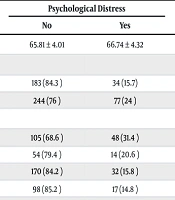
Our findings showed that 20.6% (111 people) of the elderly had psychological distress according to K6. The findings related to the relationship between gender, education, economic status, marital status, place of residence, smoking and history of having a stressful crisis during the last year with mental distress were shown in Table 1.
Table 1.
The Relationship Between Psychological Distress and Background Variables of the Elderly a
| Background Variables | Psychological Distress | P-Value | |
|---|---|---|---|
| No | Yes | ||
| Ageb | 65.81 ± 4.01 | 66.74 ± 4.32 | 0.033 |
| Genderc | 0.019 | ||
| Female | 183 (84.3 ) | 34 (15.7) | |
| Male | 244 (76 ) | 77 (24 ) | |
| Educationc | 0.001 | ||
| Elementary | 105 (68.6 ) | 48 (31.4 ) | |
| Secondary | 54 (79.4 ) | 14 (20.6 ) | |
| Diploma | 170 (84.2 ) | 32 (15.8 ) | |
| Academic | 98 (85.2 ) | 17 (14.8 ) | |
| Economic statusc | < 0.001 | ||
| Weak | 146 (67.3 ) | 71 (32.7 ) | |
| Medium | 222 (86.7 ) | 34 (13.3 ) | |
| Good | 59 (90.8 ) | 6 (9.2 ) | |
| Marital statusc | 0.387 | ||
| Single | 8 (66.7 ) | 4 (33.3 ) | |
| Married | 329 (80.4 ) | 80 (19.6 ) | |
| Widow | 90 (76.9 ) | 27 (23.1 ) | |
| Living arrangementsc | 0.219 | ||
| Alone | 53 (71.6 ) | 21 (28.4 ) | |
| Spouse and children | 210 (78.9 ) | 56 (21.1 ) | |
| Children | 55 (80.9 ) | 13 (19.1 ) | |
| Spouse | 109 (83.8 ) | 21 (16.2 ) | |
| Smokingc | 0.833 | ||
| No | 331 (79.6 ) | 85 (20.4 ) | |
| Yes | 96 (78.7 ) | 26 (21.3 ) | |
| Having experienced a stressful event in the past year c | 0.172 | ||
| No | 265 (81.3 ) | 61 (18.7 ) | |
| Yes | 162 (76.4 ) | 50 (23.6 ) | |
a Values are expressed as mean ± SD or No. (%).
b Independent samples t-test
c Chi-square
As Table 1 shows, psychological distress is significantly higher among men, people with primary education and poor economic status. The average age of the elderly suffering from psychological distress is significantly higher (66.74 years vs. 65.81 years). Also, the correlation between age and psychological distress was positive and significant (r = 0.108 and P = 0.012).
The response status to the items of the K6 is shown in Table 2. As the findings show, respectively, 26.2%, 17.6%, 17.3%, 8.9%, 18.6%, and 3.3% of the elderly reported that most of the time or always (during a month) (past) feeling nervous, hopeless, restless, depressed, needing a lot of effort to do things and being worthless.
Table 2.
Response Status to K6 Items Among the Participants a
| Item | None of the Time | A Little of the Time | Some of the Time | Most of the Time | All of the Time | Value | Total Score |
|---|---|---|---|---|---|---|---|
| During the past 30 days, about how often did you feel, … | 9.00 (4.26) | ||||||
| …nervous? | 26 (4.8 ) | 106 (19.7 ) | 265 (49.3 ) | 130 (24.2 ) | 11 (2 ) | 1.99 ± 0.84 | |
| …hopeless? | 86 (16 ) | 130 (24.2 ) | 227 (42.2 ) | 76 (14.1 ) | 19 (3.5 ) | 1.66 ± 1.02 | |
| …restless or fidgety? | 69 (12.8 ) | 108 (20.1 ) | 268 (49.8 ) | 80 (14.9 ) | 13 (2.4 ) | 1.73 ± 0.94 | |
| …so depressed that nothing could cheer you up? | 128 (23.8 ) | 159 (29.6 ) | 203 (37.7 ) | 41 (7.6 ) | 7 (1.3 ) | 1.33 ± 0.96 | |
| …that everything was an effort? | 108 (20.1 ) | 187 (34.8 ) | 143 (26.6 ) | 80 (14.9 ) | 20 (3.7 ) | 1.47 ± 1.08 | |
| …worthless? | 223 (41.4 ) | 213 (39.6 ) | 84 (15.6 ) | 12 (2.2 ) | 6 (1.1 ) | 0.82 ± 0.85 |
a Values are expressed as No. (%) or mean ± SD.
5. Discussion
The main aim of this research was determine the prevalence, socio-economic and demographic factors associated with psychological distress among elderly in Kermanshah. The findings of the present study showed that 20.6% (111 people out of 538 people) of the elderly have psychological distress according to the K6. In the study by Liu et al., in Japan, 20.7% (20) and 20.5% of elderly people living in the community showed psychological distress in the study by Matsumura et al. (21). Sujiv et al., study on people aged 60 years and older in India also showed similar results and estimated the rate of psychological distress at 18.4% (22), which was largely consistent with our results. In another study on Australian elderly, the rate of psychological distress was reported as 12.5% (23). Differences in diagnostic tools and characteristics of the studied populations lead to different results in studies evaluating the prevalence of psychological distress (24).
Gender is a relevant factor in psychological distress and its predictors (14). Gender differences in psychological distress may be moderated by social influences and gender roles. In previous studies on other populations, levels of psychological distress were higher among women compared to men (25-27). One of these studies was the study by Cotton et al., in Australia, which showed that women have a higher average psychological distress (64.7%) than men (35.3%) (25) and maybe they cited the reason that men have difficulty in describing their feelings and distress (28). While the present study showed that psychological distress among elderly men (24%) is significantly higher than among women. Maybe because elderly women use emotional and avoidant coping styles more than men in stressful situations, and also the stereotype is that men are more capable and more successful than women (29). Although there is a need to conduct more studies in relation to the role of gender in psychological distress, the findings of the present study are an alarm for men's health policy makers in Iran and the need to pay more attention to identifying factors predicting psychological distress among men and developing interventions in this field is felt.
Previous studies have shown that the level of education directly or indirectly affects the levels of psychological distress (30, 31). The findings of the present study show that psychological distress is significantly higher among people with primary education (31.4%) and poor economic status (32.7%). Several studies support our findings (32-34). Poor education may be big barriers to dominant participation in society and being cognitively active (35). This finding emphasizes that the development of interventions to prevent and reduce psychological distress should focus more on economically-socially vulnerable elderly.
The findings of this study show that the average age of the elderly with psychological distress is significantly higher (66.74 years vs. 65.81 years). This finding is in agreement with the findings of a study conducted among the elderly living in the United States, which showed that adults aged 75 to 84 were less likely to have serious psychological distress than those aged 85 and older (36). This finding is consistent with other studies (36-38). This fact can be explained as the burden of co-morbidities increases with age, and this is the basis of mental injuries. In contrast, Chan et al., study in the United States of 37,842 people aged 18 years and older showed that older people generally had lower levels of psychological distress (39).
Another important finding in the present study was that 26.2% and 17.6% of the elderly were always or most of the time nervous and hopelessness during the last month. Reasons to be nervous in old age include physical pain, emotional health issues, insufficient rest, and frustration. In previous studies, it was also shown that hopelessness is common among the elderly (40). This evidence indicates that preventing hopelessness in older adults can help prevent or reduce psychological distress, ultimately improving their mental health.
5.1. Limitations
The findings of our study should be interpreted with several limitations in mind; first, the cross-sectional nature of this study limits our ability to make causal inferences from the analyses. Second, this study was conducted on a part of retired elderly people of Kermanshah city, and its results may not be generalized to all elderly people. However, the use of a standard short questionnaire can be one of the strengths of our study. The K6 is one of the most widely used tools for psychological distress. Kessler's questionnaire has also been used in global mental health surveys (41).
5.2. Conclusions
This survey provided valuable insights regarding the prevalence and demographic factors associated with psychological distress among the elderly in western Iran. The prevalence of psychological distress among the elderly is noticeable. It is important to teach methods to help the elderly cope with psychological distress. The development and implementation of interventions to prevent and reduce psychological distress among the elderly in western Iran should focus more on people with low economic status and men. These findings can be useful for health policy makers in Iran and be used in the planning and development of interventions to prevent and reduce psychological distress among the elderly. These findings not only increase the attention of health educators to the mental health of the elderly in Kermanshah, but also provide basic information for planners in developing more targeted interventions.