Cover image of the article: Barriers and Facilitators of Rural Women's Physical Activity

Image Credit:J Health Rep Technol

Barriers and Facilitators of Rural Women's Physical Activity

Authors

Hossein AshtarianHossein Ashtarian ORCID1, Sonia AhmadiSonia Ahmadi ORCID1,*, Fatemeh RajatiFatemeh Rajati ORCID1
1Department of Health Education and Promotion, Faculty of Health, Kermanshah University of Medical Sciences, Kermanshah, Iran
*Corresponding Author: Health Education and Promotion Department, Faculty of Health, Kermanshah University of Medical Sciences, Kermanshah, Iran. Email: ahmadisonia14@gmail.com

Journal of Health Reports and Technology:Vol. 12, issue 3; e157080
Published online:Jul 31, 2026
Article type:Research Article
Received:Dec 22, 2024
Accepted:Jul 21, 2026
How to Cite:Ashtarian H, Ahmadi S, Rajati F. Barriers and Facilitators of Rural Women's Physical Activity. J Health Rep Technol. 2026;12(3):e157080. doi: https://doi.org/10.5812/jhrt-157080

Abstract

Background:

A sedentary lifestyle is recognized as a leading cause of death worldwide. Providing sports facilities and programs for rural women is essential, as doing so can improve their physical and mental health and contribute to their social and economic empowerment.

Objectives:

This study aimed to investigate facilitators and barriers to physical activity among women living in rural areas of Kangavar, Iran.

Methods:

This qualitative study used a conventional content analysis approach. In total, 24 women, 12 men, and 3 local administrative managers participated in four focus groups conducted between August and September 2021. Participants were selected using purposive sampling, and data collection continued until data saturation was reached. Data collection and analysis were conducted continuously and concurrently.

Results:

The findings revealed that although participants perceived the level of physical activity among rural women as insufficient, they nevertheless emphasized its importance. Analysis of the interview data and codes yielded five main categories of barriers: social, cultural, personal, family, and environmental.

Conclusions:

This study underscores the need to develop tailored, multilevel programs that address social, cultural, environmental, and individual factors to enhance physical activity participation in this population.

1. Background

The World Health Organization has set a target to reduce global physical inactivity by 10% by 2025; however, current trajectories indicate that this objective will not be achieved. This challenge is particularly acute in low-income countries and among women, for whom disparities in access to opportunities and cultural barriers are most pronounced (1). This widespread inactivity is directly associated with the rising global prevalence of obesity and elevated body mass index (BMI), both major risk factors for noncommunicable diseases (2). Therefore, promoting physical activity is a critical public health strategy for the primary and secondary prevention of conditions such as cardiovascular disease, type 2 diabetes, and certain cancers (3).
Beyond physical health benefits, physical activity can significantly affect depression, learning, cognitive speed, memory, and the prevention of neurological disorders such as stroke (4). Adults can maintain their health through regular physical activity. Recommended activity includes at least 30 minutes of moderate-intensity exercise (e.g., brisk walking or cycling at a steady pace) daily or, as a short-term alternative, approximately 20 minutes of high-intensity exercise (e.g., running or high-intensity interval training) at least 3 times per week (5).
A recent study in Kermanshah Province among 392 individuals aged 18 to 60 years found a statistically significant difference in physical activity levels between men and women. In addition, an inverse correlation was observed between physical activity and BMI. Various factors, including cultural norms, access to facilities, educational attainment, income level, and marital status, were identified as significant influences on physical activity patterns (6). This gender disparity is even more pronounced in certain regions, particularly rural areas, where cultural norms and limited access to dedicated sports facilities for women further restrict opportunities for physical activity.
Current evidence indicates that physical activity levels among rural women are shaped by a complex interplay of factors (7, 8). However, in rural Iran, these determinants have not been comprehensively examined. A substantial gap remains in the literature regarding a deep, contextual understanding of these barriers and facilitators. Moreover, rural women appear to have lower physical activity levels than their urban counterparts, largely due to poverty and a lack of facilities (9, 10). Investigating the determinants of physical activity among rural women is therefore a public health imperative. Their pivotal roles in rural households and agricultural productivity make their health and well-being fundamental to community sustainability and development.

2. Objectives

This study aimed to identify factors that facilitate or hinder physical activity among rural women in a village in Kangavar, Iran, to inform targeted interventions that may increase physical activity levels, improve health outcomes, and empower this population.

3. Methods

3.1. Study Area

The study was conducted in a village adjacent to the urban area of Kangavar in Kermanshah Province, western Iran. The village has a population of 911 people, including 446 females and 465 males.

3.2. Participants and Sampling Process

A total of 24 women, 12 men, and 3 local administrative managers participated in 4 focus groups conducted between August and September 2021. All participants were residents of the target village. Some local residents also held specific community roles, such as membership in the village council or service as Behvarz (community health workers). In addition, the study included 3 administrative officials: the District Governor, the Head of the Sports and Youth Department, and the Head of the local Health and Treatment Network.
Participants were selected using purposive sampling, and data collection continued until data saturation was achieved. The inclusion criteria were 1) age between 18 and 64 years, 2) willingness to participate, and 3) residence in the target village. The exclusion criterion was failure to meet any of the inclusion criteria. This age range was selected to capture a broad range of individual and social perspectives. All interviews were coordinated and conducted by the lead researcher (S.A.).
Before the interviews, participants provided verbal consent to participate and to have the interviews recorded. During the verbal consent process, each participant was asked to express willingness to participate. Before each interview, the study objectives and methods were explained, and participants were informed of their right to withdraw at any time. All interviews were conducted using a semistructured approach with a predefined interview guide containing open-ended questions and prompts to systematically explore key topics, including barriers, facilitators, and cultural perceptions. This format allowed flexibility to probe emerging ideas, follow participants’ narratives, and clarify responses in depth. All interviews were initially handwritten, then typed, and subsequently analyzed.

3.3. Data Analysis

Data collection and analysis were performed simultaneously. Because this was a qualitative study, no statistical software or quantitative tests were used. Data were analyzed manually using conventional content analysis in 3 stages: open, axial, and selective coding. During open coding, transcripts were read several times, and the main concepts were recorded as codes in the margins. Coding discrepancies were resolved by 3 independent individuals. Similar codes were then grouped into subcategories and main categories. To ensure rigor, 3 university professors in health education reviewed the questions for clarity and simplicity. In addition, the researcher recoded the transcripts after several days and compared the findings with the initial coding to confirm stability and reliability.

4. Results

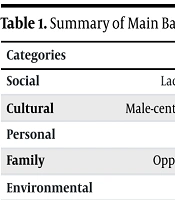
Analysis of the interview content and codes identified five main categories of barriers: social, cultural, personal, family, and environmental (Table 1).
Table 1.
Summary of Main Barriers and Facilitators Influencing Rural Women's Participation in Physical Activity
CategoriesBarriersFacilitators
SocialLack of information/support, media and official neglect, fear of injuryOfficial and community support, public awareness
CulturalMale-centered culture, harassment, fear of negative attitudes, appearance concernsMen's awareness, cultural change, cyberspace use
PersonalPhysical limitations, lack of time/interest/motivation, lazinessSelf-confidence, scheduled exercise, motivation
FamilyOpposition from family, poor economic status, childcare and houseworkHusband and family encouragement/support
EnvironmentalNo gyms/space, costly equipment, stray dogs, poor walkwaysEquipment provision, walking paths, completing facilities

5. Discussion

This study provides a clearer understanding of the main barriers to and facilitators of physical activity among rural women. The findings indicate that physical activity among rural women is insufficient and that multiple constraints affect their participation. These factors are discussed below in relation to the previous literature.
The findings indicate that many rural women are reluctant to participate in exercise activities because their families do not support them. Social support has an important effect on women's physical activity. According to Faghih et al. (11), social support is provided in 4 dimensions: emotional (empathy and love), instrumental (tangible help), informational (counseling), and evaluative (constructive feedback). Studies in different groups of women have shown that social factors can have a greater impact on physical activity than individual factors (12).
In the present study, some male participants stated that exercise is not necessary for women, whereas others believed that women exercising in the countryside could endanger the family's reputation. Alimohammadi et al. (13) reported similar findings in Iran, emphasizing the impact of cultural factors on women's participation in sports activities. Because of the nature of rural life, women's sports activities have not yet been socially accepted, and this issue requires changes in cultural patterns. Rural culture has not widely accepted women walking or exercising in gyms. Moreover, as Hejipoor et al. (14) noted, urbanization has changed the lifestyles of women in rural areas, which may negatively affect their physical activity.
In the present study, most participants acknowledged that the lack of accessible and suitable sports facilities for women is a major barrier. They identified problems such as a lack of appropriate walking paths and gyms and the presence of stray dogs. According to Wang et al. (15), proximity to sports facilities, the presence of parks, access to walking and cycling paths, and a sense of safety encourage physical activity among women. Conversely, Franzini et al. (16) found that even when facilities exist, unfavorable living conditions such as insecurity reduce their use. The availability of sports facilities plays a crucial role in encouraging rural women to improve their health and engage in social interaction (17, 18).
The present study found that lack of time, lack of motivation, laziness, physical disability, and fatigue were reasons for not participating in sports activities. An integrative review by Olsen (19) confirmed that insufficient knowledge of the benefits of physical activity and lack of motivation are important barriers among rural women.
Consistent with the present findings, Gorzelitz et al. (10) reported that low awareness of physical activity guidelines was a key barrier among rural women in the United States. Moreover, two recent studies from Iran, "The Correlation Between Junk Food Consumption and Health-Related Physical Fitness Factors in 10 - 12 Years Students of Kamyaran, Iran" (20) and "Evaluating the Impact of Total Resistance Exercise (TRX) System on Female Students and Their Static Balance" (21), emphasized the importance of physical fitness interventions in female populations, supporting the need for targeted programs in rural areas.

5.1. Limitations

Given the qualitative design of this study, the findings are not generalizable to other rural populations. Nevertheless, to the best of the authors' knowledge, no previous study in Iran has directly included rural women to explore the factors influencing their physical activity. Although some qualitative research has examined this issue from the perspective of rural sports stakeholders, the direct inclusion of rural women as participants is a key strength of the present study.

5.2. Conclusions

The past few decades have witnessed a steady decline in physical activity among large populations worldwide, and Iran has not been unaffected by this global trend. Young women and girls in the country face the critical challenge of physical inactivity, largely because of various barriers that hinder their access to sports facilities. The results of this study demonstrate that limitations in recreational and sports facilities for rural women, insufficient planning to upgrade existing infrastructure, a lack of qualified coaches, and cultural and familial barriers collectively have an adverse effect on physical activity. Consequently, physical education experts and regional policymakers should address this problem seriously and intensify efforts to overcome the existing barriers.
Footnotes

  • AI Use Disclosure:The authors declare that no generative AI tools were used in the creation of this article.

  • Authors' Contribution:All authors of the article have equal contributions.

  • Conflict of Interests Statement:The authors declare no conflict of interests.

  • Data Availability:The dataset presented in the study is available on request from the corresponding author during submission or after its publication.

  • Ethical Approval:This article has a code of ethics from the Ethics Committee of Kermanshah University of Medical Sciences. The code is: IR.KUMS.REC.1400.746.

  • Funding/Support:This article is taken from a part of the master's thesis of health education and was supported by Kermanshah University of Medical Sciences.

  • Informed Consent:Before the interviews, all participants were asked to provide verbal consent to participate in the study.

References

  • 1.
    Guthold R, Stevens GA, Riley LM, Bull FC. Worldwide trends in insufficient physical activity from 2001 to 2016: a pooled analysis of 358 population-based surveys with 1.9 million participants. Lancet Global Health. 2018;6(10):e1077-e1086. [PubMed ID: 30193830]. [PubMed Central ID: PMC8160759]. https://doi.org/10.1016/S2214-109X(18)30357-7.
  • 2.
    Troiano RP, Berrigan D, Dodd KW, Mâsse LC, Tilert T, Mcdowell M. Physical activity in the United States measured by accelerometer. Med Sci Sports Exerc. 2008;40(1):181-188. [PubMed ID: 18091006]. https://doi.org/10.1249/mss.0b013e31815a51b3.
  • 3.
    Wisløff U, Støylen A, Loennechen JP, Bruvold M, Rognmo Ø, Haram PM, et al. Superior cardiovascular effect of aerobic interval training versus moderate continuous training in heart failure patients: a randomized study. Circulation. 2007;115(24):3086-3094. [PubMed ID: 17548726]. https://doi.org/10.1161/CIRCULATIONAHA.106.675041.
  • 4.
    Giandonato JA, Tringali VM, Thoms RC. Improving Mental Health through Physical Activity: A Narrative Literature Review. Physical Activity and Health. 2021;5(1):146-153. https://doi.org/10.5334/paah.108.
  • 5.
    Pavey TG, Taylor AH, Fox KR, Hillsdon M, Anokye N, Campbell JL, et al. Effect of exercise referral schemes in primary care on physical activity and improving health outcomes: systematic review and meta-analysis. Bmj. 2011;343(nov04 2):d6462-d6462. [PubMed ID: 22058134]. [PubMed Central ID: PMC3209555]. https://doi.org/10.1136/bmj.d6462.
  • 6.
    Hoseini R, Hoseini Z, Pourahmadi D, Kamangar A. Demographic, cultural, and health correlates of physical activity and sports participation among adults in Kermanshah province, Iran. BMC Public Health. 2025;25(1). 1867. [PubMed ID: 40399839]. [PubMed Central ID: PMC12093589]. https://doi.org/10.1186/s12889-025-23083-7.
  • 7.
    Tamers SL, Beresford SAA, Cheadle AD, Zheng Y, Bishop SK, Thompson B. The association between worksite social support, diet, physical activity and body mass index. Preventive medicine. 2011;53(1 - 2):53-56. [PubMed ID: 21570422]. [PubMed Central ID: PMC3143200]. https://doi.org/10.1016/j.ypmed.2011.04.012.
  • 8.
    Sohrabi F, Shamsipour Dehkordi P, et al. The effect of body mass index and level of physical activity on motor competence women's in life span. J Birjand Univ Med Sci. 2021;28(2):147-157. https://doi.org/10.32592/JBIRJANDUNIVMEDSCI.2021.28.2.105.
  • 9.
    Befort CA, Nazir N, Perri MG. Prevalence of obesity among adults from rural and urban areas of the United States: findings from NHANES (2005 - 2008). J Rural Health. 2012;28(4):392-397. [PubMed ID: 23083085]. [PubMed Central ID: PMC3481194]. https://doi.org/10.1111/j.1748-0361.2012.00411.x.
  • 10.
    Gorzelitz JS, Malecki KM, Cadmus-Bertram LA. Awareness of Physical Activity Guidelines Among Rural Women. American journal of preventive medicine. 2020;59(1):143-145. [PubMed ID: 32564803]. [PubMed Central ID: PMC7338004]. https://doi.org/10.1016/j.amepre.2020.01.022.
  • 11.
    Faghih M, Kaveh MH, Nazari M, Khademi K, Hasanzadeh J. Effect of health belief model-based training and social support on the physical activity of overweight middle-aged women: a randomized controlled trial. Frontiers in Public Health. 2024;12. 1250152. [PubMed ID: 38356945]. [PubMed Central ID: PMC10864535]. https://doi.org/10.3389/fpubh.2024.1250152.
  • 12.
    Eime RM, Harvey JT, Craike MJ, Symons CM, Payne WR. Family support and ease of access link socio-economic status and sports club membership in adolescent girls: a mediation study. International Journal of Behavioral Nutrition and Physical Activity. 2013;10(1):1-12. [PubMed ID: 23618407]. [PubMed Central ID: PMC3639833]. https://doi.org/10.1186/1479-5868-10-50.
  • 13.
    Alimohammadi H, Adabi Firoozjah J, Kordlu H, Karimi M. [Resenting a Paradigmatic Model of Effective Factors in the Lifestyle of Rural Women to Participate in Sports Activities. Journal of Rural Research]. 2024;14. FA. https://doi.org/10.22059/jrur.2023.354870.1817.
  • 14.
    Hejipoor M, Roomiyani A, Sheykhi M, Haghnazari S, Niyazi H. Analysis Of The Effects Of Urbanism On The Changes And Changes In Lifestyle Of Rural Women Case Study: Aleshtar Township. Geography and Territorial Spatial Arrangement. 2020;10(37):143-166. https://doi.org/10.22111/gaij.2020.5960.
  • 15.
    Wang D, Brown G, Liu Y. The physical and non-physical factors that influence perceived access to urban parks. Landscape and urban planning. 2015;133:53-66. https://doi.org/10.1016/j.landurbplan.2014.09.007.
  • 16.
    Franzini L, Taylor W, Elliott MN, Cuccaro P, Tortolero SR, Janice Gilliland M, et al. Neighborhood characteristics favorable to outdoor physical activity: disparities by socioeconomic and racial/ethnic composition. Health & place. 2010;16(2):267-274. [PubMed ID: 19896408]. https://doi.org/10.1016/j.healthplace.2009.10.009.
  • 17.
    Grow HM, Saelens BE, Kerr J, Durant NH, Norman GJ, Sallis JF. Where are youth active? Roles of proximity, active transport, and built environment. Medicine & Science in Sports & Exercise. 2008;40(12):2071-2079. [PubMed ID: 18981942]. https://doi.org/10.1249/MSS.0b013e3181817baa.
  • 18.
    Niclasen B, Petzold M, Schnohr CW. The association between high recreational physical activity and physical activity as a part of daily living in adolescents and availability of local indoor sports facilities and sports clubs. Scandinavian journal of public health. 2012;40(7):614-620. [PubMed ID: 23042458]. https://doi.org/10.1177/1403494812459815.
  • 19.
    Olsen JM. An integrative review of literature on the determinants of physical activity among rural women. Public Health Nursing. 2013;30(4):288-311. [PubMed ID: 23808855]. https://doi.org/10.1111/phn.12023.
  • 20.
    Kamangar A, Azizi M, Samadi M. The Correlation Between Junk Food Consumption and Health-Related Physical Fitness Factors in 10 - 12 Years Students of Kamyaran, Iran. Journal of Health Reports and Technology. 2023;9(1):1-8. https://doi.org/10.5812/jhrt-130917.
  • 21.
    Shahraki M, Joupari Nejad S, Jafari F, Tavakoli Hafshejani T, Safari M, Saeedi Abo-s-Haghi M, et al. Evaluating the Impact of Total Resistance Exercise (TRX) System on Female Students and Their Static Balance. J Health Rep Technol. 2023;9(4). e141916. https://doi.org/10.5812/jhrt-141916.

Copyright

Copyright © 2026, Journal of Health Reports and Technology. This open-access article is available under the Creative Commons Attribution-NonCommercial 4.0 (CC BY-NC 4.0) International License (https://creativecommons.org/licenses/by-nc/4.0/), which allows for the copying and redistribution of the material only for noncommercial purposes, provided that the original work is properly cited.

Similar Articles

2
Jul
2018
Iranian Women’s Perceptions and Experiences of Barriers to and Facilitators of Physical Activity

Iranian Women’s Perceptions and Experiences of Barriers to and Facilitators of Physical Activity

Leila Amiri Farahani,
Seyede Batool Hasanpoor-Azgahdy,
Ziba Taghizadeh

Amiri Farahani L, Hasanpoor-Azgahdy SB, Taghizadeh Z. Iranian Women’s Perceptions and Experiences of Barriers to and Facilitators of Physical Activity. Shiraz E-Med J. 2018;19(8):e65287. doi: https://doi.org/10.5812/semj.65287

28
Jan
2014
Women's attitudes towards obstacles of physical activity in Sari, Iran

Women's attitudes towards obstacles of physical activity in Sari, Iran

Fatemeh Salmeh,
Mahbobeh Yaghobian

Salmeh F, Yaghobian M. Women's attitudes towards obstacles of physical activity in Sari, Iran. J Nurs Midwifery Sci. 2014;1(1):e141421. doi:

13
Mar
2021
Physical Activity Based on the BASNEF Model Constructs in Women with a Child Less Than Two Years of Age

Physical Activity Based on the BASNEF Model Constructs in Women with a Child Less Than Two Years of Age

Parshang Faghih Solaymani,
Ardeshir Rahimzadeh,
Khaled Rahmani,
Azita Masodi

Faghih Solaymani P, Rahimzadeh A, Rahmani K, Masodi A. Physical Activity Based on the BASNEF Model Constructs in Women with a Child Less Than Two Years of Age. Asian J Sports Med. 2021;12(1):e107700. doi: https://doi.org/10.5812/asjsm.107700

23
Dec
2015
Applying Transtheoretical Model to Promote Physical Activities Among Women

Applying Transtheoretical Model to Promote Physical Activities Among Women

Asiyeh Pirzadeh,
Firoozeh Mostafavi,
Fazllolah Ghofranipour,
Awat Feizi

Pirzadeh A, Mostafavi F, Ghofranipour F, Feizi A. Applying Transtheoretical Model to Promote Physical Activities Among Women. Iran J Psychiatry Behav Sci. 2015;9(4):e1580. doi: https://doi.org/10.17795/ijpbs-1580

31
Mar
2025
Constraints Predicting the Amount of Regular Physical Activity in Adults

Constraints Predicting the Amount of Regular Physical Activity in Adults

Leily Pashapoor,
Rosa Rahavi Ezabadi,
Pari Khalili Marandi

Pashapoor L, Rahavi Ezabadi R, Khalili Marandi P. Constraints Predicting the Amount of Regular Physical Activity in Adults. Asian J Sports Med. 2025;16(1):e161291. doi: https://doi.org/10.5812/asjsm-161291

More by these authors

Hossein AshtarianPubMedScholar
Sonia AhmadiPubMedScholar
Fatemeh RajatiPubMedScholar
Share
Cited by
Metrics