
1. Background
Marriage is conventionally regarded as a foundation of family and societal stability; however, recent decades have witnessed a widespread and concerning rise in marital dissolution and divorce rates (1). The process leading to divorce is rarely abrupt; rather, it is often prolonged and distressing, involving chronic conflict and emotional estrangement (2). Women seeking divorce are particularly vulnerable to psychological distress, including depression, anxiety, feelings of failure, and reduced self-esteem (3). Navigating the complex legal and social aspects of divorce can exacerbate pre-existing vulnerabilities, contributing to emotional dysregulation and cognitive overload (4). Marital breakdown also creates uncertainty regarding the future, financial independence, and social identity. Addressing the psychological factors that precede and accompany the decision to divorce is therefore an important concern for clinical psychologists seeking to reduce the adverse psychological consequences of marital breakdown (5).
The cognitive frameworks that individuals bring to their relationships, particularly their relationship beliefs, are central to this process. Relationship beliefs encompass deeply held assumptions, expectations, and attitudes about how intimate partnerships should function (6). Functional, realistic beliefs support resilience, effective communication, and mutual understanding. In contrast, dysfunctional relationship beliefs involve rigid, unrealistic standards that partners impose on each other, creating conditions for persistent disappointment and interpersonal conflict (7). These beliefs are conceptually distinct from general marital dissatisfaction. Whereas marital dissatisfaction reflects an overall emotional evaluation of a relationship, dysfunctional relationship beliefs are specific, measurable cognitive distortions, such as “disagreement is destructive” and “mindreading is expected,” that bias interpretations of a partner's behavior and generate dissatisfaction (8). Such assumptions act as cognitive filters through which ambiguous or neutral behaviors may be interpreted as malicious or neglectful (9). Over time, these distortions erode trust and emotional intimacy, trapping couples in maladaptive interactions that may culminate in divorce (10).
According to cognitive-behavioral models, dysfunctional relationship beliefs include assumptions that disagreement is destructive, partners should be able to read each other's minds, partners cannot change, and the sexes are fundamentally different, as well as demands for sexual perfectionism (11). Research has shown that women with high levels of these beliefs have lower marital satisfaction and a greater propensity to initiate divorce (12). For example, the belief that disagreement is destructive impedes constructive conflict resolution and may lead to confrontation or emotional withdrawal (13). Expectations of mindreading can also foster resentment when psychological needs remain unexpressed and unmet. Despite the documented effects of these distortions on marital stability, a gap remains in identifying the most effective interventions for restructuring them in women actively seeking divorce (14).
Compassion-focused therapy (CFT) is a promising transdiagnostic intervention designed to address shame, self-criticism, and emotional dysregulation by cultivating self-compassion and affiliative emotions (15). Grounded in evolutionary psychology, neuroscience, and attachment theory, it aims to balance emotion-regulation systems, particularly by soothing the overactive threat-detection system often observed during severe relational distress (16). By encouraging warmth, self-soothing, and nonjudgmental understanding of one's own and one's partner's emotional difficulties, CFT reduces hostile attributions and defensive behaviors, indirectly softening rigid relationship expectations (17). Previous research has indicated that CFT enhances interpersonal forgiveness, empathy, and emotional resilience in couples experiencing marital dissatisfaction (18). This emotional rebalancing enables women navigating divorce to process relational grief and reconsider dysfunctional relationship beliefs with greater psychological flexibility, rather than self-blame.
Schema therapy offers an integrative approach to entrenched psychological difficulties, including dysfunctional relationship patterns. Originally developed to treat personality disorders, it focuses on identifying and modifying early maladaptive schemas (EMS), which are pervasive, self-defeating themes arising from unmet core emotional needs in childhood (19). These schemas influence partner selection and subsequent relationship dynamics, sometimes leading to the unconscious re-creation of childhood trauma within marriage. Through limited reparenting, empathic confrontation, and imagery rescripting, schema therapy facilitates healing of vulnerable child modes and challenges schema-driven cognitive distortions (20). Schema therapy has been reported to improve marital relationships and cognitive emotion regulation in couples on the verge of divorce (19).
Despite evidence for the individual effectiveness of CFT and schema therapy in reducing relational distress, no prior study has directly compared their ability to modify dysfunctional relationship beliefs in women actively seeking divorce. This comparison is clinically relevant because relationship beliefs constitute a specific, measurable cognitive target that is theoretically more closely aligned with schema-focused techniques than with emotion-regulation approaches such as CFT. Clarifying which approach produces greater and more durable changes in these beliefs may help guide intervention selection and resource allocation in counseling before divorce.
2. Objectives
This study aimed to compare the effectiveness of CFT and schema therapy in reducing dysfunctional relationship beliefs, as assessed by the total Relationship Beliefs Inventory (RBI) score, among women seeking divorce. It examined immediate post-treatment differences and the maintenance of effects at the 3-month follow-up.
3. Methods
3.1. Design
This study used a quasi-experimental pretest-posttest design with a control group and a 3-month follow-up.
3.2. Participants
The study population comprised women aged 25 to 45 years living in Tehran who were actively seeking divorce and had been referred to family counseling centers during 2024 - 2025. An a priori power analysis was conducted using G*Power 3.1 for a repeated-measures analysis of variance (ANOVA) examining the within-between interaction. Assuming a medium effect size (f = 0.25), α = 0.05, power (1 - β) = 0.80, 3 groups, and 3 measurement occasions, the minimum required total sample size was 42. To account for potential attrition, 45 participants were recruited through convenience sampling based on the inclusion criteria. Participants were then randomly allocated, using computer-generated random numbers, to 3 equal groups (n = 15 each): CFT, schema therapy, and control.
Inclusion criteria were female sex, age 25 to 45 years, an active divorce case, at least a high school diploma, and no diagnosed severe psychiatric disorder, such as schizophrenia or bipolar disorder. Exclusion criteria were concurrent participation in other psychological interventions, missing more than 2 treatment sessions, and submitting incomplete assessment forms.
All participants provided written informed consent, were assured of the confidentiality of their personal data, and were informed of their right to withdraw at any time. The control group was assigned to a waitlist with no contact and continued only routine legal procedures related to divorce. The control group received no psychological intervention, counseling, or educational materials during the study and was offered the interventions after the study ended.
3.3. Instruments
The RBI, developed by Eidelson and Epstein (6), was used to measure the dependent variable. This self-report instrument contains 40 items assessing 5 dimensions of dysfunctional relationship expectations: “Disagreement is Destructive,” “Mindreading is Expected,” “Partners Cannot Change,” “Sexual Perfectionism,” and “The Sexes are Different.” Respondents rate each statement on a 6-point Likert scale from 0 (strongly disagree) to 5 (strongly agree). Total scores range from 0 to 200, with higher scores indicating more dysfunctional relationship beliefs. The instrument has demonstrated robust psychometric properties internationally. In an Iranian sample of infertile couples, the RBI had a total-score Cronbach's alpha of 0.80, with subscale coefficients ranging from 0.60 to 0.75 (21). In the present study, the total-score Cronbach's alpha was 0.86, indicating excellent internal consistency and supporting the instrument's suitability for measuring cognitive distortions in this population.
3.4. Procedure
Data collection began after ethical approval was obtained and coordination was completed with selected family courts and affiliated psychological clinics in Tehran. Prospective participants were screened against the inclusion and exclusion criteria. After receiving information about the study objectives and providing written informed consent, all 45 participants completed the baseline assessment using the RBI. They were then randomly allocated to the study groups.
The experimental groups received their respective therapeutic protocols over 2 months. During this period, the control group received no psychological intervention and continued routine legal procedures. Immediately after the eighth intervention session, all 3 groups completed the posttest under identical environmental conditions. All groups also completed a 3-month follow-up assessment under the same conditions.
3.5. Intervention Programs
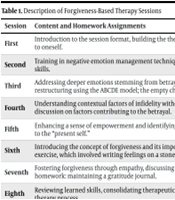
Both interventions followed standardized protocols and were delivered in groups over 8 weekly sessions of 90 minutes each, spanning 2 months. Both interventions were delivered by the same licensed clinical psychologist, who had specialized training and certification in both approaches. To minimize therapist allegiance bias, the therapist followed the manuals for each approach, received weekly external supervision from independent experts in the respective modalities, and completed session-by-session fidelity checklists reviewed by the supervisors. Interrater fidelity ratings indicated high adherence (> 90%) to both protocols. The session contents for CFT and schema therapy are summarized in Table 1 and Table 2, respectively.
Table 1.
Summary of Compassion-Focused Therapy (CFT) Sessions
| Session | Content/Objective |
|---|---|
| First | Introduction to the core concepts of compassion, psychoeducation on the evolutionary model of the brain, and emotion-regulation systems. |
| Second | Cultivating the compassionate mind; recognizing self-criticism and its physiological effects. |
| Third | Exploring the characteristics of compassionate individuals; introducing mindfulness exercises and soothing rhythm breathing. |
| Fourth | Enhancing self-knowledge; identifying personal triggers for shame and threat-system activation. |
| Fifth | Practicing self-compassion through radical acceptance; addressing resistance to self-kindness. |
| Sixth | Practicing compassion through compassionate imagery and writing compassionate letters to oneself. |
| Seventh | Extending compassion toward others; exploring forgiveness and understanding a partner's vulnerabilities without judgment. |
| Eighth | Reviewing and consolidating compassion exercises; relapse prevention and ending the group. |
Table 2.
Summary of Schema Therapy Sessions
| Session | Content/Objective |
|---|---|
| First | Initial assessment, establishing rapport, and providing psychoeducation on the core concepts of schema therapy. |
| Second | Further assessment and education; establishing group rules and explaining the basic schema model and coping styles. |
| Third | Introducing cognitive techniques; identifying early maladaptive schemas and testing their validity by gathering evidence. |
| Fourth | Continuing cognitive restructuring; developing flashcards to challenge schema-driven thoughts and dysfunctional relationship beliefs. |
| Fifth | Applying experiential and emotional techniques; introducing imagery rescripting to address the childhood origins of relational schemas. |
| Sixth | Continuing experiential techniques; using empty-chair dialogues to express unmet emotional needs and bypass maladaptive coping modes. |
| Seventh | Practicing behavioral pattern breaking; role-playing healthy communication strategies and establishing functional relationship boundaries. |
| Eighth | Reviewing behavioral pattern-breaking strategies; summarizing therapeutic gains, addressing anxieties about ending therapy, and closing the group. |
3.6. Data Analysis
Data were analyzed using descriptive and inferential statistics in SPSS version 26. Means and standard deviations were used to summarize demographic characteristics and scores across assessment periods. Repeated-measures ANOVA was used to examine intervention effects across time (pretest, posttest, and 3-month follow-up) and between groups. Sphericity was assessed using Mauchly's test, with Greenhouse-Geisser corrections applied when the assumption was violated. Normality was assessed using the Shapiro-Wilk test, and homogeneity of variance was assessed using Levene's test. Bonferroni post hoc tests were used for pairwise comparisons. Statistical significance was set at P < 0.05.
4. Results
The study included 45 women seeking divorce (mean age = 34.72 years, standard deviation [SD] = 5.22). Of these, 42.2% had a high school diploma, and 57.8% had an associate or bachelor's degree. The mean marriage duration before seeking divorce was 9.80 years (SD = 4.16). Demographic characteristics were compared to assess baseline equivalence. One-way ANOVA showed no significant between-group differences in age (F = 0.41, P = 0.665) or marriage duration (F = 0.28, P = 0.757). The chi-square test showed no significant difference in educational level (χ2 = 0.53, P = 0.767). These results confirmed successful randomization and baseline comparability.
As shown in Table 3, baseline RBI scores were comparable across groups, indicating successful randomization. Following the interventions, both experimental groups showed reductions in dysfunctional relationship beliefs, with a larger decrease in the schema therapy group. These improvements were largely maintained at the 3-month follow-up, whereas the control group showed minimal change.
Table 3.
Descriptive Statistics for Relationship Beliefs Scores Across Groups and Assessment Times a
| Group | Pretest | Posttest | 3-Month Follow-up |
|---|---|---|---|
| Compassion-focused therapy | 122.86 ± 6.10 | 107.73 ± 6.39 | 107.80 ± 6.07 |
| Schema therapy | 125.86 ± 9.94 | 86.76 ± 12.99 | 78.13 ± 13.04 |
| Control | 124.73 ± 7.45 | 125.06 ± 7.91 | 124.86 ± 8.00 |
a Values are expressed as mean ± SD. Abbreviation: SD, standard deviation.
Before the primary inferential analyses, the assumptions of repeated-measures ANOVA were assessed. The Shapiro-Wilk test showed that RBI scores did not deviate significantly from normality in any group or at any assessment time (P > 0.05). Levene's test indicated homogeneity of variance at each assessment (P > 0.05). Mauchly's test showed that sphericity was satisfied for the time effect (χ2 = 3.12, P = 0.210) and the time × group interaction (χ2 = 5.87, P = 0.209); therefore, the Greenhouse-Geisser correction was not required. These findings supported the use of parametric analyses.
Repeated-measures ANOVA showed significant main effects of group and time, as well as a significant time × group interaction. The large effect sizes (η2 ranging from 0.53 to 0.72) indicate substantial intervention effects on dysfunctional relationship beliefs (Table 4). The significant interaction indicates that the pattern of change over time differed across the 3 conditions.
Table 4.
Results of Repeated-Measures Analysis of Variance for Relationship Beliefs a
| Source of Variation | SS | df | MS | F | P | η2 |
|---|---|---|---|---|---|---|
| Group | 9624.28 | 2 | 4812.14 | 198.12 | 0.001 | 0.72 |
| Time | 13991.88 | 2 | 6995.94 | 35.57 | 0.001 | 0.53 |
| Time × Group interaction | 7763.41 | 4 | 1940.85 | 79.91 | 0.001 | 0.69 |
a Abbreviations: SS, sum of squares; df, degrees of freedom; MS, mean square; η2, partial eta squared.
Bonferroni post hoc tests were used to examine pairwise comparisons for the significant time × group interaction. Both interventions significantly reduced dysfunctional relationship beliefs from pretest to posttest and from pretest to follow-up, with gains remaining stable between posttest and follow-up (Tables 5 and 6). Schema therapy produced significantly greater reductions than CFT (mean difference = 20.97, P = 0.001), and both experimental groups significantly outperformed the control group.
Table 5.
Bonferroni Post Hoc Comparisons Across Time Points (Collapsed Across Groups) a
| Time 1 | Time 2 | Mean Difference | SE | P |
|---|---|---|---|---|
| Pretest | Posttest | 17.97 | 1.27 | 0.001 |
| Pretest | Follow-up | 20.89 | 1.35 | 0.001 |
| Posttest | Follow-up | 2.92 | 1.12 | 0.284 |
a Abbreviation: SE, standard error.
Table 6.
Bonferroni Post Hoc Comparisons Between Groups on Relationship Beliefs (Posttest) a
| Relationship Beliefs and Comparisons | Mean Difference | SE | P |
|---|---|---|---|
| Schema therapy vs. Control | -38.30 | 3.93 | 0.001 |
| Compassion-focused therapy vs. Control | -17.33 | 2.63 | 0.001 |
| Compassion-focused therapy vs. Schema therapy | 20.97 | 3.74 | 0.001 |
a Negative mean differences indicate lower (more improved) scores in the first-named group. Abbreviation: SE, standard error.
Additional pairwise comparisons of the time × group interaction showed that schema therapy scores decreased significantly from pretest to posttest (mean difference = 39.10, standard error [SE] = 2.85, P = 0.001) and from pretest to follow-up (mean difference = 47.73, SE = 3.12, P = 0.001). The additional reduction from posttest to follow-up was not significant (mean difference = 8.63, SE = 2.41, P = 0.068). In the CFT group, significant reductions occurred from pretest to posttest (mean difference = 15.13, SE = 1.98, P = 0.001) and from pretest to follow-up (mean difference = 15.06, SE = 2.05, P = 0.001), with no change between posttest and follow-up (mean difference = -0.07, SE = 1.15, P = 1.000). The control group showed no significant changes between any assessment times.
Figure 1 illustrates changes in scores across groups. Control group scores remained essentially unchanged throughout the study. The CFT group showed a moderate decrease from pretest to posttest that was sustained at follow-up. The schema therapy group showed the largest reduction and the lowest scores at both posttest and follow-up.
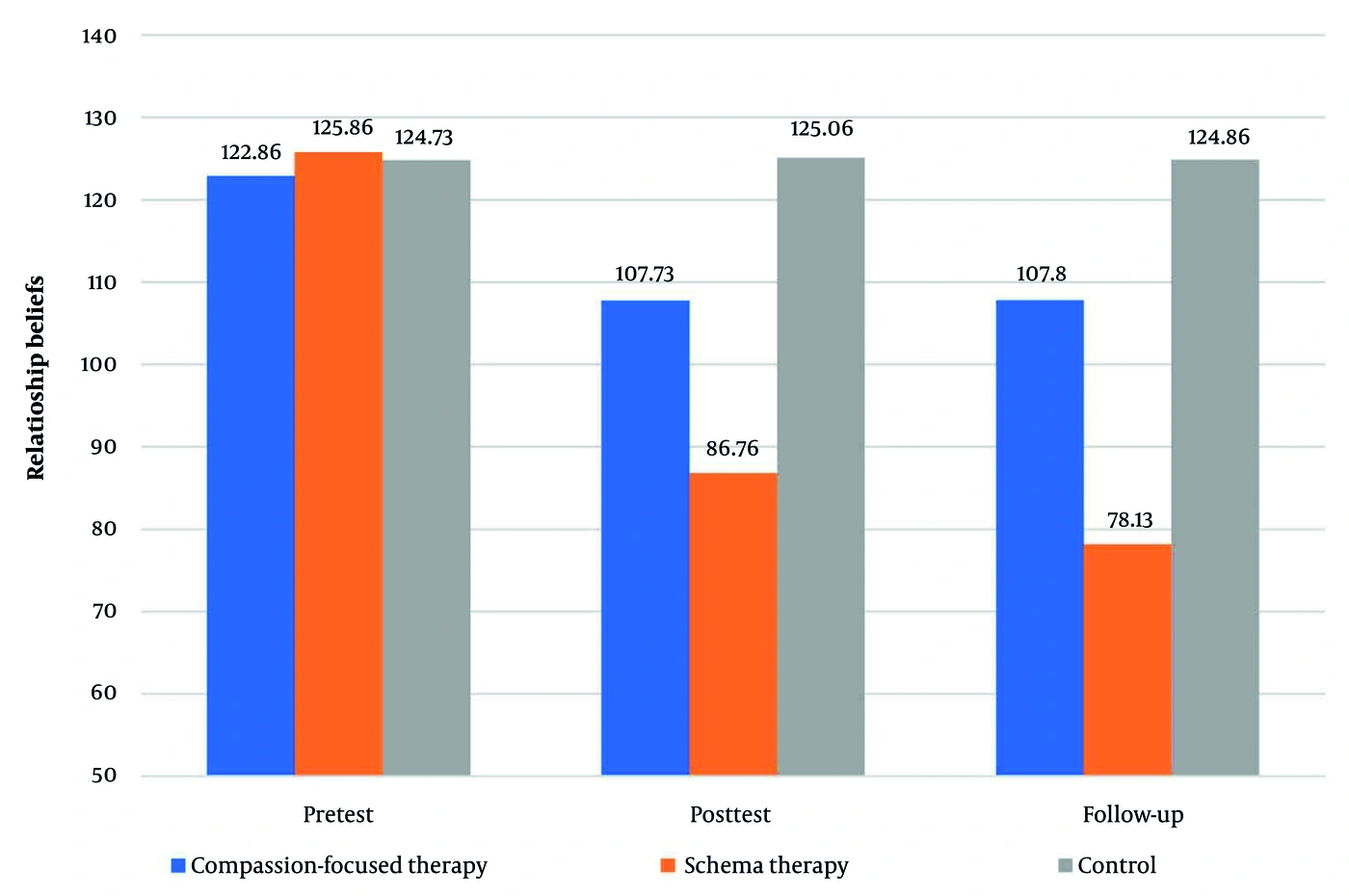
Figure 1.
Changes in relationship beliefs scores across the groups at pretest, posttest, and the 3-month follow-up.
5. Discussion
This study compared the effectiveness of CFT and schema therapy in modifying dysfunctional relationship beliefs among women seeking divorce. Both interventions significantly reduced these beliefs compared with the control group, and the benefits were maintained at the 3-month follow-up. Schema therapy produced significantly greater improvement than CFT.
The greater effectiveness of schema therapy may be explained by its theoretical framework, which directly targets EMS. Women experiencing marital dissolution often have entrenched cognitive patterns related to interpersonal relationships, including fears of abandonment, emotional deprivation, and mistrust. Schema therapy identifies and modifies these schemas through cognitive restructuring, experiential techniques such as imagery rescripting, and behavioral pattern breaking. Although this study assessed the total RBI score rather than individual subscales, the larger reduction with schema therapy is theoretically consistent with its capacity to challenge the distortions measured by the RBI. In particular, “Partners Cannot Change,” “Mindreading is Expected,” and “Disagreement is Destructive” correspond closely to schema-driven expectations of relational permanence, emotional deprivation, and defectiveness (22). By addressing the historical origins and current manifestations of maladaptive expectations, schema therapy modifies the dysfunctional beliefs that contribute to marital dissatisfaction and separation. This finding is consistent with previous research showing that schema therapy addresses entrenched cognitive distortions and supports healthier interpersonal cognitive patterns in distressed mothers (23), as well as with a recent meta-analysis confirming its effects on marital conflict (20).
Compassion-focused therapy also reduced dysfunctional relationship beliefs, although its effects were smaller than those of schema therapy. It primarily regulates affect systems by reducing activation of the threat-defense system and stimulating the soothing-affiliative system (15). The emotional distress associated with divorce often involves self-criticism, shame, and defensive hostility toward a spouse (13). By cultivating self-compassion, mindfulness, and empathy, CFT helps individuals shift from a defensive, blame-oriented state toward a more balanced and forgiving perspective (24). This emotional shift may indirectly soften rigid relationship beliefs and support a less punitive understanding of marital breakdown. These findings are consistent with research reporting reduced self-criticism among women seeking divorce after CFT (13) and improved emotional outcomes in populations experiencing substantial stress (18).
The greater effect of schema therapy in this sample is consistent with the theoretical distinction between the approaches. Schema therapy directly targets the cognitive structures underlying relationship beliefs, whereas CFT primarily targets the associated emotional reactivity and self-criticism (22). Because relationship beliefs are cognitive phenomena, an approach that explicitly identifies, challenges, and replaces entrenched schemas may be more effective in modifying them. This interpretation remains inferential because the study did not collect process data, such as changes in EMS or self-compassion, to test the proposed mechanisms directly.
The findings show both similarities and differences relative to previous research. Studies of schema therapy in distressed couples or populations seeking divorce have also reported substantial reductions in relationship-related cognitive distortions and conflict (19). Studies of CFT have more frequently examined broader emotional outcomes, including self-criticism, distress tolerance, and adjustment after divorce (13, 17, 24), rather than the specific cognitive content of relationship beliefs. The larger effect of schema therapy may therefore reflect the closer alignment between its techniques and the cognitive constructs assessed by the RBI, rather than superiority across all psychological outcomes.
The clinical implications are most directly relevant to counseling women seeking divorce. Family counseling centers and psychological services before divorce may prioritize schema therapy when the primary goal is to modify rigid, dysfunctional relationship beliefs, given its larger and sustained effects on this outcome. Specific recommendations include incorporating brief schema-focused modules, such as cognitive restructuring of “Partners Cannot Change” and imagery rescripting of relational trauma, into existing counseling programs; training counselors to identify EMS underlying the RBI subscales; and using the RBI for routine screening and outcome monitoring to guide intervention selection. Compassion-focused therapy remains a complementary or alternative approach when shame, self-criticism, or emotional dysregulation predominates.
5.1. Limitations
The convenience sample of women from Tehran limits generalizability to other cultural settings and to men. The small sample size and the lack of assessments of participants' partners also limit understanding of dyadic relationship dynamics. Reliance on self-report measures raises the possibility of demand characteristics and socially desirable responses after treatment. The waitlist control condition with no contact, although ethically appropriate, does not control for nonspecific factors such as therapist attention or expectations, which an active control condition could address. Future studies should use larger randomized designs across diverse populations, incorporate process measures, and include active control conditions.
5.2. Conclusions
Both CFT and schema therapy significantly reduced dysfunctional relationship beliefs among women seeking divorce, with gains maintained at the 3-month follow-up. Schema therapy produced significantly larger reductions than CFT, suggesting that it is more effective in modifying the specific cognitive content of relationship beliefs in this population. The findings support the preferential inclusion of schema-focused techniques in counseling before divorce when modification of relationship beliefs is the primary goal.