
1. Background
Sports serve as a tool for fostering peace and addressing social issues through physical activity and societal participation. They aim to resolve conflicts through sports and entertainment activities, thereby addressing violence and inequalities in various areas of human society (1). Additionally, sports play a crucial role in the holistic development of individuals, encompassing physical, mental, and social aspects, and contribute to the beneficial growth of the younger generation (2). The development of a sports culture within families increases sports participation among the younger generation and promotes long-term socialization (3).
Evidence indicates that persistent sedentary behavior, such as prolonged sitting, leads to abnormal glucose metabolism, cardiometabolic diseases, and increased overall mortality (4). The prevalence of inactivity is higher in most countries due to economic improvements that have influenced transportation patterns, technology usage, urbanization, and cultural values (5). According to 2013 statistics, the global cost of inactivity on direct healthcare is estimated at $54 billion, with 57% of this cost borne by the public sector. An additional $14 billion is lost due to productivity loss (6). Estimates in high-, low-, and middle-income countries show that 1% to 3% of national healthcare costs are attributed to inactivity (7). Therefore, health and hygiene education should encompass all age groups, from preschool to old age, to maintain a suitable and satisfactory level of public health and promote awareness of the instrumental role of physical activity in improving quality of life (8).
Research has shown that activities associated with low levels of metabolic energy consumption are classified as sedentary behavior and can threaten health. Conversely, regular physical activity is considered an indicator of societal health. The World Health Organization recommends that adults engage in 30 minutes of moderate-intensity physical activity five days a week (9, 10). According to the constraint-based approach, skill acquisition is influenced by the interaction between the individual, the task, and the environment. By reducing limitations in these areas, skill learning can improve. Additionally, changes in limitations can lead to motor growth (11).
Carl Newell identified three factors — individual, environment, and task — that have inhibitory characteristics and cause movement restrictions. These restrictions can limit movement but also serve a motivational role by laying the groundwork for movement behavior. Individual limitations include unique physical and psychological characteristics, which can be structural or functional. Structural constraints relate to physical structure, such as leg length, height, weight, and muscle mass, and change slowly with age and growth. Functional limitations relate to behavioral performance, such as experiences, fear, concentration, attention, and motivation, and reduce over a shorter period. Environmental constraints are present in the world around us and are general, encompassing socio-cultural, environmental, or individual factors (12).
The results of Alairo and Aminat (13) revealed that socio-cultural factors affect women's participation in sports in higher institutions in Kano province. Yiga et al. (14) showed that cultural beliefs promote diet and physical activity. Abdelhay et al. (15) found a high prevalence of internal and external barriers to physical activity among Saudi adults, with significant gender differences influenced by cultural factors. Women were more inclined to cite cultural and religious factors as obstacles. Internal obstacles included apathy and insufficient self-motivation, while external barriers included inadequate facilities and extended working hours. Factors like advanced age, body mass index, and education also contributed to these barriers. Droh et al. (16) found that socio-cultural barriers, such as fear of judgment from others and inappropriate understanding of physical activity, prevent the elderly from participating in these activities.
No research has been reported in this area within the studied statistical population. The statistical population was expected to be suitable due to their work related to sports. These factors prompted the researcher to examine the individual and socio-cultural predictors of physical activity in the targeted statistical population. The researcher aimed to determine how the targeted statistical population active in sports compared to other community members and what limitations they faced.
2. Objectives
The objective of this study is to forecast individual, social, and cultural limitations on regular physical exercise utilizing the BAZNEF model.
3. Methods
3.1. Research Method
This research is a cross-sectional and correlational study. The statistical population comprises 5,822 employees working in the Ministry of Sports and Youth, sports federations, and general departments of sports and youth in the provinces of Iran. The sample was determined randomly according to the Morgan table, ensuring an unbiased selection of participants. According to the Morgan table, 360 questionnaires were sent, and 254 were completed. The mean age of the participants was 44.88 ± 0.33 years. The research was conducted over a period of 9 months (from March to November), with inclusion criteria comprising informed consent to participate in the study; employment in the Ministry of Sports and Youth, sports federations, or provincial general sports and youth departments; and an age range of 40 to 63 years. Exclusion criteria included the presence of physical and mental health concerns.
3.2. Research Tools
The questionnaire of BAZNEF model constructs was used. This model combines two models, resulting in the behavioral intention model. In developing countries, to predict the needs of health education, the reasons affecting people's decision to perform behavior, studying behavior, and planning to change it are used (17). This questionnaire includes the following four sections:
3.2.1. Attitude Questionnaire
Includes 8 questions with an alpha coefficient of 0.88, measured on a 5-point scale from 1 (strongly disagree) to 5 (strongly agree). A higher score indicates a stronger attitude towards engaging in physical activity.
3.2.2. Subjective Norms Questionnaire
Includes 6 questions with an alpha coefficient of 0.86, measured on a 5-point scale from 1 (strongly disagree) to 5 (strongly agree). A higher score indicates abstract norms encouraging physical activity.
3.2.3. Behavior Intention Questionnaire
Includes 2 questions with an alpha coefficient of 0.85, measured on a 5-point scale from 1 (strongly disagree) to 5 (strongly agree). A higher score indicates a stronger behavioral intention to engage in physical activity.
3.2.4. Questionnaire of Enabling Factors
Includes 10 questions with an alpha coefficient of 0.64, measured on a 3-point scale (yes, somewhat, no). A higher score indicates a greater presence of enabling factors for engaging in physical activity (17).
3.2.5. Physical Activity Questionnaire
To measure physical activity, a standard physical activity questionnaire was used. The World Health Organization and several studies in Iran have used this questionnaire to assess physical activity levels. Its validity and reliability have been duly confirmed (17). With 15 questions, it classifies a person's physical activity status into three levels: Weak, moderate, and severe. According to the final score, it measures the intensity of physical activities in the last 7 days. Calculation of energy intensity of total physical activities in the last 7 days was done according to IPAQ guidelines. If the total energy calculated during the week was more than 3,000 MET/cal/week, the intensity of physical activity was classified in the intense category; if it was between 600 and 3,000 MET/cal/week, in the moderate category; and if it was less than 600 MET/cal/week, in the weak category (17).
3.3. Information Collection Method
The present study was conducted exclusively among employees of the Ministry of Sports and Youth, sports federations, and the General Departments of Sports and Youth throughout the provinces of Iran, ensuring an impartial selection of participants. The surveys were designed based on the BAZNEF model and the International Physical Activity Questionnaire (IPAQ), in addition to demographic questions, and were administered via Google Forms. They were prepared to facilitate online and virtual access for all participants. After creating and finalizing the questionnaires in Google Forms, the link was generated and distributed to participants through virtual platforms (WhatsApp, Telegram, and email) to enable their intentional completion. Participants submitted each completed questionnaire electronically to the researcher for item analysis. This research did not consider any controlled variables.
3.4. Statistical Analysis
To analyze the data, descriptive statistics were used to draw graphs, tables, and present central tendency indices. The normality of the data distribution was checked using the Kolmogorov-Smirnov test. To analyze the research findings, statistical tests of chi-square, logistic regression, and linear regression were used. The data were analyzed with SPSS version 26 statistical software at a significance level of P < 0.05. Samples that included confounding variables were excluded from this investigation.
4. Results
Table 1 presents the descriptive statistics of the constructs of the BAZNEF model among the sample individuals. According to the standard physical activity questionnaire (IPAQ), out of 254 participants in the study, 48 had weak physical activity, 154 had moderate physical activity, and 52 had vigorous physical activity.
Table 1.
Descriptive Statistics the Constructs of the BAZNEF Model for the Sample Individuals
| Variables | N | Range | Mean | SD | Variance | |
|---|---|---|---|---|---|---|
| Statistics | Mean of the Radical Part N | |||||
| Attitude | 254 | 1.88 | 4.3883 | 0.02986 | 0.47596 | 0.227 |
| Subjective norms | 254 | 2.00 | 4.0052 | 0.03649 | 0.58150 | 0.338 |
| Behavior intention | 254 | 4.00 | 3.8622 | 0.05920 | 0.94341 | 0.890 |
| Enabling factors | 254 | 2.00 | 2.3539 | 0.03096 | 0.49348 | 0.244 |
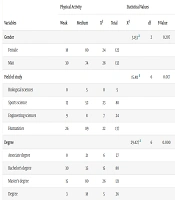
The results of the chi-square test between the background variables and regular physical activity showed that, except for the background variables of field of study, level of education, and age, no statistically significant relationship was observed between the background variables of gender, marital status, service history, weight, and height with the amount of regular physical activity of adults (Table 2).
Table 2.
Descriptive Statistical of Demographic Variables and Physical Activity
| Variables | Physical Activity | Statistical Values | |||||
|---|---|---|---|---|---|---|---|
| Weak | Medium | X2 | Total | X2 | df | P-Value | |
| Gender | 3.153 a | 2 | 0.207 | ||||
| Female | 18 | 80 | 24 | 122 | |||
| Man | 30 | 74 | 28 | 132 | |||
| Field of study | 15.411 a | 6 | 0.017 | ||||
| Biological sciences | 0 | 5 | 0 | 5 | |||
| Sports science | 13 | 52 | 23 | 88 | |||
| Engineering sciences | 9 | 8 | 7 | 24 | |||
| Humanities | 26 | 89 | 22 | 137 | |||
| Ph.D | 29.427 a | 6 | 0.000 | ||||
| Associate degree | 0 | 21 | 6 | 27 | |||
| Bachelor's degree | 30 | 35 | 15 | 80 | |||
| Master's degree | 15 | 80 | 26 | 121 | |||
| Degree | 3 | 18 | 5 | 26 | |||
| Work history | 0.873 a | 4 | 0.928 | ||||
| No work experience | 3 | 12 | 5 | 20 | |||
| 1 - 18 | 23 | 71 | 21 | 115 | |||
| 19 - 35 | 22 | 71 | 26 | 119 | |||
| Marital status | 4.055 a | 2 | 0.132 | ||||
| Single | 4 | 29 | 12 | 45 | |||
| Married | 44 | 125 | 40 | 209 | |||
| Age | 10.057 a | 4 | 0.039 | ||||
| 40 - 47 | 35 | 115 | 29 | 179 | |||
| 48 - 55 | 13 | 32 | 18 | 63 | |||
| 56 - 63 | 0 | 7 | 5 | 12 | |||
| Weight | 6.928 a | 4 | 0.140 | ||||
| 50 - 70 | 22 | 41 | 16 | 79 | |||
| 71 - 90 | 19 | 91 | 29 | 139 | |||
| 91 - 112 | 7 | 22 | 7 | 36 | |||
| Height | 7.975 a | 4 | 0.092 | ||||
| 152 - 168 | 17 | 86 | 21 | 124 | |||
| 169 - 178 | 9 | 20 | 9 | 38 | |||
| 179 - 193 | 22 | 48 | 22 | 92 | |||
a The value 0.05 is considered the alpha (α) level or significance threshold. If the p-value is less than α, the result is significant. If the p-value is greater than α, the result is not significant.
As shown in Table 3, the results of Cramer’s V test indicated a weak and direct relationship between the demographic variables of age, field of study, and level of education and physical activity of adults in the statistical population in question.
Table 3.
Cramer’s V Test Results Between Background Variables and Regular Physical Activity
| Variables | Cramer’s V Test Results | |
|---|---|---|
| Value | P | |
| Age | 0.141 | 0.039 |
| Field of study | 0.174 | 0.017 |
| Degree | 0.241 | 0.001 |
The quantity of behavioral intention, whose regression coefficient is positive or its ratio value is greater than one, has a direct and increasing effect on regular physical activity. However, the quantities of attitude, abstract norms, places, and sports equipment, whose regression coefficient is negative and their ratio value is less than one, have the opposite effect on regular physical activity (Table 4).
Table 4.
Logistic Regression of the Model Variables as Predictors of Behavior
| Variables | B | SE | Wald | df | Sig. | EXP (B) | 95% CI for EXP (B) | |
|---|---|---|---|---|---|---|---|---|
| Lower | Upper | |||||||
| Attitude | -0.062 | 0.755 | 0.007 | 1 | 0.935 | 0.940 | 0.214 | 4.130 |
| Subjective norms | -0.525 | 0.456 | 1.324 | 1 | 0.250 | 0.591 | 0.242 | 1.447 |
| Behavior intention | 2.442 | 0.412 | 35.100 | 1 | 0.001 | 11.501 | 5.126 | 25.801 |
| Sports facilities and equipment | -0.478 | 0.388 | 1.514 | 1 | 0.219 | 0.620 | 0.290 | 1.328 |
| Constant | 1.198 | 0.725 | 2.732 | 1 | 0.098 | 3.314 | ||
The significance level of the Wald test shows that the regression coefficient of the independent variables of attitude, abstract norms, places, sports equipment, and behavioral intention. Only the coefficient of the independent variable of behavioral intention in the total population is not equal to zero, and the value of the regression coefficient of this variable is generalizable to the population. According to the significance level of the logistic regression coefficient of the independent variables of attitude, abstract norms, and sports facilities and equipment, research assumptions about the effectiveness of these variables on the dependent variable are not confirmed. However, the behavioral intention variable, with a significance value of less than 0.05, has a significant contribution to the predictive ability of the model. Therefore, the behavioral intention structure was identified as the most important predictor of regular physical activity among adults.
The value of the correlation coefficient R (0.466a) from the linear regression shows that there is a lower-than-average correlation of 46% between the independent variables of subjective norms and attitude with the dependent variable of the intention to perform regular physical activity among young people. The value of the coefficient of determination showed that 21% of the behavioral intention to do regular physical activity of the adult sample depends on two independent variables, subjective norms, and attitude, which are considered in this model. Durbin-Watson's statistic (1.997) in this test indicates the independence of the examinees' grades and opinions, which is highly reliable.
The results of the linear regression analysis of variance also showed that there is a significant relationship between the independent variables of subjective norms and attitude and the dependent variable of behavioral intention to perform physical activity (F(2,253) = 34.83, P = 0.001). Additionally, the linear regression coefficients showed that the attitude variable with a coefficient of 0.67 and subjective norms with a coefficient of 0.34 have a positive and direct effect on the dependent variable of behavioral intention to perform regular physical activity. Furthermore, the values of Tolerance (0.812) and VIF (1.23) statistics showed that there is no collinear phenomenon in this model. The results obtained using linear regression analysis indicate that subjective norms and attitudes influence the behavioral intention to engage in physical activity in adults.
5. Discussion
The present study aimed to predict socio-cultural and individual restrictions on the amount of regular physical activity among employees working in the Ministry of Sports and Youth, sports federations, and general administrations of sports and youth in Iran's provinces. The findings showed that, except for the demographic variables of study field, level of education, and age, there is no statistically significant relationship between the background variables of gender, marital status, service history, weight, and height with the amount of regular physical activity of adults. Research investigating the relationship between background variables and physical activity indicates that each of these variables can influence physical activity, highlighting the importance of background variables in physical activity.
Abedini and Talebi (18) found a considerable disparity in citizens' propensity for public sports according to gender, age, and education level, but not marital status, which aligns with this study's results concerning age and education level. The alignment is attributable to the random sampling procedure, whereas the absence of alignment results from sample discrepancies. In another study, Ahmadi and Nouri (19) revealed no significant correlation between housing and motivation to engage in sports activities, while a significant correlation exists between education level and motivation to participate in sports activities. Ahmadi and Nouri's findings about how education affects motivation to participate in sports match the current study, possibly due to similar research methods and statistical techniques.
Reza Jorvand et al. (20) showed that gender has the strongest relationship with barriers to physical activity. However, the present study is inconsistent with these findings. One possible reason for this inconsistency is the use of information-gathering tools such as the HBM-ISCS standard questionnaire. Additionally, the findings revealed that family, friends, significant others, motivation to participate, and the availability of sports facilities and equipment are the least predictors of regular physical activity among adults. Only the individual attribute of behavioral intention is considered the most predictive factor of regular physical activity among adults. While adults may have a desire to participate in sports, doing so requires motivation. Therefore, it is important to strengthen the driving force for physical activity in adults. As a suggestion, the country's employment administrative organization should include indicators related to participation or non-participation in sports activities in the annual performance evaluation form for employees. Additionally, recognition should be given to the top players in employee competitions within the country. These indicators can drive physical activity among state employees and improve their physical and mental health.
Jung et al. (21) demonstrated that persistent and increased physical activity is associated with lower frailty in middle-aged and older adults in Korea. Consequently, engaging in physical activity among older adults is crucial for preventing frailty. Bohm et al. (22) found that elderly people who walked with family or friends were 2.45 times more likely to do so than those who did not. They had access to physical activity recommendations in their free time. Those who used their friends to practice moderate to vigorous physical activity (MVPA) received 3.23 times more physical activity recommendations than others. The least common social support was joint exercise for walking and MVPA. Tabsinejad et al. (23) revealed that enabling factors are the strongest predictors of physical activity. Hashemi Motlaq et al. (24) found that the social support variable can predict physical activity. Ramzankhani et al. (25) showed that individual factors, including demographic and psychological factors, and factors such as lack of time, play a role in the physical activity of employees. Environmental determinants included the physical, cultural-social, and economic environment, and organizational factors related to physical activity included work shift time, number of working hours, type of job, facilities in the work environment, and financial and environmental support from the organization. Identifying these factors can be used in interventions and health promotion plans in the work environment.
Another study showed that working men and women in Iran are in an unfavorable situation in terms of physical fitness, and the physical activity of the research samples (employees) was at a minimum. The low level of physical activity among employees is considered an alarm for a healthy lifestyle (26).
Another result of the research is that abstract norms and attitudes influence the behavioral intention to engage in physical activity among adults. The influence of these factors can be attributed to individual motivations and dependence on the family. However, the level of solidarity among adults is low due to marriage, independence, and living separately from parents and family members, as well as various life problems. When explaining the effect of attitude on behavioral intention, it should be noted that this is a purely internal matter that depends on the individual. For example, a person may believe that the only way to relieve stress is through exercise and regular physical activity, or they may feel that engaging in physical activity will boost their self-confidence and improve their social relationships. Therefore, the attitude (motivation to participate) is an internal individual matter and cannot be generalized to all members of society. But the variable of abstract norms is an external influencing factor on the individual, and it can be said that to what extent a person is supported and encouraged by family, friends, and colleagues, or not encouraged and maybe even blamed, the effect of the environment on a person's thinking, and what kind of society a person is placed in, all depend on a person's decisions influencing whether or not to engage in physical activity. Many studies have concluded that abstract norms and attitudes affect the behavioral intention of engaging in physical activity in adults (18, 27), which is consistent with the results of the current research.
In the study findings of Aminat (13), cultural and social factors influenced women's participation in sports in higher institutions in Kano province. The results of Yiga et al.'s research (14) showed that existing cultural beliefs promote physical activity. The study findings of Farzaneh et al. (27) also showed that the priorities of urban and rural women are similar. However, the highest priority is related to economic and personal barriers, and the lowest priority is related to cultural and family barriers.
5.1. Conclusions
Individual behavioral intention is the most significant predictor of regular physical activity among adults. This factor also influences the physical activity of employees. Additionally, subjective norms and attitudes impact the intention to engage in physical activity among adults. Socio-cultural and individual constraints, such as participation motivation, also affect the intention to regularly engage in physical activity. Therefore, to promote physical activity among employees and encourage their active participation, it is important to identify other socio-cultural, individual, and environmental factors that influence physical activity in this active group. Since the current research focuses on adults (employees) aged 40 to 63 years, it is recommended to conduct similar studies in different age groups and among women as well. To improve the level of physical activity among adults, officials and workers of governmental and non-governmental organizations should anticipate and provide the necessary infrastructure for regular physical activity among employees.