
1. Background
The perinatal period is of major interest to physicians and health policymakers. Early neonatal mortality (≤ 2 h), stillbirth, maternal mortality, and obstetric complications requiring surgical intervention are key health indicators. Evaluating these outcomes can inform clinical decision-making and health policy.
Neonatal health plays a crucial role in adult health and overall population health (1). Neonatal mortality accounts for a substantial proportion of under-five mortality worldwide (2). Therefore, neonatal health should be considered an essential priority (3). Recent global data indicate that nearly 2.3 million newborns die each year; most of these deaths occur in the first week after delivery, and a considerable proportion occurs during the first days of life (4).
Stillbirth imposes a substantial physiological and financial burden on families and societies (5). Approximately 2.6 million stillbirths occur each year worldwide (6). The stillbirth rate in the Middle East has ranged from 10 to 20 per 1,000 births (7). Although several conditions are associated with stillbirth, determining its etiology remains complex (8).
Maternal death continues to be a major cause of preventable mortality and morbidity globally, with the highest burden in low- and middle-income countries (9), and reducing maternal mortality is a global health priority (10). Approximately 358,000 obstetric deaths are recorded worldwide each year (11).
2. Objectives
This study investigated the associations between maternal and neonatal characteristics and perinatal outcomes. Multinomial logistic regression was used to analyze neonatal and maternal outcomes separately as multicategory outcome variables.
3. Methods
3.1. Study Design and Data Source
This study used a preprocessed extract of all recorded deliveries from the Iranian national birth registry in 2017, provided by the Ministry of Health and Medical Education. The registry extract contained complete information on all variables included in the final analyses for 1,431,597 mother–neonate records. Missingness was minimal (< 3%) and was limited to variables not included in the analytic models. No record-level exclusions were applied, and no imputation was performed. The full dataset (N = 1,431,597) was used for all analyses. A concise participant-record flow diagram is provided in Figure S1 in the Supplementary File. Data quality procedures were overseen by the Neonatal Health Department. Ethical approval was obtained from Tabriz University of Medical Sciences (IR.TBZMED.REC.1402.249). Data were accessed between July 2023 and July 2024.
3.2. Predictor Variables
Maternal and neonatal predictor variables were obtained from physician-completed records within the national birth registration system. Candidate predictors included maternal age, neonatal sex, hypertensive disorders, non-gestational diabetes mellitus, premature rupture of membranes (PROM), placenta accreta, fetal arrhythmias, chorioamnionitis, a history of stillbirth, and a history of neonatal death. Maternal age was categorized as < 18 years, 18 - 35 years, and > 35 years, and neonatal sex was categorized as male or female. The remaining clinical variables were recorded as binary categorical variables (yes/no) based on registry documentation. Placenta accreta was used as the standardized term for abnormal placental adhesion disorders throughout the manuscript.
Chorioamnionitis was initially considered as a candidate predictor but was not retained in the final multivariable models because of its very low event frequency, which resulted in unstable estimates. Registry variables were based on clinician-documented diagnoses entered into standardized Ministry of Health birth registration forms and were not independently laboratory validated or ICD coded within the registry dataset.
3.3. Outcome Definitions
Neonatal outcomes were categorized into four mutually exclusive groups based on registry records within the first 2 hours after delivery: 1) rooming-in with the mother without the need for hospitalization, 2) neonatal hospitalization within 2 hours after delivery, 3) stillbirth, and 4) early neonatal mortality (≤ 2 h). Because the national registry captures delivery-related maternal and neonatal outcomes within the immediate postpartum period, mortality ascertainment in this study was restricted to deaths recorded within the first 2 hours after delivery.
Maternal outcomes within 2 hours after delivery were categorized into four mutually exclusive groups: admission to the general ward, requirement for surgical intervention, admission to the intensive care unit (ICU), and maternal mortality.
Stillbirths were classified as fetal outcomes occurring before signs of life and were analyzed separately from live-born neonatal outcomes within the registry classification system.
3.4. Statistical Analysis
Univariate analyses were first performed to describe crude associations; however, inclusion in the multivariable models was not determined solely by univariate statistical significance. Candidate variables were identified a priori based on clinical relevance, previous evidence, and registry availability. Therefore, univariate analyses were used for descriptive purposes only and did not serve as exclusion criteria.
Multicollinearity among predictors was evaluated using variance inflation factors, with no evidence of problematic collinearity. Sparse-cell frequencies and model convergence diagnostics were assessed before final model estimation to evaluate the stability of parameter estimates and model convergence.
Multinomial logistic regression was used to assess associations between predictors and the mutually exclusive, registry-defined outcome categories within the immediate postpartum period. Odds ratios (ORs) with 95% confidence intervals (CIs) were reported. The statistical significance of regression coefficients was assessed using Wald tests, with P < 0.05 considered statistically significant. Analyses were performed using R version 4.2.0.
In the multinomial logistic regression analyses, rooming-in was used as the reference category for neonatal outcomes. For maternal outcomes, because of low event counts and to ensure model stability, general ward admission and surgical intervention were combined into a composite reference category representing non-ICU maternal care, against which ICU admission and maternal mortality were compared.
4. Results
A total of 1,431,597 mother–neonate records from the complete Iranian national birth registry for 2017 were included in the analysis. The mean maternal age was 29 years (standard deviation [SD] = 5.94). Of the 1,431,597 neonates, 692,042 (48.3%) were female and 739,555 (51.7%) were male (Table 1). Table 1 summarizes the maternal and neonatal characteristics included as predictors in the analysis.
Table 1.
Maternal, Neonatal, and Clinical Characteristics of the Study Population a
| Variables | Frequency | Percentage |
|---|---|---|
| Maternal age (y) | ||
| < 18 | 45,939 | 3 |
| 18 - 35 | 1,176,239 | 82 |
| > 35 | 209,419 | 15 |
| Maternal hypertensive disorders | ||
| No | 1,416,817 | 99 |
| Yes | 14,780 | 1 |
| Placenta accreta | ||
| No | 1,426,867 | 99.7 |
| Yes | 4,730 | 0.3 |
| Chorioamnionitis | ||
| No | 1,431,321 | 99.98 |
| Yes | 276 | 0.02 |
| Non-gestational diabetes mellitus | ||
| No | 1,429,754 | 99.9 |
| Yes | 1,843 | 0.1 |
| Neonatal sex | ||
| Female | 692,042 | 48.3 |
| Male | 739,555 | 51.7 |
| Women with a history of neonatal death | ||
| No | 1,427,779 | 99.7 |
| Yes | 3,818 | 0.3 |
| Maternal outcomes within 2 hours after delivery | ||
| Admission to the general ward | 1,411,662 | 98.6 |
| Required surgical intervention | 15,218 | 1.1 |
| Admission to the ICU | 4,617 | 0.3 |
| Maternal mortality | 100 | < 0.1 |
| PROM | ||
| No | 1,421,225 | 99.3 |
| Yes | 10,372 | 0.7 |
| Previous stillbirth history | ||
| No | 1,428,919 | 99.8 |
| Yes | 2,678 | 0.2 |
| Fetal arrhythmias | ||
| No | 1,418,802 | 99.1 |
| Yes | 12,795 | 0.9 |
| Neonatal outcome | ||
| Rooming-in | 1,365,149 | 95.4 |
| Hospitalization | 53,221 | 3.7 |
| Stillbirth | 11,108 | 0.8 |
| Early neonatal mortality (≤ 2 h) | 2,119 | 0.1 |
a Data are based on the total analytic sample (N = 1,431,597). Abbreviations: ICU, intensive care unit; PROM, premature rupture of membranes.
For neonatal outcomes, several maternal and neonatal characteristics were significantly associated with neonatal hospitalization. Extreme maternal age (< 18 or > 35 years) increased the odds of neonatal hospitalization by 17% and 21%, respectively, compared with the reference age group (18 - 35 years). Female neonates had 14% lower odds of hospitalization than male neonates. Maternal hypertension (OR = 2.08), a history of neonatal death (OR = 2.27), a history of stillbirth (OR = 1.94), PROM (OR = 5.65), non-gestational diabetes mellitus (OR = 2.90), placenta accreta (OR = 1.63), and fetal arrhythmias (OR = 3.23) were all significantly associated with increased odds of neonatal hospitalization.
Regarding stillbirth, both young (< 18 years) and advanced (> 35 years) maternal age groups had higher odds than women aged 18 - 35 years (32% and 55% higher, respectively). Strong associations were also observed for hypertension (OR = 2.04), prior neonatal death (OR = 4.70), previous stillbirth (OR = 5.70), PROM (OR = 5.41), non-gestational diabetes mellitus (OR = 2.86), placenta accreta (OR = 4.34), and fetal arrhythmias (OR = 2.62).
For early neonatal mortality (≤ 2 h), advanced maternal age (> 35 years) increased the odds by 38%, whereas female neonates had 17% lower odds than male neonates. The odds were markedly elevated among women with a history of neonatal death (OR = 7.52), previous stillbirth (OR = 19.16), PROM (OR = 19.53), non-gestational diabetes mellitus (OR = 4.78), and fetal arrhythmias (OR = 4.61) (Table 2 and Figure 1).
Table 2.
Multinomial Logistic Regression Results for Neonatal Outcomes a
| Variables | Hospitalization OR | Hospitalization 95% CI | Hospitalization P Value | Stillbirth OR | Stillbirth 95% CI | Stillbirth P Value | Early Neonatal Mortality (≤ 2 h) OR | Early Neonatal Mortality 95% CI | Early Neonatal Mortality P Value |
|---|---|---|---|---|---|---|---|---|---|
| Maternal age (y) | |||||||||
| < 18 | 1.17 | 1.12 - 1.23 | < 0.0001 | 1.32 | 1.19 - 1.45 | < 0.0001 | 1.04 | 0.81 - 1.33 | 0.784 |
| > 35 | 1.21 | 1.18 - 1.24 | < 0.0001 | 1.55 | 1.48 - 1.62 | < 0.0001 | 1.38 | 1.24 - 1.54 | < 0.0001 |
| Neonatal sex | 0.86 | 0.84 - 0.87 | < 0.001 | 0.96 | 0.93 - 1.01 | 0.062 | 0.83 | 0.76 - 0.90 | < 0.0001 |
| Hypertension | 2.08 | 1.96 - 2.22 | < 0.001 | 2.04 | 1.79 - 2.33 | < 0.0001 | 1.22 | 0.83 - 1.79 | 0.323 |
| Women with a history of neonatal death | 2.27 | 2.00 - 2.56 | < 0.0001 | 4.70 | 3.95 - 5.58 | < 0.0001 | 7.52 | 5.54 - 10.21 | < 0.0001 |
| Previous stillbirth history | 1.94 | 1.66 - 2.26 | < 0.0001 | 5.70 | 4.73 - 6.86 | < 0.0001 | 19.16 | 16.77 - 22.74 | < 0.0001 |
| PROM | 5.65 | 5.47 - 6.13 | < 0.0001 | 5.41 | 5.09 - 5.77 | < 0.0001 | 19.53 | 16.71 - 22.46 | < 0.0001 |
| Non-gestational diabetes mellitus | 2.90 | 2.49 - 3.38 | < 0.0001 | 2.86 | 2.10 - 3.90 | < 0.0001 | 4.78 | 2.79 - 8.21 | < 0.0001 |
| Placenta accreta | 1.63 | 1.30 - 2.05 | < 0.0001 | 4.34 | 3.31 - 5.94 | < 0.001 | 0.65 | 0.13 - 3.39 | 0.611 |
| Fetal arrhythmias | 3.23 | 3.04 - 3.43 | < 0.0001 | 2.62 | 2.28 - 3.00 | < 0.0001 | 4.61 | 3.65 - 5.82 | < 0.0001 |
a Reference levels: rooming-in for neonatal outcomes, no for binary predictors, maternal age 18 - 35 years, and male for neonatal sex. The final neonatal multinomial regression model included 1,431,597 mother-neonate records. Outcome counts were hospitalization (n = 53,221), stillbirth (n = 11,108), early neonatal mortality (≤ 2 h; n = 2,119), and rooming-in (reference category; n = 1,365,149). Abbreviations: CI, confidence interval; OR, odds ratio; PROM, premature rupture of membranes.
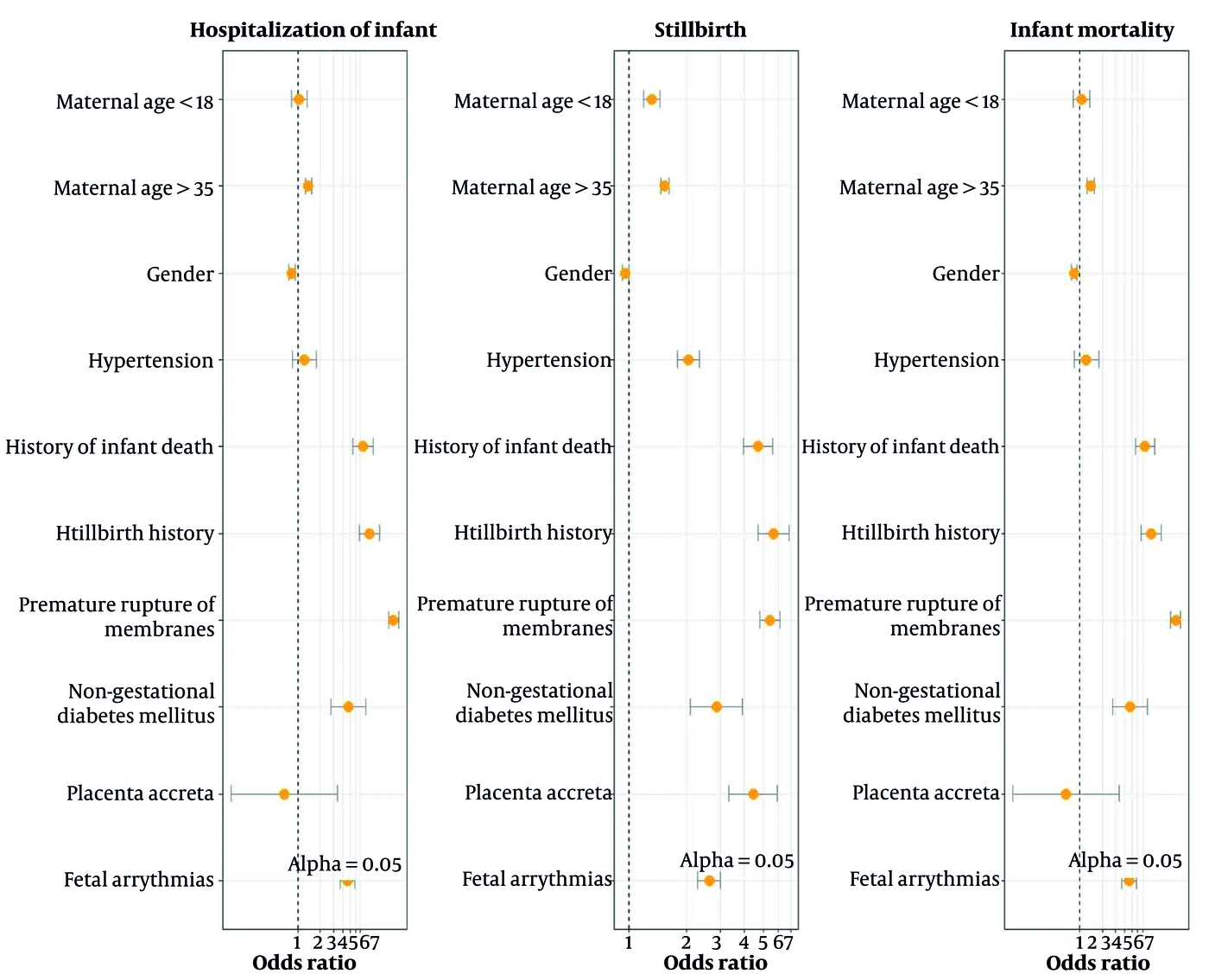
Figure 1.
Odds ratios and 95% confidence intervals for neonatal outcome categories. Abbreviations: CI, confidence interval; OR, odds ratio; PROM, premature rupture of membranes. Reference levels: rooming-in for neonatal outcomes, no for binary predictors, maternal age 18 - 35 years, and male for neonatal sex.
For maternal outcomes, mothers aged < 18 years had 21% lower odds of ICU admission, whereas those aged > 35 years had 31% higher odds than the reference age group. PROM and fetal arrhythmias were also associated with approximately 30% and 38% higher odds of ICU admission, respectively. Maternal age > 35 years was associated with 71% higher odds of maternal mortality, whereas fetal arrhythmias were associated with nearly fourfold higher odds of maternal mortality (OR = 3.91) (Table 3 and Figure 2).
Table 3.
Multinomial Logistic Regression Results for Maternal Outcomes Within Two Hours After Delivery a
| Variables | ICU Admission OR | ICU Admission 95% CI | ICU Admission P Value | Maternal Mortality OR | Maternal Mortality 95% CI | Maternal Mortality P Value |
|---|---|---|---|---|---|---|
| Maternal age (y) | ||||||
| < 18 | 0.79 | 0.71 - 0.87 | < 0.0001 | 1.07 | 0.34 - 3.38 | 0.910 |
| > 35 | 1.31 | 1.26 - 1.36 | < 0.0001 | 1.71 | 1.01 - 2.63 | 0.030 |
| Fetal arrhythmias | 1.38 | 1.20 - 1.59 | < 0.0001 | 3.91 | 1.23 - 12.36 | 0.020 |
| PROM | 1.30 | 1.10 - 1.54 | < 0.0001 | 3.00 | 0.68 - 13.12 | 0.150 |
a Reference levels: the combined category of general ward admission and surgical intervention (n = 1,426,880) for maternal outcomes, no for binary predictors, and maternal age 18 - 35 years. Outcome counts were ICU admission (n = 4,617) and maternal mortality (n = 100). Abbreviations: CI, confidence interval; ICU, intensive care unit; OR, odds ratio; PROM, premature rupture of membranes. Overall, several maternal and neonatal characteristics, particularly maternal age, hypertension, obstetric history, pregnancy complications, neonatal sex, and fetal arrhythmias, were significantly associated with early neonatal and maternal outcomes.
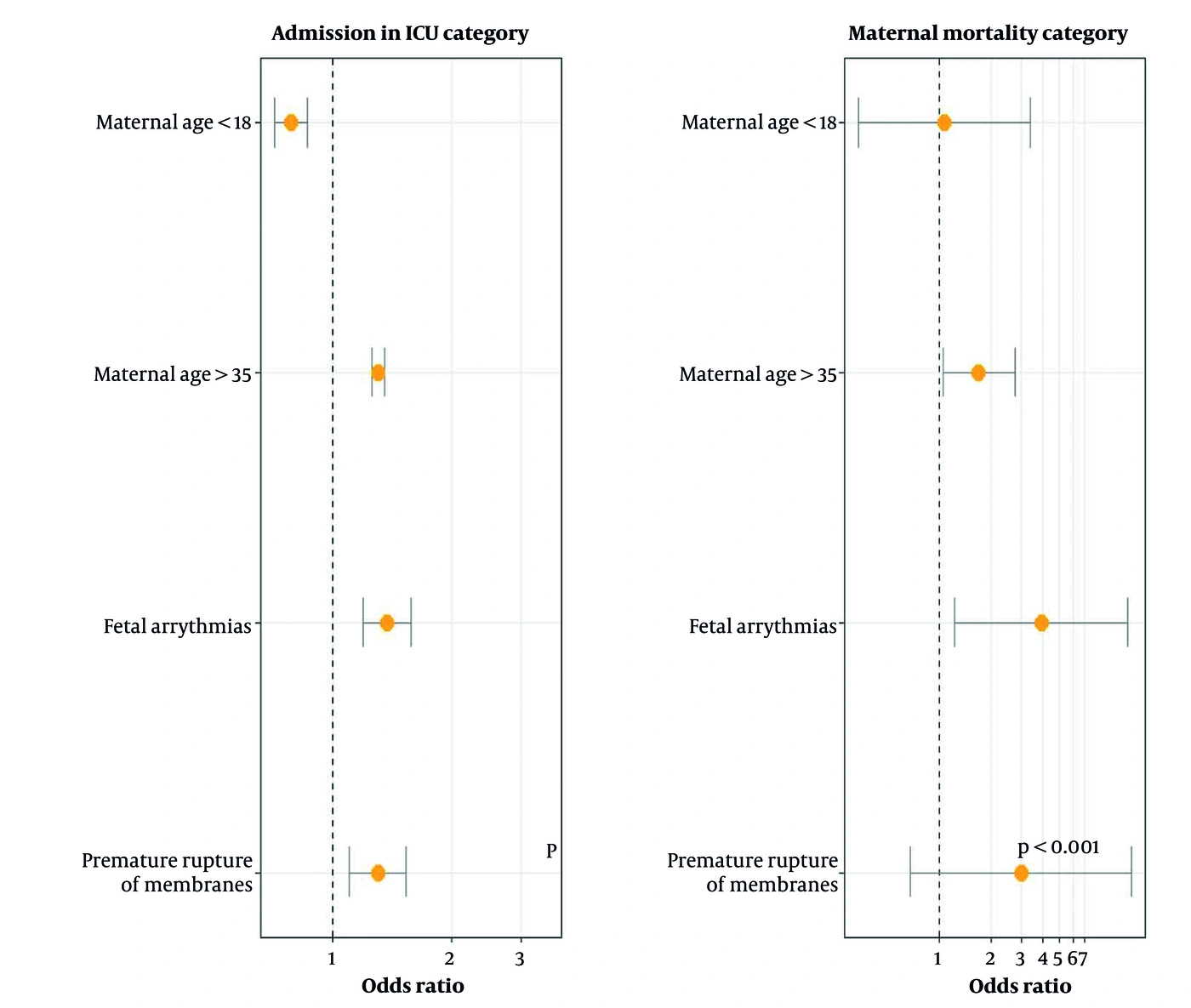
Figure 2.
Odds ratios and 95% confidence intervals for maternal outcome categories. Abbreviations: CI, confidence interval; ICU, intensive care unit; OR, odds ratio; PROM, premature rupture of membranes. Reference levels: the combined category of general ward admission and surgical intervention for maternal outcomes, no for binary predictors, and maternal age 18 - 35 years.
5. Discussion
This national registry-based study identified several maternal and neonatal characteristics associated with adverse maternal and neonatal outcomes within the first 2 hours after delivery. Maternal age, hypertensive disorders, previous stillbirth or neonatal death, PROM, non-gestational diabetes mellitus, placenta accreta, fetal arrhythmias, and neonatal sex were associated with one or more neonatal outcomes. Maternal age, PROM, and fetal arrhythmias were also associated with maternal ICU admission or maternal mortality. The strongest associations with early neonatal mortality were observed for previous stillbirth, PROM, a history of neonatal death, non-gestational diabetes mellitus, and fetal arrhythmias.
Female neonates had 17% lower odds of early neonatal mortality than male neonates in the present study. This finding is consistent with previous evidence indicating greater neonatal vulnerability among male neonates. Pongou reported higher infant mortality among males than females (12), while Aghai et al. similarly found higher early neonatal mortality among male infants in a large registry-based study conducted in India and Pakistan (13). However, differences in the magnitude of sex-related disparities across studies may reflect differences in study populations, outcome definitions, follow-up periods, and perinatal characteristics. In particular, the present study was restricted to deaths recorded within the first 2 hours after delivery, which limits direct comparisons with studies assessing mortality over longer neonatal or infant follow-up periods.
Fetal arrhythmias were strongly associated with adverse neonatal outcomes, including neonatal hospitalization, stillbirth, and early neonatal mortality. Previous studies have similarly reported increased risks of adverse neonatal outcomes among pregnancies complicated by clinically significant fetal arrhythmias (14). The magnitude of the associations may differ across studies because fetal arrhythmias comprise a heterogeneous group of rhythm disturbances with varying severity, and registry-based data such as ours do not provide detailed information on arrhythmia subtype, duration, or treatment. Placenta accreta was also associated with neonatal hospitalization and stillbirth in our study. Previous research has reported higher rates of adverse neonatal outcomes among pregnancies complicated by placenta accreta spectrum disorders (15). Differences in reported effect sizes may partly reflect variation in disease severity, gestational age at delivery, referral patterns, and access to specialized obstetric care.
Advanced maternal age (> 35 years) was associated with 55% higher odds of stillbirth than maternal age of 18 - 35 years. This finding is consistent with the population-based study by Waldenström et al., which also demonstrated an increased risk of stillbirth among women of advanced maternal age (16). Differences in the magnitude of risk between studies may be related to differences in maternal age categorization, parity, population characteristics, obstetric care, and covariates included in multivariable adjustment.
Maternal hypertensive disorders were associated with approximately twofold higher odds of stillbirth in the present study. This finding is consistent with previous evidence demonstrating associations between hypertensive disorders during pregnancy and adverse maternal and neonatal outcomes. Bromfield et al. similarly reported increased risks of adverse outcomes among pregnancies complicated by hypertensive disorders (17). Differences in the magnitude of associations across studies may reflect differences in the definition and severity of hypertensive disorders, population characteristics, access to prenatal care, and the extent of statistical adjustment.
PROM showed one of the strongest associations with adverse neonatal outcomes, particularly early neonatal mortality and stillbirth. Endale et al. also reported substantial adverse fetal and neonatal outcomes among pregnancies complicated by term PROM, including stillbirth and neonatal mortality (18). However, direct comparison of effect estimates is limited because their study included only pregnancies with term PROM and did not include a non-PROM comparison group. Differences between studies may also reflect variation in gestational age, duration of membrane rupture, intrauterine infection, obstetric management, and outcome definitions.
A history of adverse pregnancy outcomes was also strongly associated with subsequent neonatal outcomes. Previous stillbirth was associated with markedly higher odds of early neonatal mortality, and a history of neonatal death was associated with hospitalization, stillbirth, and early neonatal mortality. These findings may indicate the persistence of underlying maternal, obstetric, genetic, or health care-related risk factors across pregnancies. However, because the registry did not contain detailed information on the causes of previous stillbirth or neonatal death, the mechanisms underlying these associations could not be further evaluated.
The observed sex difference in neonatal outcomes may partly reflect biological differences between male and female neonates. Previous studies have suggested that the greater vulnerability of male neonates, particularly among preterm infants, may involve a combination of genetic, hormonal, and immunological mechanisms (19, 20). However, these mechanisms were not directly evaluated in the present registry-based study and should therefore be considered possible explanations rather than causal mechanisms.
From a clinical and public health perspective, the identified associations may help inform risk stratification and surveillance of pregnancies with known maternal or fetal risk factors. Women with a history of stillbirth or neonatal death, PROM, hypertensive disorders, non-gestational diabetes mellitus, advanced maternal age, or fetal arrhythmias may warrant particular attention during prenatal and perinatal assessment. Current recommendations already emphasize blood pressure screening during pregnancy (21), and our findings further support the importance of recognizing combinations of maternal and fetal risk factors. Nevertheless, because the present study was observational, these findings should not be interpreted as evidence that intensified monitoring or specific interventions will necessarily improve outcomes. Prospective studies are needed before translating these associations into formal clinical recommendations.
A major strength of this study was the use of a large national registry encompassing more than 1.4 million mother-neonate records, which provided substantial statistical power to evaluate multiple maternal and neonatal outcomes. In addition, multinomial logistic regression enabled simultaneous comparison of several mutually exclusive outcome categories using clinically meaningful reference groups.
5.1. Limitations
Several limitations should be considered when interpreting these findings. First, although the study used a national registry extraction with no record-level exclusions, routinely collected registry data may be subject to misclassification and variability in clinical documentation. The registry variables were based on clinician-recorded diagnoses and lacked detailed information on disease severity, timing, treatment, and some clinical subtypes. Second, information on potentially important confounders, including socioeconomic status, maternal lifestyle factors, quality of prenatal care, and other clinical characteristics, was unavailable; therefore, residual confounding cannot be excluded. Third, maternal and neonatal mortality ascertainment was restricted to events recorded within the first 2 hours after delivery; consequently, the findings should not be generalized to mortality occurring later in the neonatal or postpartum period. Finally, because this was an observational registry-based study, causal relationships cannot be established, and the reported odds ratios should be interpreted as measures of association rather than causal effects.
5.2. Conclusions
This national registry-based study identified several maternal and neonatal characteristics associated with adverse outcomes within the first 2 hours after delivery. Maternal hypertensive disorders, previous stillbirth or neonatal death, PROM, non-gestational diabetes mellitus, placenta accreta, fetal arrhythmias, maternal age extremes, and neonatal sex were associated with one or more adverse neonatal outcomes, while maternal age, PROM, and fetal arrhythmias were associated with maternal ICU admission or mortality. The particularly strong associations observed for previous adverse pregnancy outcomes, PROM, and fetal arrhythmias may help identify groups requiring greater clinical attention. However, given the observational design and the limited 2-hour outcome window, these findings should be interpreted as epidemiological associations and require confirmation in prospective studies.