
1. Background
The National Vital Statistics Report defines birth injuries as impairments of body function or structure in newborns caused by adverse events during birth (1). Birth trauma, also referred to as birth injury, poses a substantial challenge to healthcare systems and affects approximately 20 to 26 per 1,000 deliveries. These injuries can be classified into two distinct categories according to etiology: those arising from hypoxia and ischemia and those resulting from mechanical stress during labor (2). Understanding the risk factors associated with birth trauma is essential because it enables the implementation of preventive measures to reduce perinatal morbidity and mortality (3).
Effective management of birth trauma requires an understanding of the spectrum of these injuries. This spectrum includes soft-tissue damage to muscles and skin, head and neck injuries, bone fractures, and the most concerning condition, hypoxic-ischemic encephalopathy (HIE), which is caused by oxygen deprivation and can lead to permanent brain damage.
Maternal conditions such as diabetes, obesity, cephalopelvic disproportion, short stature, extreme maternal age, and primigravida status have been implicated as potential contributors to birth injuries (4). Fetal factors, including prematurity, low birth weight, prolonged labor, oxytocin use, epidural anesthesia, malpresentation, and congenital abnormalities, are also recognized as important risk factors (3).
2. Objectives
By elucidating risk factors, healthcare providers can implement targeted interventions, optimize clinical decision-making, and improve perinatal care (5). However, data on birth trauma and its risk factors remain scarce in Iran, particularly regarding sociodemographic factors and regional variations in healthcare delivery. Unique factors, such as cultural attitudes toward delivery mode, disparities in prenatal education, and regional differences in obstetric practices, may influence injury rates. This study aimed to address this gap by providing the first multicenter analysis of predictors of birth trauma in Iran and assessing risk factors for birth trauma in the Iranian population, with implications for tailoring perinatal care policies and reducing perinatal morbidity and mortality.
3. Methods
3.1. Study Design and Participants
This case-control study was conducted at three referral hospitals in Tehran, Iran, between April 2019 and March 2020. All neonates born during this period were eligible for inclusion. The case group comprised neonates with birth trauma documented in their medical records, whereas the control group consisted of neonates without any documented birth trauma. Twice as many controls as cases were selected to enhance statistical power and improve the precision of the estimates. Birth trauma cases were identified and documented based on the clinical diagnosis of attending neonatologists or pediatricians, supplemented by International Classification of Diseases, 10th Revision codes, including P10 to P15, recorded in the medical records. All diagnoses were confirmed through review of imaging, clinical notes, and discharge summaries.
3.2. Inclusion and Exclusion Criteria
The inclusion criteria comprised live births at the three participating hospitals during the study period, with consent to participate. To minimize selection bias, neonates with insufficient medical records were excluded. However, the possibility of missed cases due to incomplete documentation cannot be entirely ruled out. Although medical records were systematically reviewed, mild trauma cases, such as minor abrasions and small cephalohematomas, may have been underreported because documentation tends to prioritize severe injuries. This may have led to an underestimation of the overall incidence.
3.3. Data Collection
The characteristics of cases and controls were collected using a standardized data collection form. Maternal factors, including age, education, employment, prenatal care, and medical history; neonatal factors, such as gestational age, sex, resuscitation, and anthropometric indices; and birth factors, including delivery agent, delivery method, delivery time, rupture of membranes, presentation, and cesarean incisions, were recorded. The need for resuscitation was defined as any requirement for positive-pressure ventilation, chest compressions, or epinephrine administration in the delivery room, according to the Iranian Neonatal Resuscitation Guidelines, 2020 edition. Neonatal intensive care unit (NICU) admission criteria included an Apgar score ≤ 5 at 5 minutes, the need for respiratory support, or clinical signs of encephalopathy.
3.4. Sample Size
This study was conducted in two phases. In the first phase, the prevalence of birth trauma was determined by reviewing all neonates born at the three participating hospitals during the study period.
In the second phase, a case-control study design was used to investigate factors associated with birth trauma. All 43 neonates with documented birth trauma were included as cases. To enhance statistical power and improve the precision of estimates, 86 neonates without birth trauma were selected as controls, maintaining a 2:1 control-to-case ratio. The total sample size for the case-control analysis was 129 neonates, including 43 cases and 86 controls. This sample size was considered sufficient to detect significant differences between groups with 80% power and a two-sided alpha level of 0.05, based on previously reported associations between neonatal, maternal, and delivery factors and birth trauma (6). The sample size of 43 trauma cases, although sufficient for initial exploration, may limit the robustness of multivariable regression, particularly for variables with low frequency, such as maternal education subgroups. Therefore, the findings should be interpreted as preliminary and validated in larger cohorts. A 2:1 control-to-case ratio was selected to enhance statistical power and improve the precision of estimates, based on prior sample size calculations for logistic regression with 80% power and a two-sided alpha of 0.05.
3.5. Ethical Considerations
The study protocol adhered to the ethical principles outlined in the Medical Association Declaration of Helsinki on Ethical Principles for Medical Research. The research protocol was reviewed and approved by the Medical Ethics Committee of Tehran University of Medical Sciences (TUMS). Written informed consent was obtained from the parents or legal guardians of all newborn participants before inclusion in the study.
3.6. Statistical Analysis
Descriptive statistics were used to summarize the data using the Statistical Package for the Social Sciences (SPSS), version 23. Means and standard deviations were calculated for quantitative data. Associations between predictor variables and birth trauma were assessed using the Mann-Whitney U test and the chi-square test, as appropriate. In addition, a logistic regression model was used to estimate the adjusted effects of determining factors on the occurrence of birth trauma. A P value less than 0.05 was considered statistically significant. For categorical variables with expected counts < 5, Fisher exact test was applied.
4. Results
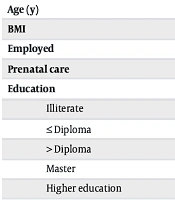
The overall incidence of birth injuries was 43 of 4,902 births, corresponding to a rate of 8.77 cases per 1,000 live births. Specifically, the incidence was 10.35 per 1,000 live births at Yas Hospital, 11.79 per 1,000 live births at Imam Khomeini Hospital, and 6.63 per 1,000 live births at Arash Hospital. To conduct a case-control study comparing various factors, a control group of 86 neonates born without birth trauma was included, maintaining a 2:1 ratio. The mean gestational age of the participants was 36.32 (SD = 7.66) weeks. The mean maternal age was 29.97 (SD = 5.91) years. Approximately 98% of mothers in this study received prenatal care. Approximately 19% and 3% had gestational diabetes mellitus (GDM) and hypertensive disorders in pregnancy (HDP), respectively. No maternal smoking or drug abuse was observed. In addition, no mother reported prior pelvic surgery or antepartum hemorrhage. Because of low expected frequencies in some education categories, the Fisher exact test was used to compare maternal education between groups. Mothers of neonates with birth trauma had significantly lower education levels (P = 0.03). However, no significant differences were found between the two groups regarding maternal age, employment status, Body Mass Index (BMI), or medical history. The demographic characteristics are summarized in Table 1.
Table 1.
Maternal Baseline Characteristics a
| Characteristics | Total n = 129 | With Birth Trauma n = 43 | Without Birth Trauma n = 86 | P-Value b |
|---|---|---|---|---|
| Age (y) | 29.97 ± 5.91 | 29.95 ± 5.56 | 29.98 ± 6.10 | 0.933 |
| BMI | 28.73 ± 5.04 | 29.14 ± 5.84 | 28.51 ± 4.59 | 0.225 |
| Employed | 78 (60.5) | 26 (60.5) | 52 (60.5) | 0.779 |
| Prenatal care | 127 (98.4) | 41 (95.3) | 86 (100) | 0.109 |
| Education | 0.030 | |||
| Illiterate | 16 (13.8) | 0 | 16 (20.5) | |
| ≤ Diploma | 83 (71.6 | 31 (81.6 | 52 (66.7) | |
| > Diploma | 3 (2.6) | 2 (5.3) | 1 (1.3) | |
| Master | 10 (8.6) | 3 (7.9) | 7 (9.0) | |
| Higher education | 4 (3.4) | 2 (5.3) | 2 (2.3P | |
| GDM | 25 (19.5) | 11 (25.6) | 14 (16.5) | 0.243 |
| HDP | 4 (3.1) | 2 (4.7) | 2 (2.3) | 0.407 |
a Values are expressed as No. (%) and mean ± SD. Chi-square, Mann-Whitney U, and Fisher exact tests were used. Abbreviations: BMI, Body Mass Index; GDM, gestational diabetes mellitus; HDP, hypertensive disorders in pregnancy; ROM, rupture of membrane.
b P < 0.05 was considered statistically significant.
Examination of neonatal factors showed that the need for birth resuscitation was significantly associated with birth trauma (P = 0.002). Neonatal characteristics are summarized in Table 2.
Table 2.
Neonatal Baseline Characteristics a
| Characteristics | Total n = 129 | Birth Trauma Positive n = 43 | Birth Trauma Negative n = 86 | P-Value b |
|---|---|---|---|---|
| Gender (Female) | 54 (42.2) | 18 (41.9) | 36 (42.4) | 0.555 |
| Gestational age (wk) | 36.31 ± 7.65 | 37.60 ± 3.26 | 36.67 ± 9.05 | 0.401 |
| Birth weight | 3171.5 ± 532.7 | 3153.6 ± 592.3 | 3180.5 ± 503.3 | 0.994 |
| Birth height | 50.4 ± 3.2 | 50.1 ± 3.6 | 50.5 ± 3.1 | 0.803 |
| Head circumference | 34.4 ± 1.9 | 34.2 ± 2.3 | 34.5 ± 1.7 | 0.316 |
| Birth resuscitation | 14 ± 10.9 | 10 ± 23 | 4 ± 5 | 0.002 |
a Values are expressed as No. (%) or mean ± SD.
b P < 0.05 was considered statistically significant.
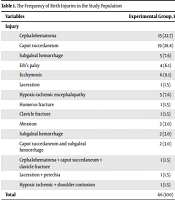
Birth trauma cases were categorized into five types: head and neck injuries (28 cases, 65.1%), central or peripheral nervous system injuries (1 case, 2%), brachial plexus injuries (4 cases, 9.3%), abdominal organ injuries (2 cases, 4.6%), and bone fractures (8 cases, 18.6%). Bone fractures included clavicular fractures (n = 5), humeral fractures (n = 2), and a skull fracture (n = 1), with no femoral fractures observed.
In addition, the method of delivery and the birth-giving agent were assessed in relation to birth trauma. The results indicated a significantly higher incidence of birth trauma among neonates delivered by normal vaginal delivery (NVD) than among those delivered by cesarean section (C/S) (P < 0.001). However, no significant difference was observed in the incidence of birth trauma according to the birth-giving agent (P = 0.185).
Of the neonates, 11 were classified as low birth weight, whereas the remaining neonates had normal birth weight. The incidence of birth trauma did not differ significantly between these groups (P = 0.531). In addition, 16 neonates were born preterm, whereas the remaining neonates were full term. No significant difference was observed in the incidence of birth trauma between these groups (P = 0.250). Among preterm neonates, there was no significant variation in the occurrence of trauma among very preterm, moderate preterm, and late preterm neonates (P = 0.683).
Similarly, no difference in the incidence of birth trauma was found between nulliparous and multiparous mothers (P = 0.392).
Adjusted odds ratios with 95% confidence intervals are presented in Table 3. Multivariate logistic regression analysis showed that a diploma literacy level or higher (B = -0.659, adjusted odds ratio [aOR] = 0.57, P = 0.020) and cesarean delivery (B = -2.795, aOR = 0.064, P < 0.001) were protective factors against birth trauma. The need for birth resuscitation (B = 2.695, aOR = 14.79, P = 0.002) was significantly associated with higher odds of birth trauma (Table 4).
Table 3.
Delivery Characteristics a
| Variables | with Birth Trauma | Without Birth Trauma | P-Value b |
|---|---|---|---|
| Birth-giving agent | 0.185 | ||
| Perinatologist | 0 | 1 (1.2) | |
| Obstetrician | 15 (36.6) | 44 (52.4) | |
| Senior Assistant | 11 (26.8) | 22 (26.2) | |
| Junior Assistant | 15 (36.6) | 17 (20.2) | |
| Birth season | 0.191 | ||
| Spring | 12 (27.9) | 28 (32.6) | |
| Summer | 3 (7) | 12 (14) | |
| Fall | 15 (34.9) | 16 (18.6) | |
| Winter | 13 (30.2) | 30 (34.9) | |
| Birth time (h) | 0.587 | ||
| 8 AM-2 PM | 20 (47.6) | 34 (40.5) | |
| 2 PM-8 PM | 13 (31) | 25 (29.8) | |
| 8 PM-8 AM | 9 (21.4) | 25 (29.8) | |
| FHR reduction | 0.759 | ||
| Yes | 5 (11.6) | 8 (9.3) | |
| No | 38 (40.5) | 78 (90.7) | |
| Mode of delivery | <0.001 | ||
| C/S | 10 (23.3) | 61 (71.8) | |
| NVD | 33 (76.7) | 24 (28.2) | |
| Rupture of membrane | 0.547 | ||
| Yes | 2 (4.7) | 3 (3.5) | |
| No | 41 (95.3) | 82 (95.5) | |
| Presentation | 0.474 | ||
| Vertex | 19 (44.2) | 38 (44.2) | |
| Face | 0 (0) | 2 (2.3) | |
| Breech | 2 (1.2) | 1 (4.7) | |
| Cesarean incision | 0.332 | ||
| Low horizontal | 0 | 2 (2.3) | |
| Low vertical | 3 (7) | 17 (19.8) | |
| Pfannenstiel | 5 (11.6) | 10 (11.6) | |
| Classic | 0 | 1 (1.2) |
a Values are expressed as No. (%). Abbreviations: FHR, fetal heart rate; C/S, cesarean section; NVD, normal vaginal delivery.
b Chi-square and Fisher exact tests were used. P < 0.05 was considered statistically significant.
Table 4.
Adjusted Predictors of Birth Trauma
| Variables (Reference Group) | B | P-Value a | Adjusted OR | Confidence Interval (95%) |
|---|---|---|---|---|
| Maternal education (diploma and higher) | -0.659 | 0.020 | 0.517 | 0.29 - 0.90 |
| Delivery (NVD) | -2.795 | <0.001 | 0.064 | 0.019 - 0.196 |
| Resuscitation | 2.695 | 0.002 | 14.799 | 2.91 - 75.03 |
| Prenatal care | -20.57 | 0.999 | 0.002 | 0.001 - 2.351 |
| Delivery agent | 0.049 | 0.871 | 1.050 | 0.581 - 1.900 |
a Logistic regression tests were used. P < 0.05 was considered statistically significant. Abbreviations: NVD, natural vaginal delivery; OR, odds ratio.
A sensitivity analysis excluding extremely preterm neonates (< 28 weeks) confirmed the robustness of the findings; results are available upon request. Data on instrumental delivery, including forceps or vacuum use, and the birth attendant’s years of experience were not consistently available across all centers and therefore were not included in the analysis.
5. Discussion
This study examined the prevalence of and risk factors associated with birth trauma in three referral hospitals in Tehran, Iran. The overall rate of birth trauma in this study was 0.8% (43 of 4902 cases). This rate is lower than the 2.2% reported in a previous study (7) and substantially lower than the 16.7% prevalence observed in an Ethiopian study (8). The pooled incidence of birth trauma in a recent meta-analysis of low- and middle-income countries was estimated at 34 per 1,000 live births (9). Differences in clinical practices, healthcare provider skill levels, healthcare infrastructure, and cesarean section rates may contribute to variation in prevalence estimates. The sample size in this study may also have contributed to the lower observed prevalence compared with larger studies. The lower prevalence of birth trauma in this study also suggests that effective practices may be in place in this region.
Consistent with prior research (8), this study identified several significant risk factors for birth trauma, including lower maternal education, vaginal delivery, and the need for birth resuscitation. However, unlike the Ethiopian study (8), maternal age was not a significant predictor in the present investigation. The protective effect of higher maternal education may be mediated by greater health literacy, earlier and more consistent prenatal care attendance, and an increased ability to advocate for safer delivery practices, all of which may reduce traumatic birth outcomes.
Additional risk factors highlighted in the literature, such as primiparity, lack of antenatal care, maternal employment status, prolonged labor, instrumental delivery, breech presentation, and higher maternal or neonatal anthropometric measures, including weight, height, and head circumference (8, 10, 11), were not consistently replicated in the present study. These discrepancies may reflect differences in study populations and analytic approaches.
An Ethiopian study found that primipara (OR = 12.27), no formal education (OR = 2.52), lack of antenatal care (OR = 2.40), and maternal unemployment (OR = 4.26) were significantly associated with a higher likelihood of birth injuries. In addition, maternal age between 25 and 34 years (OR = 6.68) and instrumental delivery methods (OR = 2.81) were associated with a higher likelihood of birth injuries than maternal age older than 34 years and cesarean delivery, respectively (8). In contrast, this study did not find any correlation between maternal age and the occurrence of birth injuries.
A prospective cohort study by Mondal et al. (10) investigated 73 cases of birth injuries among 4741 participants and found that increasing maternal age (OR = 2.46) and weight (OR = 1.26), higher birth weight (OR = 358.6), prolonged labor (OR = 207.6), breech presentation (OR = 23.3), and an inopportune delivery time from 2:00 to 8:00 AM (OR = 91.4) were significant risk factors for neonatal birth injury. Gestational age and delivery mode were not significant. The adjusted odds ratios from the logistic regression model indicated that birth weight, prolonged labor, and delivery time were the strongest predictors, whereas increasing maternal height (aOR = 0.189) and infant head circumference (aOR = 0.159) appeared to be protective factors.
In a retrospective single-center cohort study by Linder et al. (11), among 118280 children, 2874 were diagnosed with birth trauma, yielding a rate of 24.3 per 1000 births. The most common forms of birth trauma were scalp injuries and clavicular fractures. Independent risk factors for birth trauma included instrumental delivery, birth weight, delivery during high-risk hours, parity, maternal age, and head circumference. Cesarean delivery was the sole protective factor against birth trauma (OR, 0.2; 95% CI, 0.2 - 0.3). Infants in the study group experienced longer hospitalizations (3.3 vs 2.7 days; P = 0.001) and had a higher likelihood of NICU admission (3.9% vs 1.9%; P < 0.001). Contrary to some literature, maternal diabetes and hypertension were not significant predictors in this cohort. This finding may be partially explained by higher cesarean section rates among these high-risk pregnancies in these settings, thereby reducing exposure to traumatic vaginal delivery.
Another cross-sectional study by Mosavat and Zamani (12) reported macrosomia as a significant factor, particularly in cases of brachial plexus injury and clavicle fracture. In contrast to Mosavat and Zamani, this study found no significant association between macrosomia and birth trauma. This may reflect differences in obstetric practices, such as higher cesarean rates for suspected macrosomia in this setting, or variations in neonatal assessment protocols.
Furthermore, a review study by Ojumah et al. (13) demonstrated a progressive increase in the risk of birth trauma with higher birth weights, highlighting the importance of monitoring and managing neonates with greater birth weights to prevent potential injuries. However, the present results do not support this association, indicating that excessive birth weight did not increase the risk of birth trauma. Unlike the Ethiopian study by Belay et al. (8), primiparity was not a significant predictor in this cohort. This discrepancy may be attributable to differences in healthcare accessibility, maternal education levels, or institutional protocols for managing first-time deliveries.
Based on these findings, targeted antenatal education programs are recommended for women with lower educational attainment. Structured simulation training for birth attendants may also help reduce resuscitation-associated trauma. In addition, maternal education level should be considered in birth planning and risk assessment protocols.
5.1. Strengths and Limitations
This study included three hospitals, increasing the likelihood that the results could be generalized to neonates born in similar settings. Multivariate logistic regression analysis was used to control for as many confounders as possible. Because this was a case-control study, cause-and-effect relationships between variables cannot be established. The retrospective design also limits causal inference. The findings are from a single region in Iran; therefore, future multicountry collaborations are needed to enhance generalizability.
5.2. Conclusions
This study provides further evidence regarding risk factors associated with birth trauma, including maternal education, birth method, and birth resuscitation. These findings support the existing literature and emphasize the importance of targeted interventions and careful management during labor to minimize the occurrence of birth trauma. Future research should focus on developing comprehensive strategies to mitigate these risk factors and improve overall neonatal outcomes.