
1. Background
Emergency contraception (EC) is an important intervention for preventing unintended pregnancy after unprotected intercourse, contraceptive failure, or sexual assault. Globally, an estimated 121 million unintended pregnancies occurred annually between 2015 and 2019. More than 72 million of these pregnancies ended in abortion. Approximately 45% of abortions were unsafe, contributing substantially to maternal morbidity and mortality. Most unsafe abortions occur in low- and middle-income countries (1).
Nigeria records an estimated 6.8 million pregnancies annually, many of which are unintended. Approximately 56% end in abortion (2, 3). Although abortion is legally restricted except to save the pregnant woman's life (4), more than 610,000 induced abortions occur annually. Young people account for over 60% of these abortions (5). The clandestine nature of many procedures contributes to unsafe abortion and associated morbidity (3, 6). EC therefore provides an important opportunity to prevent unintended pregnancies and reduce the risk of unsafe abortion.
Available EC methods include the combined estrogen–progestogen (Yuzpe) regimen, progestogen-only pills, and copper intrauterine devices. Levonorgestrel-only emergency contraceptive pills (ECPs) are widely used in Nigeria because of their accessibility and over-the-counter availability. Pharmacists play an important role in EC dispensing, counseling, and patient education. However, studies have reported gaps in EC knowledge, misconceptions about safety, and religious or ethical concerns among pharmacists and pharmacy students (7-14).
Evidence from other healthcare settings suggests that knowledge and attitudes can influence healthcare professionals' practices and professional responsibilities (15). Similarly, inadequate EC knowledge and limited healthcare provider counseling have been identified as barriers to effective contraceptive decision-making among women undergoing cancer treatment (16).
Although EC has been studied in general and healthcare populations, evidence among pharmacy students remains limited (9, 17-19), particularly in Nigeria (2, 3, 20, 21). Assessing pharmacy students' knowledge, attitudes, and practices (KAP) is therefore important, as it can help identify educational gaps and address misconceptions. The findings may also inform pharmacy curriculum development and future EC service provision.
2. Objectives
To assess knowledge, attitudes, practices, and perceived barriers regarding EC among undergraduate pharmacy students, and to identify factors associated with poor knowledge and negative attitudes.
3. Methods
3.1. Study Design, Setting, and Population
A descriptive cross-sectional study was conducted at a Nigerian university. The target population comprised all undergraduate pharmacy students registered during the 2025 academic year. Students who provided written informed consent were eligible, whereas those who were suspended, expelled, or on academic deferment were excluded.
3.2. Sample Size and Sampling Method
Assuming a 5% margin of error, a 95% confidence interval, and a target population of 561 students, the minimum required sample size was calculated as 229 using Raosoft®. Eligible students who were present during data collection were recruited using convenience sampling.
3.3. Data Collection Instrument and Procedure
A structured, self-administered, paper-based questionnaire adapted from previously published instruments (9, 22, 23) was used for data collection. Face and content validity were assessed by subject-matter experts. The questionnaire was pilot-tested among 20 undergraduate pharmacology students of the same faculty. Cronbach alpha values for the knowledge and attitude items were 0.664 and 0.609, respectively. The questionnaire comprised 12 knowledge items, 14 attitude items, and sex-specific practice items, along with 2 multiple-choice questions addressing reasons for first-time use and perceived barriers among female respondents. Attitude items were measured on a 5-point Likert scale ranging from “strongly disagree” to “strongly agree,” whereas practice items used “yes,” “no,” or “can’t say.” The complete questionnaire is provided as Appendix 1 in the Supplementary File. Data were collected between November and December 2025. Questionnaires were distributed in lecture halls and retrieved on the same day.
3.4. Data Transformation and Statistical Analysis
Double data entry was used to minimize transcription errors, and negatively worded attitude items were reverse-coded. Knowledge and attitude scores were categorized using modified Bloom’s criteria (24). Knowledge was scored as correct = 1 and incorrect = 0; scores ≥ 60% (8 - 12 points) indicated good knowledge. Attitude responses were scored as 2, 1, or 0 for agreement, neutral, and non-agreement, respectively. Attitude scores ≥ 60% (17 - 28 points) indicated positive attitudes. For regression analyses, poor knowledge and negative attitude were coded as 1.
Data were analyzed using SPSS version 25. Descriptive statistics were used to summarize participants' characteristics and KAP outcomes. The Shapiro–Wilk test was used to assess normality, with nonparametric methods applied where appropriate. Variables associated with poor knowledge at P < 0.20 in chi-square analyses, along with theoretically relevant variables, were entered into a multivariable logistic regression model using the ENTER method. Adjusted odds ratios (AORs) with 95% CIs were reported, and P < 0.05 indicated statistical significance. Multicollinearity was assessed using variance inflation factor (VIF) and tolerance statistics, and model fit was assessed using the Hosmer–Lemeshow test, likelihood-ratio χ2, and Cox and Snell and Nagelkerke R2. Missing data were handled by listwise deletion.
4. Results
4.1. Sociodemographic Characteristics
A total of 502 students completed the questionnaire, from a target population of 561 students. Thus, the analyzed sample represented 89.5% of the target population. The median age was 23 years (IQR: 20 - 25), with most respondents aged 21 - 25 years (52.4%). As shown in Table 1, males constituted 59.8% of participants, and most participants were single (80.5%). Christians accounted for 52.6% of respondents, whereas 47.4% were Muslims. Third-year students constituted the largest academic group (30.7%).
Table 1.
Demographic Characteristics of the Study Participants
| Variables | No. (%) |
|---|---|
| Age group (y) | |
| < 21 | 146 (29.1) |
| 21 - 25 | 263 (52.4) |
| > 25 | 93 (18.5) |
| Gender | |
| Female | 202 (40.2) |
| Male | 300 (59.8) |
| Marital status | |
| Single | 404 (80.5) |
| In a relationship | 74 (14.7) |
| Married | 24 (4.8) |
| Religion | |
| Islam | 238 (47.4) |
| Christianity | 264 (52.6) |
| Study year | |
| First | 82 (16.4) |
| Second | 89 (17.7) |
| Third | 154 (30.7) |
| Fourth | 83 (16.5) |
| Fifth | 94 (18.7) |
4.2. Knowledge of Emergency Contraception
Overall knowledge of EC was limited. The median knowledge score was 5 (IQR: 4 - 8) out of a maximum score of 12, and only 37.5% of students demonstrated good knowledge. Marked gaps were observed in understanding the mechanism of action (14.1%), recommended dose (29.1%), and indications for use (22.9%). Misconceptions were common: 35.5% believed that ECPs were abortion pills, 57.8% considered them suitable for regular contraception, and 39.4% stated that they provide protection from sexually transmitted infections (Table 2).
Table 2.
Emergency Contraception Knowledge of Pharmacy Students a
| Items | Statements | Correct | Incorrect |
|---|---|---|---|
| 1 | Mechanism of action of ECPs | 71 (14.1) | 431 (85.9) |
| 2 | ECPs are not the same as abortion pills | 324 (64.5) | 178 (35.5) |
| 3 | ECPs are also known as the “morning-after” or “postcoital” pill | 331 (65.9) | 171 (34.1) |
| 4 | Name of a common ECP in the Nigerian market | 339 (67.5) | 163 (32.5) |
| 5 | Contents of ECPs | 273 (54.4) | 229 (45.6) |
| 6 | ECPs are not used for regular contraception | 212 (42.2) | 290 (57.8) |
| 7 | Best administration time of ECPs for clinical effectiveness | 345 (68.7) | 157 (31.3) |
| 8 | Best time, in hours, to take an ECP after unprotected sexual intercourse | 157 (31.3) | 345 (68.7) |
| 9 | Recommended ECP dose | 146 (29.1) | 356 (70.9) |
| 10 | Situations in which ECPs can be used | 115 (22.9) | 387 (77.1) |
| 11 | Prescription status of ECPs in Nigeria | 163 (32.5) | 339 (67.5) |
| 12 | ECPs do not provide protection from sexually transmitted infections | 304 (60.6) | 198 (39.4) |
| Knowledge score | 5 (4 - 8) | ||
| Good knowledge | 188 (37.5) | ||
| Poor knowledge | 314 (62.5) | ||
a Values are expressed as No. (%) or median (IQR).
4.3. Attitudes Toward Emergency Contraception
The median attitude score was 15 (IQR: 13 - 19) out of a maximum score of 28, with 58.8% exhibiting negative attitudes. As shown in Table 3, most students supported EC awareness (67.1%) and its inclusion in contraceptive counselling (72.1%); however, fewer endorsed its safety (41.6%), ethical acceptability (47.0%), or universal access (37.8%). Support for adolescent access was particularly low (20.1%).
Table 3.
Participants’ Attitudes Toward Emergency Contraception a
| Items | Statements | Agreement | Neutral | Non-agreement |
|---|---|---|---|---|
| 1 | ECP is safe and has very few contraindications | 209 (41.6) | 158 (31.5) | 135 (26.9) |
| 2 | Adolescents (teenagers) should be given easy access to ECPs | 101 (20.1) | 85 (16.9) | 316 (62.9) |
| 3 | Adolescents (teenagers) should be encouraged to use ECPs. b | 137 (27.3) | 112 (22.3) | 253 (50.4) |
| 4 | ECPs do not discourage regular contraceptive method use among youth. b | 107 (21.3) | 189 (37.6) | 206 (41.0) |
| 5 | All sexually active women should be aware of emergency contraception. | 337 (67.1) | 96 (19.1) | 69 (13.7) |
| 6 | Routine information about emergency contraception should be included in contraceptive counselling. | 362 (72.1) | 89 (17.7) | 51 (10.2) |
| 7 | Information on emergency contraception should be included in sex education in schools. | 328 (65.3) | 97 (19.3) | 77 (15.4) |
| 8 | Use of ECPs is ethical. b | 236 (47.0) | 169 (33.7) | 97 (19.3) |
| 9 | It is not a sinful act to use emergency contraception.b | 211 (42.0) | 184 (36.7) | 107 (21.3) |
| 10 | Nonprescription emergency contraception will not promote unsafe sex. b | 109 (21.7) | 135 (26.9) | 258 (51.4) |
| 11 | Nonprescription ECPs will not discourage regular contraceptive use. b | 114 (22.7) | 184 (36.7) | 204 (40.6) |
| 12 | All females should have the right to access emergency contraception. | 190 (37.8) | 137 (27.3) | 175 (34.9) |
| 13 | Emergency contraception offers women a second chance to prevent pregnancy. | 329 (65.5) | 123 (24.5) | 50 (10.0) |
| 14 | ECP is not abortifacient. b | 257 (51.2) | 150 (29.9) | 95 (18.9) |
| Attitude score | 15 (13 - 19) | |||
| Positive attitude | 207 (41.2) | |||
| Negative attitude | 295 (58.8) | |||
a Values are expressed as No. (%) or median (IQR).
b Negatively worded items in the administered questionnaire.
4.4. Practices Related to Emergency Contraception
Among female students, 20.8% had discussed EC with a sexual partner, 14.4% reported previous ECP use, 40.1% indicated that they would use ECPs in the future if needed, 37.1% reported being comfortable dispensing ECPs despite moral or religious concerns, and 56.9% reported willingness to recommend ECPs to someone who needed them (Table 4). Among female students who had used ECPs, the most commonly reported reason for first-time use was unprotected casual sexual intercourse (32.6%), as shown in Figure 1. Among male students, 23.0% had purchased ECPs for someone, and 23.3% had discussed EC with a sexual partner. More than half (57.3%) reported confidence in counselling others about ECP use despite moral or religious concerns, and 57.3% reported recommending ECPs to a partner or friend (Table 4).
Table 4.
Pharmacy Students’ Practices Toward Emergency Contraception a
| Items and Emergency Contraceptive Practice Statements | Yes | No | Can’t say |
|---|---|---|---|
| Female pharmacy students | |||
| 1. Ever discussed emergency contraception with a sexual partner | 42 (20.8) | 136 (67.3) | 24 (11.9) |
| 2. Ever used ECPs | 29 (14.4) | 152 (75.2) | 21 (10.4) |
| 3. Would use ECPs in the future, if needed | 81 (40.1) | 43 (21.3) | 78 (38.6) |
| 4. Comfortable dispensing ECPs despite moral or religious concerns | 75 (37.1) | 69 (34.2) | 58 (28.7) |
| 5. Would recommend ECPs to someone who needs them | 115 (56.9) | 23 (11.4) | 64 (31.7) |
| Male pharmacy students | |||
| 6. Ever purchased ECPs for someone (partner or friend) | 69 (23.0) | 194 (64.7) | 37 (12.3) |
| 7. Ever discussed emergency contraception with someone (partner or friend) | 70 (23.3) | 174 (58.0) | 56 (18.7) |
| 8. Confident counselling others about ECP use despite moral or religious concerns | 172 (57.3) | 62 (20.7) | 66 (22.0) |
| 9. Would recommend ECPs to someone (partner or friend) | 172 (57.3) | 66 (22.0) | 62 (20.7) |
a Values are expressed as No. (%).
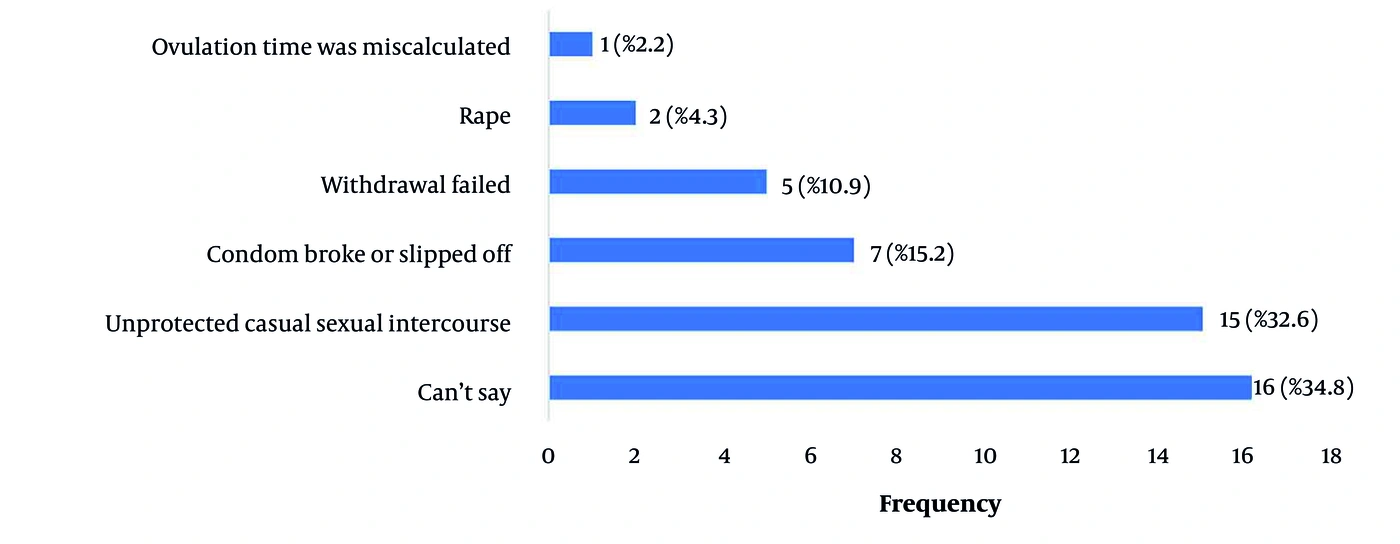
Figure 1.
Reasons for first-time use of ECPs among female pharmacy students
4.5. Barriers to Emergency Contraception Use
The most frequently reported barriers among female students were lack of knowledge (21.4%), religious or moral beliefs (19.2%), and fear of side effects (17.8%) (Figure 2).
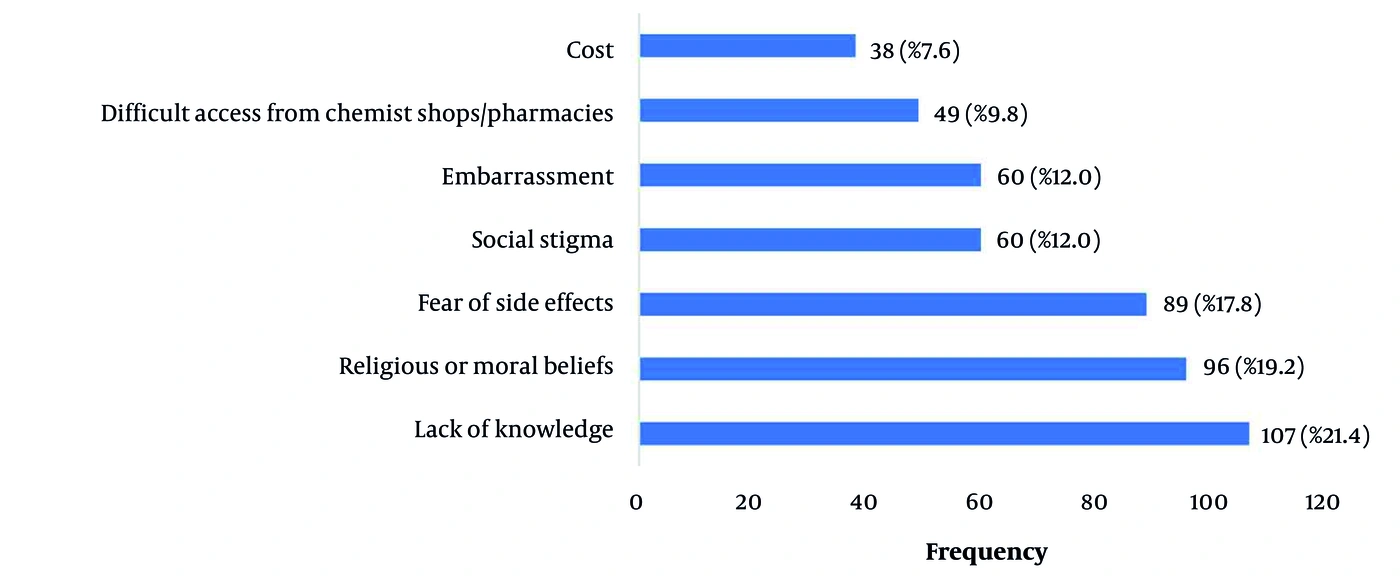
Figure 2.
Barriers to emergency contraception access among female pharmacy students
4.6. Factors Associated with Poor Emergency Contraception Knowledge and Negative Attitudes
Diagnostic assessment of the regression analyses indicated no serious multicollinearity in the model, with a maximum condition index of 16.13 for poor knowledge. The poor-knowledge model was statistically significant (likelihood-ratio χ2 = 86.20, df = 7, P < 0.001) and showed adequate fit (Hosmer–Lemeshow χ2 = 5.75, df = 8, P = 0.675; Nagelkerke R2 = 0.215). Tolerance values ranged from 0.729 to 0.966, while VIF values ranged from 1.035 to 1.371 for age, religion, and study year, respectively. These findings indicate that multicollinearity was unlikely to have materially influenced the adjusted estimates. The model had no empty or extremely sparse categories and converged successfully. Overall, the diagnostics indicated acceptable model fit and no evidence of problematic collinearity.
Univariable analysis showed significant associations between poor EC knowledge and age group (P < 0.001) and study year (P < 0.001). Sex was also significantly associated with attitude, with male students showing more negative attitudes than female students (62.3% vs 53.5%, P < 0.05). In the adjusted model, Muslim students had higher odds of poor knowledge than Christian students (AOR = 1.68, 95% CI: 1.11 - 2.54). Study year remained strongly associated with poor knowledge. Compared with fifth-year students, the odds of poor knowledge were significantly higher among first-year (AOR = 5.11, 95% CI: 2.23 - 11.20), second-year (AOR = 9.16, 95% CI: 4.23 - 19.80), third-year (AOR = 8.60, 95% CI: 4.57 - 16.18), and fourth-year students (AOR = 3.44, 95% CI: 1.81 - 6.55) (P < 0.05 for all), as shown in Table 5.
Table 5.
Analysis of Factors Associated with Poor Knowledge and Negative Attitudes Toward Emergency Contraception a
| Variables | Knowledge Categories | Attitude Categories | |||||
|---|---|---|---|---|---|---|---|
| Good | Poor | P Value | AOR | Positive | Negative | P Value | |
| Age group (y) | < 0.001 b | 0.578 | |||||
| 16 – 20 | 32 (21.9) | 114 (78.1) | 1.61 (0.78 – 3.30) | 56 (38.4) | 90 (61.6) | ||
| 21 – 25 | 106 (40.3) | 157 (59.7) | 1.04 (0.60 – 1.79) | 109 (41.4) | 154 (58.6) | ||
| > 25 | 50 (53.8) | 43 (46.2) | 1.00 | 42 (45.2) | 51 (54.8) | ||
| Gender | 0.529 | 0.048 b | |||||
| Female | 79 (39.1) | 123 (60.9) | - | 94 (46.5) | 108 (53.5) | ||
| Male | 109 (36.3) | 191 (63.7) | - | 113 (37.7) | 187 (62.3) | ||
| Marital status | 0.428 | 0.249 | |||||
| Single | 149 (36.9) | 255 (63.1) | - | 160 (39.6) | 244 (60.4) | ||
| In a relationship | 27 (36.5) | 47 (63.5) | - | 34 (45.9) | 40 (54.1) | ||
| Married | 12 (50.0) | 12 (50.0) | - | 13 (54.2) | 11 (45.8) | ||
| Religion | 0.188 | 0.569 | |||||
| Islam | 82 (34.5) | 156 (65.5) | 1.68 (1.11 – 2.54) b | 95 (39.9) | 143 (60.1) | ||
| Christianity | 106 (40.2) | 158 (59.8) | 1.00 | 112 (42.4) | 152 (57.6) | ||
| Study year | < 0.001 b | 0.445 | |||||
| First | 26 (31.7) | 56 (68.3) | 5.11 (2.23 – 11.20) b | 33 (40.2) | 49 (59.8) | ||
| Second | 19 (21.3) | 70 (78.7) | 9.16 (4.23 – 19.80) b | 42 (47.2) | 47 (52.8) | ||
| Third | 37 (24.0) | 117 (76.0) | 8.60 (4.57 – 16.18) b | 55 (35.7) | 99 (64.3) | ||
| Fourth | 37 (44.6) | 46 (55.4) | 3.44 (1.81 – 6.55) b | 37 (44.6) | 46 (55.4) | ||
| Fifth | 69 (73.4) | 25 (26.6) | 1.00 | 40 (42.6) | 54 (57.4) | ||
a Values are expressed as No. (%) or AOR (95% CI).
b Chi-square test or logistic regression analysis significant at P < 0.05; reference category = 1.00.
5. Discussion
This study identified substantial gaps in actual EC knowledge among pharmacy students, accompanied by generally negative attitudes and limited EC-related practices. These findings are important because pharmacy students are future pharmacists who may provide EC information, dispensing, and counselling. Adequate knowledge and appropriate professional attitudes are therefore essential for safe and effective pharmaceutical care.
Overall, EC knowledge was inadequate, particularly regarding the mechanism of action, dose, indications, and timing, indicating that awareness does not necessarily translate into clinically relevant knowledge. Similar gaps have been reported among Nigerian undergraduates (5, 25, 26) and community pharmacists, despite widespread EC dispensing (11), as well as in other settings (19, 22, 27, 28).
Important misconceptions were identified, particularly the belief that EC is an abortifacient. ECPs primarily prevent or delay ovulation and do not terminate an established pregnancy (29). EC does not prevent sexually transmitted infections and should not replace regular contraception or barrier methods. WHO recommends EC after unprotected intercourse or contraceptive failure, preferably as soon as possible within the recommended period (29). Similar misconceptions, including the use of unproven substances as emergency contraceptives, have been reported among Nigerian university students (30). These findings emphasize the need for pharmacy education focused on accurate, clinically relevant EC knowledge.
Negative attitudes toward EC were prominent, consistent with studies from India and Turkey (22, 23, 31). Although students supported EC education, concerns remained regarding safety, ethical acceptability, accessibility, and adolescent use. These reservations may reflect misconceptions, sociocultural and religious norms, and concerns about sexual behavior. Pharmacists' knowledge and attitudes have similarly been associated with EC dispensing practices (32). WHO states that EC has no age restrictions for women and girls of reproductive age when clinically appropriate (29). Evidence that health education improves EC knowledge and attitudes among Nigerian university students supports structured EC education that addresses pharmacological, ethical, and communication issues (33, 34).
Limited EC practice was consistent with previous Nigerian studies showing a gap between awareness and appropriate utilization (26, 30). Misinformation, stigma, concerns about adverse effects, religious or moral beliefs, embarrassment, accessibility, and cost may influence use. Thus, knowledge-focused interventions alone may be insufficient. Pharmacy students should be trained to provide confidential, evidence-based, and nonjudgmental EC counselling.
The significant association between sex and attitudes in the univariable analysis, with more negative attitudes among males, suggests that sex may influence perceptions of EC. Female students may perceive EC as more personally relevant because of the potential consequences of unintended pregnancy. However, sociocultural norms, religious beliefs, perceived contraceptive responsibility, and exposure to reproductive-health information may also explain this difference. Because the association was not retained beyond univariable analysis, it should be interpreted cautiously.
The association between study year and EC knowledge is consistent with Nigerian and US studies (5, 19) and may reflect greater educational exposure to reproductive-health pharmacotherapy and counselling. However, the cross-sectional design precludes causal inference. Similarly, associations involving religion may reflect educational exposure, social norms, information access, or unmeasured factors rather than religion itself. Residual confounding is therefore possible, making these findings exploratory rather than causal.
The findings underscore the need for earlier and more systematic integration of EC into undergraduate pharmacy education, covering its mechanism of action, indications, timing, dosing, safety, misconceptions about abortion, sexually transmitted infection prevention, and transition to regular contraception. WHO recommends accessible EC integrated into contraceptive services, highlighting the importance of preparing future pharmacists to provide accurate, evidence-based counselling (29, 35). Case-based learning, simulations, role-play, and structured counselling exercises could strengthen students’ clinical competence, while culturally sensitive communication and ethical decision-making should be emphasized, particularly when counselling adolescents.
5.1. Strength and Limitations
The study included students across different academic years and assessed multiple dimensions of EC, including knowledge, attitudes, practices, and perceived barriers. However, the cross-sectional design limits causal interpretation, and convenience sampling at a single institution limits generalizability. Self-reported responses may be affected by recall and social-desirability bias, particularly regarding sexual behavior and EC use. Potential information bias associated with self-reported responses was minimized through the use of a structured, self-administered questionnaire adapted from previously published instruments. Recall bias was minimized by focusing questions, where possible, on participants' current knowledge, attitudes, and relatively recent experiences rather than requiring recall of distant events. To minimize social-desirability bias, participants were informed that participation was voluntary, that their responses would remain confidential and anonymous, and that the information provided would be used solely for research purposes. Practice items also represent different aspects of behavior and professional readiness and should not necessarily be treated as a single behavioral construct.
5.2. Conclusions
The findings demonstrate important gaps in EC knowledge and generally unfavorable attitudes among pharmacy students, together with limited EC-related practices and multiple perceived barriers. The results highlight the need for structured, evidence-based EC education within pharmacy curricula, incorporating pharmacological knowledge, counselling skills, ethical reasoning, and culturally sensitive communication. Such interventions could better prepare future pharmacists to provide accurate, accessible, and patient-centred EC services.