
1. Background
The increasing release of antibiotics into aquatic environments has emerged as a major environmental concern because it not only contributes to the spread of antimicrobial resistance but also exerts complex, long-term effects on aquatic ecosystems. Among widely used pharmaceutical compounds, co-amoxiclav (amoxicillin + clavulanic acid) has attracted particular attention because of its extensive application in human and veterinary medicine and its relative persistence in aqueous media (1). In this context, biosorption-based technologies and bio-derived adsorbents, particularly those produced from microalgae and biochars, have been widely explored (2, 3).
Biochar is a carbonaceous material obtained by heating plant residues and waste under oxygen-limited or oxygen-free conditions. The thermal decomposition of biomass under oxygen-free conditions is referred to as pyrolysis. Biochar is highly stable and is produced for waste management, climate change mitigation, energy production, and improvement of soil properties (4). Recently, various studies have shown that biochar, owing to its porous structure, active functional groups, and high chemical stability, is efficient at removing various pollutant ions from aqueous solutions. The simplicity, low cost, and environmental compatibility of the process support the use of this adsorbent as an efficient option for treating wastewater contaminated with various pollutants (5).
The microalga Spirulina platensis is considered a promising candidate because its cell structure contains functional groups such as -COOH, -OH, and surface amine groups, which enable the uptake of metal ions and organic molecules through surface interactions and biosorption processes (6). Recent studies have shown that microalgae can remove antibiotics from aqueous solutions with appreciable efficiency; for example, mean removal rates of approximately 45% - 70% have been reported (7).
Furthermore, the conversion of microalgal biomass into biochar through pyrolysis or other thermochemical processes is a strategic approach for producing adsorbents with a high specific surface area, abundant porosity, and reactive surface functionalities. In particular, biochar derived from Spirulina typically exhibits favorable properties such as high cation-exchange capacity, self-doped nitrogen, and oxygen-containing surface groups, all of which enhance its interaction with contaminants (8). To further improve performance, modification of biochar by loading transition metals, particularly manganese (Mn) or manganese-molybdate (Mn-Mo) systems, has been proposed. Such modifications can operate through two main mechanisms: first, by increasing the specific surface area, developing a more porous structure, and introducing additional active surface sites; and second, by imparting catalytic properties or activity in advanced oxidation processes, thereby promoting the degradation of organic pollutants (9). A previous study demonstrated that Mn-containing biochars can markedly enhance antibiotic removal compared with unmodified biochars (10).
Despite these advances, comprehensive comparative studies that simultaneously examine live Spirulina and its derived biochar modified with manganese-molybdate, specifically for co-amoxiclav removal under controlled laboratory conditions, remain scarce.
2. Objectives
Accordingly, the present study was designed to evaluate and compare the efficiency of co-amoxiclav removal by live Spirulina platensis and Mn-Mo-modified Spirulina biochar.
3. Methods
3.1. Chemicals
The antibiotic co-amoxiclav (amoxicillin/clavulanic acid, purity ≥ 98%) was purchased from Sigma-Aldrich (St. Louis, MO, USA). All other reagents, including manganese nitrate, sodium molybdate, ammonium hydroxide, buffer solutions, and washing agents, were of analytical grade and were used as received without further purification. A stock solution of co-amoxiclav (1000 mg/L) was prepared in deionized water (18.2 MΩ·cm, Milli-Q system, Millipore), stored in amber glass bottles at 4°C, and used for a maximum of 7 days. Working solutions (5 - 100 mg/L) were freshly prepared daily by appropriate dilution of the stock solution.
3.2. Preparation and Cultivation of Spirulina Platensis
A pure strain of Spirulina platensis was obtained from the National Genetic Resources Center of Iran. The alga was cultivated in standard F/2 medium according to the protocol of Guillard (1962) under controlled conditions: temperature, 25°C; light intensity, 2000 - 2500 lux; a 12:12-hour light-dark photoperiod; and continuous aeration with filtered air. Biomass was harvested during the exponential growth phase by centrifugation at 5000 rpm for 10 min. The collected biomass was washed 3 times with deionized water. The wet biomass was used directly as a biosorbent in adsorption experiments or dried at 60°C and stored for subsequent biochar production (11).
3.3. Synthesis of Biochar and MnMoO4-Modified Biochar
Dried Spirulina biomass was converted to biochar by pyrolysis at 350°C in a muffle furnace under oxygen-limited conditions. The resulting biochar was ground and sieved to a particle size of 60 mesh, and the sieved fraction was used for further modification.
To prepare MnMoO4-modified biochar, 5 g of the sieved biochar was dispersed in 100 mL of deionized water using a sonicator until a uniform suspension was obtained. A 0.1 M Mn(NO3)2 solution was then added gradually under stirring, and the mixture was stirred for 15 min. Subsequently, a 0.1 M Na2MoO4 solution was added dropwise while the Mn2+/MoO42- molar ratio was adjusted to 1:1.
The pH of the suspension was adjusted to 9 - 10 using NH4OH, and the growth of MnMoO4 nanostructures on the biochar surface was allowed to proceed at 80°C - 90°C for 2 - 3 hours (12). The resulting precipitate was separated by centrifugation at 8000 rpm, washed 3 times with distilled water and ethanol until neutral pH, and dried in an oven at 60°C. To stabilize the final structure, the dried material was further heated at 350°C - 400°C for 2 hours. Surface modification and successful loading of MnMoO4 were verified by BET surface area analysis, FTIR spectroscopy, XRD, and FE-SEM.
3.4. Calibration Curve and Determination of Co-Amoxiclav
Co-amoxiclav concentrations were determined spectrophotometrically using a UV-vis spectrophotometer. A calibration curve was constructed over the range of 5 - 100 mg/L. Based on preliminary scanning, the maximum absorption wavelength (λmax) was identified at 229 nm and was used for all measurements. Absorbance was recorded in 1-cm quartz cuvettes using deionized water as the blank. A linear relationship between absorbance and concentration was obtained, with a coefficient of determination (R2) greater than 0.995 (13).
3.5. Design of Co-Amoxiclav Adsorption Experiments
Adsorption experiments were performed using 3 different sorbents: live Spirulina platensis, algal biochar, and MnMoO4-modified biochar.
In each batch experiment, 1.0 g of adsorbent was added to 100 mL of co-amoxiclav solution. The effects of pH (3, 5, 7, 9, and 11), contact time (10 - 240 min), and temperature (25°C) were investigated. The suspensions were incubated in an orbital shaker at 300 rpm. After the desired contact time, samples were centrifuged at 5000 rpm, and the residual concentration of co-amoxiclav in the supernatant was determined by UV-vis spectrophotometry at 229 nm. To evaluate performance under more realistic conditions, the same experimental procedure was repeated using treated hospital wastewater as the aqueous matrix.
3.6. Effect of Ionic Strength
The influence of ionic strength on adsorption was examined using NaCl solutions with concentrations between 0 and 4 M under the previously determined optimal pH and contact time. Changes in removal efficiency were analyzed in relation to increasing ionic strength and the associated electrostatic competition between co-amoxiclav species and background ions (14).
3.7. Effect of Interfering Ions
To assess the impact of potentially competing or disruptive ions, nitrate, sulfate, fluoride, and copper ions were added to the co-amoxiclav solutions at concentrations of 5 - 15 mg/L. After incubation under the selected optimal conditions and subsequent centrifugation, the final adsorption efficiency was determined, and the effect of each ion on the removal process was evaluated (15).
3.8. Desorption and Reusability of Adsorbents
The stability and reusability of the adsorbents were assessed through desorption experiments. Adsorbed co-amoxiclav was desorbed using 80% methanol with a contact time of 1 hour. The desorption solution was separated and analyzed, and the regenerated adsorbents were dried and reused in at least 5 consecutive adsorption-desorption cycles to evaluate performance loss over repeated use.
3.9. Statistical Analysis
All experiments were conducted in triplicate, and results are reported as mean values. Statistical analysis was performed using one-way analysis of variance in SPSS software, version 26. Differences were considered statistically significant at P < 0.05.
4. Results
BET analysis showed that modification of Spirulina biochar with manganese-molybdate resulted in a pronounced increase in specific surface area, pore volume, and pore diameter. The specific surface area reached 185.4 m2/g, with a pore volume of 0.238 cm3/g and an average pore diameter of 5.14 nm, confirming a predominantly mesoporous structure. This enhanced porosity suggests the formation of additional active sites and improved adsorption capacity for pharmaceutical compounds.
FTIR spectra further supported successful surface modification. After loading MnMoO4, the intensity of the -OH stretching band at approximately 3400 cm-1 decreased, indicating that surface hydroxyl groups participated in interactions with MnMoO4. The band at approximately 1620 cm-1, attributed to aromatic C = C vibrations, remained nearly unchanged, indicating the structural stability of the carbon framework. In contrast, the C-O band at approximately 1100 cm-1 decreased in intensity, which was attributed to surface interactions with metal species. New bands at approximately 875 and 620 cm-1 were assigned to Mo=O and Mn-O vibrations, respectively, confirming the formation of MnMoO4 on the biochar surface (Figure 1).
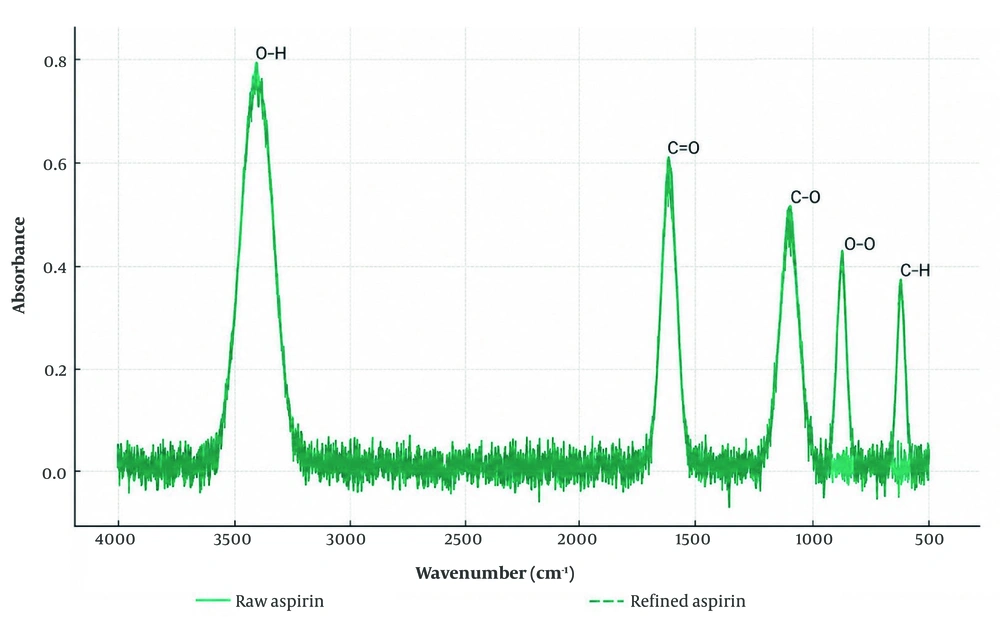
Figure 1.
FTIR spectrum of Spirulina biochar before and after MnMoO4 modification.
The XRD pattern of raw biochar exhibited only a broad diffraction peak at 2θ of approximately 23°, characteristic of amorphous carbon. After modification, several sharp diffraction peaks emerged at 2θ values of 12.4°, 25.1°, 28.6°, 32.8°, 38.9°, and 48.5°. These peaks matched well with the standard diffraction pattern of MnMoO4 (JCPDS 73 - 1234), confirming the formation of a stable crystalline MnMoO4 phase on the biochar surface (Figure 2).
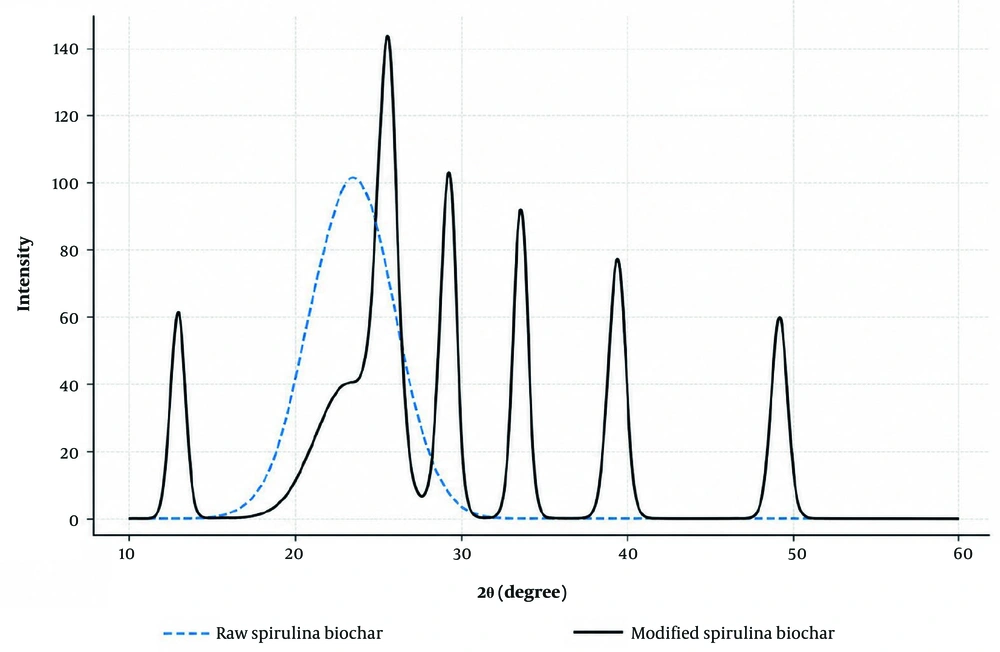
Figure 2.
XRD patterns of Spirulina biochar before and after MnMoO4 modification.
FE-SEM images revealed that raw Spirulina biochar had a relatively smooth yet porous surface. After modification, MnMoO4 nanoparticles with rod-like, flower-like, and clustered morphologies were uniformly distributed across the biochar surface. This morphological transformation indicates increased surface roughness and the generation of new active sites, which are expected to facilitate adsorptive interactions with co-amoxiclav (Figure 3).
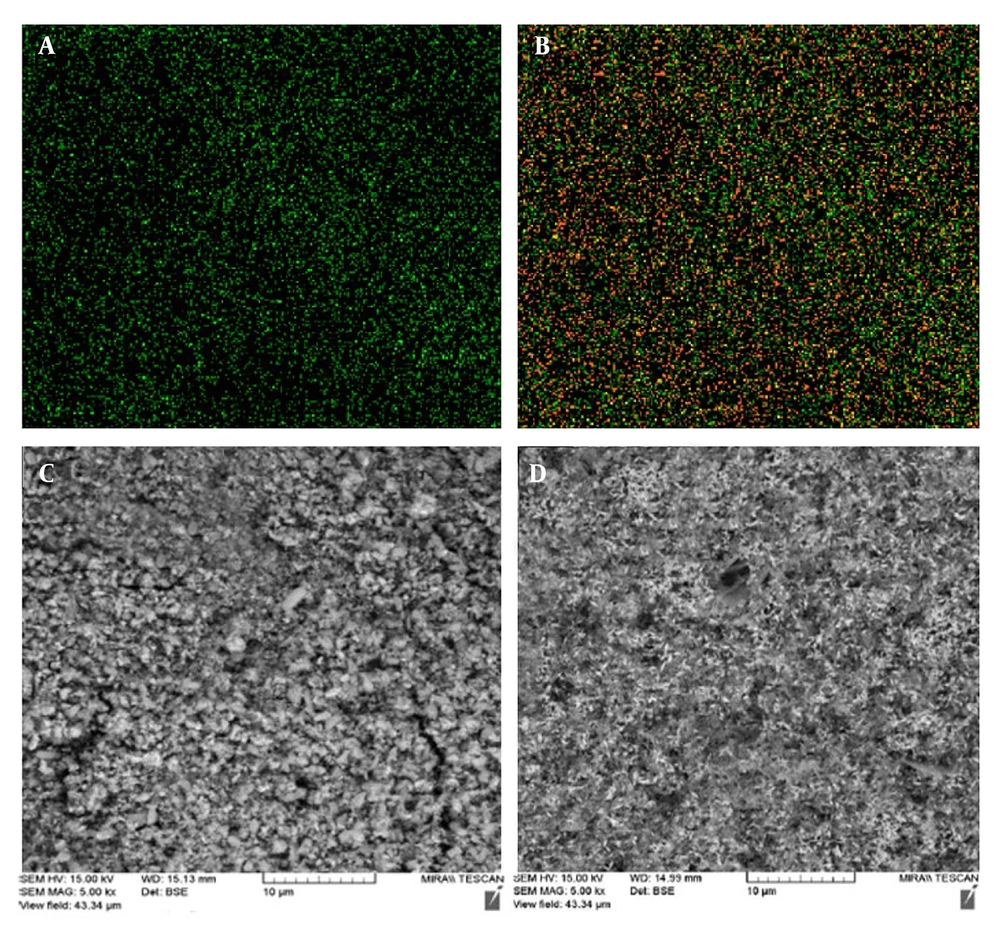
Figure 3.
SEM images of Spirulina biochar before and after modification. (A, C) Unmodified Spirulina biochar (C at 10 μm magnification). (B, D) MnMoO4-modified Spirulina biochar (D at 10 μm magnification).
The adsorption performance of the 3 sorbents (live Spirulina, unmodified biochar, and MnMoO4-modified biochar) toward co-amoxiclav was evaluated over a wide pH range. The results showed that neutral pH (pH = 7) provided optimal conditions for adsorption, with mean removal efficiencies of 64%, 76%, and 84% for live Spirulina, biochar, and modified biochar, respectively. Under strongly acidic (pH 3) and alkaline (pH 9 and 11) conditions, adsorption efficiency decreased, reflecting the sensitivity of the process to the ionization state of both the sorbent surface and the drug molecules and underscoring the importance of pH control for maximizing removal (Table 1).
Table 1.
Co-Amoxiclav Removal Efficiency (%) by Different Adsorbents at Various pH Values a
| pH | Live Spirulina | Biochar | MnMoO4-Modified Biochar |
|---|---|---|---|
| 3 | 40.0 | 46.9 | 53.8 |
| 5 | 55.0 | 60.0 | 68.0 |
| 7 | 64.0 | 76.0 | 84.0 |
| 9 | 60.0 | 68.0 | 76.0 |
| 11 | 48.0 | 56.0 | 64.0 |
a Values are expressed as percentage.
At the optimal pH, the decrease in residual co-amoxiclav concentration was directly related to both contact time and initial drug concentration. As contact time increased from 10 to 240 min, the residual concentration steadily declined, indicating time-dependent adsorption kinetics. For example, at an initial concentration of 5 mg/L, the residual co-amoxiclav concentration using MnMoO4-modified biochar was reduced to only 0.5 mg/L after 240 min, whereas at an initial concentration of 100 mg/L, the corresponding residual concentration was 9 mg/L.
Statistical analysis confirmed that differences among the 3 treatments were significant at all sampling times (P < 0.05), clearly demonstrating the superior performance of MnMoO4-modified biochar in co-amoxiclav removal. Overall, the results indicate enhanced adsorption capacity arising from MnMoO4 nanoparticle loading, increased specific surface area, and improved surface functionality. Together with the observed dependence on pH and contact time, these features define an efficient adsorption system for removing co-amoxiclav from aqueous solutions (Figure 4).
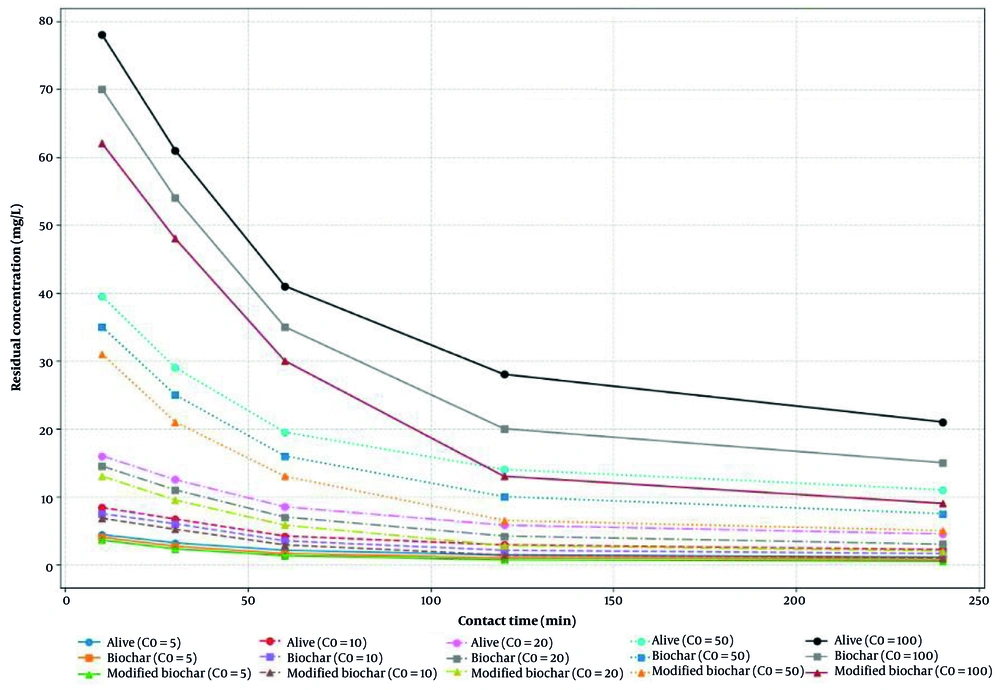
Figure 4.
Residual co-amoxiclav concentrations (mg/L) at different initial concentrations and contact times at the optimal pH of 7.
5. Discussion
The findings of this study clearly indicate that modification of Spirulina platensis-derived biochar with crystalline MnMoO4 markedly improves its physicochemical properties and, consequently, its capacity and efficiency for removing the antibiotic co-amoxiclav from aqueous solutions. According to BET analysis, the substantial increases in specific surface area (185.4 m2/g), pore volume (0.238 cm3/g), and average pore diameter (5.14 nm) after modification indicate the formation of a predominantly mesoporous structure. Such mesoporosity is theoretically and experimentally regarded as highly favorable for removing pharmaceutical molecules of medium molecular size. This observation is consistent with the results reported by Liao et al. (16), who identified the development of mesopores in modified biochars as a key factor in enhancing antibiotic adsorption.
FTIR spectroscopy further confirmed that relevant chemical transformations occurred on the surface of the modified biochar. The decrease in the intensity of the -OH band was attributed to the formation of surface bonds with MnMoO4, while the appearance of characteristic Mo=O and Mn-O bands indicated the presence of stable metal-oxygen linkages. These bonds can act as electron-accepting active centers, facilitating the adsorption of co-amoxiclav. Similarly, another study reported that incorporation of transition metals into carbonaceous matrices, through the formation of M-O-C-type bonds, increases the affinity of adsorbents for polar organic compounds, consistent with the present findings (17).
XRD analysis demonstrated that biochar modification led to the formation of crystalline MnMoO4 phases, as evidenced by sharp diffraction peaks matching the standard pattern of MnMoO4. These crystalline domains not only improve structural stability but also introduce heterogeneous adsorption sites with enhanced interaction strength toward drug molecules. A comparable phenomenon was documented by another study, which showed that incorporation of molybdate species into carbon-based adsorbents significantly improved the removal efficiency of antibiotics.
FE-SEM images provided visual evidence of pronounced changes in surface morphology after modification. The modified biochar exhibited increased surface roughness and abundant MnMoO4 nanoparticles with rod-like and flower-like architectures, forming aggregated clusters. Such heterogeneous nanostructured morphologies effectively generate additional active sites and facilitate mass transfer, thereby directly contributing to the observed increase in adsorption capacity. This result is consistent with the report of Bai et al. (18), who highlighted the role of metallic nanostructure aggregates in enhancing the adsorption of sulfonamide antibiotics.
Adsorption performance evaluation showed that MnMoO4-modified biochar achieved the highest co-amoxiclav removal efficiency at neutral pH (84%), whereas lower efficiencies were obtained for unmodified biochar (76%) and live Spirulina (64%). The pronounced decline in removal under strongly acidic and strongly alkaline conditions suggests that the adsorption process is governed by 2 key factors: (1) the ionization state of the drug and (2) the surface charge of the adsorbent. This pH-dependent behavior closely resembles the pattern reported by another study on the adsorption of amoxicillin and other beta-lactam antibiotics onto modified carbonaceous adsorbents, where maximum uptake was also observed near neutral pH (19).
As contact time increased from 10 to 240 min, the residual concentration of co-amoxiclav decreased gradually, indicating time-dependent adsorption kinetics and progression toward equilibrium. The superior removal performance of the modified biochar, even at relatively high initial concentrations (up to 100 mg/L), reflects the presence of numerous active sites and a multistep adsorption mechanism. This mechanism plausibly involves a combination of surface adsorption, electrostatic interactions, metal-ligand complexation, and π-π interactions between the aromatic moieties of co-amoxiclav and the carbon matrix. These interpretations agree with the trends reported by Sabzehmeidani et al. (20) for antibiotic removal using metal-carbon nanocomposite adsorbents.
Overall, comparison of the present results with previous studies indicates that MnMoO4 modification significantly enhances the performance of biochar for removing recalcitrant pharmaceuticals such as co-amoxiclav beyond what is typically reported for more conventional modified biochars. This improvement can be attributed to the combined effects of increased mesoporosity, the formation of catalytically and electronically active crystalline metal phases, altered surface chemistry, and the creation of heterogeneous high-energy adsorption sites (21). These attributes render MnMoO4-modified Spirulina biochar an efficient, stable, and competitive adsorbent suitable for application in the treatment of pharmaceutical wastewater.
5.1. Limitations
This study has several important limitations. First, the adsorbent was primarily evaluated in synthetic solutions, and the influence of coexisting components typically present in real wastewater, such as competing inorganic ions, dissolved organic matter, and pH fluctuations, was not assessed. Second, only a single antibiotic was examined, and potential competitive or synergistic effects in the presence of mixed contaminant systems were not investigated. Third, advanced kinetic and isotherm modeling was not fully developed, which limits the ability to accurately resolve the dominant adsorption mechanisms. In addition, long-term stability, regeneration efficiency, and adsorbent performance over multiple adsorption-desorption cycles were not comprehensively quantified. Finally, no pilot-scale or continuous-flow experiments were conducted, restricting direct extrapolation of the results to industrial or full-scale applications.
5.2. Conclusions
This study demonstrated that modification of Spirulina platensis biochar with crystalline MnMoO4 markedly enhances the physicochemical properties of the adsorbent and significantly improves the removal efficiency of the antibiotic co-amoxiclav from aqueous solutions. Increases in specific surface area and mesoporosity, together with the formation of stable metal-oxygen bonds and the presence of catalytically active MnMoO4 nanostructures, played a decisive role in boosting adsorption capacity and generating heterogeneous high-affinity sites.
Maximum adsorption occurred at neutral pH, and MnMoO4-modified biochar consistently outperformed both unmodified biochar and live Spirulina across all tested concentrations and contact times. Mechanistic analysis suggests the concurrent contribution of surface adsorption, electrostatic interactions, metal complexation, and π-π interactions to the overall uptake process. Collectively, these findings identify MnMoO4-modified Spirulina biochar as an efficient and robust adsorbent with strong potential for use in advanced treatment of pharmaceutical effluents, particularly those containing β-lactam antibiotics such as co-amoxiclav.